Top ten most accessed Analyst articles from April to June 2014

During the months April – June 2014, the most downloaded Analyst articles were:

Single molecule sensing by nanopores and nanopore devices
Li-Qun Gu and Ji Wook Shim  
Analyst, 2010, 135, 441-451
DOI: 10.1039/B907735A

A bioelectronic sensor based on canine olfactory nanovesicle–carbon nanotube hybrid structures for the fast assessment of food quality
Juhun Park, Jong Hyun Lim, Hye Jun Jin, Seon Namgung, Sang Hun Lee, Tai Hyun Park and Seunghun Hong
Analyst, 2012, 137, 3249-3254
DOI: 10.1039/C2AN16274A

Measurement of biomarker proteins for point-of-care early detection and monitoring of cancer
James F. Rusling, Challa V. Kumar, J. Silvio Gutkind and Vyomesh Patel
Analyst, 2010, 135, 2496-2511
DOI: 10.1039/C0AN00204F 

Upconversion nanoparticles in biological labeling, imaging, and therapy 
Feng Wang, Debapriya Banerjee, Yongsheng Liu, Xueyuan Chen and Xiaogang Liu 
Analyst, 2010, 135, 1839-1854 
DOI: 10.1039/C0AN00144A 

Recent advances in sample preparation techniques to overcome difficulties encountered during quantitative analysis of small molecules from biofluids using LC-MS/MS 
Caroline Bylda, Roland Thiele, Uwe Kobold and Dietrich A. Volmer    
Analyst, 2014, 139, 2265-2276 
DOI: 10.1039/C4AN00094C 

Aptamer-based biosensors for biomedical diagnostics
Wenhu Zhou, Po-Jung Jimmy Huang, Jinsong Ding and Juewen Liu    
Analyst, 2014, 139, 2627-2640
DOI: 10.1039/C4AN00132J 

Illuminating disease and enlightening biomedicine: Raman spectroscopy as a diagnostic tool 
David I. Ellis, David P. Cowcher, Lorna Ashton, Steve O’Hagan and Royston Goodacre    
Analyst, 2013, 138, 3871-3884 
DOI: 10.1039/C3AN00698K 

Recent advances in electrochemical sensing for hydrogen peroxide: a review 
Wei Chen, Shu Cai, Qiong-Qiong Ren, Wei Wen and Yuan-Di Zhao    
Analyst, 2012, 137, 49-58 
DOI: 10.1039/C1AN15738H 

Simultaneous targeted analysis of five active compounds in licorice by ultra-fast liquid chromatography coupled to hybrid linear-ion trap tandem mass spectrometry 
Weijun Kong, Jing Wen, Yinhui Yang, Feng Qiu, Ping Sheng and Meihua Yang    
Analyst, 2014, 139, 1883-1894 
DOI: 10.1039/C3AN02209A 

Quantum dots in diagnostics and detection: principles and paradigms
R. Pisanic II, Y. Zhang and T. H. Wang    
Analyst,2014, 139, 2968-2981 
DOI: 10.1039/C4AN00294F 

If you have any comments or thoughts on any of these articles, we welcome you to write these in the comment box below.

Do you fancy submitting an article to Analyst? Why not submit to us here today or alternatively email us with your suggestions!

Digg This
Reddit This
Stumble Now!
Share on Facebook
Bookmark this on Delicious
Share on LinkedIn
Bookmark this on Technorati
Post on Twitter
Google Buzz (aka. Google Reader)

Call for Applications: Visiting Researchers Programme to Visit China in 2015

The Royal Society of Chemistry will award up to £1500 to fund researchers from the UK to visit Chinese Universities

An image of a map of China

Image courtesy of © iStock

The State Administration for Foreign Experts Affairs (SAFEA) is a division of the Chinese Government with which RSC has a cooperation agreement. Under this agreement the RSC and SAFEA will jointly fund researchers from the UK to visit Chinese Universities. The purpose of the visits are to stimulate collaboration between UK and Chinese institutions. They will allow the visitor to contribute their experience towards the development of excellent emerging science and build links with the Chinese Chemistry community.

In addition, the visitor will advise Chinese research groups on all aspects of presenting their research to an international audience. The programme will strengthen links between the UK and Chinese Science and between the RSC and our partners in China.

We would be very grateful if you could please send us the following information as part of your application:

Detailed CV containing your career progress

A letter detailing your objectives and what you hope to achieve in China

Current research interests, especially areas where you wish to collaborate

List of current collaborators in China (If any)

List of your current and past publications

Preferred dates to travel to China

Applications are open until the 31st October 2014 for RSC members based in the UK and Ireland. Visits usually last up to a week. The Royal Society of Chemistry covers up to £1500 for international flights, and visa and local costs are usually covered by the local Chinese host universities. Prior collaboration in China is not necessary because SAFEA and the RSC will work together to find appropriate Chinese University hosts.

Please email to register your interest in participating in the programme.

Digg This
Reddit This
Stumble Now!
Share on Facebook
Bookmark this on Delicious
Share on LinkedIn
Bookmark this on Technorati
Post on Twitter
Google Buzz (aka. Google Reader)

Printed sensors kick up a stink

Written by Harriet Brewerton for Chemistry World

Methyl mercaptan is easily detectable by the human nose © Shutterstock

Scientists in Canada have used an inkjet-printer to create sensors that give off a smell when a target biomolecule is present.

Visual outputs, such as fluorescence and colour changes, are what indicate a positive reading in most sensors. Carlos Filipe and his team at McMaster University, however, have come up with a sensor where the output comes in the form of a smell. ‘People use the sense of smell in their everyday-lives but this fact has been largely under-explored for analytical purposes. A very convenient aspect of using smell is that a person or user does not have to be constantly looking at a read-out or a display to get a signal, the signal will come to the user.’

Read the full article in Chemistry World»


Read the original journal article in Analyst – it’s free to access until 3rd October:

An inkjet-printed bioactive paper sensor that reports ATP through odour generation
Zhuyuan Zhang, Jingyun Wang, Robin Ng, Yingfu Li, Zaisheng Wu, Vincent Leung, Spencer Imbrogno, Robert Pelton, John D. Brennan and Carlos D. M. Filipe  
Analyst, 2014, Advance Article
DOI: 10.1039/C4AN01113A, Communication

Digg This
Reddit This
Stumble Now!
Share on Facebook
Bookmark this on Delicious
Share on LinkedIn
Bookmark this on Technorati
Post on Twitter
Google Buzz (aka. Google Reader)

HOT articles in Analyst!
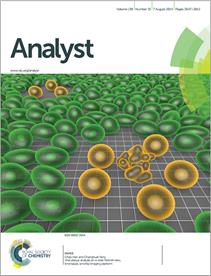
Take a look at our recent HOT Analyst articles, these are now free to access for the next few weeks!

A label-free activatable aptamer probe for colorimetric detection of cancer cells based on binding-triggered in situ catalysis of split DNAzyme
Hui Shi, Duo Li, Fengzhou Xu, Xiaoxiao He, Kemin Wang, Xiaosheng Ye, Jinlu Tang and Chunmei He  
Analyst, 2014,139, 4181-4184
DOI: 10.1039/C4AN00561A, Communication

A three-dimensional interpenetrating electrode of reduced graphene oxide for selective detection of dopamine
Xiaowen Yu, Kaixuan Sheng and Gaoquan Shi  
Analyst, 2014,139, 4525-4531
DOI: 10.1039/C4AN00604F, Paper

Fine structural features of nanoscale zero-valent iron characterized by spherical aberration corrected scanning transmission electron microscopy (Cs-STEM)
Airong Liu and Wei-xian Zhang  
Analyst, 2014,139, 4512-4518
DOI: 10.1039/C4AN00679H, Paper

On-chip monitoring of skeletal myoblast transplantation for the treatment of hypoxia-induced myocardial injury
Juan He, Chao Ma, Wenming Liu and Jinyi Wang  
Analyst, 2014,139, 4482-4490
DOI: 10.1039/C4AN00697F, Paper

Global in vivo terminal amino acid labeling for exploring differential expressed proteins induced by dialyzed serum cultivation
Li-Qi Xie, Ai-Ying Nie, Shu-Jun Yang, Chao Zhao, Lei Zhang, Peng-Yuan Yang and Hao-Jie Lu  
Analyst, 2014,139, 4497-4504
DOI: 10.1039/C4AN00728J, Paper

A novel variable selection approach that iteratively optimizes variable space using weighted binary matrix sampling
Bai-chuan Deng, Yong-huan Yun, Yi-zeng Liang and Lun-zhao Yi  
Analyst, 2014, Advance Article
DOI: 10.1039/C4AN00730A, Paper

Using electron paramagnetic resonance to map N@C60 during high throughput processing
Simon R. Plant and Kyriakos Porfyrakis  
Analyst, 2014,139, 4519-4524
DOI: 10.1039/C4AN00734D, Paper

Affinity-based precipitation via a bivalent peptidic hapten for the purification of monoclonal antibodies
Michael W. Handlogten, Jared F. Stefanick, Peter E. Deak and Basar Bilgicer  
Analyst, 2014,139, 4247-4255
DOI: 10.1039/C4AN00780H, Paper

Real-time detection of metal ions using conjugated polymer composite papers
Ji Eun Lee, Hyeon Woo Shim, Oh Seok Kwon, Yang-Il Huh and Hyeonseok Yoon  
Analyst, 2014,139, 4466-4475
DOI: 10.1039/C4AN00804A, Paper

Identification and discrimination of binding sites of an organoruthenium anticancer complex to single-stranded oligonucleotides by mass spectrometry
Suyan Liu, Kui Wu, Wei Zheng, Yao Zhao, Qun Luo, Shaoxiang Xiong and Fuyi Wang  
Analyst, 2014,139, 4491-4496
DOI: 10.1039/C4AN00807C, Paper

Simultaneous analysis of nanoparticles and small molecules by high-performance liquid chromatography using a silica monolithic column
Naoki Itoh, Akira Sano, Tomofumi Santa and Masaru Kato  
Analyst, 2014,139, 4453-4457
DOI: 10.1039/C4AN00819G, Communication

Parameters affecting ion intensities in transmission-mode direct analysis in real-time mass spectrometry
Lindsay P. Harding, Gareth M. B. Parkes and James D. Townend  
Analyst, 2014,139, 4176-4180
DOI: 10.1039/C4AN00859F, Communication

Simultaneous multiplexed quantification of nicotine and its metabolites using surface enhanced Raman scattering
Omar Alharbi, Yun Xu and Royston Goodacre  
Analyst, 2014, Advance Article
DOI: 10.1039/C4AN00879K, Paper

A graphene oxide-based enzyme-free signal amplification platform for homogeneous DNA detection
Zhen Zhang, Yufei Liu, Xinghu Ji, Xia Xiang and Zhike He  
Analyst, 2014, Advance Article
DOI: 10.1039/C4AN00933A, Paper

A spatiotemporally defined in vitro microenvironment for controllable signal delivery and drug screening
Ching-Te Kuo, Hao-Kai Liu, Guan-Syuan Huang, Chi-Hao Chang, Chen-Lin Chen, Ken-Chao Chen, Ruby Yun-Ju Huang, Ching-Hung Lin, Hsinyu Lee, Chiun-Sheng Huang and Andrew M. Wo  
Analyst, 2014, Advance Article
DOI: 10.1039/C4AN00936C, Paper

Detection of strep throat causing bacterium directly from medical swabs by touch spray-mass spectrometry
Alan K. Jarmusch, Valentina Pirro, Kevin S. Kerian and R. Graham Cooks  
Analyst, 2014, Advance Article
DOI: 10.1039/C4AN00959B, Communication

A rapid method to estimate the concentration of citrate capped silver nanoparticles from UV-visible light spectra
D. Paramelle, A. Sadovoy, S. Gorelik, P. Free, J. Hobley and D. G. Fernig  
Analyst, 2014, Advance Article
DOI: 10.1039/C4AN00978A, Paper

Diagnosing malaria infected cells at the single cell level using focal plane array Fourier transform infrared imaging spectroscopy
Bayden R. Wood, Keith. R. Bambery, Matthew W. A. Dixon, Leann Tilley, Michael J. Nasse, Eric Mattson and Carol J. Hirschmugl  
Analyst, 2014, Advance Article
DOI: 10.1039/C4AN00989D, Communication

A napthelene–pyrazol conjugate: Al(III) ion-selective blue shifting chemosensor applicable as biomarker in aqueous solution
Manjira Mukherjee, Siddhartha Pal, Somenath Lohar, Buddhadeb Sen, Supriti Sen, Samya Banerjee, Snehasis Banerjee and Pabitra Chattopadhyay  
 Analyst, 2014, Advance Article
DOI: 10.1039/C4AN01039F, Paper

Microfluidic device with tunable post arrays and integrated electrodes for studying cellular release
Asmira Selimovic, Jayda L. Erkal, Dana M. Spence and R. Scott Martin  
 Analyst, 2014, Advance Article
DOI: 10.1039/C4AN01062K, Paper

High efficiency tandem mass spectrometry analysis using dual linear ion traps
Linfan Li, Xiaoyu Zhou, James W. Hager and Zheng Ouyang  
 Analyst, 2014, Advance Article
DOI: 10.1039/C4AN01070A, Communication

Detection of counterfeit electronic components through ambient mass spectrometry and chemometrics
Kevin P. Pfeuffer, Jack Caldwell, Jake T. Shelley, Steven J. Ray and Gary M. Hieftje  
 Analyst, 2014,139, 4505-4511
DOI: 10.1039/C4AN01071J, Paper

Hydroxylated near-infrared BODIPY fluorophores as intracellular pH sensors
Mohamed M. Salim, Eric A. Owens, Tielong Gao, Jeong Heon Lee, Hoon Hyun, Hak Soo Choi and Maged Henary  
 Analyst, 2014, Advance Article
DOI: 10.1039/C4AN01104J, Paper

An inkjet-printed bioactive paper sensor that reports ATP through odour generation
Zhuyuan Zhang, Jingyun Wang, Robin Ng, Yingfu Li, Zaisheng Wu, Vincent Leung, Spencer Imbrogno, Robert Pelton, John D. Brennan and Carlos D. M. Filipe  
 Analyst, 2014, Advance Article
DOI: 10.1039/C4AN01113A, Communication

Digg This
Reddit This
Stumble Now!
Share on Facebook
Bookmark this on Delicious
Share on LinkedIn
Bookmark this on Technorati
Post on Twitter
Google Buzz (aka. Google Reader)

Call for papers: themed issue dedicated to sensing using biological and synthetic nanopores and nanopipettes.

biological and synthetic nanopores and nanopipettes

You are invited to contribute to the upcoming Analyst themed issue showcasing fundamental discoveries, progress and developments in sensing using biological and synthetic nanopores and nanopipettes.

For your article to be considered for the themed issue we must receive your manuscript by December 1st 2014.

Guest Edited by Dr Joshua Edel and Professor Sang-Hyun Oh, this upcoming themed issue will highlight the significant progress in developments related to single molecule biosensing using nanopores and nanopipettes. The issue will feature review articles, original research papers and communications across the breadth of the subject area.

If you would like to contribute a review article or original research paper to the biological and synthetic nanopores and nanopipettes themed issue, please contact us.

Digg This
Reddit This
Stumble Now!
Share on Facebook
Bookmark this on Delicious
Share on LinkedIn
Bookmark this on Technorati
Post on Twitter
Google Buzz (aka. Google Reader)

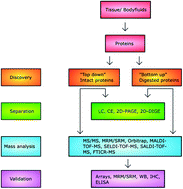
Understanding the “How” of Disease Biomarker Discovery

An Overview of Biomarker Discovery

An Overview of Biomarker Discovery

A disease biomarker is a key indicator that when detected from the body can help determine whether an individual is at risk to develop a certain disease. Thus, the discovery of suitable biomarkers is very important to enable earlier diagnosis of disease, better treatment options, and lower overall healthcare costs. Over the years, substantial progress has been made in the field of proteomics to study proteins as disease biomarkers. However, while most effort has been made towards identifying new biomarkers, less focus has been made towards understanding and optimizing the methodologies, which is required in order to find effective biomarkers.

Nina Bergman and Jonas Bergquist from Uppsala University in Sweden have written a review article to outline the proteomic methods that are currently used for biomarker identification and analysis, assess some of the advantages and disadvantages of each method and provide insight into what the future may hold for biomarker discovery. Click on the link below to learn more (free access until September 6th):

Recent developments in proteomic methods and disease biomarkers
Nina Bergman and Jonas Bergquist
Analyst, 2014, Advance Article
DOI: 10.1039/C4AN00627E

Digg This
Reddit This
Stumble Now!
Share on Facebook
Bookmark this on Delicious
Share on LinkedIn
Bookmark this on Technorati
Post on Twitter
Google Buzz (aka. Google Reader)

Strep throat spotted in seconds

Written by Megan Tyler for Chemistry World

Scientists have developed a non-invasive mass spectrometry-based diagnostic technique that can diagnose strep throat in less than 10 seconds.

Almost all of us will experience a sore throat at some point in our lives, and a number of these sore throats (~30%) will be caused by infections with Streptococci bacteria. Streptococcal pharyngitis, which is usually caused by Streptococcus pyogenes, is commonly known as ‘strep throat’ and can be treated with antibiotics if successfully diagnosed. Although the vast majority of strep throat cases resolve themselves within a few days, Streptococcal infections can lead to serious complications, such an inflammatory disease called rheumatic fever that can result in heart failure and even death. Children and the elderly are particularly susceptible to complications, so for these individuals, the rapid diagnosis and treatment of strep throat can be life-saving.

Touch spray-mass spectrometry can detect strep throat causing bacterium directly from medical swabs


Read the full article in Chemistry World»

Read the original journal article in Analyst – it’s free to access until 12th September:
Detection of strep throat causing bacterium directly from medical swabs by touch spray – mass spectrometry
Alan K Jarmusch, Valentina Pirro, Kevin S Kerian and R. Graham Cooks
Analyst, 2014, Accepted Manuscript, DOI: 10.1039/C4AN00959B

Digg This
Reddit This
Stumble Now!
Share on Facebook
Bookmark this on Delicious
Share on LinkedIn
Bookmark this on Technorati
Post on Twitter
Google Buzz (aka. Google Reader)

Analyst Impact Factor announced: 3.906!

Analyst, 2014, Issue 1We are delighted to announce that our latest Impact Factor* is 3.906!
Analyst remains the home of premier fundamental discoveries, inventions and applications in the analytical and bioanalytical sciences. It publishes leading edge interdisciplinary research that presents a significant advance in fundamental theory or practice of the chemical, physical and biological sciences from an analytical perspective and remains in the top 3 general analytical journals publishing primary research.

The Editorial office thanks all of our Board members, authors, readers and reviewers for their continued support.

We invite you to submit your latest piece of high impact work with us here.

Click through to see how the other Royal Society of Chemistry journals did.

*The Impact Factor provides an indication of the average number of citations per paper. Produced annually, Impact Factors are calculated by dividing the number of citations in a year by the number of citeable articles published in the preceding two years. Data based on 2013 Journal Citation Reports®, (Thomson Reuters, 2014).

Digg This
Reddit This
Stumble Now!
Share on Facebook
Bookmark this on Delicious
Share on LinkedIn
Bookmark this on Technorati
Post on Twitter
Google Buzz (aka. Google Reader)

Analytical Sciences in Brazil – web themed issue

Analyst and Analytical Methods recently joined forces to produce a web themed issue on Analytical Sciences in Brazil, highlighting the growth of the field of analytical science in Brazil with the aim to provide a showcase for some of the best researchers in this area.

As an extra special feature of this issue, please read below the introductory Editorial from Guest Editors, Professor Ivo M. Raimundo Jr and Professor Boris Mizaikoff, translated into Portuguese.

Analytical Sciences in Brazil – Editorial

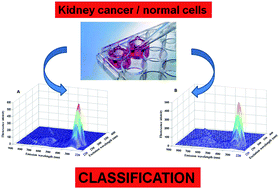
 The use of EEM fluorescence data and OPLS/UPLS-DA algorithm to discriminate between normal and cancer cell lines: a feasibility studyÉ uma honra apresentar este número temático virtual dos periódicos Analyst e Analytical Methods dedicado à Ciências Analíticas no Brasil. Esta iniciativa oportuna da Royal Society of Chemistry acontece em um período particularmente especial e importante para os pesquisadores brasileiros, visto que recentemente as agências de financiamento nacionais e estaduais têm feito esforços excepcionais objetivando uma melhora consistente na qualidade das pesquisas, desenvolvimentos e inovações desenvolvidas no Brasil, que são expressos de forma significativa nos programas “Institutos Nacionais de Ciência e Tecnologia” e “Ciência sem Fronteiras”. O programa “Institutos Nacionais de Ciência e Tecnologia” tem a finalidade de agregar grupos de pesquisa de todo o Brasil em Centros Virtuais para realizar pesquisas colaborativas nas fronteiras da ciência em áreas estratégicas nacionais, para dar suporte ao desenvolvimento sustentável do país e estimular a inovação em ciência. “Ciência sem Fronteiras” é um programa de mobilidade e intercâmbio internacional com o objetivo de expandir e consolidar ainda mais a ciência, tecnologia e inovação, encorajando e apoiando os processos de internacionalização das universidades e centros de pesquisa. Além disso, são criadas oportunidades para a implementação de projetos de colaboração de longa duração entre pesquisadores brasileiros e pesquisadores internacionais com elevada experiência, promovendo também o intercâmbio de estudantes de graduação e pós-graduação, além de pós-doutorandos, com instituições internacionais de alto nível. Enquanto estes programas certamente melhorarão a competitividade da pesquisa brasileira, é a ciência conduzida pelos pesquisadores envolvidos que darão vida a estes programas.
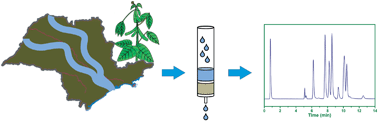
Trace analysis of pesticides and an assessment of their occurrence in surface and drinking waters from the State of São Paulo (Brazil)

O tópico deste número temático é extremamente significativo, uma vez que enfatiza a importância da química analítica em um cenário científico global. Por um bom período, a química analítica foi considerada uma área periférica da química e os químicos analíticos eram vistos apenas como provedores de dispositivos e métodos para análises qualitativas e quantitativas demandadas, por exemplo, pelas indústrias (controle de qualidade e de processos), laboratórios clínicos e monitoramento ambiental. Entretanto, durante as últimas décadas a “química analítica convencional” sofreu uma notável evolução, transformando-se em “ciências analíticas modernas”, que pode ser, não totalmente, mas em parte certamente atribuída aos avanços da microeletrônica, microfabricação, nanomateriais/nanotecnologia e quimiometria. Atualmente, as ciências analíticas modernas amadureceram, tornando-se uma disciplina de pesquisa altamente interdisciplinar, ágil e transformadora, abordando, por exemplo, de tecnologia analítica de processos à análise de uma única célula, de monitoramento ambiental à química verde, de diagnósticos clínicos/médicos ao sensoriamento (bio)químico e de análise de composição de materiais à quantificação de contaminantes em alimentos. Adicionalmente, além de determinar “o que” e “quanto” existe de um constituinte-alvo, a química analítica contemporânea adicionou os domínios espaciais, temporais e de especiação à estes parâmetros, isto é, “onde”, “quando” e “como” um analito está presente dentro de uma determinada matriz. Em outras palavras, a Química Analítica evoluiu para uma disciplina chave da química moderna, movendo-se de sua periferia para o seu núcleo central.

Qual a situação das Ciências Analíticas no Brasil? Esta foi a questão que fizemos quando foi lançada a ideia de um número especial neste tema. O Brasil está ainda focando em “química analítica” ou está contribuindo ativamente com desenvolvimentos inovadores em “ciências analíticas”? Enquanto esta questão pode ser certamente respondida sob diferentes aspectos e considerações, a resposta da comunidade de química analítica brasileira fala por si mesma: dois meses após a data limite para submissão de artigos para este número especial, 38 manuscritos haviam sido aceitos para publicação, os quais documentam de forma notável a relevância, a vitalidade e a inovação das ciências analíticas no Brasil. Mais importante e para particular satisfação dos Editores, em vez de regiões específicas – e provavelmente favorecidas financeiramente – dentro do Brasil, as contribuições têm sido submetidas de norte a sul e de leste a oeste do país. Por exemplo, enquanto as regiões ao norte e à oeste eram certamente consideradas “distantes” dos epicentros da ciência, isto mudou dramaticamente durante os últimos trinta anos, assim como a química analítica. De uns poucos Programas de Pós-Graduação em universidades no sul e sudeste, o cenário científico expandiu-se para proporcionar uma ampla multiplicidade, espalhada por todo o país. Este imenso esforço de pesquisadores de diferentes estados, que foram as sementes destes novos programas, hoje reflete na diversidade e força do ensino de química por todo o Brasil. Portanto, a resposta é claramente “sim”. O Brasil dedica-se e contribui para as ciências analíticas modernas, acima e além das contribuições publicadas neste número especial!
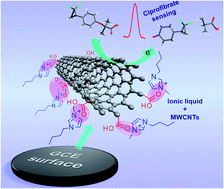
A novel architecture based upon multi-walled carbon nanotubes and ionic liquid to improve the electroanalytical detection of ciprofibrate

Finalmente, os Editores deste número temático – Prof. Ivo M. Raimundo Jr. (Universidade Estadual de Campinas, Brasil) e Prof. Boris Mizaikoff (Universidade de Ulm, Alemanha) – gostariam de agradecer profundamente May Copsey (Editora) e Rebecca Brodie (vice-editora) por tratar de todos os detalhes referentes à esta edição, a qual não seria possível sem suas generosas assistências. Além disso, gostariam também de agradecer o Instituto Nacional de Ciências e Tecnologias Analíticas Avançadas, que forneceu as bases para esta iniciativa. Por fim, mas não menos importante, gostariam de agradecer todos os pesquisadores brasileiros que contribuíram para este número, possibilitando que o Analyst e o Analytical Methods proporcionem aos seus leitores um sabor especial das Ciências Analíticas atualmente produzidas no Brasil!

To read some of the exciting research being performed in Brazil, please click through and check out the web themed issue.

Digg This
Reddit This
Stumble Now!
Share on Facebook
Bookmark this on Delicious
Share on LinkedIn
Bookmark this on Technorati
Post on Twitter
Google Buzz (aka. Google Reader)

International Mass Spectrometry Conference 2014

International Mass Spectrometry Conference 2014The 20th International Mass Spectrometry Conference (IMSC) 2014 is fast approaching and this year will be held in Geneva, Switzerland, Aug 24-29, 2014.

Run jointly by the Swiss Group for Mass Spectrometry (SGMS), the French Mass Spectrometry Society (SFSM), the Division of Mass Spectrometry of the Italian Chemical Society (DSM), and under the auspices of the International Mass Spectrometry Foundation (IMSF), the meeting returns to Europe in 2014, after Kyoto (2012) and before it goes overseas again, to Toronto (2016).

Travel grant deadline is soon!  30 July 2014 – so get your applications in

For more information see the website: http://www.imsc2014.ch/

Digg This
Reddit This
Stumble Now!
Share on Facebook
Bookmark this on Delicious
Share on LinkedIn
Bookmark this on Technorati
Post on Twitter
Google Buzz (aka. Google Reader)