Archive for the ‘News’ Category

Idea featured in Lab on a Chip article to benefit from the RSC’s support of Marblar

The RSC has teamed up with an Oxford University spin-out to sponsor six challenges on Marblar – a radical new online platform for finding applications for unused scientific discoveries.

More than 95% of technologies developed in universities never make it to market, leaving publicly or philanthropy-funded research collecting dust on the shelf.  Often, given that academic research can be so ahead of its time, the commercial relevance of these technologies isn’t immediately obvious.

Marblar aims to remove this bottleneck by crowdsourcing ideas for real-world applications from the global science and technology community, with the ultimate goal to create new products and new companies that will drive job creation around these innovative discoveries.

An idea from one Lab on a Chip article – SlipChip – has been chosen as one of the RSC sponsored challenges.

SlipChip is a low-cost microfluidic device that uses only two pieces of plastic or glass to enable the user to perform multiple small-scale chemical reactions simply and precisely. By simply ’slipping’ the glass or plastic ‘chips’ across each other, a number of reactions can be carried out in nanoscale volumes in parallel.

SlipChip was developed at the University of Chicago by Professor Rustem Ismagilov and his then graduate student, Feng Shen. They’ve since created a spinout company called SlipChip based on this technology and Ismagilov has continued his work at the California Institute of Technology. Given the technology’s ability to precisely manipulate reactions in a programmable way, they see applications in multiple fields. Through Marblar, they hope to find ideas beyond their discipline that can exploit SlipChip’s ability to ‘count molecules’, as well as new capabilities for the technology.

Visit the Marblar website to get involved, or read the Lab on a Chip article below:

Digital PCR on a SlipChip
Feng Shen, Wenbin Du, Jason E. Kreutz, Alice Fok and Rustem F. Ismagilov
DOI: 10.1039/C004521G

Digg This
Reddit This
Stumble Now!
Share on Facebook
Bookmark this on Delicious
Share on LinkedIn
Bookmark this on Technorati
Post on Twitter
Google Buzz (aka. Google Reader)

Issue 22 – Focus on Scandinavia

Issue 22 of Lab on a Chip features work from Scandinavia – read the editorial from the Guest Editors Professors Thomas Laurell and Jörg Kutter here. The issue features 8 articles from Scandinavian authors, and profiles of the athours included can be found here.

The front cover features work from Jörg Kutter and co-workers at the Technical University of Denmark, reporting on the optical properties of gold nanoparticle probes, used as sensors for environmental contaminants.

Gold nanoparticle-based optical microfluidic sensors for analysis of environmental pollutants
Josiane P. Lafleur, Silja Senkbeil, Thomas G. Jensen and Jörg P. Kutter
DOI: 10.1039/C2LC40543A

Artwork linked to research from Vincent Aimez and colleagues from the Université de Sherbrooke can be seen on the inside front cover of the issue – they have developed a microfluidic device to monitor the radioactivity concentration in the blood of rats and mice in real time.

Blood compatible microfluidic system for pharmacokinetic studies in small animals
Laurence Convert, Frédérique Girard Baril, Vincent Boisselle, Jean-François Pratte, Réjean Fontaine, Roger Lecomte, Paul G. Charette and Vincent Aimez
DOI: 10.1039/C2LC40550D

The back cover of the issue features work from Samir Iqbal and co-workers at the University of Texas and Lehigh University. The team designed a Hele-Shaw device with aptamer functionalized glass beads to isolate cancer cells from a cellular mixture.

Capture, isolation and release of cancer cells with aptamer-functionalized glass bead array
Yuan Wan, Yaling Liu, Peter B. Allen, Waseem Asghar, M. Arif Iftakher Mahmood, Jifu Tan, Holli Duhon, Young-tae Kim, Andrew D. Ellington and Samir M. Iqbal
DOI: 10.1039/C2LC21251J

Other HOT papers in the issue include:

Two-hundredfold volume concentration of dilute cell and particle suspensions using chip integrated multistage acoustophoresis
Maria Nordin and Thomas Laurell
DOI: 10.1039/C2LC40629B

Inertial microfluidics in parallel channels for high-throughput applications
Jonas Hansson, J. Mikael Karlsson, Tommy Haraldsson, Hjalmar Brismar, W. van der Wijngaart and Aman Russom
DOI: 10.1039/C2LC40241F

Low cost integration of 3D-electrode structures into microfluidic devices by replica molding
Benjamin Mustin and Boris Stoeber
DOI: 10.1039/C2LC40728K

A microfluidic device with removable packaging for the real time visualisation of intracellular effects of nanosecond electrical pulses on adherent cells
C. Dalmay, M. A. De Menorval, O. Français, L. M. Mir and B. Le Pioufle
DOI: 10.1039/C2LC40857K

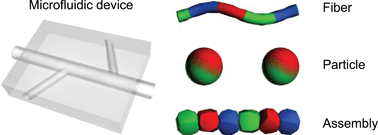
Programmable microfluidic synthesis of spectrally encoded microspheres
R. E. Gerver, R. Gómez-Sjöberg, B. C. Baxter, K. S. Thorn, P. M. Fordyce, C. A. Diaz-Botia, B. A. Helms and J. L. DeRisi
DOI: 10.1039/C2LC40699C

Digg This
Reddit This
Stumble Now!
Share on Facebook
Bookmark this on Delicious
Share on LinkedIn
Bookmark this on Technorati
Post on Twitter
Google Buzz (aka. Google Reader)

Point of Care Diagnostics Workshop – 4 Dec 2012, London UK

Point-of-Care Diagnostics Workshop
4 December 2012, Burlington House, London, UK

Point-of-care diagnostic (POC) test devices provide rapid results on an ever expanding range of medical tests, helping to streamline healthcare and improve clinical outcomes. Research on microfluidics for POC applications has increased markedly in recent years, fuelled by an interest in constructing field-deployable analytical instruments. The interest in POC microfluidic-based devices has been intense and has cut across all major disciplines in lab-on-a-chip research, including engineering (biomedical, chemical, electrical, and mechanical), chemistry, and physics.  For further details please visit the website.

Abstract submission deadline: 31 October 2012. Abstract submission is now available online.

Application deadline: 31 October 2012. Application is now available online.

Workshop format
The aims of this Joint Biochemical Society/Royal Society of Chemistry workshop are to provide participants with a better understanding of the challenges involved in translating research outputs into application and to help encourage collaborations with industry and clinicians on POC. The workshop will bring together researchers who work at the interface between biology, chemistry and the wider life and medical sciences. Participants will be encouraged to participate in oral presentations, as well as in discussion groups intended to help move this area forward.

Speakers
Dr Ana Alfirevic, University of Liverpool, UK
Professor Andrew de Mello, ETH Zürich, Switzerland

Attendance is by application only and will be FREE of charge for Biochemical Society and Royal Society of Chemistry members.

This workshop is the fourth of a series entitled “Analytical Tools for the Life Sciences”, a collaborative project between the Biochemical Society and Royal Society of Chemistry members.

Digg This
Reddit This
Stumble Now!
Share on Facebook
Bookmark this on Delicious
Share on LinkedIn
Bookmark this on Technorati
Post on Twitter
Google Buzz (aka. Google Reader)

Want to know more about Organs-on-chips? Read our free articles!

As the meeting at the Lorentz Center entitled ‘Organs on Chips: Human Disease Models‘ draws to a close, we thought we’d remind you about the fantastic free* collection of articles we’ve put together from Lab on a Chip and Integrative Biology on the topic.

The collection can be found here, and includes papers such as:

Microengineered physiological biomimicry: Organs-on-Chips
Dongeun Huh, Yu-suke Torisawa, Geraldine A. Hamilton, Hyun Jung Kim and Donald E. Ingber
DOI: 10.1039/C2LC40089H

Organs-on-chips: breaking the in vitro impasse
Andries D. van der Meer and Albert van den Berg
DOI: 10.1039/C2IB00176D

Ensembles of engineered cardiac tissues for physiological and pharmacological study: Heart on a chip
Anna Grosberg, Patrick W. Alford, Megan L. McCain and Kevin Kit Parker
DOI: 10.1039/C1LC20557A

Hurry though, as the collection is only available with free* access till the 8th October!

*Free access is provided to recognised institutions or to individuals through an RSC Publishing Personal Account. Registration is quick and easy at http://pubs.rsc.org/en/account/register.

Digg This
Reddit This
Stumble Now!
Share on Facebook
Bookmark this on Delicious
Share on LinkedIn
Bookmark this on Technorati
Post on Twitter
Google Buzz (aka. Google Reader)

Top ten most accessed articles in July 2012

This month sees the following articles in Lab on a Chip that are in the top ten most accessed:

Microfluidically-unified cell culture, sample preparation, imaging and flow cytometry for measurement of cell signaling pathways with single cell resolution
Meiye Wu, Thomas D. Perroud, Nimisha Srivastava, Catherine S. Branda, Kenneth L. Sale, Bryan D. Carson, Kamlesh D. Patel, Steven S. Branda and Anup K. Singh
Lab Chip, 2012, 12, 2823-2831
DOI: 10.1039/C2LC40344G

Blood separation on microfluidic paper-based analytical devices
Temsiri Songjaroen, Wijitar Dungchai, Orawon Chailapakul, Charles S. Henry and Wanida Laiwattanapaisal
Lab Chip, 2012, 12, 3392-3398
DOI: 10.1039/C2LC21299D

Microfluidic electronics
Shi Cheng and Zhigang Wu
Lab Chip, 2012, 12, 2782-2791
DOI: 10.1039/C2LC21176A

In vitro formation and characterization of a perfusable three-dimensional tubular capillary network in microfluidic devices
Ju Hun Yeon, Hyun Ryul Ryu, Minhwan Chung, Qing Ping Hu and Noo Li Jeon
Lab Chip, 2012, 12, 2815-2822
DOI: 10.1039/C2LC40131B

High throughput method for prototyping three-dimensional, paper-based microfluidic devices
Gregory G. Lewis, Matthew J. DiTucci, Matthew S. Baker and Scott T. Phillips
Lab Chip, 2012, 12, 2630-2633
DOI: 10.1039/C2LC40331E

Commercialization of microfluidic point-of-care diagnostic devices
Curtis D. Chin, Vincent Linder and Samuel K. Sia
Lab Chip, 2012, 12, 2118-2134
DOI: 10.1039/C2LC21204H

Surface acoustic wave (SAW) acoustophoresis: now and beyond
Sz-Chin Steven Lin, Xiaole Mao and Tony Jun Huang
Lab Chip, 2012, 12, 2766-2770
DOI: 10.1039/C2LC90076A

Lab-in-a-tube: on-chip integration of glass optofluidic ring resonators for label-free sensing applications
Stefan M. Harazim, Vladimir A. Bolaños Quiñones, Suwit Kiravittaya, Samuel Sanchez and Oliver G. Schmidt
Lab Chip, 2012, 12, 2649-2655
DOI: 10.1039/C2LC40275K

Digital microfluidics: a versatile tool for applications in chemistry, biology and medicine
Mais J. Jebrail, Michael S. Bartsch and Kamlesh D. Patel
Lab Chip, 2012, 12, 2452-2463
DOI: 10.1039/C2LC40318H

Droplet microfluidics
Shia-Yen Teh, Robert Lin, Lung-Hsin Hung and Abraham P. Lee
Lab Chip, 2008, 8, 198-220
DOI: 10.1039/B715524G

Why not take a look at the articles today and blog your thoughts and comments below.

Fancy submitting an article to Lab on a Chip? Then why not submit to us today or alternatively email us your suggestions.

Digg This
Reddit This
Stumble Now!
Share on Facebook
Bookmark this on Delicious
Share on LinkedIn
Bookmark this on Technorati
Post on Twitter
Google Buzz (aka. Google Reader)

Body heat could drive drug delivery

Micropump yeast body heatAnother Lab on a Chip article has been picked up by the press, describing a nifty micropump which is powered by fermentation of yeast.  Manuel Ochoa and Babak Ziaie, Purdue University, created the “microorganism-powered thermopneumatic pump” by stacking PDMS layers with a silicon substrate drug reservoir and a chamber for the yeast.  They showed that when the yeast ferments under body temperatures, the micropump could displace the drug in the reservoir.  The technology has caused excitement due to its potential for use in transdermal drug delivery patches, by driving tiny microneedle arrays.

A fermentation-powered thermopneumatic pump for biomedical applications
Manuel Ochoa and Babak Ziaie
DOI: 10.1039/C2LC40620A

Digg This
Reddit This
Stumble Now!
Share on Facebook
Bookmark this on Delicious
Share on LinkedIn
Bookmark this on Technorati
Post on Twitter
Google Buzz (aka. Google Reader)

Article on light-activated muscle has people twitching

A collaborative study by Harry Asada (MIT) and Roger Kamm (Penn State) and colleagues just published in Lab on a Chip has been causing a bit of a stir on the blogosphere recently.  The article describes the stimulation of muscle, not by electrical signals as used in the body, but by light.  The team engineered skeletal muscle tissue to contain a light-responsive protein, which allowed it to contract when blue light was shone on it, as shown in the video below from the MIT press release:

Jumping straight from this amazing achievement to the future, several blogs have already discussed the potential of this technology for advanced biorobotics  (this article was our favourite).  Professor Asada is a little more modest and discusses the potential of the engineered muscle to control endoscopes or be used in drug screening programmes.

Read the paper here or take a look at some of the posts on the topic:

siliconANGLE
Judgement Day Beckons: Scientists Grow ‘Light-Activated’ Muscle Tissue For Robots

Wired
Light-activated skeletal muscle could be used to make realistic robots

The Verge
Laser-stimulated muscle tissue could be used to build ‘bio-integrated’ robots

Machines like us
Researchers engineer light-activated skeletal muscle

Formation and optogenetic control of engineered 3D skeletal muscle bioactuators
Mahmut Selman Sakar,  Devin M Neal,  Thomas Boudou,  Michael A Borochin,  Yinqing Li,  Ron Weiss,  Roger Kamm,  Christopher S. Chen and H Harry Asada
Lab Chip, 2012, Accepted Manuscript
DOI: 10.1039/C2LC40338B

Digg This
Reddit This
Stumble Now!
Share on Facebook
Bookmark this on Delicious
Share on LinkedIn
Bookmark this on Technorati
Post on Twitter
Google Buzz (aka. Google Reader)

Moving microrobots with bubbles

Microrobots smaller than the width of a human hair have been directed to assemble patterns made of single yeast cells and cell-laden agarose microgels using cavitation bubbles by a team from Hawaii. The robots could be used to push cells together to grow artificial tissue.

The microbot manipulating agarose gel blocks, some containing cells, into a 3x4 array

The microbot manipulating agarose gel blocks, some containing cells, into a 3x4 array

There have been a number of different methods used to manipulate single cells into patterns; including micromanipulators, which physically trap and hold cells but need skilled technicians to use them; and optical tweezers, which can be automated but usually need strong lasers or electrical fields that can affect the cells.

Read the full article in Chemistry World.

Or read the Lab on a Chip paper:
Hydrogel microrobots actuated by optically generated vapour bubbles
Wenqi Hu, Kelly S. Ishii, Qihui Fan and Aaron T. Ohta
Lab Chip, 2012,12, 3821-3826
DOI: 10.1039/C2LC40483D

Digg This
Reddit This
Stumble Now!
Share on Facebook
Bookmark this on Delicious
Share on LinkedIn
Bookmark this on Technorati
Post on Twitter
Google Buzz (aka. Google Reader)

HOT article: Digital microfluidics for measuring glucose in human blood serum

Hywel Morgan and colleagues at Sharp Laboratories of Europe, the University of Southampton and Sharp Corporation, Japan, demonstrate a large area digital microfluidic array in this HOT article.

Using a thin film transistor (TFT) array rather than the traditional patterned electrodes usually used in electrowetting on dielectric (EWOD) devices, the team developed active matrix electrowetting on dielectric (AM-EWOD) devices. The TFT array enables each of the many thousand electrodes to be individually addressable, and the array is ‘fully reconfigurable and can be programmed to support multiple simultaneous operations’.

Read how the device can be used for measuring glucose in human blood serum in the full article (it’s free to access for four weeks*!):

Programmable large area digital microfluidic array with integrated droplet sensing for bioassays
B. Hadwen, G. R. Broder, D. Morganti, A. Jacobs, C. Brown, J. R. Hector, Y. Kubota and H. Morgan
DOI: 10.1039/C2LC40273D

*Following a simple registration.

Digg This
Reddit This
Stumble Now!
Share on Facebook
Bookmark this on Delicious
Share on LinkedIn
Bookmark this on Technorati
Post on Twitter
Google Buzz (aka. Google Reader)

Issue 17 now online

We’ve got another jam-packed issue for you this week, with some colourful articles on the cover from Lee Hubble, Jochen Hoffman and Helena Zec.

On the outside front cover Lee Hubble from CSIRO and colleagues have used functionalised gold nanoparticle chemiresistor sensors to simultaneously perform on-chip protein separation and metabolite detection in biofluids. They were able to avoid problems of protein and lipid-fouling by using ultrafiltration membranes to prevent large molecules interacting with the golf nanoparticle chemiresitor sensors:

Gold nanoparticle chemiresistors operating in biological fluids
Lee J. Hubble, Edith Chow, James S. Cooper, Melissa Webster, Karl-Heinz Müller, Lech Wieczorek and Burkhard Raguse
DOI: 10.1039/C2LC40575J

The inside front cover from Jochen Hoffman and colleagues at University of Freiburg demonstrates an method that combines large scale picowell array-based  liquid phase PCR amplification with solid phase PCR.  The authors have immobilised the PCR products on a microscope slide to enable recovery and achieved single DNA molecule amplification:

Solid-phase PCR in a picowell array for immobilizing and arraying 100 000 PCR products to a microscope slide
Jochen Hoffmann,  Martin Trotter,  Felix von Stetten,  Roland Zengerle and Günter Roth
DOI: 10.1039/C2LC40534B

And on the back cover Helena Zec and colleagues present a droplet platform for generating nanolitre droplets of combinational mixtures.  Sample plugs from a multiwell are split into nanolitre droplets which can be injected with four different reagents – in this paper, food colouring, to prove their concept.  Due to the automatic spatial indexing of the droplets, droplet barcoding is not necessary.

Microfluidic platform for on-demand generation of spatially indexed combinatorial droplets
Helena Zec, Tushar D. Rane and Tza-Huei Wang
DOI: 10.1039/C2LC40399D

Also in this issue we have the latest Research Highlights from Ali Khademhosseini to keep you up to date with the most important miniaturisation research, Acoustofluidics number 17 from Michael Gedge and Martyn Hill and an interesting Focus article from Samuel Stavis on testing standards for lab on a chip devices, as well as plenty of HOT articles.

View the issue

Ps. Don’t forget all our cover articles are free to access for 6 weeks following a simple registration!

Digg This
Reddit This
Stumble Now!
Share on Facebook
Bookmark this on Delicious
Share on LinkedIn
Bookmark this on Technorati
Post on Twitter
Google Buzz (aka. Google Reader)