Archive for the ‘Nanoscale Advances’ Category

Call for papers: Themed collection on Supercapacitors

Guest Editors: Zhaojun Han, Ruopian (Sophie) Fang, Dewei Chu, Da-Wei Wang (all affiliated with University of New South Wales)
Advisory Guest Editor: Kostya Ostrikov

Supercapacitors are important electrochemical energy storage devices that can deliver high power, fast charge/discharge rate, long lifespan and safe operation. The last few decades have witnessed significant progress in supercapacitors for clean and sustainable energy applications. Depending on charge storage process, supercapacitors can be classified as electric double-layer capacitor (EDLC) or pseudocapacitor. This themed collection will focus on all aspects of supercapacitors, including electrochemistry, electrode materials, electrolytes, performance evaluation, device design and fabrication, and applications. It will also cover the integration of supercapacitors with other energy harvesting or storage systems for broader energy applications. The scope includes:


  • New electrode materials for EDLC and pseudocapacitor
  • Charge storage mechanism investigation, theory, modelling and simulations
  • Electrolyte development
  • Performance evaluation such as energy density, power density, safety and cyclability
  • Applications of supercapacitors in areas such as electronics, transport, aerospace and stationary power stations
  • Integrated energy systems consisting of supercapacitors
  • Multifunctional energy storage devices
  • Other emerging properties or applications of supercapacitors.


You are welcome to submit either an original research article or a review-type article within the scope.

If you are interested in contributing to this collection please get in touch with the Editorial Office by email.

Please add a “note to the editor” in the submission form when you submit your manuscript to say that this is a submission for the themed collection. The Editorial Office and Guest Editors reserve the right to check suitability of submissions in relation to the scope of the collection and inclusion of accepted articles in the collection is not guaranteed. All manuscripts will be subject to the journal’s usual peer review process. Accepted manuscripts will be added to the online collection as soon as they are online, and they will be published in a regular issue of Nanoscale Advances. Article Processing Charges (APCs) apply to all accepted articles in Nanoscale Advances and more information about APCs and waivers can be found here.

Digg This
Reddit This
Stumble Now!
Share on Facebook
Bookmark this on Delicious
Share on LinkedIn
Bookmark this on Technorati
Post on Twitter
Google Buzz (aka. Google Reader)

Professor Teresa Pellegrino joins the Associate Editor team

Professor Teresa Pellegrino joins the Associate Editor team

Welcome to Nanoscale and Nanoscale Advances!

 

Professor Teresa Pellegrino

We are delighted to welcome Professor Teresa Pellegrino, Istituto Italiano di Tecnologia, Italy, as a new Associate Editor working across Nanoscale and Nanoscale Advances.

Teresa Pellegrino received her Master’s in Chemistry in 2000 and her PhD in Chemical Synthesis and Applied Enzymatic Chemistry in 2005 from the University of Bari, Italy. In 2014 she became a tenured Team Leader of the Nanomaterials for Biomedical Applications Group at the Italian Institute of Technology, Genoa, Italy.

Her current research interests focus on the synthesis of inorganic nanocrystals with an emphasis on magnetic materials and organic-inorganic nanostructured materials for drug delivery, magnetic hyperthermia, photo-thermal treatment and radiotherapy.


Submit your latest research to Professor Pellegrino’s Editorial Office


Read some of her recent papers below.

Magnetic nanoparticles and clusters for magnetic hyperthermia: optimizing their heat performance and developing combinatorial therapies to tackle cancer
Helena Gavilán, Sahitya Kumar Avugadda, Tamara Fernández-Cabada, Nisarg Soni, Marco Cassani, Binh T. Mai, Roy Chantrell and Teresa Pellegrino
Chem. Soc. Rev., 2021, DOI: 10.1039/D1CS00427A

Di- and tri-component spinel ferrite nanocubes: synthesis and their comparative characterization for theranostic applications
Niccolò Silvestri, Helena Gavilán, Pablo Guardia, Rosaria Brescia, Soraia Fernandes, Anna Cristina S. Samia, Francisco J. Teran and Teresa Pellegrino
Nanoscale, 2021, DOI: 10.1039/D1NR01044A

Photo-induced copper mediated copolymerization of activated-ester methacrylate polymers and their use as reactive precursors to prepare multi-dentate ligands for the water transfer of inorganic nanoparticles
Binh T. Mai, Markus J. Barthel, Aidin Lak, Tommaso Avellini, Ana Maria Panaite, Emille M. Rodrigues, Luca Goldoni and Teresa Pellegrino
Polym. Chem., 2020, DOI: 10.1039/D0PY00212G

Novel synthesis of platinum complexes and their intracellular delivery to tumor cells by means of magnetic nanoparticles
Alessandra Quarta, Manuel Amorín, María José Aldegunde, Laura Blasi, Andrea Ragusa, Simone Nitti, Giammarino Pugliese, Giuseppe Gigli, Juan R. Granja and Teresa Pellegrino
Nanoscale, 2019, DOI: 10.1039/C9NR07015J

Dually responsive gold–iron oxide heterodimers: merging stimuli-responsive surface properties with intrinsic inorganic material features
Hamilton Kakwere, Maria Elena Materia, Alberto Curcio, Mirko Prato, Ayyappan Sathya, Simone Nitti and Teresa Pellegrino
Nanoscale, 2018, DOI: 10.1039/C7NR06726G

Unraveling viscosity effects on the hysteresis losses of magnetic nanocubes
D. Cabrera, A. Lak, T. Yoshida, M. E. Materia, D. Ortega, F. Ludwig, P. Guardia, A. Sathya, T. Pellegrino and F. J. Teran
Nanoscale, 2017, DOI: 10.1039/C7NR00810D


Please join us in welcoming Professor Pellegrino to Nanoscale and Nanoscale Advances!

Best wishes,

Dr Heather Montgomery Dr Jeremy Allen
Managing Editor, Nanoscale Executive Editor, Nanoscale Advances
Digg This
Reddit This
Stumble Now!
Share on Facebook
Bookmark this on Delicious
Share on LinkedIn
Bookmark this on Technorati
Post on Twitter
Google Buzz (aka. Google Reader)

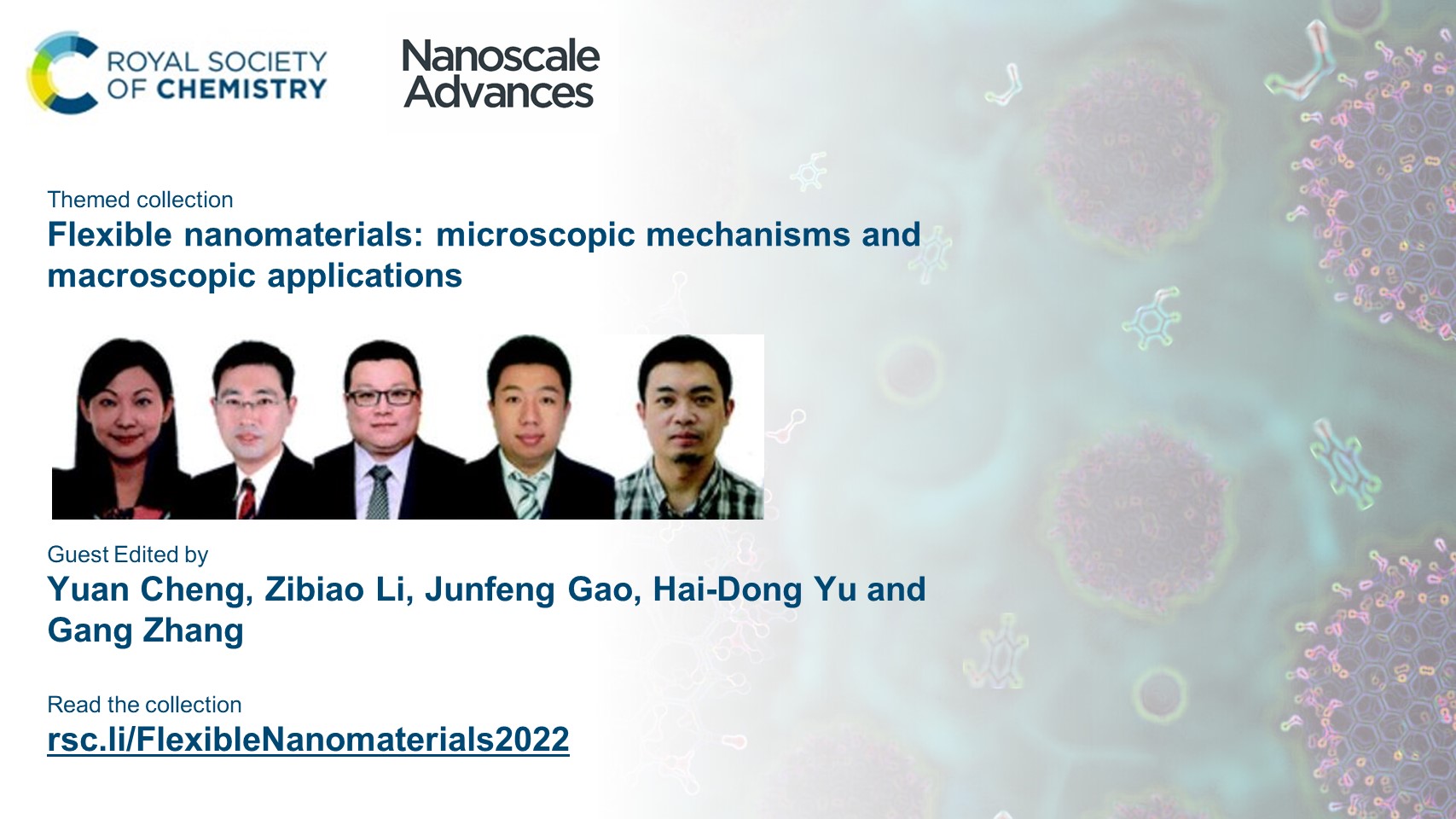
Themed collection: Flexible Nanomaterials

We are delighted to invite you to read a new themed collection on Flexible Nanomaterials: Microscopic Mechanisms and Macroscopic Applications


Read the collection


Guest edited by Yuan Cheng (Monash University, Australia), Zibiao Li (A*STAR, Singapore), Junfeng Gao (Dalian University of Technology, China), Hai-Dong Yu (Northwestern Polytechnical University, China) and Gang Zhang (A*STAR, Singapore). This themed collection is focussed on the fundamental physical and chemical properties of flexible materials, as well as controlled functionalization, in order to harness the materials’ fundamental properties and enhanced performance in applications in the fields of flexible electronics, rechargeable batteries, thermoelectrics, optoelectronics, and soft robotics.


Articles in the collection are published in Nanoscale Advances and are freely available with gold open access. Read the Editorial article that introduces the collection:

Introduction to flexible nanomaterials: microscopic mechanisms and macroscopic applications


We hope you enjoy reading this collection. If you work on flexible nanomaterials and want to know more about publishing your next piece of work with Nanoscale Advances, please get in touch.

Digg This
Reddit This
Stumble Now!
Share on Facebook
Bookmark this on Delicious
Share on LinkedIn
Bookmark this on Technorati
Post on Twitter
Google Buzz (aka. Google Reader)

Professor Zhiqun Lin joins the Associate Editor team

Professor Zhiqun Lin joins the Associate Editor team

Welcome to Nanoscale and Nanoscale Advances!


Professor Zhiqun Lin

We are delighted to welcome Professor Zhiqun Lin, Georgia Institute of Technology, USA, as a new Associate Editor working across Nanoscale and Nanoscale Advances.

Zhiqun Lin received his Ph.D in Polymer Science and Engineering from the University of Massachusetts, Amherst in 2002. He is currently a Professor in the School of Materials Science and Engineering at the Georgia Institute of Technology.

His research interests include solar cells, photocatalysis, electrocatalysis, batteries, quantum dots (rods), multifunctional nanocrystals, Janus nanostructures, conjugated polymers, semiconductor organic-inorganic nanocomposites, block copolymers, polymer blends, hierarchical structure formation and assembly, and surface and interfacial properties.


Submit your latest research to Professor Lin’s Editorial Office


Read some of his recent papers below.

Piezo-phototronic effect on photocatalysis, solar cells, photodetectors and light-emitting diodes
Baoying Dai, Gill M. Biesold, Meng Zhang, Haiyang Zou, Yong Ding, Zhong Lin Wang and Zhiqun Lin
Chem. Soc. Rev., 2021, DOI: 10.1039/D1CS00506E

Tailoring oxygen evolution reaction activity of metal-oxide spinel nanoparticles via judiciously regulating surface-capping polymers
Christopher D. Sewell, Zewei Wang, Yeu-Wei Harn, Shuang Liang, Likun Gao, Xun Cui and Zhiqun Lin
J. Mater. Chem. A, 2021, DOI: 10.1039/D1TA04511C

Continuous production of ultrathin organic–inorganic Ruddlesden–Popper perovskite nanoplatelets via a flow reactor
Gill M. Biesold, Shuang Liang, Brent K. Wagner, Zhitao Kang and Zhiqun Lin
Nanoscale, 2021, DOI: 10.1039/D1NR03239A

Stimuli-responsive Janus mesoporous nanosheets towards robust interfacial emulsification and catalysis
Jiangyan Yang, Jialin Wang, Yijiang Liu, Huaming Li and Zhiqun Lin
Mater. Horiz. 2020, DOI: 10.1039/D0MH01260B

Tailoring carrier dynamics in perovskite solar cells via precise dimension and architecture control and interfacial positioning of plasmonic nanoparticles
Xun Cui, Yihuang Chen, Meng Zhang, Yeu Wei Harn, Jiabin Qi, Likun Gao, Zhong Lin Wang, Jinsong Huang, Yingkui Yang and Zhiqun Lin
Energy Environ. Sci., 2020, DOI: 10.1039/C9EE03937F

An integrated experimental and theoretical study on the optical properties of uniform hairy noble metal nanoparticles
Di Yang, Yihuang Chen, Hongshang Peng, Gengxiang Chen and Zhiqun Lin
Nanoscale, 2018, DOI: 10.1039/C8NR07115B


Please join us in welcoming Professor Lin to Nanoscale and Nanoscale Advances!

Best wishes,

Dr Heather Montgomery Dr Jeremy Allen
Managing Editor, Nanoscale Executive Editor, Nanoscale Advances
Digg This
Reddit This
Stumble Now!
Share on Facebook
Bookmark this on Delicious
Share on LinkedIn
Bookmark this on Technorati
Post on Twitter
Google Buzz (aka. Google Reader)

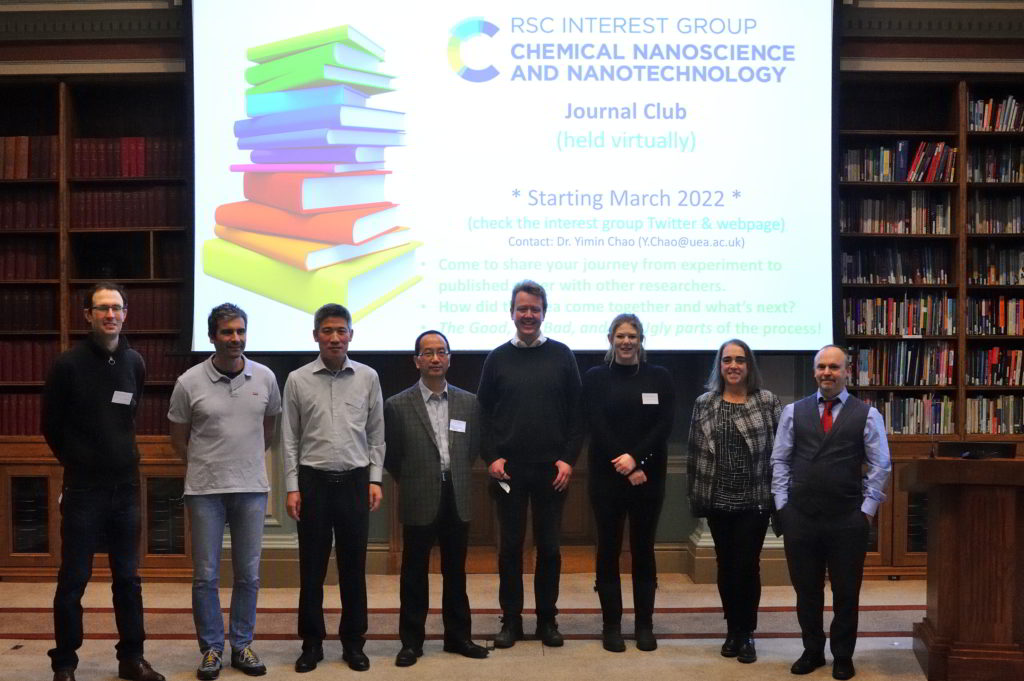
RSC Chemical Nanoscience and Nanotechnology Network Annual Symposium

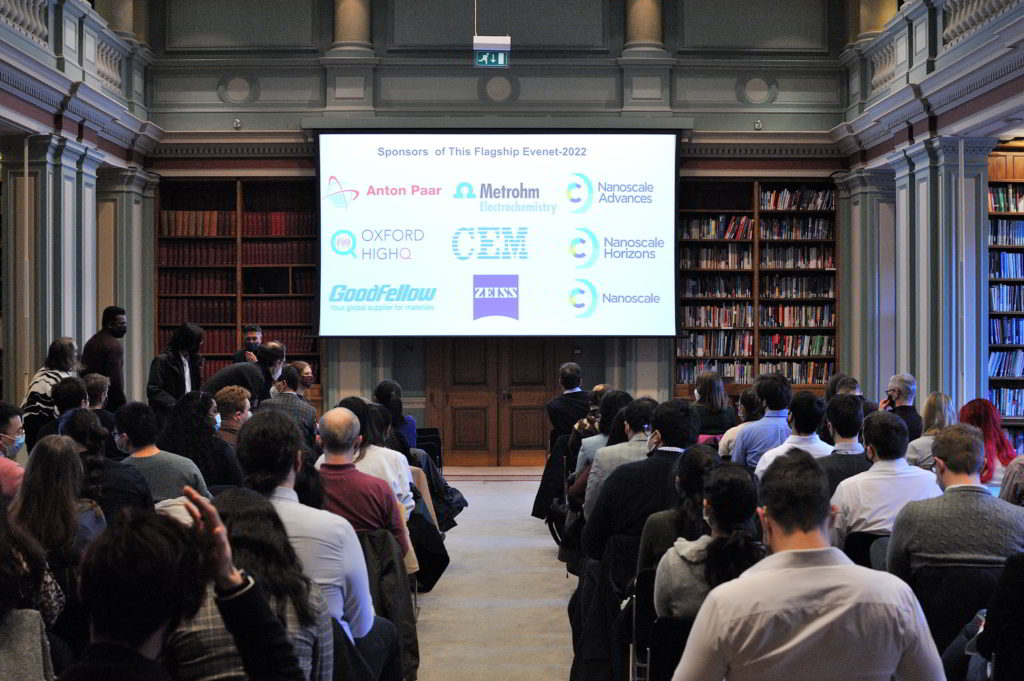
In mid-January 2022, the RSC Chemical Nanoscience & Nanotechnology Network were delighted to welcome attendees to the annual symposium!

This annual flagship event of the RSC CNN Special Interest Group covers recent developments in fundamentals and applications of novel materials, with the aim to provide a forum of nanoscience and nanotechnology researchers to engage and exchange information, discuss challenges and build networks. Held in a hybrid format, more than 70 delegates attended in person at Burlington House in London, and many attendees dialed in to attend virtually.


Congratulations to the prize winners!

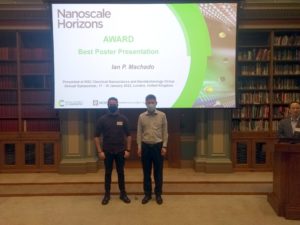
Congratulations to poster prize winner Ian Machado!

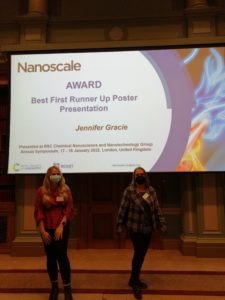
Congratulations to poster prize first runner-up Jennifer Gracie

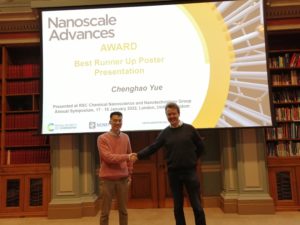
Congratulations to poster prize runner-up Chengao Yue


An exciting new initiative from the RSC CNN interest group is coming in March 2022: a virtual Journal Club! If you’re on Twitter, follow @RSC__CNN to keep up to date.

Digg This
Reddit This
Stumble Now!
Share on Facebook
Bookmark this on Delicious
Share on LinkedIn
Bookmark this on Technorati
Post on Twitter
Google Buzz (aka. Google Reader)

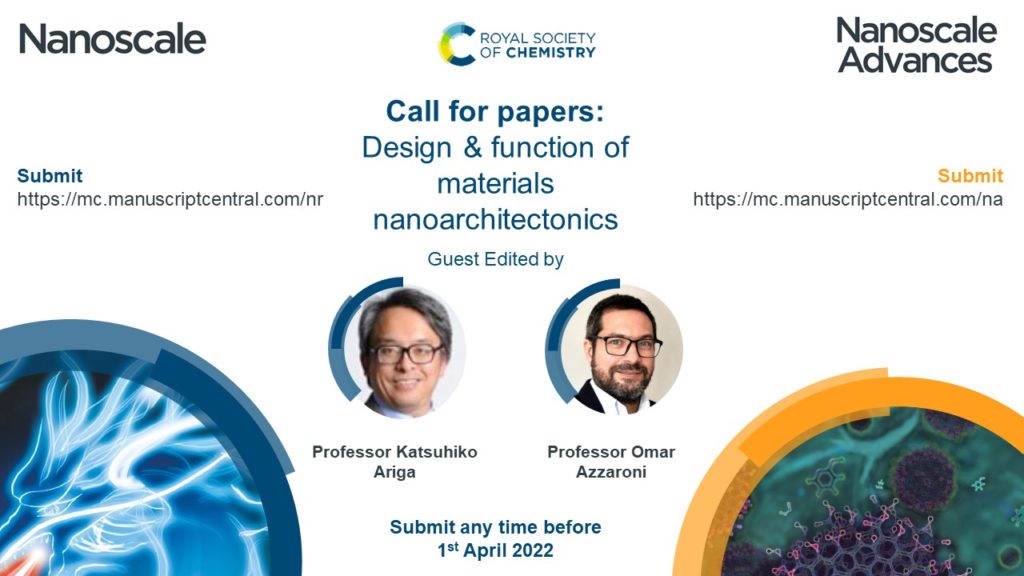
Call for Papers: Design and Function of Materials Nanoarchitectonics

Nanoscale and Nanoscale Advances invite you to contribute to our new themed collection on the design and function of materials nanoarchitectonics.

Nanoarchitectonics refers to the creation of functional materials using nanoscale component units, encompassing fields such as nanostructured materials synthesis, supramolecular assembly, nanoscale structural fabrications, and materials hybridizations.

Find out more about nanoarchitectonics in this recent Focus article by Guest Editor Katsuhiko Ariga.

The Guest Editor team welcome submissions utilizing both theoretical and experimental methods. You are welcome to submit to either journal, and all published articles will be collated into a single online collection for promotion.

Find out more about Nanoscale here: www.rsc.li/nanoscale

Find out more about Nanoscale Advances* here: www.rsc.li/nanoscale-advances


Submit any time before 1st April 2022


Submit to Nanoscale

Submit to Nanoscale Advances


Please make sure you mention on the submission form that your contribution is intended for the nanoarchitectonics themed collection.

We welcome contributions of original research as a Communication or Full Paper. All submissions will be subject to initial assessment and rigorous peer review to meet the usual high standards of the journals.


*Nanoscale Advances is an international gold open access journal (impact factor 4.5), publishing research across the breadth of nanoscience and nanotechnology. Please note that article processing charges apply to all articles submitted to Nanoscale Advances if, following peer-review, they are accepted for publication. Details of the APC and discounted rates can be found here. Corresponding authors who are not already members of the Royal Society of Chemistry are entitled to one year’s Affiliate membership as part of their APC. Find out more about our member benefits. 


Digg This
Reddit This
Stumble Now!
Share on Facebook
Bookmark this on Delicious
Share on LinkedIn
Bookmark this on Technorati
Post on Twitter
Google Buzz (aka. Google Reader)

Editor’s Choice: Controlling anisotropy in nanomaterials

Controlling anisotropy in nanomaterials

A collection of articles selected by Shouheng Sun

Professor Shouheng Sun, Brown University, USA, and Associate Editor for Nanoscale and Nanoscale Advances, presents his highlights of the latest research published in the journals on anisotropic nanomaterials.

Professor Shouheng Sun


“Anisotropy is an important characteristic that offers desirable direction-dependent properties in materials. Recent advances in nanoscience research have led to extensive studies in controlling anisotropy in nanomaterials to provide unprecedented control over their properties and functionality.

This online collection from Nanoscale and Nanoscale Advances highlights work on controlling anisotropy in nanomaterials to achieve desired chemical and physical properties. These articles provide understanding of the growth of anisotropic nanostructures at the atomic and molecular level, and explore their use in optoelectronic, magnetic, catalytic, biomedical and molecular separation applications.”


Read the collection


We hope you enjoy reading these articles.

Best wishes,

Professor Shouheng Sun

Brown University, USA


Digg This
Reddit This
Stumble Now!
Share on Facebook
Bookmark this on Delicious
Share on LinkedIn
Bookmark this on Technorati
Post on Twitter
Google Buzz (aka. Google Reader)

Professor Jinlan Wang joins the Associate Editor team

Professor Jinlan Wang joins the Associate Editor team

Welcome to Nanoscale and Nanoscale Advances!


Professor Jinlan Wang

We are delighted to welcome Professor Jinlan Wang, Southeast University, China, as a new Associate Editor working across Nanoscale and Nanoscale Advances.

Jinlan Wang received her Ph.D from Nanjing University, China, in 2002. She subsequently spent three years at Argonne National Laboratory, USA, before joining Southeast University in China in 2006 as a full Professor. She has since developed the computational physics and chemistry group there and is currently a Chief Professor of Southeast University.

Her current research mainly focuses on computational studies and design of two-dimensional materials and clean energy materials, using techniques ranging from machine learning to classical molecular dynamics or different level first-principles methods.


Submit your latest research to Professor Wang’s Editorial Office


Please join us in welcoming Professor Wang to Nanoscale and Nanoscale Advances!

Best wishes,

Dr Heather Montgomery Dr Anna Rulka
Managing Editor, Nanoscale Executive Editor, Nanoscale Advances
Digg This
Reddit This
Stumble Now!
Share on Facebook
Bookmark this on Delicious
Share on LinkedIn
Bookmark this on Technorati
Post on Twitter
Google Buzz (aka. Google Reader)

Editor’s Choice: Computational studies of nanomaterials for energy, catalysis and electronics

Computational studies of nanomaterials for energy, catalysis and electronics

A collection of articles selected by Xiao Cheng Zeng

Professor Xiao Cheng Zeng, University of Nebraska-Lincoln, USA, and Associate Editor for Nanoscale and Nanoscale Advances, presents his highlights of the latest computational research published in the journals on nanomaterials for energy, catalysis and electronics.


Professor Xiao Cheng Zeng

“Computational nanomaterials research has been playing a growing role over the past decade in the design of new nanomaterials, bringing deeper insights into novel properties of nanomaterials, supporting and corroborating experimental research, and gathering new data for machine learning and model development.

This online collection from Nanoscale and Nanoscale Advances covers several active areas of computational nanomaterials research, including design and/or investigation of nanoscale and single-atom catalysts, low-dimensional ferromagnetic, ferroelectric and multiferroic materials, low-dimensional semiconductors, halide perovskites, protein-ligand binding affinity, plasmonic nanoparticles, and metal nanoclusters. We hope this themed collection will be informative to contemporary computational nanomaterials research.”


Read the collection


We hope you enjoy reading these articles.

Best wishes,

Professor Xiao Cheng Zeng

University of Nebraska-Lincoln, USA


Digg This
Reddit This
Stumble Now!
Share on Facebook
Bookmark this on Delicious
Share on LinkedIn
Bookmark this on Technorati
Post on Twitter
Google Buzz (aka. Google Reader)

Editor’s Choice: Recent breakthroughs in nanobiotechnology

Recent breakthroughs in nanobiotechnology

A collection of articles selected by Yves Dufrêne

Professor Yves Dufrêne, UCLouvain, Belgium, an Associate Editor for Nanoscale and Nanoscale Advances, presents an online article collection featuring his highlights of the latest research published in these journals on nanobiotechnology.


Professor Yves Dufrêne

“Nanobiotechnology is an exciting, rapidly evolving research field, which is predicted to have a dramatic impact on human activities, whether scientific, economical or societal. Nanomedicine, the medical application of nanotechnology, offers new opportunities to fight a range of diseases, including cancers and microbial infections. Progress in nanobiotechnology and nanomedicine strongly relies on the development of advanced tools and approaches for probing and manipulating biosystems, from single molecules to cells and tissues.


Proceeding from fundamental studies to medical applications, this collection of research and review articles published in Nanoscale and Nanoscale Advances provides a snapshot of recent progress made in the nanobio field, covering the development of innovative methodologies, nanotechniques and nanomaterials, such as biosensors, nanoscale and single-molecule characterization techniques, nanoparticles, drug encapsulation, biomedical nanomaterials, and micro- and nanopatterning, as well as the application of these new developments to DNA, proteins, microbes, cells, and to the design of novel therapies against cancer, bacteria and viruses.”


Read the collection


We hope you enjoy reading these articles.

Best wishes,

Professor Yves Dufrêne

UCLouvain, Belgium


Digg This
Reddit This
Stumble Now!
Share on Facebook
Bookmark this on Delicious
Share on LinkedIn
Bookmark this on Technorati
Post on Twitter
Google Buzz (aka. Google Reader)