
Archive for May, 2024

Photo-induced synthesis of polymeric nanoparticles and chemiluminescent degradable materials via flow chemistry

Polymeric particles represent a widely utilized class of materials due to their adjustable size and shape, high volume-surface area ratio, customizable properties and ease of surface modification. These attributes make them indispensable across diverse fields, finding applications in coatings, pigments, drug delivery, nanomedicine, catalysis and more. Traditional methods of synthesis, predominantly via thermal heterogeneous polymerization like emulsion or dispersion polymerization, often necessitate the use of surfactants/stabilizers and thermal initiators, risking material contamination and complicating purification processes. In recent years, light polymerization has gained significant attention due to its ability to operate under milder conditions and offer temporal regulation. However, employing the photo-flow reaction, which is commonly viewed as an appealing method for upscaling reactions, proves challenging for heterogeneous systems due to constraints such as limited light penetration and scattering.

In a recent study by Holloway et al., an upscaled, photochemical synthesis of polymeric particles via flow chemistry was achieved based on precipitation step-growth polymerization without radical or surfactant sources. This innovative approach optimized an easy, scalable, and fast synthetic procedure and produced functional polymeric materials with chemiluminescent self-reporting properties and chemical-stimulated degradability, thus opening novel avenues for scaled-up synthesis of functional polymeric particles (Figure 1).
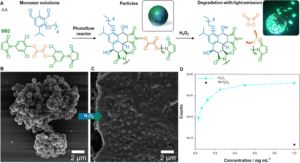
Figure 1: (A) Overview of the particle formation with AA and BB2 monomers and subsequent cleavage of the oxalate bond in presence of H2O2, resulting in the degradation of the particles and light emission. (B) SEM image of the particles after synthesis. (C) SEM image of the particles after adding H2O2. (D) Photocount recorded at various particles concentrations. Reproduced from DOI: 10.1039/D4MH00106K with permission from the Royal Society of Chemistry.

Harnessing their expertise in photochemical reactions, the team synthesized functional AA and BB monomers capable of Diels-Alder step-growth polymerization under light irradiation. The oligomers, with limited solubility in the reaction solvent, precipitated out upon reaching a critical molecular weight, facilitating particle formation via precipitation polymerization mechanism. Thorough optimization of polymerization parameters enabled precise control over particle size, yield, and shape, with solvent selection and flow rate playing crucial roles in the process. The solvent selection significantly affected polymer solubility, with dramatic effects on yield and particle size. The reaction yield increased impressively, from 1% in acetonitrile, a commonly used solvent, to up to 60% in the optimized water/methanol mixture. Since the reactions took place in a flow system, the flow rate was of paramount importance. In-depth investigation revealed that tuning the flow rate allowed manipulation of reaction yield, particle size, and shape, with the ability to tune the particle size over 545 nm (ranging from 185 to 730 nm). Furthermore, the initial monomer concentration played an important role in the reaction, as the limited solubility of the monomers prohibited equimolar monomer ratios at higher concentrations, significantly affecting particle morphology.

After successfully demonstrating the photo-flow reaction, the authors took advantage of the polymer’s nature, demonstrating its potential application in point-of-care devices. The Diels-Alder adduct exhibited intrinsic fluorescence, serving as a fluorophore for the peroxylate chemiluminescent reaction. Specifically, upon the addition of H2O2, the particles degraded via oxalate bond cleavage, resulting in the excitation of the fluorophore and subsequent photon emission with a strong signal, allowing for degradation monitoring.

In summary, this work surpasses previous approaches by developing a scalable photo-flow system capable of producing polymeric particles with tuneable properties within minutes, free from additives or radical initiators. The molecular design of these polymers enables the synthesis of functional and degradable particles responsive to chemical stimuli, featuring the potential for diverse applications. Overall, this study elegantly combines fundamental aspects of polymerization and materials design to pave the way for a plethora of applications in various fields.

To find out more, please read:

Photo-induced synthesis of polymeric nanoparticles and chemiluminescent degradable materials via flow chemistry
Joshua O. Holloway, Laura Delafresnaye, Emily M. Cameron, Jochen A. Kammerer and Christopher Barner-Kowollik
Mater. Horiz., 2024, DOI:10.1039/D4MH00106K


About the blogger



Dr. Kostas Parkatzidis is a Swiss National Science Foundation Postdoc Fellow in the group of Professor Zhenan Bao at Stanford University (United States), working on the molecular design of polymer-based skin-inspired materials for various applications. Kostas obtained his PhD from ETH Zurich (Switzerland) under the supervision of Professor Athina Anastasaki where he focused on the development of advanced polymer synthesis and chemical recycling methodologies. He also holds MSc in Organic Chemistry and BSc in Materials Science and Technology obtained from the University of Crete (Greece). Since 2023, Kostas has served as a Materials Horizons Community Board member.

Digg This
Reddit This
Stumble Now!
Share on Facebook
Bookmark this on Delicious
Share on LinkedIn
Bookmark this on Technorati
Post on Twitter
Google Buzz (aka. Google Reader)

Development of High-Toughness Liquid-Free Ionic Conductive Elastomers Through Multiple Cross-Linking Strategies

Current ionic conductors, such as hydrogels and ionogels, offer diverse capabilities but also exhibit limitations. These systems rely on a substantial amount of liquid to provide a mobile environment for free ions, while a covalently crosslinked network enhances mechanical strength. However, the presence of liquid compromises thermal and electrochemical stability and reduces mechanical integrity. Furthermore, the covalently crosslinked network often results in irreversible polymer structures, creating a fundamental conflict between ionic conductivity, self-healing capabilities, and mechanical performance—challenges that are particularly pronounced in flexible and wearable ionotronic devices. To address these issues, many researchers are focusing on developing versatile ionic conductive elastomers with innovative polymer molecular structures. Yet, the design of liquid-free ion-conducting elastomers typically struggles to achieve high ionic conductivity due to restricted segmental motion of polymer chains in covalently crosslinked networks, leading to significantly slower ion transport efficiency and a reduced volume of free ions.

Figure 1: Molecular structure and mechanism design of SSxDAy–LiTFSIz%. (a) Schematic of the molecular structure of a high-strength, ultra-toughness and healing polyurethane with multiple dynamic bonding interactions in this elastomer. (b) SSxDAy–LiTFSIz%-based (i) wearable strain and (ii) pressure sensors and (iii) self-powered TENG. Reproduced from DOI: 10.1039/d3mh02217j with permission from the Royal Society of Chemistry.

To enhance molecular segmental motion and ion transport, Ou and colleagues recently proposed a strategy that combines dual dynamic covalent bonds with non-covalent interactions. By integrating multilevel hydrogen bonds, disulfide bonds, and dynamic donor-acceptor (D–A) bonds into a polyurethane system, they developed liquid-free ionic conductive polyurethane elastomers (ICPEs), designated as SS50DA50–LiTFSIz%. Polytetramethylene ether glycol was selected as the soft phase, whereas the ether chain segments engage in ionic transport through loosely coordinated lithium-oxygen (O–Li+) bonding interactions. This configuration facilitates the development of all-solid ICPEs characterized by high ionic conductivity. The well-designed structure of SS50DA50 enables self-healing at 130°C for 2 hours, achieving a high tensile strength of 58.90 MPa and toughness of 260.33 MJ m-3, with a healing efficiency of 92% and complete recyclability. This performance is attributed to the dynamic covalent crosslinked bonds that maintain the relative positions of the polymer chain segments under tension, thereby maintaining the three-dimensional integrity of the network and substantially improving both the tensile strength and toughness of the elastomers. Additionally, the ICPEs (SS50DA50–LiTFSI80%) demonstrated high mechanical strength (1.18 MPa), superior ionic conductivity (0.14 mS cm-1), and excellent healing capacity (healing efficiency >95%), highlighting their potential as wearable sensors for physical rehabilitation training.

Because of their excellent sensitivity and durability properties, the SS50DA50–LiTFSI80% elastomers are used in multifunctional sensors and triboelectric nanogenerators, capable of real-time and rapid detection of various human activities, and can recognize writing signals and encrypted information transmission. Furthermore, SS50DA50–LiTFSI80% achieved an excellent open-circuit voltage of 464 V, a short-circuit current of 16 mA, a transferred charge of 50 nC, and a power density of 720 mW m-2. Its outstanding output performance offers significant practical value for wearable electronics and self-powered products.

In summary, the innovative design of ICEs such as SS50DA50–LiTFSI80% features a polyurethane matrix enriched with multiple dynamic bonds, including hydrogen and disulfide bonds. This design offers a more robust and sustainable alternative with enhanced functionality compared to traditional hydrogels. The improved mechanical properties, healing abilities, and recyclability of these materials make them pivotal for the future of flexible and wearable technology. The potential applications of these elastomers extend from sustainable wearable electronics to energy-harvesting devices and solid-state polymer electrolytes.

To find out more, please read:

Liquid-free ionic conductive elastomers with high mechanical properties and ionic conductivity for multifunctional sensors and triboelectric nanogenerators
Fangyan Ou, Ting Xie, Xinze Li, Zhichao Zhang, Chuang Ning, Liang Tuo, Wenyu Pan, Changsheng Wang, Xueying Duan, Qihua Liang, Wei Gao, Zequan Li,* and Shuangliang Zhao
Mater. Horiz., 2024, DOI: 10.1039/d3mh02217j


About the blogger


Fang Cheng Liang is currently a Lecturer in the Department of Materials Science and Engineering at the National University of Singapore (NUS) and serves as a Community Board member for Materials Horizons. Before joining NUS, he was a Research Assistant Professor at the Research and Development Center for Smart Textile Technology at the National Taipei University of Technology, Taiwan. He earned dual Ph.D. degrees in Organic Chemistry and Polymer Science and Engineering from the University Grenoble Alpes and National Taipei University of Technology in 2019. His research focuses on sustainable self-healing soft materials, liquid metal hydrogels, reconfigurable liquid crystal elastomers, and hybrid organic-inorganic perovskite applications in light-emitting diodes, triboelectric nanogenerators, soft robotics, and wearable electronics.

Digg This
Reddit This
Stumble Now!
Share on Facebook
Bookmark this on Delicious
Share on LinkedIn
Bookmark this on Technorati
Post on Twitter
Google Buzz (aka. Google Reader)