


To celebrate the growth and development of the RSC Applied Polymers community and to highlight the remarkable authors who continue to contribute their high quality work to the journal, we would like to share the opinions and insights of these authors through this introductory blog post. Once dubbed #RSCAppliedfirst50, our blog posts aim to give a voice to the authors behind the research and hope that their insights might shed light upon growing challenges and progress in polymer science and its applications.
In this edition, we hear from Taohedul Islam and Xiangbo Meng from University of Arkansas, USA, as they discuss their recently published article, ‘Ambient-processed bio-based solid polymer electrolyte for solid-state batteries‘.
An introduction from the authors
Solid-state batteries are widely regarded as a promising successor to conventional lithium-ion batteries because of their potential to deliver improved safety and higher energy density. While several inorganic solid-state electrolytes have achieved ionic conductivities comparable to, or even exceeding, those of flammable organic liquid electrolytes, an important question remains: can these materials be manufactured economically and at scale?
A major challenge for industrial production of many inorganic solid-state electrolytes, particularly sulfide-based systems, is their extreme sensitivity to air and moisture. These materials often require synthesis, handling, and storage under strictly controlled inert atmospheres, adding significant cost and complexity to manufacturing. In addition, inorganic electrolytes generally suffer from poor interfacial contact with electrodes and frequently require high stack pressures to maintain efficient battery operation.
Polymer-based electrolytes offer several advantages in addressing these challenges. Their softer and more compliant nature enables better electrode-electrolyte contact, while their fabrication is typically simpler and can be carried out at lower temperatures. However, the sustainability of the polymer sources used in polymeric solid electrolytes remains an important consideration.
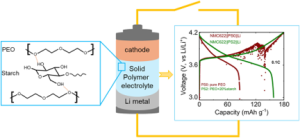
In our work, we developed a starch-modified polyethylene oxide (PEO-Starch, PS) solid polymer electrolyte using air-stable and readily available precursors. Notably, the entire electrolyte fabrication process was performed outside a glovebox, demonstrating compatibility with ambient-condition processing and highlighting its potential suitability for industrial dry-room manufacturing. Through systematic optimization, the PS electrolyte delivered improved electrochemical performance compared with conventional PEO electrolytes and enabled stable operation with both LiFePO4 and LiNi0.6Mn0.2Co0.2O2 cathodes.
Our results demonstrate that combining sustainable, bio-derived materials with air-processable manufacturing can provide a practical pathway toward scalable solid-state battery technologies. With further interfacial engineering, these electrolytes could help accelerate the development of safer, more sustainable, and commercially viable next-generation energy storage systems.
Meet the authors
 |
Dr Taohedul Islam is a Postdoctoral Research Fellow in the research group of Prof. Xiangbo Meng at the University of Arkansas, Fayetteville, USA. His research focuses on solid-state batteries, solid polymer electrolytes, lithium/sodium metal batteries, silicon anodes, and synchrotron-based characterization techniques including XRD, XAFS, and PDF analysis. He received his Ph.D. in Chemistry from Jackson State University in 2025, where he developed advanced chalcogel and chalcocarbogel materials for energy storage applications. His current work aims to develop scalable, sustainable, and high-performance materials for next-generation batteries.
|
 |
Dr Xiangbo Meng is currently a full professor in Department of Mechanical Engineering at the University of Arkansas (Fayetteville, AR, USA) and holds a 21st Century Professorship. Prior to joining University of Arkansas in 2016, Dr Meng was a Research Fellow in Energy Systems Division at Argonne National Laboratory (Lemont, IL) from 2012 – 2016 and a Research Associate (2012) in the Chemistry Department at Brookhaven National Laboratory (Upton, NY) from 2011 – 2012. Dr Meng has completed two PhD degrees in Mechanical & Materials Engineering (2011) and in Chemical & Biochemical Engineering (2008) at the University of Western Ontario (ON, Canada). In the past 20 years, he has been focusing on addressing interfacial issues of various battery systems, including lithium-ion batteries, lithium metal batteries, sodium-ion batteries, solid-state batteries, and so on. His research features the applications of atomic and molecular layer deposition (ALD and MLD) for constructing novel adaptive interphases of batteries.
|
Ambient-processed bio-based solid polymer electrolyte for solid-state batteries
Taohedul Islam; Xingyi Lyu; Yan Qin; Kang Lu; Kevin Velasquez Carballo; Fumiya Watanabe; Tao Li; Wenquan Lu; Xiangbo Meng
RSC Appl. Polym. (2026). DOI: 10.1039/d6lp00260a
 |
RSC Applied Polymers is a leading international journal for the application of polymers, including experimental and computational studies on both natural and synthetic systems. In this journal, you can discover cross-disciplinary scientific research that leverages polymeric materials in a range of applications. This includes high impact advances made possible with polymers across materials, biology, energy applications and beyond. |