


To celebrate the growth and development of the RSC Applied Polymers community and to highlight the remarkable authors who continue to contribute their high quality work to the journal, we would like to share the opinions and insights of these authors through this introductory blog post. Once dubbed #RSCAppliedfirst50, our blog posts aim to give a voice to the authors behind the research and hope that their insights might shed light upon growing challenges and progress in polymer science and its applications.
In this edition, we hear from Amanda Muñoz-Juan, Daniela Díaz, Nerea Murugarren, Judith Marin Ortega, Felipe Zamorano, Consuelo Guardiola, Martín Pérez, and Anna Laromaine Sagué as they discuss their recently published article, ‘Engineering deuterated bacterial cellulose via biosynthesis for neutron applications‘.
An introduction from the authors
What if a microorganism could be used not only to produce a biomaterial, but also to tailor its isotopic composition for entirely new applications?
Bacterial nanocellulose (BNC) is a versatile biomaterial produced by microorganisms. Its biocompatibility and unique three-dimensional nanofibrous structure make it an attractive platform for applications ranging from biomedicine to advanced materials. But what happens when we replace hydrogen with its heavier isotope, deuterium?
Deuterium atoms interact differently with other molecules than hydrogen atoms, leading to distinct bonding energies and reactivity that open new applications for cellulose. Deuterated bacterial nanocellulose (dBNC) has therefore attracted attention for fundamental studies of biomolecular interactions, spectroscopy, and emerging technological applications. However, producing highly deuterated cellulose in a biological system is not straightforward. Bacteria must progressively adapt to deuterated environments, and using large volumes of expensive deuterated reagents can make the process time-consuming and costly.
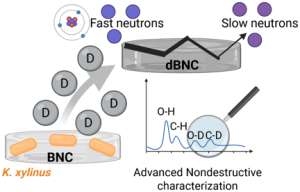
In this work, we explored a film-to-film biosynthesis strategy to adapt Komagataeibacter xylinus to increasingly deuterated conditions, using D2O and deuterated glycerol as key components of the culture environment. Freshly harvested bacterial cellulose films containing adapted bacteria initiate the formation of new membranes in a medium with a higher deuterium concentration. This allowed us to reduce the volume of deuterated medium required while accelerating adaptation and production.
We characterized deuterium incorporation into dBNC films using complementary spectroscopic techniques (FTIR, Raman, NIR, and synchrotron-based micro-FTIR). These analyses show that deuterium bonds increased with each adaptation step while preserving the characteristic BNC structure. dBNC films grown in media containing 100% deuterated glycerol and 100% D2O still exhibited some hydrogen bonds because other hydrogenated components in the medium persisted. The partial retention of hydrogen could serve as an additional parameter for material engineering, using the degree of H/D to distinguish it from other materials.
Finally, we explored how these deuterated films interact with fast neutrons. Observing recoil deuterons provides experimental evidence of neutron–deuterium interactions within the films and opens the door to further investigations of dBNC in neutron-based applications.
For us, this work combines microbial biosynthesis, isotope chemistry and material science, and provides a new perspective on using bacteria to engineer isotopically tailored materials for emerging applications.
Meet the authors
 |
Dr. Amanda Muñoz-Juan, PhD in Biotechnology from the Universitat Autònoma de Barcelona (UAB), and Institut de Ciència de Materials de Barcelona (ICMAB-CSIC). She is currently a postdoctoral researcher at Aarhus University. She participated in the production and characterisation of deuterated bacterial cellulose films as part of her PhD thesis entitled “Effects of bacterial cellulose fibres on Caenorhabditis elegans”. She has received relevant fellowships, including EMBO mobility and NORPOD grants. Currently, she focuses on evaluating changes in the gut-brain axis during inflammation, using Danio rerio (zebrafish) as a model.
|
 |
Daniela Díaz is a biomedical engineer with a Master’s degree in Biomedical Experimental Research. During her master’s, she specialised in the production and characterisation of bacterial cellulose for biomedical applications, particularly in regenerative medicine. Her experience includes developing and characterising three-dimensional scaffolds, advanced microscopy and profilometry techniques, cell growth evaluation, and scientific reporting. Her professional background also includes experience in research ethics.
|
 |
Nerea Murugarren, BSc in Biochemistry from the UAB and an MSc by Research in Metabolism and Systems Research from the University of Birmingham. She is currently a PhD student in Molecular Biosciences at the Centre of Molecular Biology Severo Ochoa in Madrid (Spain). She performed studies on film – to film biosynthesis of BNCf. She has research experience in several disciplines and techniques, from material sciences (bacterial nanocellulose engineering) to biochemistry and molecular biology (genome replication study, current field).
|
 |
Judith Marin Ortega, BSC in Chemistry (UAB) and MSc in Industrial Chemistry and Introduction to Chemical Research (UAB), is currently working in the R&D department of a European technology company. She contributed to research on the incorporation of deuterium into bacterial nanocellulose (BNC) films as part of her undergraduate thesis at the Institut de Ciència de Materials de Barcelona (ICMAB-CSIC). Completing and presenting this work marked the beginning of her career in industry.
|
 |
Felipe Zamorano, B.Sc. in Metallurgical Engineering from the University of Santiago of Chile and an M.Sc. in Medical Physics from Instituto Balseiro (Argentina). He is currently a PhD student in Physics at UAB and the Institute of Microelectronics of Barcelona (IMB-CNM-CSIC). His current research focuses on developing and characterising advanced silicon-based detectors for neutron spectroscopy in accelerator environments, combining semiconductor detector technology, Monte Carlo simulations, and experimental validation. His research has contributed to peer-reviewed publications in radiation detection and medical physics.
|
 |
Dr. Consuelo Guardiola, tenured researcher and Head of the Medical Physics Division at IMB-CNM-CSIC. She held positions at the University of Pennsylvania and Université Paris Saclay. Her research combines microelectronics, radiation physics, and biophysics to develop advanced detector technologies for radiotherapy, including proton and hadron therapy, FLASH radiotherapy, neutron detection, and dosimetry. She has received prestigious fellowships such as the Marie Skłodowska-Curie, CNRS-Momentum, and Ramón y Cajal awards, among others. She has published over 80 peer-reviewed papers and holds seven patents.
|
 |
Dr. Martín Pérez, researcher at the National Atomic Energy Commission (CNEA) and the National Scientific and Technical Research Council (CONICET), Argentina. His research focuses on developing and characterising innovative radiation detectors for applications including neutron and charged-particle detection, radiography, neutron imaging, and X-ray spectroscopy. He received a Marie Skłodowska-Curie fellowship at IMB-CNM-CSIC. His current work focuses on developing silicon (Si) and SiC semiconductor radiation detectors. Some of the technologies resulting from his research have been patented in Argentina, the United States, and Europe.
|
 |
Dra. Anna Laromaine Sagué, tenured researcher in the group of Nanoparticles and Nanocomposites at the ICMAB-CSIC. Trained as a chemist, she spent six years as a postdoctoral researcher at international centres including Imperial College London, MIT, and Harvard University. At ICMAB, her work bridges materials science, chemistry, and biology. Her research focuses on the design and synthesis of nanomaterials for biomedical applications and the use of Caenorhabditis elegans as a model system to study nanomaterial-organism interactions. She has published over 80 peer-reviewed publications, holds nine patents, and has supervised more than 40 students; she is also involved in science outreach and dissemination.
|
Engineering deuterated bacterial cellulose via biosynthesis for neutron applications
Amanda Muñoz-Juan; Daniela Diaz; Judith Marin-Ortega; Nerea Murugarren; Mariano Campoy-Quiles; Felipe Zamorano; Consuelo Guardiola; Martín Pérez; Anna Laromaine
RSC Appl. Polym. (2026) 4 (4): 1289–1297. DOI: 10.1039/d6lp00041j
 |
RSC Applied Polymers is a leading international journal for the application of polymers, including experimental and computational studies on both natural and synthetic systems. In this journal, you can discover cross-disciplinary scientific research that leverages polymeric materials in a range of applications. This includes high impact advances made possible with polymers across materials, biology, energy applications and beyond. |