



RSC Applied Interfaces publishes interdisciplinary work with an applied focus, which can be read for free here. To celebrate the excellent articles that have been published so far in our journal, we asked some of our authors to discuss their work in more detail.
In this post, we hear from Ryan Berthelot and Fabio Variola at University of Ottawa, Canada, as they discuss their recently published article entitled ‘Exploring the influence of anodization-derived nanotubular and honeycomb surfaces on the osteogenic behaviour of human MG63 osteoblastic cells‘.
An introduction from Ryan Berthelot and Fabio Variola
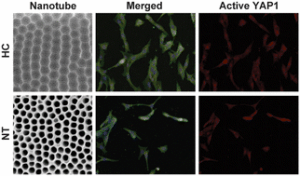
This study investigates how anodization-derived titanium nanotopographies regulate human MG63 osteoblastic cell behavior. Specifically, it compares a conventional, highly ordered nanotubular surface (~75 nm diameter) with a two-tier honeycomb (HC) architecture characterized by higher spatial disorder, entropy, and hierarchical organization. By integrating nanoscale surface metrics (entropy, lacunarity, fractal dimension) with biological readouts spanning adhesion, proliferation, differentiation, and mineral quality, the work demonstrates that different nanotopographies selectively bias early versus late stages of osteogenesis. The HC surface accelerates early cellular events, while the conventional nanotubular surface promotes the formation of higher-quality, more crystalline mineral deposits, revealing a structure–function trade-off relevant to implant design.
How do interfaces play a key role in this application?
Interfaces are central to this application because the implant–cell interface is the primary mediator of mechanotransduction, dictating how cells sense and respond to their physical environment. In this study, nanoscale interfacial features modulate focal adhesion formation, cytoskeletal organization, and activation of the YAP/Hippo pathway, thereby linking surface architecture to gene regulation and osteogenic commitment. Importantly, the work shows that not only feature size, but also spatial organization and disorder at the interface (quantified through entropy-based metrics), critically influence cellular decision-making. These findings underscore the interface as an active, instructive element that governs both early cell fate and long-term functional outcomes in bone-interfacing implants.
Highlights of this study
- Demonstrates that a high-entropy, hierarchical honeycomb nanotopography enhances early osteoblastic adhesion, viability, and differentiation.
- Identifies increased focal adhesion maturation and nuclear YAP1 localization as key mechanistic drivers of the enhanced early cellular response.
- Reveals that conventional, ordered nanotubular surfaces promote more mature mineralization, yielding deposits enriched in crystalline hydroxyapatite.
- Introduces spatial statistical descriptors (entropy, fractal dimension, lacunarity) as biologically meaningful design parameters for implant surfaces.
- Establishes a clear functional distinction between nanotopographies that favor early osteoinduction versus long-term mineral quality.
Next steps in this research
Future work will focus on translating these findings toward clinically relevant implant designs by developing hybrid or gradient nanotopographies that sequentially support early cellular recruitment and long-term mineral stability. Extending this framework to primary human osteogenic cells and in vivo models will be critical to validate the observed structure–function relationships. In parallel, integrating spatial disorder metrics into scalable manufacturing and quality-control pipelines will enable disorder to be used as a design variable rather than a fabrication byproduct. Ultimately, this approach aims to guide the rational development of next-generation bone-interfacing implants optimized across the full timeline of osseointegration.
Meet the authors

Ryan Berthelot
Ryan Berthelot has a Ph.D. in Biomedical Engineering from the University of Ottawa under the supervision of Prof. Fabio Variola. His doctoral research, supported by the NSERC Doctoral Scholarship, focused on the design of biomimetic in vitro systems for improving osseointegration of nanostructured titanium biomaterials, particularly to enhance orthopedic implant performance in adverse environments. Over the past decade, by integrating materials science and cell biology with advanced nano- and micro-scale imaging techniques, his work has explored quantitative structure–function principles governing cell–material interactions at biointerfaces. His research aims to advance next-generation regenerative biomaterials and translational platforms for improved integrative outcomes in challenging metabolic conditions.

Fabio Variola
Dr. Fabio Variola is a Full Professor in the Department of Mechanical Engineering at the University of Ottawa (Canada), with cross-appointments in Cellular and Molecular Medicine and as an Affiliate Investigator at the Children’s Hospital of Eastern Ontario. He currently serves as the Director of the Ottawa-Carleton Institute for Biomedical Engineering (OCIBME). His research focuses on the design of cell-instructive biointerfaces and scaffolds to control cell behavior for bone, neural and uterine tissue engineering. He has supervised and mentored a large and diverse cohort of highly qualified personnel across undergraduate, graduate and postdoctoral levels, many of whom have progressed to academic, clinical and industrial careers. By integrating materials science and cell biology, his work advances quantitative structure–function principles for next-generation regenerative biomaterials and translational in vitro platforms.
Exploring the influence of anodization-derived nanotubular and honeycomb surfaces on the osteogenic behaviour of human MG63 osteoblastic cells
Ryan Berthelot and Fabio Variola
RSC Appl. Interfaces, 2025, 2, 1913-1927. DOI: 10.1039/D5LF00190K
 RSC Applied Interfaces is a dedicated, interdisciplinary reference journal for cutting-edge research on the applications of surfaces and interfaces. In addition to the applied focus, work considered for publication in RSC Applied Interfaces is expected to be highly original and of top quality. The journal seeks to report major scientific advances beyond the state of the art, at the cutting edge of this interdisciplinary field.