


RSC Applied Interfaces publishes interdisciplinary work with an applied focus, which can be read for free here. To celebrate the excellent articles that have been published so far in our journal, we asked some of our authors to discuss their work in more detail.
In this post, we hear from Ming-Han Chen and Yan-Cheng Lin at National Cheng Kung University, Taiwan, as they discuss their recently published article entitled ‘N-type semiconducting polymers with an improved isotropic mobility–stretchability stability by using structural isomers as conjugation break spacers’
An introduction from Ming-Han Chen and Yan-Cheng Lin
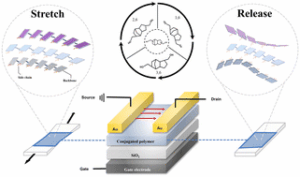
This study systematically compared the effects of stereo- and structurally selective/random, conjugated break spacers (CBSs) on the stretchability of conjugated polymers. The results showed that stereoselective and structurally selective CBS improved the regularity of polymer arrangement but negatively impacted film stretchability. Conversely, stereo-/structural random CBSs improved film stretchability by introducing free volume and reducing film crystallinity and regularity while maintaining interfacial contact and impedance. Furthermore, we found that stereo/structural random CBSs resulted in high isotropic carrier mobility. Under cyclic stretching tests, the charge transport capability in the orthogonal stretching directions, as well as the ratio between them, were well maintained. This stress-stable film and interfacial charge transport are crucial for stretchable and wearable electronics, and represent an important characteristic that has been rarely explored and difficult to achieve in the past.
This study represents the representative work of the serial studies from our research group on intrinsically stretchable conjugated polymers. Recent developments have involved a series of CBS systems: linear alkyl, branched alkyl, heteroatom incorporation, and heterocyclic epimers. This paper, using stereo/structural random systems, has gradually guided our research and has shown that polycyclic CBS mixtures can effectively maintain the stretchability of conjugated polymers and even achieve isotropic stretching mobility. This is a significant breakthrough and will open the door for our subsequent development of CBS systems using polycyclic isomers in intrinsically stretchable conjugated polymers.
Meet the authors
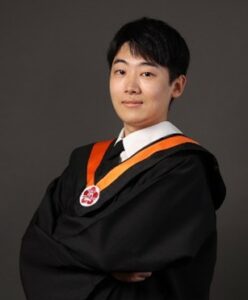
Ming-Han Chen
Ming-Han Chen is an M.S. student in the Department of Chemical Engineering at National Cheng Kung University. He received his B.S. from National Cheng Kung University and joined Prof. Yan-Cheng Lin’s research group in 2024. His research interests focus on developing intrinsically stretchable conjugated polymers for field-effect transistor applications. He contributed to a series of studies on the design of functional groups and conjugation breakers in naphthalene-diimide-based N-type conjugated polymers.

Yan-Cheng Lin
Yan-Cheng Lin is an assistant professor at National Cheng Kung University in the Department of Chemical Engineering. He has published 150 refereed papers, five review papers, and three book chapters. His research interests include conjugated polymers for field-effect, photonic, and electrochemical transistors, and polycondensation for biobased, high-frequency insulating, and ion-exchange membranes. These studies contributed to the development of polymer design and synthesis for soft optoelectronics, mixed ionic–electronic conductors, low-carbon-emission polymer alternatives, flexible printed circuits, photoresists, and membranes for electrolysis and flow battery applications.
N-type semiconducting polymers with an improved isotropic mobility–stretchability stability by using structural isomers as conjugation break spacers
Ming-Han Chen, Yu-Chun Huang, Fu-En Szu, Jung-Yao Chen, Man-kit Leung and Yan-Cheng Lin
RSC Appl. Interfaces, 2025,2, 1784-1798. DOI: 10.1039/D5LF00196J
RSC Applied Interfaces is a dedicated, interdisciplinary reference journal for cutting-edge research on the applications of surfaces and interfaces. In addition to the applied focus, work considered for publication in RSC Applied Interfaces is expected to be highly original and of top quality. The journal seeks to report major scientific advances beyond the state of the art, at the cutting edge of this interdisciplinary field.