Archive for November, 2011

HOT: a micro-hydrocyclone for particle separation and sustainable microinjection moulding

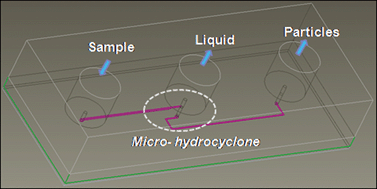
Hydrocyclones are widely used in industries such as petrochemicals and mining for the separation of particulates from fluids at the macro- and mesoscale.  This is the first report of microscale hydrocyclone, tested on polystyrene microbeads suspended in PBS, providing continuous separation with exceptional flow rates and without clogging.  Microfluidic applications potentially include chemical analysis, materials research, point-of-care and blood sample preparation.

Microfluidic device based on a micro-hydrocyclone for particle–liquid separation
P. Bhardwaj, P. Bagdi and A. K. Sen
DOI: 10.1039/C1LC20606K
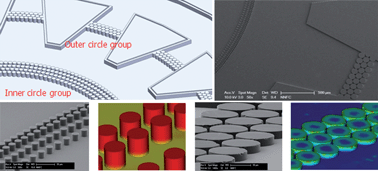

Cyclic olefin copolymer has been used to create a whole microfluidic device through microinjection moulding with the aim of bridging the gap between lab techniques and mass production of lab on a chip devices.  The team that successfully developed the platform have also come up with a dimensionless number μf to provide an insight into the physics of microinjection moulding.

Sustainable fabrication of micro-structured lab-on-a-chip
Hwa Jin Oh, Jae Hong Park, Seok Jae Lee, Byeong Il Kim, Young Seok Song and Jae Ryoun Youn
DOI: 10.1039/C1LC20441F

Digg This
Reddit This
Stumble Now!
Share on Facebook
Bookmark this on Delicious
Share on LinkedIn
Bookmark this on Technorati
Post on Twitter
Google Buzz (aka. Google Reader)

Micro fuel cells for microchips

Micro fuel cells for microchips

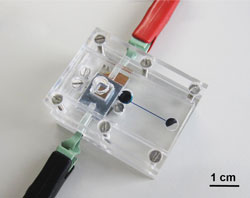
Microfluidic devices have been hailed as the technology that will revolutionise areas such as diagnostics in medicine, food safety, drug development and genetic sequencing since their conception in the late 1980s. However, a limiting factor in translating neat microfluidic ideas to practical, portable devices has been integrating all the necessary components. The microfluidic chip may be small and perfectly formed, but the power source, pumps and control electronics for sample analysis are often external, bulky components – existing in the macroscale rather than the microscale.

Now, a team led by Neus Sabaté at the Institute of Microelectronics of Barcelona has integrated a micro direct methanol fuel cell into a microfluidic platform, which is capable of producing up to 4mW, sufficient to power the device. The carbon dioxide produced as a by-product of the fuel cell reaction is used to push liquids through the microchannels, removing the need for an external pump. The team has shown that by controlling the fuel cell operating conditions, they can control the flow rate of the liquid, which bears an almost linear relationship to the current generated in the device.

Jonathan Cooper, an expert in lab-on-a-chip technologies from the University of Glasgow, UK, comments: ‘A real strength of this work is the excellent job the researchers have done in integrating and packaging the device to show a working prototype. The flow rates are high enough for devices to function for several minutes and the device offers the prospect of enabling autonomous functionality on chip.’

The next step for Sabaté is to show that the device can truly function independently. ‘We are trying to prove that we can indeed perform measurements on analytes by integrating a low power electronic chip module and amperometric sensors,’ she says.  Her team is also working on higher degrees of device integration by fabricating them from just one type of polymer and experimenting with different fuels such as glucose.

Fuel cell-powered microfluidic platform for lab-on-a-chip applications
Juan Pablo Esquivel, Marc Castellarnau, Tobias Senn, Bernd Löchel, Josep Samitier and Neus Sabaté
DOI: 10.1039/C1LC20426B

Read the original article in Chemistry World

Digg This
Reddit This
Stumble Now!
Share on Facebook
Bookmark this on Delicious
Share on LinkedIn
Bookmark this on Technorati
Post on Twitter
Google Buzz (aka. Google Reader)

Lab on a Chip now publishing Accepted Manuscripts

Lab on a Chip now offers you the chance to publish your accepted article as an Accepted Manuscript. This means that your research is available, in citable form, to the community even more rapidly. Find out more

Digg This
Reddit This
Stumble Now!
Share on Facebook
Bookmark this on Delicious
Share on LinkedIn
Bookmark this on Technorati
Post on Twitter
Google Buzz (aka. Google Reader)

HOT articles: broadband for droplets, clinical-scale bubble production and streaming potential for energy

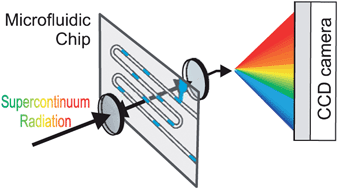
Broadband cavity-enhanced absorption spectroscopy has been used to increase the effective optical pathlengths in optical detection applied to microfluidic systems.  The BBCEAS method was capable of in situ analyte detection quickly (273 Hz/3.66 ms acquisition time) and with high sensitivity (αmin < 10−2 cm−1).

Broadband cavity-enhanced absorption spectroscopy for real time, in situ spectral analysis of microfluidic droplets
Simon R. T. Neil, Cathy M. Rushworth, Claire Vallance and Stuart R. Mackenzie
DOI: 10.1039/C1LC20854C


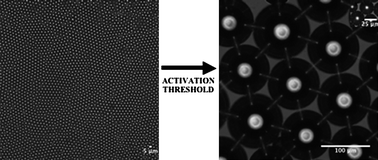
The production of clinical-scale quantities of droplet emulsions for in vivo therapy uses, such as gas embolotherapy, has been achieved by researchers from the universities of California and North Carolina.  Highly monodisperse liquid perfluoropentane droplets in the 3–6 μm range necessary for clinical phase-change droplets were produced at rates exceeding 105 droplets per second.

High-speed, clinical-scale microfluidic generation of stable phase-change droplets for gas embolotherapy
David Bardin, Thomas D. Martz, Paul S. Sheeran, Roger Shih, Paul A. Dayton and Abraham P. Lee
DOI: 10.1039/C1LC20615J


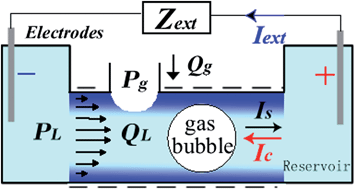
The power generated by streaming potential from multiphase flow has been improved by the use of two phase flow in a microscale system.  A two phase microfluidic system, which converts mechanical energy to electrical energy, was devised and the addition of bubbles to the device produced a significant increase in the power and energy conversion over a single phase system.

Strong enhancement of streaming current power by application of two phase flow
Yanbo Xie, John D. Sherwood, Lingling Shui, Albert van den Berg and Jan C. T. Eijkel
DOI: 10.1039/C1LC20423H

Digg This
Reddit This
Stumble Now!
Share on Facebook
Bookmark this on Delicious
Share on LinkedIn
Bookmark this on Technorati
Post on Twitter
Google Buzz (aka. Google Reader)