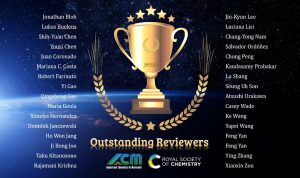
In 2025, reviewers from 39 countries and regions generously contributed their time and expertise to Industrial Chemistry & Materials (ICM), collectively supporting the journal in advancing the internationalization, fairness, and transparency of the peer-review process. Based on the quantity, quality, and timeliness of reviews, ICM is pleased to recognize 2025 Outstanding Reviewers for their exceptional contributions. We sincerely thank them for their dedication in upholding the scientific rigor and integrity of the journal.
ICM 2025 Outstanding Reviewers:
Dr. Jonathan Bloh, DECHEMA-Forschungsinsitut, Germany, ORCID 0000-0002-3814-1875
Dr. Lukas Buelens, Ghent University, Belgium, ORCID 0000-0002-4896-1498
Dr. Shih-Yuan Chen, National Institute of Advanced Industrial Science and Technology (AIST), Japan, ORCID 0000-0002-7093-2511
Dr. Yousi Chen, Dalian University of Technology, China, ORCID 0000-0002-9087-235X
Dr. Juan Coronado, Instituto de Catalisis y Petroleoquimica, Spain, ORCID 0000-0003-1919-8371
Prof. Mariana Conceicao da Costa, Universidade Estadual de Campinas, Brazil, ORCID 0000-0003-1710-7202
Prof. Robert Farrauto, Columbia University, United States, ORCID 0000-0001-8127-1424
Prof. Qingsheng Gao, Jinan University, China, ORCID 0000-0002-4273-8500
Dr. Yi Gao, Shanghai Advanced Research Institute, Chinese Academy of Sciences , China, ORCID 0000-0001-6015-5694
Prof. Maria Goula, University of Western Macedonia, Greece, ORCID 0000-0002-6188-4095
Prof. Simelys Hernandez, Politecnico di Torino, Italy, ORCID 0000-0002-6722-0273
Prof. Dominik Janczewski, Warsaw University of Technology, Poland, ORCID 0000-0002-5466-6444
Prof. Ho Won Jang, Seoul National University, South Korea, ORCID 0000-0002-6952-7359
Prof. Ji Bong Joo, Konkuk University, South Korea, ORCID 0000-0002-4950-6278
Prof. Taku Kitanosono, The University of Tokyo, Japan, ORCID 0000-0003-0743-1420
Prof. Rajamani Krishna, Universiteit van Amsterdam, Netherlands, ORCID 0000-0002-4784-8530
Prof. Jin-Kyun Lee, Inha University, South Korea, ORCID 0000-0001-9468-5749
Dr. Luciana Lisi, Consiglio Nazionale delle Ricerche, Italy, ORCID 0000-0002-7837-4294
Prof. Chang-Yong Nam, Brookhaven National Laboratory, United States, ORCID 0000-0002-9093-4063
Prof. Salvador Ordóñez, University of Oviedo, Spain, ORCID 0000-0002-6529-7066
Prof. Chong Peng, Dalian University of Technology, China, ORCID 0000-0002-0593-3083
Prof. Kandasamy Prabakar, Pusan National University, South Korea, ORCID 0000-0001-7582-0765
Prof. Lu Shang, Nanjing University of Science and Technology, China, ORCID 0000-0001-5701-5017
Prof. Seung Uk Son, Sungkyunkwan University, South Korea, ORCID 0000-0002-4779-9302
Prof. Atsushi Urakawa, Delft University of Technology, Netherlands, ORCID 0000-0001-7778-4008
Prof. Casey Wade, Ohio State University, United States, ORCID 0000-0002-7044-9749
Dr. Ke Wang, Institute of Process Engineering, Chinese Academy of Sciences, China, ORCID 0000-0003-4508-1302
Prof. Yapei Wang, Renmin University of China, China, ORCID 0000-0001-5420-0364
Prof. Feng Yan, Southern University of science and Technology, China, ORCID 0000-0002-9603-2968
Prof. Feng Yan, Soochow University, China, ORCID 0000-0001-9269-7025
Prof. Ying Zhang, University of Science and Technology of China , China, ORCID 0000-0003-2519-7359
Prof. Xiaoxin Zou, Jilin University, China, ORCID 0000-0003-4143-9274
We warmly congratulate the ICM 2025 Outstanding Reviewers and sincerely thank them for their continued support and invaluable contributions!

Contact us: icm@rsc.org
Visit our website: rsc.li/icm
Find all the latest developments, research and news from across our portfolio on X, LinkedIn, and sign-up to our e-alerts.
Comments Off on Celebrating the 2025 Outstanding Reviewers of Industrial Chemistry & Materials















 Contact us:
 Suojiang Zhang, Professor at the Institute of Process Engineering (IPE), Chinese Academy of Sciences (CAS), President of Henan University, China. He is a leading scientist in ionic liquids (ILs) and green chemical engineering who was elected as a Member of Chinese Academy of Sciences in 2015 and Fellow of the Canadian Academy of Engineering in 2024. He has published over 700 papers in Chemical Reviews, Nature Communications, Angewandte Chemie, Advanced Materials, AIChE Journal, Chemical Engineering Journal, etc., with 40,543 citations and an h-index of 97, 11 books, and 8 chapters. He holds 291 patents, including 6 United States of America/Japan patents. He has developed over 10 IL-based green technologies with successful industrial applications, such as the world’s first 200,000 t/a IL-catalyzed CO2 to dimethyl carbonate industry plant. He is a member of the Chinese Academy of Sciences and has received the TWAS Award in Chemistry, the Ho Leung Ho Lee Foundation Science and Technology Progress Award, and the 2nd Class Award for National Natural Science of China. As head of the CAS–TWAS Centre of Excellence for Green Technology and the International Green Technology Alliance, he has cultivated over 50 graduate students from Pakistan, India, Nigeria, etc., contributing greatly to exchanges and cooperation with developing countries.
 Contact us: