
We are delighted to introduce our new series of Tutorial Reviews!
Tutorial Reviews are designed to introduce readers to a concept or methodology at the forefront of inorganic chemistry research and should particularly appeal to early career researchers as well as established researchers seeking new fields to explore.
Our Tutorial reviews will include a ‘key learning points’ box, highlighting up to five points that a reader should expect to gain from reading the review.
See our published Tutorial Reviews below.
Spin-controlled electro- and photocatalysis: principles, modeling, and enhancement strategies (Open Access)
|
|
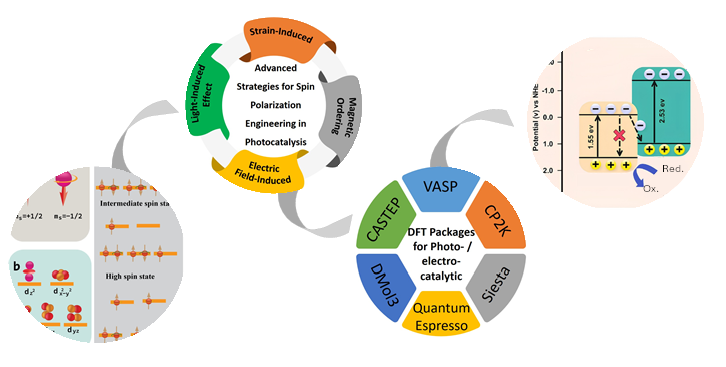
This tutorial reviews electron-spin-based concepts, including spin polarization and its role in catalytic applications, the application of strain, the introduction of external electric fields, and the integration of multiple control techniques. Additionally, the tutorial discusses advanced exchange–correlation approaches, including GGA, LDA+U, and hybrid functionals such as HSE, which improve the accuracy of band gap calculations and enable a more reliable description of spin polarization, magnetic ordering, and spin-dependent electronic structures.
Saeedeh Mohammadi,* Masoud Shahrokhi, Şükrü Kaya and Dalton Trans. (2026) 10.1039/d6dt00917d |
Using peak shift analysis to elucidate proton-coupled electron transfer mechanisms and kinetics for cobalt hydride formation (Open Access)
|
|
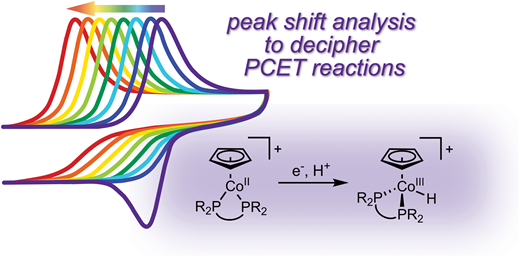
This tutorial outlines approaches to probe the mechanisms of proton-coupled electron transfer reactions that form metal hydride complexes, integrating electrochemical and computational methods to provide insights that guide catalyst design.
Ana Sonea and Jillian L. Dempsey* Dalton Trans. (2026) 10.1039/d6dt00711b |
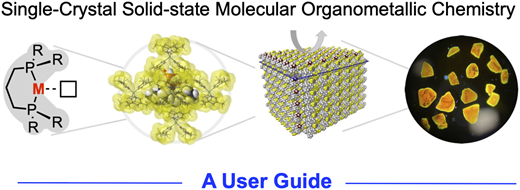 |
This tutorial review provides a practical guide for solid/gas in crystallo solid-state molecular organometallic chemistry (SMOM).
Kristof M. Altus,* Samantha K. Furfari, Joe C. Goodall, Matthew R. Gyton, Jack H. Heaton, Chloe L. Johnson, Alasdair I. McKay, Mads Sondrup Møller, Sebastian D. Pike, Andrew S. Weller* |
Spontaneous assemblies of gigantic polyoxomolybdates; from structure and properties to synthetic methods (Open Access)
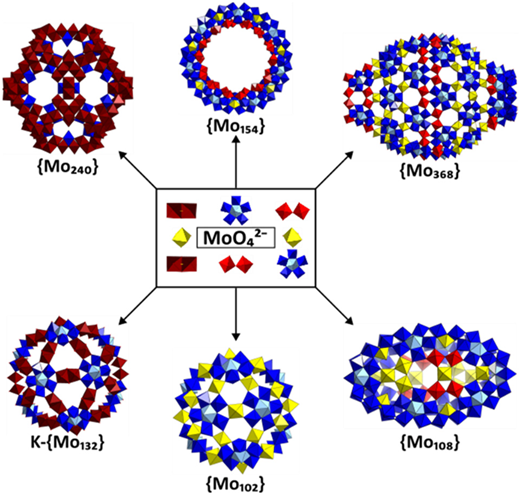 |
Gigantic polyoxomolybdates, dominated by the Molybdenum Blue (MB) family, constitute a key subclass of polyoxometalates (POMs) and play a role in elucidating structural construction principles and showcasing the diversity of POM architectures.
Vishal Lakhanpal, De-Liang Long, Leroy Cronin* Dalton Trans. (2026) 55 (16): 6237–6252. 10.1039/d5dt03084f
|
A practical guide to measuring and reporting photophysical data (Open Access)
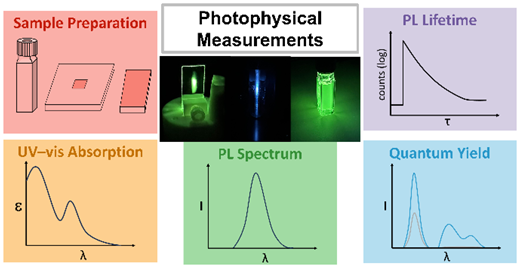 |
This tutorial provides practical recommendations for measuring and reporting photophysical data, including both experimental considerations and best practices for presenting the data in published work.
Vinh Q. Dang, Thomas S. Teets* Dalton Trans. (2025) 54 (44): 16268–16284. 10.1039/d5dt02095f |
Fluorescence spectroscopy: detection and sensing of SO2 and H2S using MOFs and other emerging porous materials (Open Access)
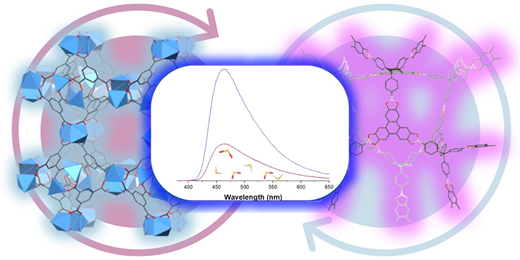 |
MOFs and other advanced emerging porous materials (i.e., COFs, POCs) have demonstrated tuneable structural and photoluminescent features, which can be helpful to monitor highly toxic SO2 and H2S pollutants using fluorescence spectroscopy techniques.
Marco L. Martínez, Pablo Marín-Rosas, Valeria B. López-Cervantes, Ariel Guzmán-Vargas, Ricardo A. Peralta,* Diego Solis-Ibarra,* Ilich A. Ibarra* Dalton Trans. (2025) 54 (37): 13806–13819. 10.1039/d5dt01521a |
Assessment methods for identifying suitable charge carriers for non-aqueous redox flow batteries
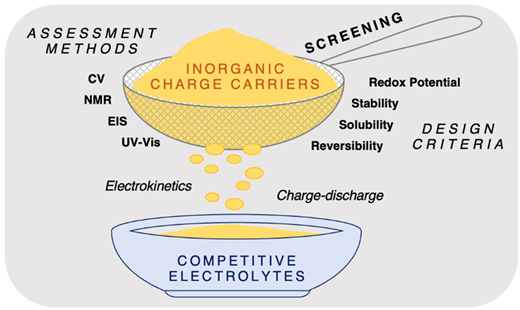 |
This tutorial-review describes a systematic framework for selecting suitable electrolytes to improve the efficiency of resulting non-aqueous redox flow batteries.
Dalton Trans. (2025) 54 (26): 10164–10177.
10.1039/d5dt00830a
|







![[double bond, length as m-dash]](https://www.rsc.org/images/entities/char_e001.gif) Ir multiple bonds
Ir multiple bonds