Archive for the ‘Reviews’ Category

Perspective: Ann Valentine reviews the bioinorganic chemistry of sea squirts

This week’s issue of Dalton Transactions contains an excellent review from Ann Valentine, of Yale University.

Her perspective article focuses on the how the ascidians, which are marine invertebrates commonly known as sea squirts, control how metals like vanadium, titanium and iron react in water.

The sea squirts are amazing creatures that have an unparalleled ability to keep high concentrations of vanadium in their cells, and are an excellent way of studying biological control over inorganic coordination chemistry.

Read the full review to find out more about these fascinating organisms…

The challenges of trafficking hydrolysis prone metals and ascidians as an archetype
Jean P. Gaffney and Ann M. Valentine
Dalton Trans., 2011, 40, 5827-5835

Want to know more about sea squirts? Look at the Encyclopedia of Marine Life of Britain and Ireland.

Digg This
Reddit This
Stumble Now!
Share on Facebook
Bookmark this on Delicious
Share on LinkedIn
Bookmark this on Technorati
Post on Twitter
Google Buzz (aka. Google Reader)

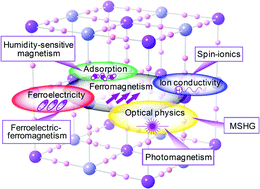
Perspective: Multi-functional magnets with Prussian blue analogs

In this Dalton Transactions Perspective, Shin-ichi Ohkoshi and Hiroko Tokoro discuss cyano-bridged bimetal assemblies (particularly Prussian blue analogs) that demonstrate novel magnetic functionalities.  Charge-transfer phase transitions, reversible photomagnetism, second harmonic generation along with magnetization-induced second harmonic generation, ferroelectric ferromagnetism, humidity-sensitive magnetism, high ionic conductivity, and a coupling effect (termed spin-ionics) between ionic conduction and magnetic ordering within Prussian blue analogs is described.

Prussian blue analogs have been intensively studied due to (i) their flexible structure, which meet conditions for charge-transfer, photoinduced change, and absorption and desorption of water, and (ii) the strong exchange coupling of the magnetic centers through cyano-bridged ligands.

To find out more about this fascinating area, read for free until 29th April here.

Novel magnetic functionalities of Prussian blue analogs
Hiroko Tokoro and Shin-ichi Ohkoshi
Dalton Trans., 2011, Advance Article, DOI: 10.1039/C0DT01829E

Digg This
Reddit This
Stumble Now!
Share on Facebook
Bookmark this on Delicious
Share on LinkedIn
Bookmark this on Technorati
Post on Twitter
Google Buzz (aka. Google Reader)

Dalton Transactions issue 14

Dalton Transactions issue 14 is now available online

The outside cover article features a Perspective by Mahdi M. Abu-Omar and descibes how manganese(V) imido complexes of 5,10,15-tris(pentafluorophenyl)corrole (H3tpfc) can be prepared by the reaction of MnIII(tpfc) and organic nitrene generated from either photolytic or thermal activation of organic azides.

Read more about the cover article at:
High-valent iron and manganese complexes of corrole and porphyrin in atom transfer and dioxygen evolving catalysis.
Mahdi M. Abu-Omar
Dalton Trans., 2011, 40, 3435-3444
DOI: 10.1039/C0DT01341B, Perspective

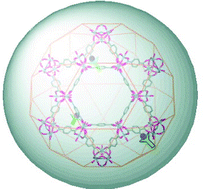
The inside cover features research by the Braunschweig group in Germany on the reactivity of a platinum-substituted borirene.

For the full story read in more depth at:
Reactivity of a platinum-substituted borirene
Holger Braunschweig, Qing Ye, Krzystof Radacki and Thomas Kupfer
Dalton Trans., 2011, 40, 3666-3670
DOI: 10.1039/C0DT01694B

Digg This
Reddit This
Stumble Now!
Share on Facebook
Bookmark this on Delicious
Share on LinkedIn
Bookmark this on Technorati
Post on Twitter
Google Buzz (aka. Google Reader)

Perspective: Microwave synthesis of MOFs

Microwave synthesis of MOFs

Microwave heating used in organic chemistry for decades has only recently been applied to Metal–Organic Frameworks (MOF). 
 
In this Dalton Transactions Perspective, Klinowski and co-workers clearly describe the advantages of using microwave synthesis to prepare a range of coordination network materials: short reaction times, fast kinetics of crystal nucleation and growth, and high yields of desirable products which can be isolated with few or no secondary products.  The growth of nano-sized crystallites which may find direct applications in functional devices is highlighted.

Read more at:

Microwave-Assisted Synthesis of Metal–Organic Frameworks  Jacek Klinowski, Filipe A. Almeida Paz, Patrícia Silva and João Rocha
Dalton Trans., 2011, 40, 321-330
DOI: 10.1039/C0DT00708K, Perspective

Digg This
Reddit This
Stumble Now!
Share on Facebook
Bookmark this on Delicious
Share on LinkedIn
Bookmark this on Technorati
Post on Twitter
Google Buzz (aka. Google Reader)

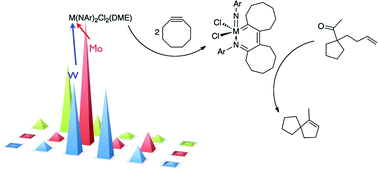
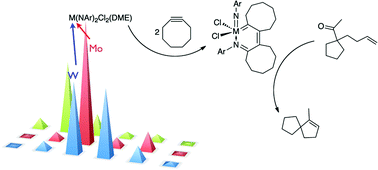
Perspective: Conversions between metal–ligand multiple bond types

In this Dalton Transactions Perspective, Aaron Odom from Michigan State University examines single-step methods for the conversion of one type of metal-ligand multiple bond to another. These reactions have a wide variety of applications in organic synthesis, e.g. in carbonyl olefination.

The Perspective includes recent examples from the author’s own laboratory on metallacycles prepared directly from an imido ligand.

Read more: Conversions between metal-ligand multiple bond (MLMB) types: carbonyl olefination and other applications
Aaron L. Odom
Dalton Trans., 2011, Advance Article
DOI: 10.1039/C0DT00825G, Perspective

Digg This
Reddit This
Stumble Now!
Share on Facebook
Bookmark this on Delicious
Share on LinkedIn
Bookmark this on Technorati
Post on Twitter
Google Buzz (aka. Google Reader)