
Archive for the ‘News’ Category

Happy Easter from Dalton Transactions: Celebrating our themed issues

In celebration of Easter Dalton Transactions is highlighting our recent themed issues, published since the beginning of the year.

We are very proud of them, and would like to thank all the authors, referees and guest editors for making them so successful.

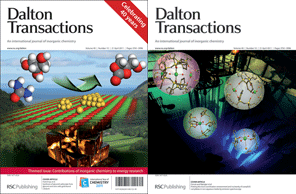
Contributions of inorganic chemistry to energy research

This themed issue, guest edited by Duncan Wass, University of Bristol and Neil Robertson, University of Edinburgh, showcases papers from the inorganic community that are working towards the development of technologies for the sustainable provision of energy.

Read the editorial to find out more about the importance of energy research in chemistry…

Fluorine Chemistry

This issue is a web themed issue bringing together research on fluorine chemistry from across RSCPublishing, in celebration of the tenth anniversary of the RSC Fluorine Interest group.

Read Veronique Gouverneur’s thoughts on the issue…

New Talent: Asia

This themed issue focuses on up and coming young researchers from Asia working in coordination and inorganic chemistry. Guest edited by Masahiro Yamashita, this issue really showcases the potential of our young authors.

Read the editorial to find out more about these rising stars…

Happy Easter!

Digg This
Reddit This
Stumble Now!
Share on Facebook
Bookmark this on Delicious
Share on LinkedIn
Bookmark this on Technorati
Post on Twitter
Google Buzz (aka. Google Reader)

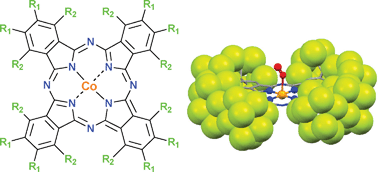
Dalton Transactions on Science Daily: Phthalocyanine catalysts

The recently published work of New Jersey Institute of Technology scientists in Dalton Transactions has been picked up by the website Science Daily.
Professor Sergiu M. Gorun original article on phthalocyanine catalysts can be viewed here:

Broadening the reactivity spectrum of a phthalocyanine catalyst while suppressing its nucleophilic, electrophilic and radical degradation pathways
Andrei Loas, Robert Gerdes, Yongyi Zhang and Sergiu M. Gorun
Dalton Trans., 2011, Advance Article
DOI: 10.1039/C1DT10458F, Communication

Read the Science Daily news story…

http://www.sciencedaily.com/releases/2011/04/110419151453.htm

Digg This
Reddit This
Stumble Now!
Share on Facebook
Bookmark this on Delicious
Share on LinkedIn
Bookmark this on Technorati
Post on Twitter
Google Buzz (aka. Google Reader)

Dalton Transactions Younger Researchers Symposium

A chance for networking and discussion!

A chance to meet fellow postgraduates and postdocs from the wider UK inorganic community this year at the Dalton Transactions Younger Researchers Symposium. The meeting, organised in associated with Johnson Matthey, is taking place in University of Warwick on 20-21 September 2011.

Registration for the symposium is FREE of charge and accommodation and the conference dinner cost comes to a mere £67 – a bargain indeed! Speakers include the 2010 Dalton Transactions Europe/Africa Lectureship Winner, Professor Karsten Meyer, Dr Erwin Reisner and Dr Michaele Hardie. More information available at the event webpage.
 
Register now!

Digg This
Reddit This
Stumble Now!
Share on Facebook
Bookmark this on Delicious
Share on LinkedIn
Bookmark this on Technorati
Post on Twitter
Google Buzz (aka. Google Reader)

Meet the team: 17th Rideal Conference, Cardiff

Jamie Humphrey, Dalton Transactions Editor

Dr Jamie Humphrey, Managing Editor of Dalton Transactions, CrystEngComm and Catalysis Science & Technology will be attending the 17th Rideal Conference, hosted by the Cardiff Catalysis Institute in the Cardiff School of Chemistry between April 19th 2011 and April 21st 2011.

If you are attending please get in touch, Jamie will be delighted to speak to you.

To find out more about the Rideal conference visit their website:

http://www.rideal.cf.ac.uk/index.html

Find out what other conferences members of the Editorial Offices will be attending.

Digg This
Reddit This
Stumble Now!
Share on Facebook
Bookmark this on Delicious
Share on LinkedIn
Bookmark this on Technorati
Post on Twitter
Google Buzz (aka. Google Reader)

Dalton Transactions Issue 17

Dalton Transactions issue 17 is now available.


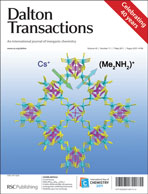
The outside cover article features work by Jian-Rong Li and Xiao-Ying Huang from the Chinese Academy of Sciences.

They prepared a microporous chalcogenide via solvothermal synthesis. The compound is a 3D open framework that exhibits framework flexibility upon cation exchange.

Read the cover article:
[(Me)2NH2]0.75[Ag1.25SnSe3]: A three-dimensionally microporous chalcogenide exhibiting framework flexibility upon ion-exchange
Jian-Rong Li and Xiao-Ying Huang
Dalton Trans., 2011, 40, 4387–4390
DOI: 10.1039/C0DT01381A


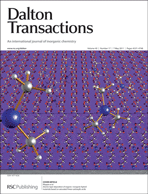
The inside cover article is by Karina Barnholt Klepper and colleagues from the University of Oslo who produced thin films of organic–inorganic hybrid materials by atomic layer deposition.

The films are based on saturated linear carboxylic acids and trimethylaluminium and are stable in contact with water.

For more details see:
Atomic layer deposition of organic–inorganic hybrid materials based on saturated linear carboxylic acids
Karina Barnholt Klepper, Ola Nilsen, Per-Anders Hansen and Helmer Fjellvåg
Dalton Trans., 2011, 40, 4636–4646
DOI: 10.1039/C0DT01716G

Digg This
Reddit This
Stumble Now!
Share on Facebook
Bookmark this on Delicious
Share on LinkedIn
Bookmark this on Technorati
Post on Twitter
Google Buzz (aka. Google Reader)

Last chance to nominate! Dalton Transactions European/African Lectureship

Time is running out to nominate your colleagues for the Dalton Transactions European/African Lectureship 2011! Send your nominee’s details to the Dalton Transactions Editorial Office by 22nd April 2011.

Nominate now by sending us: a nomination letter, a letter seconding the nomination, a cv (maximum 5 pages) and a statement from the candidate (not more than one page) describing their most significant research contributions.

And remember, to be eligible for the Dalton Transactions European/African Lectureship, the candidate should be within the first 12 years of receiving their doctorate or equivalent degree. Find out more….

Digg This
Reddit This
Stumble Now!
Share on Facebook
Bookmark this on Delicious
Share on LinkedIn
Bookmark this on Technorati
Post on Twitter
Google Buzz (aka. Google Reader)

Dalton Transactions issue 16

Dalton Transactions issue 16 is now published online

Featuring the cover articles:

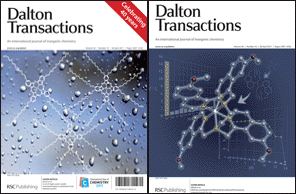
The outside front cover features three tetraethyleneglycol-substituted zinc phthalocyanines.  Their photophysical and photochemical properties, binding to plasma proteins and photocytotoxicity are investigated together with their potential as photodynamic therapy photosensitisers.
Read more ….
 
 
A set of highly water-soluble tetraethyleneglycol-substituted Zn(II) phthalocyanines: synthesis, photochemical and photophysical properties, interaction with plasma proteins and in vitro phototoxicity
Sinem Tuncel, Fabienne Dumoulin, Jürgen Gailer, Melani Sooriyaarachchi, Devrim Atilla, Mahmut Durmuş, Denis Bouchu, Huguette Savoie, Ross W. Boyle and Vefa Ahsen
Dalton Trans., 2011, 40, 4067-4079 DOI: 10.1039/C0DT01260B


The inside front cover features three methoxy-substituted 1-isoTQEN derivatives for use as fluorescent
zinc sensor molecules.  Read more about these and the implications for a molecular design strategy at…..

Methoxy-substituted isoTQEN family for enhanced fluorescence response toward zinc ion
Yuji Mikata, Azusa Yamashita, Keiko Kawata, Hideo Konno, Saori Itami, Keiko Yasuda and Satoshi Tamotsu

Dalton Trans., 2011, 40, 4059-4066
DOI:
10.1039/C0DT01617A

Digg This
Reddit This
Stumble Now!
Share on Facebook
Bookmark this on Delicious
Share on LinkedIn
Bookmark this on Technorati
Post on Twitter
Google Buzz (aka. Google Reader)

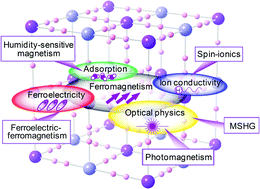
Perspective: Multi-functional magnets with Prussian blue analogs

In this Dalton Transactions Perspective, Shin-ichi Ohkoshi and Hiroko Tokoro discuss cyano-bridged bimetal assemblies (particularly Prussian blue analogs) that demonstrate novel magnetic functionalities.  Charge-transfer phase transitions, reversible photomagnetism, second harmonic generation along with magnetization-induced second harmonic generation, ferroelectric ferromagnetism, humidity-sensitive magnetism, high ionic conductivity, and a coupling effect (termed spin-ionics) between ionic conduction and magnetic ordering within Prussian blue analogs is described.

Prussian blue analogs have been intensively studied due to (i) their flexible structure, which meet conditions for charge-transfer, photoinduced change, and absorption and desorption of water, and (ii) the strong exchange coupling of the magnetic centers through cyano-bridged ligands.

To find out more about this fascinating area, read for free until 29th April here.

Novel magnetic functionalities of Prussian blue analogs
Hiroko Tokoro and Shin-ichi Ohkoshi
Dalton Trans., 2011, Advance Article, DOI: 10.1039/C0DT01829E

Digg This
Reddit This
Stumble Now!
Share on Facebook
Bookmark this on Delicious
Share on LinkedIn
Bookmark this on Technorati
Post on Twitter
Google Buzz (aka. Google Reader)

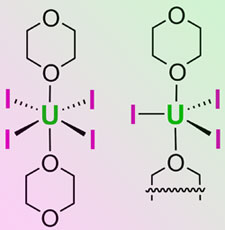
Precursor boost for uranium chemistry

This week Chemistry World reports how the study of uranium chemistry should become significantly easier thanks to researchers in the US who have discovered a simple way to make key precursors to a wide range of low valency uranium compounds.

A deep understanding of uranium chemistry is important not only for developing improved nuclear fuel cycles, but because the element has also shown promise in materials such as superconductors and catalysts. Uranium complexes are highly sensitive to water and air, but the only viable syntheses started from aqueous reactions of uranium oxides with harsh chlorinating reagents at high temperatures. Read more in Simon Hadlington’s Chemistry World story

See also Jackie’s recent ChemComm article reporting convenient access to thorium complexes.

Digg This
Reddit This
Stumble Now!
Share on Facebook
Bookmark this on Delicious
Share on LinkedIn
Bookmark this on Technorati
Post on Twitter
Google Buzz (aka. Google Reader)

Dalton Transactions issue 15: Contributions of inorganic chemistry to energy research

This themed issue Contributions of inorganic chemistry to energy research is now available online

With Guest editors Duncan Wass and Neil Robertson, this themed issue focuses on the inorganic chemistry that lies at the heart of many sustainable energy technologies, including  solar energy conversion, hydrogen storage, fuel cells, batteries, nuclear chemistry, biomass conversion, CO2 conversion and other aspects of catalysis for energy.

Check out the cover articles:

Synthesis of glycerol carbonate from glycerol and urea with gold-based catalysts
Ceri Hammond, Jose A. Lopez-Sanchez, Mohd Hasbi Ab Rahim, Nikolaos Dimitratos, Robert L. Jenkins, Albert F. Carley, Qian He, Christopher J. Kiely, David W. Knight and Graham J. Hutchings
Dalton Trans., 2011, 40, 3927-3937
DOI: 10.1039/C0DT01389G

Probing the local coordination environment and nuclearity of uranyl(VI) complexes in non-aqueous media by emission spectroscopy
Michael P. Redmond, Stephanie M. Cornet, Sean D. Woodall, Daniel Whittaker, David Collison, Madeleine Helliwell and Louise S. Natrajan
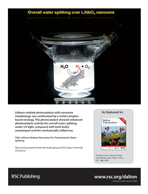
Lithium niobate nanowires for photocatalytic water splitting
Kenji Saito, Kazunori Koga and Akihiko Kudo
Dalton Trans., 2011, 40, 3909-3913
Digg This
Reddit This
Stumble Now!
Share on Facebook
Bookmark this on Delicious
Share on LinkedIn
Bookmark this on Technorati
Post on Twitter
Google Buzz (aka. Google Reader)