Archive for the ‘Hot Articles’ Category

Catalytic MOFs in a Click!

Metal Organic Frameworks (MOFs) have received a great deal of attention over the past fifteen years and have proved applicable in a variety of areas including gas storage, catalysis, gas purification and drug delivery. For catalysis, MOFs have been reported that can catalyze a range of organic transformations. By modifying the internal structure of  MOFs that allow them to interact with guest species, their chemical reactivity can be fine tuned.
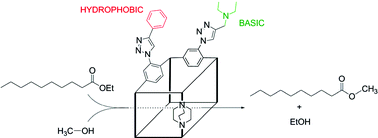
In this article Marie Savonnet et al. have post synthetically modified MOFs by using “click chemistry” for application in base catalysis. Basic catalyltic amino centres and lipophillic phenyl groups were successfully introduced into the  DMOF parent structure. These new functionalized MOFs are able to catalyse the transesterification of ethyldecanoate in methanol with good performance. The substrates were co-adsorbed into the MOF structure and from the presence of basic amino groups in the internal MOF structure, methanol can be activated for nucleophillic attack of the ethyldecanoate carbonyl group. This paper demonstrates that through rational design, MOF catalysts can be engineered with appropriate pore size and functionalities for a particular application.

To find out more about this Dalton Transactions Hot Article read the full paper

Tailoring metal-organic framework catalysts by click chemistry
Marie Savonnet, Aurélie Camarata, Jerome Canivet, Delphine Bazer-Bachi, Nicolas Bats, Vincent Lecocq, Catherine Pinel and David Farrusseng
Dalton Trans., 2012, Advance Article
DOI: 10.1039/C2DT11994C

Digg This
Reddit This
Stumble Now!
Share on Facebook
Bookmark this on Delicious
Share on LinkedIn
Bookmark this on Technorati
Post on Twitter
Google Buzz (aka. Google Reader)

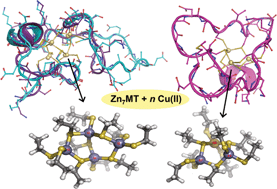
HOT Article: Shedding new light on Zn and Cu metallothionein clusters

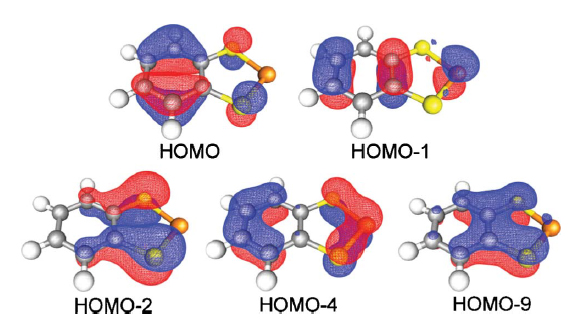
This HOT Article describes a computational study on Zn- and Cu-clusters with relevance for metallothioneins. It  shows promising results that may have important consequences for our understanding of the interaction between metal ions and metallothionein proteins.

Read more for FREE until 31st January 2012 at:

Metallothionein Zn2+– and Cu2+-clusters from first-principles calculations
Per Greisen, Jakob B. Jespersen and Kasper P. Kepp
Dalton Trans., 2012, Advance Article
DOI: 10.1039/C1DT11785H

Digg This
Reddit This
Stumble Now!
Share on Facebook
Bookmark this on Delicious
Share on LinkedIn
Bookmark this on Technorati
Post on Twitter
Google Buzz (aka. Google Reader)

Going Quaternary

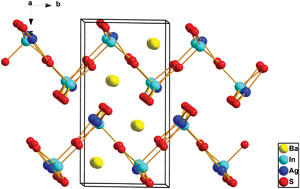
Multinary chalcogenides have been synthesised for decades, some of these structures have interesting magnetic, thermoelectric and optical properties. Many contain at least one alkali metal while there are relatively few containing alkaline earths, examples of the latter variety include BaM4Se7 (M = Al, Ga) and Ba5Ga4Se10.

Jiyong Yao et al. describe in their HOT article the synthesis of the first two members of the alkaline-earth/group XI/group XIII/chalcogen system, which is not only an interesting alkaline earth chalcogenide but also the first reported quaternary arrangement. The analogue Ba4LiGa5Se12 was also synthesised and the three new types of structure were fully characterized and the optical properties determined.

To find out more about this Dalton Transactions Hot Article read the full paper which is free to access for 4 weeks.

Ba2AgInS4 and Ba4MGa5Se12 (M = Ag, Li): syntheses, structures, and optical properties
Wenlong Yin, Kai Feng, Dajiang Mei, Jiyong Yao, Peizhen Fu and Yicheng Wu
Dalton Trans., 2012, Advance Article
DOI: 10.1039/C2DT11895E

Digg This
Reddit This
Stumble Now!
Share on Facebook
Bookmark this on Delicious
Share on LinkedIn
Bookmark this on Technorati
Post on Twitter
Google Buzz (aka. Google Reader)

Hot Article: Coordinatively unsaturated iridium clusters

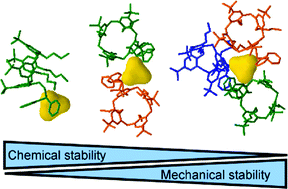
Enzymes are able to stabilize metal clusters in an accessible and coordinatively unsaturated state, which allows them to control of adsorption and catalysis at the metal cluster site using an organic–ligand approach. However, the structural features that allow enzymes to achieve such high degrees of coordinative unsaturation remain unknown.

Alexander Katz and his group from UC Berkeley make steps towards determining this by making new stable coordinatively unsaturated iridium clusters in solution and finding out the factors that control their stability. The team use calix[4]arene phosphine ligands to stabilize decarbonylated Ir4 clusters and prevent their aggregation. You can find out whether the groups have solved the enzyme metal cluster puzzle by reading their Hot Article in Dalton Transactions.

The Hot Article is free to access until 31st January 2012:

Stabilization of coordinatively unsaturated Ir4 clusters with bulky ligands: a comparative study of chemical and mechanical effects
Alexander Okrut, Oz Gazit, Namal de Silva, Rita Nichiporuk, Andrew Solovyov and Alexander Katz
Dalton Trans., 2012, DOI: 10.1039/C1DT11734C

Digg This
Reddit This
Stumble Now!
Share on Facebook
Bookmark this on Delicious
Share on LinkedIn
Bookmark this on Technorati
Post on Twitter
Google Buzz (aka. Google Reader)

Probing the invisible

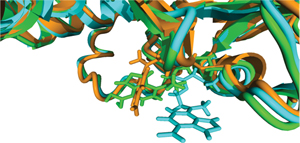
Cytochrome P450 are an enzyme superfamily with a diverse range of functions and are particularly interesting in pharmaceutical, bioanalytical and environmental applications. They are able to metabolise drugs, degrade toxins and catalyse reactions for valuable products. Looking for new substrates which are active with P450 is a very active area of research however determining if a new substrate has reacted isn’t always easy.

There are known substrates for Cytochrome P450 BM3 which do not induce a spin shift on the heme iron, making the reaction undetectable by UV-vis. Expensive and time consuming assays with cofactors and LC-MS studies is one option but Gianfranco Gilardi et al. have developed a fluorescence probe which indicates binding for both physiological and non-physiological substrates and can be used to determine dissociation constants.

To find out more read the full Hot Article which is free to access for 4 weeks.

Fluorescence detection of ligand binding to labeled cytochrome P450 BM3
Valentina E. V. Ferrero, Giovanna Di Nardo, Gianluca Catucci, Sheila J. Sadeghi and Gianfranco Gilardi
Dalton Trans., 2012, Advance Article
DOI: 10.1039/C1DT11437A

Digg This
Reddit This
Stumble Now!
Share on Facebook
Bookmark this on Delicious
Share on LinkedIn
Bookmark this on Technorati
Post on Twitter
Google Buzz (aka. Google Reader)

POMs away! Investigating rotational isomerism in POMs

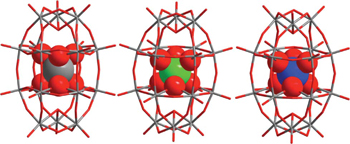
Polyoxometalates (POMs) are an outstanding family of compounds, well known for their huge structural diversity, interesting catalytic activities and rich electrochemistry. POMs are comprised of metal oxide building blocks with a general formula {MOx}n.

Lee Cronin and his team have a long association with the study of these exciting structures and in their recent Hot Article in Dalton Transactions this team takes a look at the rotational isomerism of the non-classical Wells–Dawson POMs. The group combine their theoretical investigation with ESI-MS to connect theory to experimental results. In doing so they determine the general stability trend of these types of POMs. Find out more by reading the article itself which is free to access until the 31st January 2012.

Exploring the rotational isomerism in non-classical Wells–Dawson anions {W18X}: a combined theoretical and mass spectrometry study
Laia Vilà-Nadal, Scott G. Mitchell, De-Liang Long, Antonio Rodríguez-Fortea, Xavier López, Josep M. Poblet and Leroy Cronin
Dalton Trans., 2012, DOI: 10.1039/C2DT11919F

Digg This
Reddit This
Stumble Now!
Share on Facebook
Bookmark this on Delicious
Share on LinkedIn
Bookmark this on Technorati
Post on Twitter
Google Buzz (aka. Google Reader)

Lighting the way

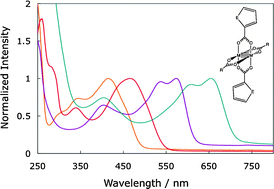
Light emitting diodes provide an efficient form of lighting while solar cells give us energy from sunlight. Thienyl carboxylates attached to MM quadruple bonds have shown interesting photophysical properties with potential applications in these areas. Malcolm Chisholm et al. discuss in their Hot Article the electronic properties of four new compounds which are based on Mo and W complexes bound to 5 membered heterocycles containing either O or Se.

The authors thoroughly characterize the complexes, computationally calculate the electronic structures, examine the electronic absorption spectra and steady state emission spectra, use transient absorption spectroscopy and electrochemical studies. The results are very interesting and indicate these complexes may have potential in solar cells given their different electronic states.

For full details of the investigation you can access the full article for free for 4 weeks

Furan- and selenophene-2-carboxylato derivatives of dimolybdenum and ditungsten (MM): a comparison of their chemical and photophysical properties
Samantha E. Brown-Xu, Malcolm H. Chisholm, Judith C. Gallucci, Yagnaseni Ghosh, Terry L. Gustafson and Carly R. Reed
Dalton Trans., 2012, Advance Article
DOI: 10.1039/C1DT11889G, Paper

Digg This
Reddit This
Stumble Now!
Share on Facebook
Bookmark this on Delicious
Share on LinkedIn
Bookmark this on Technorati
Post on Twitter
Google Buzz (aka. Google Reader)

Biocompatible Ir(III) complex photoluminescence

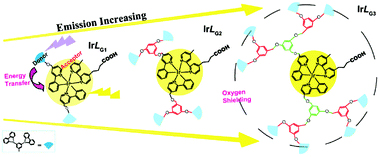
Photoluminescent substances have many applications including dopants for organic light-emitting diodes (OLEDs), luminescent bio-labeling reagents, photocatalysts and chemosensors for oxygen. Cyclometalated Ir(III) complexes are particularly interesting in this capacity as they have high photochemical stability, high quantum efficiencies and a broad range of emission properties that allow their luminescence to span from near infra-red to blue light. Yanfang Li, Yang Liu and Ming Zhou prepare and characterize a dendritic FRET donor–acceptor system with cationic Ir(III) complex core in their Hot Article in Dalton Transactions. Their biocompatible system displays efficient photoluminescence of the Ir(III) complexes via a FRET pathway and the luminophore core is protected from quenching by molecular oxygen under the photo excitation.

Read the full article which is free to access for 4 weeks

Synthesis and properties of a dendritic FRET donor–acceptor system with cationic iridium(III) complex core and carbazolyl periphery
Yanfang Li, Yang Liu and Ming Zhou
Dalton Trans., 2012, Advance Article
DOI: 10.1039/C1DT11716E

Digg This
Reddit This
Stumble Now!
Share on Facebook
Bookmark this on Delicious
Share on LinkedIn
Bookmark this on Technorati
Post on Twitter
Google Buzz (aka. Google Reader)

HOT Article: Pd(0) catalyst precursors

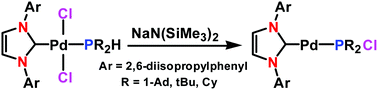
This HOT Article presents the facile synthesis of Pd(0) complexes that could be utilized as catalyst precursors.  The weak donor power of the PR2Cl ligand may make this route a simple entry to the reactive “Pd(NHC)” moiety for catalysis applications.

Read more for FREE until the 9th January 2012 at:

Generation of [(IPr)Pd(PR2Cl)] complexes via P–Cl reductive elimination
Bennett J. Tardiff, Kevin D. Hesp, Michael J. Ferguson and Mark Stradiotto
Dalton Trans., 2012, Advance Article
DOI: 10.1039/C1DT11910A

Digg This
Reddit This
Stumble Now!
Share on Facebook
Bookmark this on Delicious
Share on LinkedIn
Bookmark this on Technorati
Post on Twitter
Google Buzz (aka. Google Reader)

Are there anymore phosphenium “free” ions?


The title of the ‘Hot Article’ by John Slattery and Sharifa Hussein quite succinctly describes their research ‘How Lewis acidic is your cation? Putting phosphenium ions on the fluoride ion affinity scale’. The authors calculated the fluoride ion affinities (FIA’s) using ab initio and DFT methods to find out the relative Lewis acidities of over thirty phosphenium ions with a range of substituents, while I wouldn’t want to spoil the paper by giving away the reactivity series I will report that the authors noted there is “some hope that phosphenium ions that are currently unknown as “free” ions may yet be isolable without recourse to mesomeric stabilisation”.

Read the full article which is free to access for 4 weeks

How Lewis acidic is your cation? Putting phosphenium ions on the fluoride ion affinity scale
John M. Slattery and Sharifa Hussein
Dalton Trans., 2012, Advance Article
DOI: 10.1039/C1DT11636C

Digg This
Reddit This
Stumble Now!
Share on Facebook
Bookmark this on Delicious
Share on LinkedIn
Bookmark this on Technorati
Post on Twitter
Google Buzz (aka. Google Reader)