

Archive for the ‘Open calls’ Category

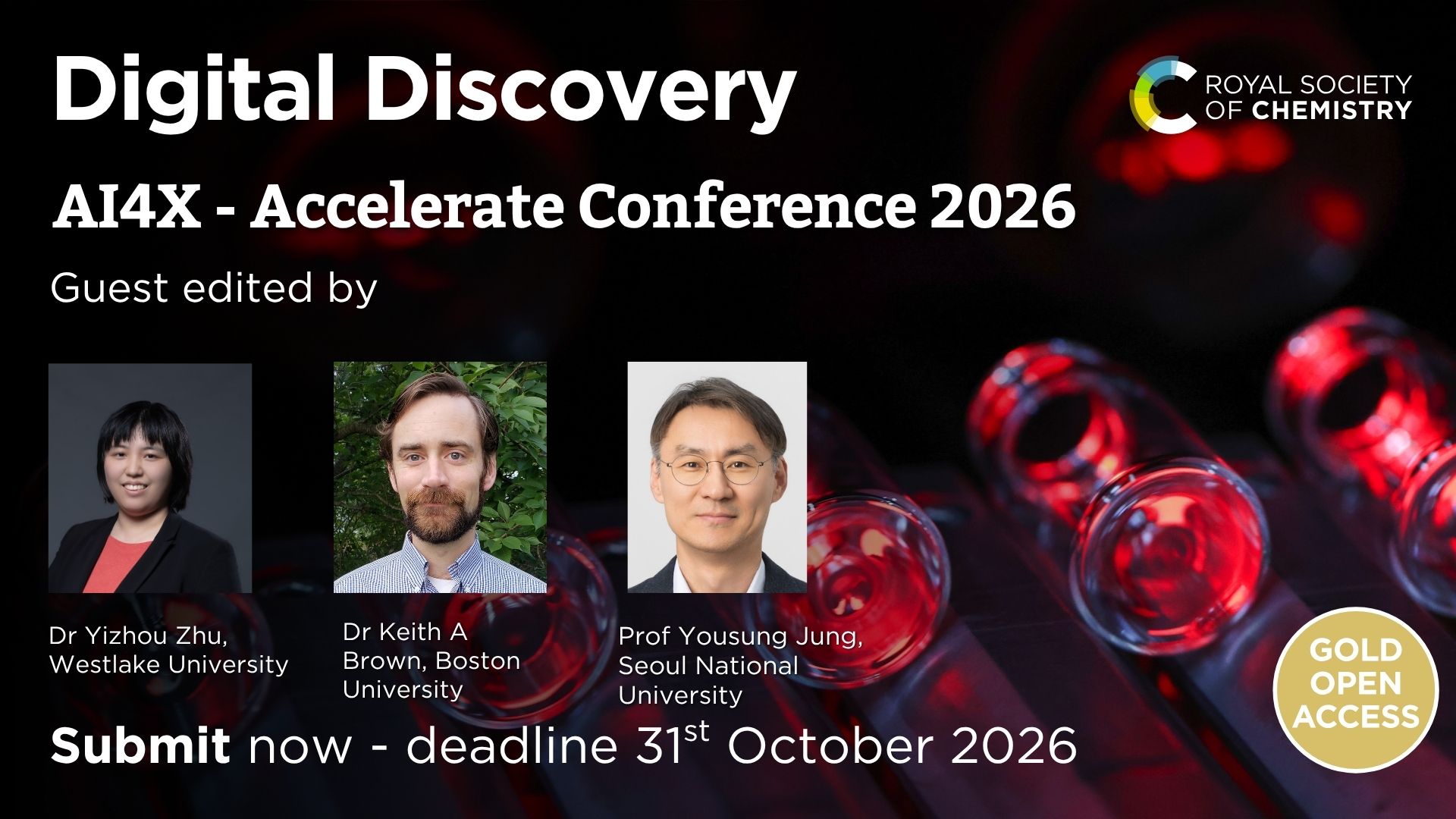
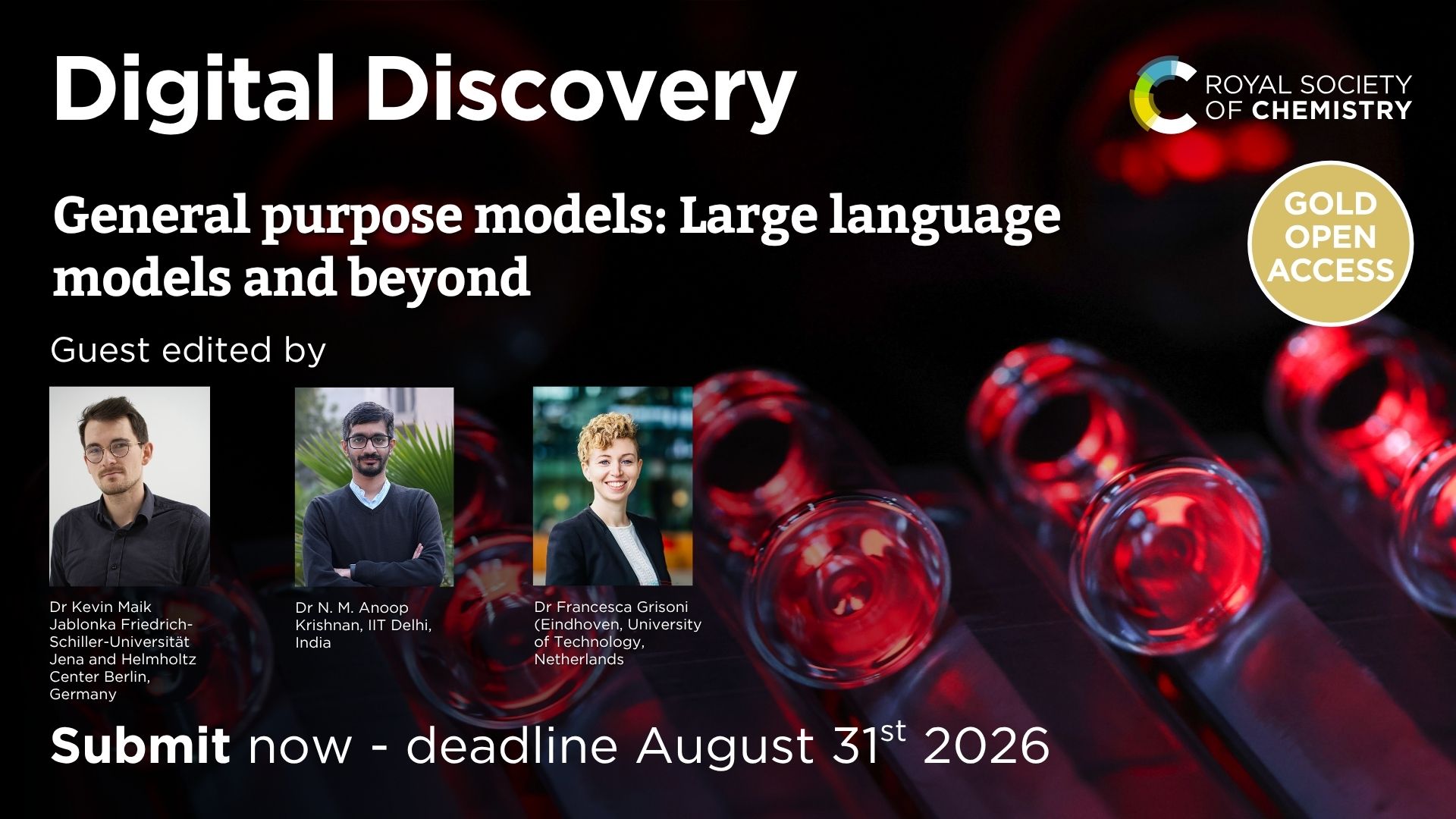
Call for papers: General purpose models: Large language models and beyond themed collection

Digital Discovery is delighted to welcome papers for its latest themed collection on General purpose models: Large language models and beyond, led by Dr N M Anoop Krishnan (IIT Delhi), Dr Francesca Grisoni (Eindhoven), and Dr Kevin Maik Jablonka (Friedrich Schiller Universität Jena and Helmholtz Center Berlin). If you do not directly work in this field, please do feel free to forward this call for papers to any of your colleagues that might be interested in contributing to this themed collection.

Contributions are welcome in both the theory and applications of general-purpose models (GPMs)-LLMs and beyond. We define a GPM as a model pre-trained on a broad, heterogeneous corpus spanning multiple data modalities (e.g., text, images, graphs) or representations (e.g., common names, 3D coordinates, molecular images). GPMs can be applied to a wide spectrum of downstream tasks – spanning different objectives (classification, regression, generation, reasoning), input formats, and domains (from NLP to chemistry and vision) – with little or no task-specific fine-tuning.

We are particularly interested in work that deepens our understanding of what enables broad capability and generalization, including rigorous benchmarking, careful experimental design, and principled analyses of model and agent behaviour. We will consider methods ranging from near-term, practical systems to more conceptual advances, including architectures that move beyond today’s dominant transformer paradigm.

We encourage submissions on topics including, but by no means limited to:

  • Novel benchmarks and evaluation protocols for general-purpose capabilities (including robustness, generalization, and cross-domain transfer)
  • Careful ablation studies that yield actionable insight into what drives performance, scaling, and emergent behaviors
  • Novel training approaches, objectives, curricula, and data strategies (including alignment- and efficiency-oriented methods)
  • Agentic systems and setups, including well-controlled studies of tool use, planning, memory, autonomy, and safety/reliability under deployment constraints
  • Multimodal GPMs, spanning text, images, graphs, 3D/structured representations, and domain-specific modalities
  • Architectures beyond transformers, such as state-space models, diffusion-based text generation, and other emerging modeling paradigms

The deadline for submissions is 31 August 2026.

If you would like to contribute to this collection, please let us know by email at digitaldiscovery-rsc@rsc.org, and we will set up a submission link for you to contribute your article.

Promotion of the collection is scheduled for promotion in late 2026, with articles published online as soon as they’re accepted. Authors are welcome to submit original research in the form of a Communication or Full Paper. Authors who would like to contribute a Review article should contact the Editorial office with their proposal. The Editorial Office reserves the right to check suitability of submissions for both the journal and the scope of the collection, and inclusion of accepted articles in the final themed collection is not guaranteed.

You can find out more detailed information about our journal scope and our valued editorial board members on our website. If you have any questions about the journal or the collection, please contact us at the above address.
Workshop on AI in Drug Discovery at the 34th International Conference on Artificial Neural Networks ICANN25

The 2nd Workshop on AI in Drug Discovery (https://e-nns.org/icann2025/aidd) to be held within the esteemed 34th International Conference on Artificial Neural Networks (ICANN 2025), invites cutting-edge contributions in the rapidly evolving field of AI-driven drug discovery. We are seeking submissions encompassing various facets such as generative models, eXplainable AI (XAI), uncertainty quantification, reaction informatics and synthetic route prediction, quantum machine learning for reactivity, methodologies for mining very large compound data sets, federated learning, analysis of HTS data, multimodal and equivariant neural networks, and other topics related to the use of ML in chemistry. This workshop aims to bring together machine learning experts, computational chemists and chemoinformaticians working on the development and application of ML in chemistry, environmental health and (eco)toxicology.


WORKSHOP TOPICS

We look forward to receiving contributions from all researchers active in the field, whether they are developing novel methodologies or expanding the scope of established methodologies. A non-exhaustive list of topics includes:

  • Big Data and Advanced Machine Learning in Chemistry
  • eXplainable AI (XAI) in Chemistry
  • Use of Deep Learning to Predict Molecular Properties
  • Cheminformatics
  • Modeling and Prediction of Chemical Reactions
  • Generative Models


SUBMISSION INSTRUCTIONSContributions (full papers or extended abstracts) should be submitted through the regular ICANN submission system at https://e-nns.org/icann2025/submission.  Select track “Workshop: AI in Drug Discovery”. Accepted papers/abstracts will appear in the ICANN2025 proceedings. The authors of accepted articles/abstracts will be invited to submit new or updated papers to a special issue of Digital Discovery (including 25% discount on the publication fee) before end of December 2025. Notice that all submissions for this SI should be full research papers, with an emphasis on novelty in methodology. If any of the work has been previously published as an abstract, it will not pose an issue, provided that the full paper includes all necessary details for replication, including data and code. If the full paper has been published, the journal submission should be significantly expanded or revised. A journal article should provide additional value beyond what was published in the conference proceedings and should include substantial new material or findings that were not part of the conference version.


IMPORTANT DATES

  • Deadline for full papers and extended abstracts via submission system: 15th of April
  • Deadline for extended abstract submission: 1th of May
  • Notification of acceptance: 15th of May
  • Conference dates: 9 – 12 September 2025


PROGRAM COMMITTEE

Ola Engkvist (AstraZeneca), Matteo Aldeghi (Bayer), Marc Bianciotto (Sanofi), Chris Barbel (Molecular Networks), Jan Halborg Jensen (U. Copenhagen), Alexandre Varnek (U. Strasbourg),  Mike Preuss (U. Leiden), Alessandra Roncaglioni (IRFMN), Noelia Ferruz (CRG), Fabian Theis (TUM), Francesca Grisoni (TU/e), Rodolphe Vuilleumier (ENS-PSL), Michael Wand (USI), Philippe Schwaller (EPFL), Hyun Kil Shin (KIT) and Jürgen Schmidhuber (USI)

The workshop will be organized in connection with the Horizon Europe Marie Skłodowska-Curie Actions Doctoral Network EID grant agreement No. 101120466 “Explainable AI for Molecules” (AiChemist) https://aichemist.eu.


ORGANIZERS

Dr. Igor V. Tetko

Group Leader Chemoinformatics

Institute of Structural Biology, Helmholtz Munich, Germany

Contact: aidd@aichemist.eu

Dr. Djork-Arné Clevert

VP Machine Learning Research
Pfizer, Berlin, Germany

Contact: Djork-Arne.Clevert@pfizer.com