Archive for the ‘Collections’ Category

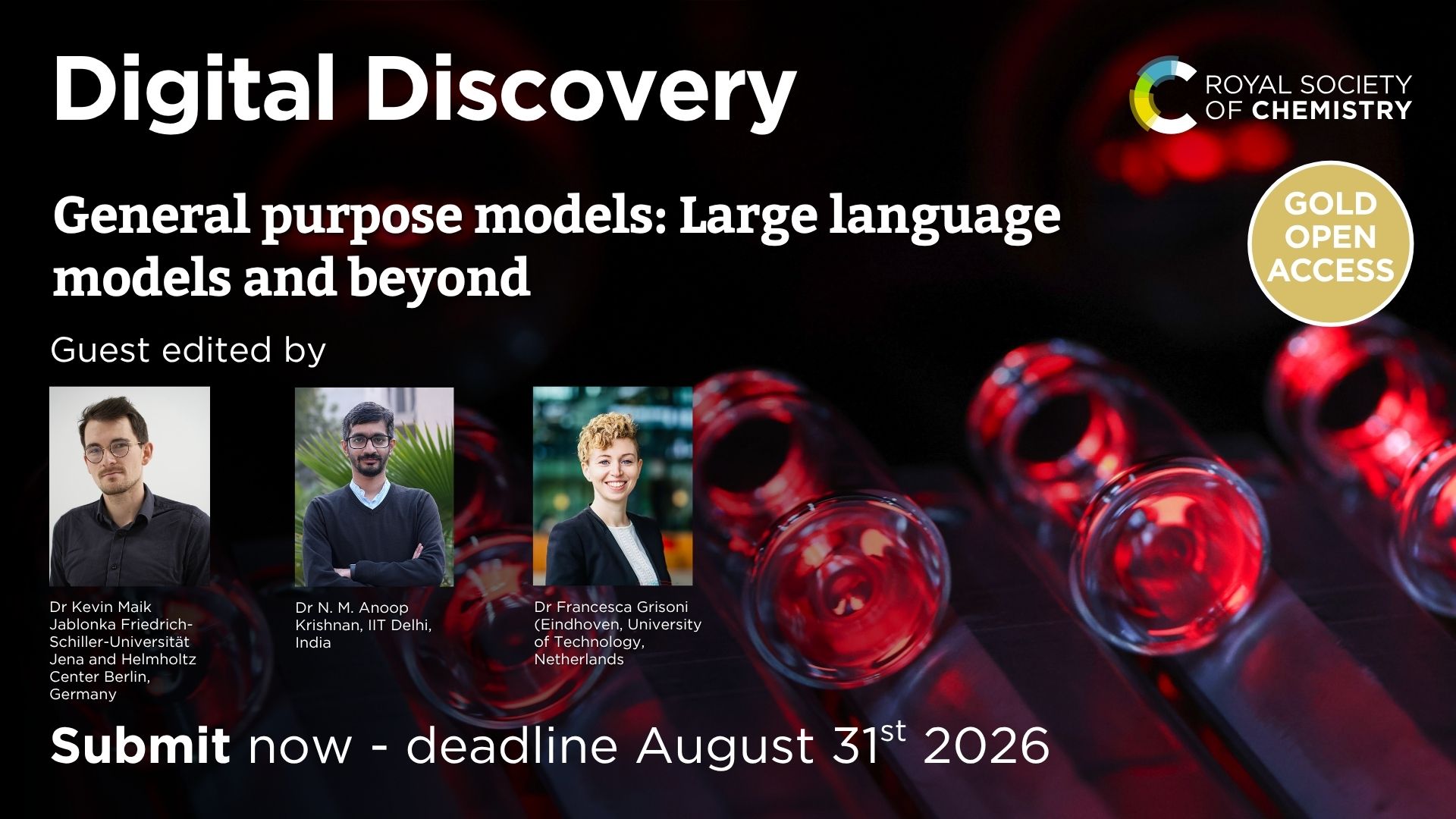
Call for papers: General purpose models: Large language models and beyond themed collection

Digital Discovery is delighted to welcome papers for its latest themed collection on General purpose models: Large language models and beyond, led by Dr N M Anoop Krishnan (IIT Delhi), Dr Francesca Grisoni (Eindhoven), and Dr Kevin Maik Jablonka (Friedrich Schiller Universität Jena and Helmholtz Center Berlin). If you do not directly work in this field, please do feel free to forward this call for papers to any of your colleagues that might be interested in contributing to this themed collection.

Contributions are welcome in both the theory and applications of general-purpose models (GPMs)-LLMs and beyond. We define a GPM as a model pre-trained on a broad, heterogeneous corpus spanning multiple data modalities (e.g., text, images, graphs) or representations (e.g., common names, 3D coordinates, molecular images). GPMs can be applied to a wide spectrum of downstream tasks – spanning different objectives (classification, regression, generation, reasoning), input formats, and domains (from NLP to chemistry and vision) – with little or no task-specific fine-tuning.

We are particularly interested in work that deepens our understanding of what enables broad capability and generalization, including rigorous benchmarking, careful experimental design, and principled analyses of model and agent behaviour. We will consider methods ranging from near-term, practical systems to more conceptual advances, including architectures that move beyond today’s dominant transformer paradigm.

We encourage submissions on topics including, but by no means limited to:

  • Novel benchmarks and evaluation protocols for general-purpose capabilities (including robustness, generalization, and cross-domain transfer)
  • Careful ablation studies that yield actionable insight into what drives performance, scaling, and emergent behaviors
  • Novel training approaches, objectives, curricula, and data strategies (including alignment- and efficiency-oriented methods)
  • Agentic systems and setups, including well-controlled studies of tool use, planning, memory, autonomy, and safety/reliability under deployment constraints
  • Multimodal GPMs, spanning text, images, graphs, 3D/structured representations, and domain-specific modalities
  • Architectures beyond transformers, such as state-space models, diffusion-based text generation, and other emerging modeling paradigms

The deadline for submissions is 31 August 2026.

If you would like to contribute to this collection, please let us know by email at digitaldiscovery-rsc@rsc.org, and we will set up a submission link for you to contribute your article.

Promotion of the collection is scheduled for promotion in late 2026, with articles published online as soon as they’re accepted. Authors are welcome to submit original research in the form of a Communication or Full Paper. Authors who would like to contribute a Review article should contact the Editorial office with their proposal. The Editorial Office reserves the right to check suitability of submissions for both the journal and the scope of the collection, and inclusion of accepted articles in the final themed collection is not guaranteed.

You can find out more detailed information about our journal scope and our valued editorial board members on our website. If you have any questions about the journal or the collection, please contact us at the above address.

New themed collection in collaboration with Accelerate Conference 2022

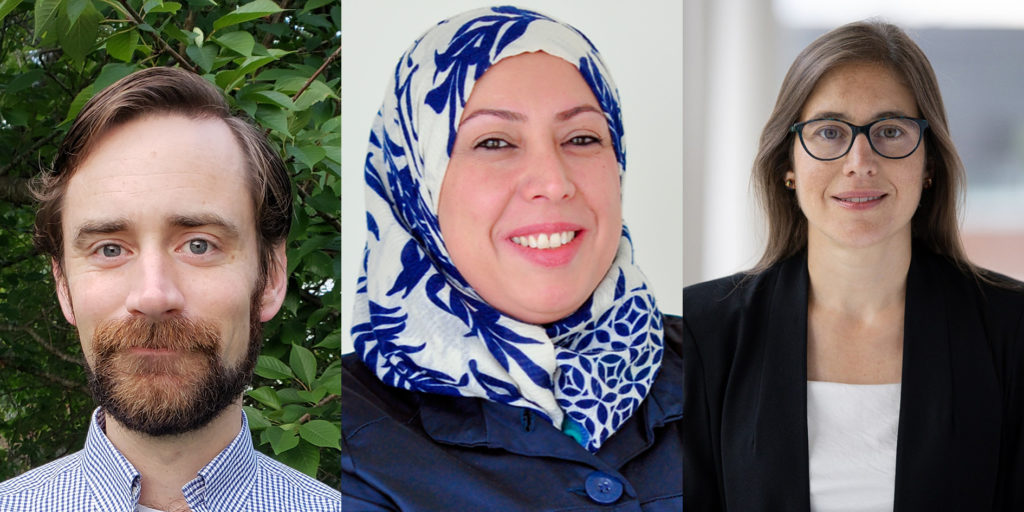
Portraits of the three Guest Editors

We’re pleased to announce that a new themed collection from Digital Discovery has now been published online.
Read the collection

This new themed collection represents a collaboration between the editors of Digital Discovery and the Acceleration Consortium, organisers of the Accelerate Conference. The goal of the conference was to explore the power of self-driving labs (SDLs), which combine AI, automation, and advanced computing to accelerate materials and molecular discovery.

This themed collection, Guest Edited by Prof. Keith A. Brown (Boston University, USA), Prof. Fedwa El Mellouhi (Hamad Bin Khalifa University, Qatar), and Prof. Claudiane Ouellet-Plamondon (École de technologie supérieure, Canada), features contributions that cover various aspects of this process, whether specifically presented at the conference or not.

Examples include, realization of new SDLs; fundamental studies of the operation of SDLs; sustainable, resilient, low carbon, materials and chemical discoveries made using SDLs.

A list of the articles has been provided below. All articles in Digital Discovery are open access and free to read.

We hope you enjoy this new themed collection from Digital Discovery.

A new collection to feature contributors to Accelerate Conference 2023 and Accelerate Conference 2024 is currently in preparation – watch this space for more information!


Editorial

Introduction to “Accelerate Conference 2022”
Keith A. Brown, Fedwa El Mellouhi and Claudiane Ouellet-Plamondon
Digital Discovery, 2024, 3, DOI: 10.1039/D4DD90036G


Perspectives

The laboratory of Babel: highlighting community needs for integrated materials data management
Brenden G. Pelkie and Lilo D. Pozzo
Digital Discovery, 2023, 2, 544–556, DOI: 10.1039/D3DD00022B

What is missing in autonomous discovery: open challenges for the community
Phillip M. Maffettone, Pascal Friederich, Sterling G. Baird, Ben Blaiszik, Keith A. Brown, Stuart I. Campbell, Orion A. Cohen, Rebecca L. Davis, Ian T. Foster, Navid Haghmoradi, Mark Hereld, Howie Joress, Nicole Jung, Ha-Kyung Kwon, Gabriella Pizzuto, Jacob Rintamaki, Casper Steinmann, Luca Torresi and Shijing Sun
Digital Discovery, 2023, 2, 1644–1659, DOI: 10.1039/D3DD00143A

Autonomous cementitious materials formulation platform for critical infrastructure repair
Howie Joress, Rachel Cook, Austin McDannald, Mark Kozdras, Jason Hattrick-Simpers, Aron Newman and Scott Jones
Digital Discovery, 2024, 3, 231–237, DOI: 10.1039/D3DD00211J


Papers

A fully automated platform for photoinitiated RAFT polymerization
Jules Lee, Prajakatta Mulay, Matthew J. Tamasi, Jonathan Yeow, Molly M. Stevens and Adam J. Gormley
Digital Discovery, 2023, 2, 219–233, DOI: 10.1039/D2DD00100D

A high-throughput workflow for the synthesis of CdSe nanocrystals using a sonochemical materials acceleration platform
Maria Politi, Fabio Baum, Kiran Vaddi, Edwin Antonio, Joshua Vasquez, Brittany P. Bishop, Nadya Peek, Vincent C. Holmberg and Lilo D. Pozzo
Digital Discovery, 2023, 2, 1042–1057, DOI: 10.1039/D3DD00033H

Neural networks trained on synthetically generated crystals can extract structural information from ICSD powder X-ray diffractograms
Henrik Schopmans, Patrick Reiser and Pascal Friederich
Digital Discovery, 2023, 2, 1414–1424, DOI: 10.1039/D3DD00071K

Driving school for self-driving labs
Kelsey L. Snapp and Keith A. Brown
Digital Discovery, 2023, 2, 1620–1629, DOI: 10.1039/D3DD00150D

Robotically automated 3D printing and testing of thermoplastic material specimens
Miguel Hernández-del-Valle, Christina Schenk, Lucía Echevarría-Pastrana, Burcu Ozdemir, Enrique Dios-Lázaro, Jorge Ilarraza-Zuazo, De-Yi Wang and Maciej Haranczyk
Digital Discovery, 2023, 2, 1969–1979, DOI: 10.1039/D3DD00141E

Towards a modular architecture for science factories
Rafael Vescovi, Tobias Ginsburg, Kyle Hippe, Doga Ozgulbas, Casey Stone, Abraham Stroka, Rory Butler, Ben Blaiszik, Tom Brettin, Kyle Chard, Mark Hereld, Arvind Ramanathan, Rick Stevens, Aikaterini Vriza, Jie Xu, Qingteng Zhang and Ian Foster
Digital Discovery, 2023, 2, 1980–1998, DOI: 10.1039/D3DD00142C

A human-in-the-loop approach for visual clustering of overlapping materials science data
Satyanarayana Bonakala, Michael Aupetit, Halima Bensmail and Fedwa El-Mellouhi
Digital Discovery, 2024, 3, 502–513, DOI: 10.1039/D3DD00179B

Partnering with the AI for Accelerated Materials Design workshop at NeurIPS ’23

We are pleased to announce that we are partnering with the AI for Accelerated Materials Design “AI4Mat” workshop at NeurIPS 2023. Digital Discovery will be publishing selected submissions from this exciting workshop in an upcoming special article collection, to be publicised in early 2024.

The AI for Accelerated Materials Discovery (AI4Mat) Workshop 2023 provides an inclusive and collaborative platform where AI researchers and material scientists converge to tackle the cutting-edge challenges in AI-driven materials discovery and development. Its goal is to foster a vibrant exchange of ideas, breaking down barriers between disciplines and encouraging insightful discussions among experts from diverse disciplines and curious newcomers to the field. The workshop embraces a broad definition of materials design encompassing matter in various forms, such as crystalline and amorphous solid-state materials, glasses, molecules, nanomaterials, and devices. By taking a comprehensive look at automated materials discovery spanning AI-guided design, synthesis and automated material characterization, the organisers aim to create an opportunity for deep, thoughtful discussion among researchers working on these interdisciplinary topics, and highlight ongoing challenges in the field.

Find out more about the workshop, including submission guidelines, at the web site. Details of the Digital Discovery article collection will be shared with the participants in due course.