
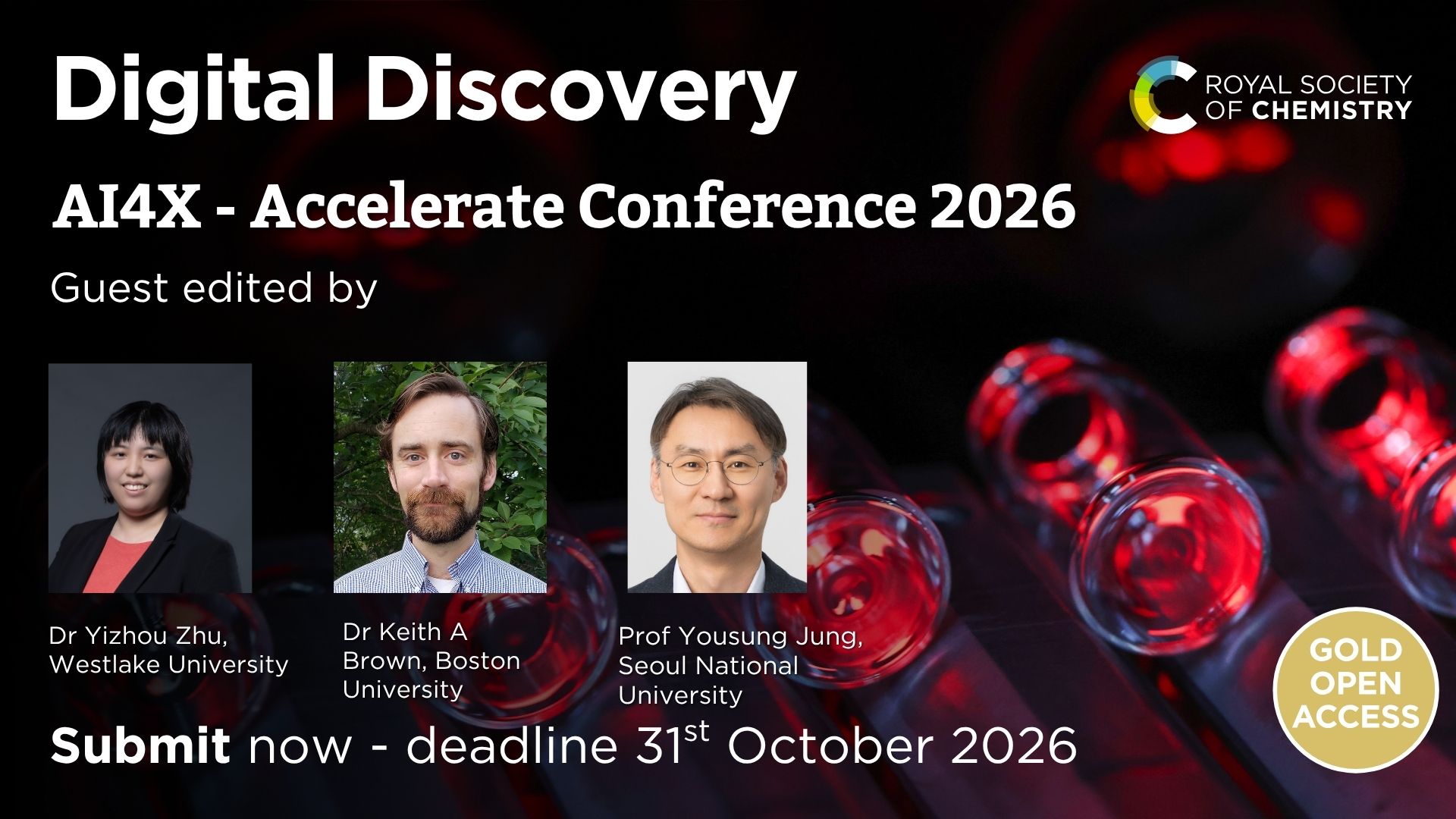
Digital Discovery is delighted to welcome papers for its latest themed collection on work presented at the 2026 AI4X – Accelerate Conference. The collection is led by Yizhou Zhu (Westlake University, China), Keith A Brown (Boston University, USA), Yousung Jung (Seoul National University, South Korea).
This new themed collection represents a collaboration between the editors of Digital Discovery and the Acceleration Consortium, organisers of the 2026 AI4X – Accelerate Conference. The goal of the conference is to bring together researchers from diverse disciplines to share their perspectives on Science with AI and their visions for the future. This themed collection aims to explore the field of AI, machine learning, and self-driving labs and we welcome contributions that cover any aspect of this process, whether specifically presented at the conference or not. Examples include realization of new SDLs; fundamental studies of the operation of SDLs; AI for Materials Science; LLMs for Science; ethical approaches to AI for science research; and AI for all areas of chemistry research.
Other collections in this series include the 2023 and 2024 Accelerate Conferences and the 2025 Accelerate Conference themed collections.
The deadline for submissions is 31 October 2026.
If you would like to contribute to this collection, please let us know by email at digitaldiscovery-rsc@rsc.org, and we will set up a submission link for you to contribute your article.
Promotion of the collection is scheduled for promotion in early 2027, with articles published online as soon as they’re accepted. Authors are welcome to submit original research in the form of a Communication or Full Paper. Authors who would like to contribute a Review article should contact the Editorial office with their proposal. The Editorial Office reserves the right to check suitability of submissions for both the journal and the scope of the collection, and inclusion of accepted articles in the final themed collection is not guaranteed.
You can find out more detailed information about our journal scope and our valued editorial board members on our website. If you have any questions about the journal or the collection, please contact us at the above address.