Rate coefficients for OH + acetone

Dwayne E. Heard (Chair of the Faraday Discussions Standing Committee on Conferences) and colleagues show that low temperature measurements reveal a dramatic negative temperature dependence to the rate coefficients for the OH + acetone reaction.

Observation of a large negative temperature dependence for rate coefficients of reactions of OH with oxygenated volatile organic compounds studied at 86–112 K
Robin J. Shannon, Sally Taylor, Andrew Goddard, Mark A. Blitz and Dwayne E. Heard
Phys. Chem. Chem. Phys., 2010, DOI: 10.1039/C0CP00918K

Digg This
Reddit This
Stumble Now!
Share on Facebook
Bookmark this on Delicious
Share on LinkedIn
Bookmark this on Technorati
Post on Twitter
Google Buzz (aka. Google Reader)

ISE 2010 – off to a great start!

Greetings from the 61st Annual Meeting of the International Society of Electochemistry (ISE 2010) in Nice, France! 

So far the conference has got off to a great start. It began this morning with a very warm welcome from ISE President, Rob Hillman, who is also on the PCCP Advisory Board. Rob highlighted the broad and multi-disciplinary scope of this year’s conference ‘Electrochemistry from Biology to Physics’.

This morning saw a focus on bioelectrochemistry, with oral presentations from many of the authors from PCCP’s recently published themed issue on bioelectrochemistry. These included Phil Bartlett, Ernesto Julio Calvo, Elana Ferapontova and also one of the Guest Editors of the issue, Nicolas Mano from Bordeaux. View this great issue here. One hot topic that’s come up a lot already this morning is enzyme based biofuel cells.

Watch out for more updates from ISE 2010…


Digg This
Reddit This
Stumble Now!
Share on Facebook
Bookmark this on Delicious
Share on LinkedIn
Bookmark this on Technorati
Post on Twitter
Google Buzz (aka. Google Reader)

2011 Physical Chemistry Prizes and Awards – Nominations now open

The RSC currently presents around 60 prestigious Prizes and Awards annually to scientists in all the main chemical science disciplines allowing for the greatest range of scientists to be recognised for their work; individuals, teams and organisations working across the globe.

Physical Chemistry is one of the nine categories of awards, which has 16 Prizes and Awards including the prestigious Spiers Memorial Award, Marlow Award, Faraday Lectureship Prize and the three Centenary Prizes.

Our Prizes and Awards represent the dedication and outstanding achievements in the chemicals sciences and are a platform to showcase inspiring science to gain the recognition deserved.

Do you know someone who has made a significant contribution to advancing the chemical sciences?

View our full list of Prizes and Awards and use the online system to nominate yourself or colleagues.

Digg This
Reddit This
Stumble Now!
Share on Facebook
Bookmark this on Delicious
Share on LinkedIn
Bookmark this on Technorati
Post on Twitter
Google Buzz (aka. Google Reader)

Second harmonic generation imaging – biological dyes

PCCP “Perspectiveread this ‘HOT’ article today

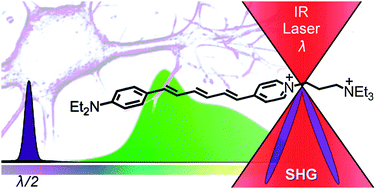
SHG imaginingSecond harmonic generation imaging needs better chromophores. In this Perspective, Koen Clays and colleagues consider structure–function relationships and evaluate methods of obtaining brighter SHG images.

Dyes for biological second harmonic generation imaging
James E. Reeve, Harry L. Anderson and Koen Clays
Phys. Chem. Chem. Phys., 2010, DOI: 10.1039/C003720F

Digg This
Reddit This
Stumble Now!
Share on Facebook
Bookmark this on Delicious
Share on LinkedIn
Bookmark this on Technorati
Post on Twitter
Google Buzz (aka. Google Reader)

Nanomaterials in industrial catalysis

nanomaterials in industrial catalysisPCCP “Perspective”read it today

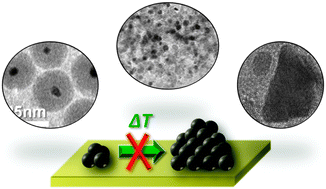
Emerging approaches towards stabilization of metal nanoparticles are key for the application of nanomaterials in industrial catalysis. These approaches are discussed in this high-profile feature review article.

Stabilizing metal nanoparticles for heterogeneous catalysis
Anmin Cao, Rongwen Lu and Götz Veser
Phys. Chem. Chem. Phys., 2010, DOI: 10.1039/C0CP00729C

Digg This
Reddit This
Stumble Now!
Share on Facebook
Bookmark this on Delicious
Share on LinkedIn
Bookmark this on Technorati
Post on Twitter
Google Buzz (aka. Google Reader)

Top Ten most-read PCCP articles

The latest top ten most accessed PCCP articles

See the most-read papers of July 2010 here:


Anthony Harriman, Phys. Chem. Chem. Phys., 2010, 12, 7317-7318
DOI: 10.1039/C0CP90032J
 
Akihito Ishizaki, Tessa R. Calhoun, Gabriela S. Schlau-Cohen and Graham R. Fleming, Phys. Chem. Chem. Phys., 2010, 12, 7319-7337
DOI: 10.1039/C003389H
 
David J. Nesbitt and Martin A. Suhm, Phys. Chem. Chem. Phys., 2010, 12, 8151-8151
DOI: 10.1039/C0CP90051F
 
Frank Endres and Sherif Zein El Abedin, Phys. Chem. Chem. Phys., 2006, 8, 2101-2116
DOI: 10.1039/B600519P
 
Bo Albinsson and Jerker Mårtensson, Phys. Chem. Chem. Phys., 2010, 12, 7338-7351
DOI: 10.1039/C003805A
 
Wibe A. de Jong, Eric Bylaska, Niranjan Govind, Curtis L. Janssen, Karol Kowalski, Thomas Müller, Ida M. B. Nielsen, Hubertus J. J. van Dam, Valera Veryazov and Roland Lindh, Phys. Chem. Chem. Phys., 2010, 12, 6896-6920
DOI: 10.1039/C002859B
 
Anthony C. Legon, Phys. Chem. Chem. Phys., 2010, 12, 7736-7747
DOI: 10.1039/C002129F
 
Peter Politzer, Jane S. Murray and Timothy Clark, Phys. Chem. Chem. Phys., 2010, 12, 7748-7757
DOI: 10.1039/C004189K
 
Christopher J. Cramer and Donald G. Truhlar, Phys. Chem. Chem. Phys., 2009, 11, 10757-10816
DOI: 10.1039/B907148B
 
François-Yves Dupradeau, Adrien Pigache, Thomas Zaffran, Corentin Savineau, Rodolphe Lelong, Nicolas Grivel, Dimitri Lelong, Wilfried Rosanski and Piotr Cieplak, Phys. Chem. Chem. Phys., 2010, 12, 7821-7839
DOI: 10.1039/C0CP00111B


Digg This
Reddit This
Stumble Now!
Share on Facebook
Bookmark this on Delicious
Share on LinkedIn
Bookmark this on Technorati
Post on Twitter
Google Buzz (aka. Google Reader)

TYC-Workshop on Energy Materials: on this week!

The 1st TYC-Workshop on Energy Materials started yesterday at University College London, UK, and is set to be a very exciting meeting!

PCCP is sponsoring this meeting and will also be publishing an exciting issue on energy materials in the coming months, highlighting some of the great research being presented. Sign up for the PCCP e-alert today for future updates on this issue.

The meeting is organised by Jochen Blumberger and includes a host of top speakers including: Richard Catlow, Anthony Cheetham, James Durrant, Kit Bowen and many more!

Topics being covered this week include:

  • Photo-induced energy conversion
  • Hydrogen storage
  • Electrochemistry, Fuel Cells and Energy Storage
Digg This
Reddit This
Stumble Now!
Share on Facebook
Bookmark this on Delicious
Share on LinkedIn
Bookmark this on Technorati
Post on Twitter
Google Buzz (aka. Google Reader)

Hydrogen Interactions with Diamond: call for papers

PCCP high-profile themed issue announcement:

Hydrogen Interactions with Diamond

Submission deadline: 10 January 2010

Guest Editors: John Foord (University of Oxford) and Alon Hoffman (Technion Inst.)

Enormous interest has developed in the use of diamond as a functional material in recent years, with diverse applications in areas like optical windows, radiation detectors, thermal dissipation, high power electronics, NEMS, medical implants, electrochemistry, bioelectronics and biosensors. This in turn has focussed attention on understanding the basic physical, chemical, mechanical and interfacial properties of diamond materials, in a research field that spans physics, chemistry, materials science and biology. One of the central themes in this basic research is the interaction of hydrogen with diamond.

The purpose of this themed issue is therefore to bring important areas of this large body of research together in an issue of PCCP, which will focus on the basic physical science which underlies the interaction of hydrogen with diamond materials and will cover specific areas including:

  • Chemistry and structure of hydrogenated diamond surfaces
  • The role of hydrogen in growth chemistry
  • Electronic structure of diamond interfaces
  • Surface conductivity
  • Electron emission and Photoemission
  • Hydrogen plasma smoothing and etching
  • Electrochemistry
  • Diffusion
  • Hydrogen Defects in Diamond
  • Bulk electronic and optical properties


The themed issue will be published in summer 2011 and will be displayed at relevant conferences to maximise the visibility of the work published.

Please pass this information on to any relevant colleagues, or let us know if you have any suggestions of people to invite. The deadline for submissions to the themed issue is the 10th January 2011, though submissions before this date are of course welcomed.


Digg This
Reddit This
Stumble Now!
Share on Facebook
Bookmark this on Delicious
Share on LinkedIn
Bookmark this on Technorati
Post on Twitter
Google Buzz (aka. Google Reader)

Ionisable solutes partition into octanol

‘HOT’ PCCP article – read it now:

This paper looks at ionisable solutes partition into octanol as ions and ion pairs, they discover that log P for a neutral species and the ion is not constant.

The transfer of neutral molecules, ions and ionic species from water to wet octanol
Michael H. Abraham and William E. Acree, Jr.
Phys. Chem. Chem. Phys., 2010, DOI: 10.1039/C0CP00695E

Digg This
Reddit This
Stumble Now!
Share on Facebook
Bookmark this on Delicious
Share on LinkedIn
Bookmark this on Technorati
Post on Twitter
Google Buzz (aka. Google Reader)

Kinetics of solid oxide fuel cells

Read this just published PCCP Perspective article by Wolfgang Bessler and colleagues:

Model anodes and anode models for understanding the mechanism of hydrogen oxidation in solid oxide fuel cells
Wolfgang G. Bessler, Marcel Vogler, Heike Störmer, Dagmar Gerthsen, Annika Utz, André Weber and Ellen Ivers-Tiffée
Phys. Chem. Chem. Phys., 2010, DOI: 10.1039/C0CP00541J

This article reviews and presents new results on mechanistic modeling and experimental analysis of the kinetics of SOFC anodes.

Digg This
Reddit This
Stumble Now!
Share on Facebook
Bookmark this on Delicious
Share on LinkedIn
Bookmark this on Technorati
Post on Twitter
Google Buzz (aka. Google Reader)