Seong Keun Kim Interview – Inspirational science

Recently I interviewed new PCCP Editorial Board member Professor Seong Keun Kim, we talked about his latest research, how he was inspired by a comic book character and the importance of science in Korea.

Read on to find out more…

Seong Keun Kim is head of the Molecular Reaction Dynamics Laboratory at Seoul National University, Korea. He uses spectroscopic, microscopic and computational methods to investigate a wide range of subjects from molecular physics and nanoscience to cell biology.

S K Kim

Korea is becoming a major player in chemical research. How important is chemistry to the future development of the country?

Korea is very strong in the electronics, automobile, ship building and steel industries, but it is also the world’s fifth largest producer of chemicals by volume. So chemistry plays a critical role in the day-to-day operations of virtually every Korean industry, and strong chemical research is compulsory for innovation and product development.

Why did you choose to specialise in the nano-bio area?

I am a physical chemist by training but have always been interested in what goes on in other areas, within and beyond chemistry. The nano-bio area serves as a good window through which we can probe nature in a broader sense at a manageable level. And it turns out that my chemical knowledge, and the array of powerful techniques from the physical chemistry toolbox, can be very handy for nano-bio research.

What projects are you working on?

We have been working on a wide range of topics, from atomic and molecular physics to surface science to genetic assays. Lately, however, we have been focusing on elucidating the molecular interactions and reaction mechanisms for biologically relevant problems.

What’s going to be the next big thing in your field?

‘Seeing’ the chemical transformation of molecules, such as DNA and proteins, in a cell in real time.

What’s the trickiest problem you’ve had to overcome in your research? How did you solve it?

I’ve had my share of puzzles, but the trickiest one happens to be the one I am wrestling with now. A well-known, simple, non-fluorescing compound becomes highly fluorescent upon photoirradiation. We are trying to understand the photochemical reaction pathway, which has so far been quite evasive.

Who or what inspired you to become a scientist?

A Korean comic book character from the early 1960s that depicted a Mr Know-It-All scientist. Later, the Apollo mission and the vivid, flaming images of a rocket launch left an indelible impression.

In high school, a short film shown in the classroom about molecules moving, jittering and bouncing off each other was taken as a providential sign pointing in the direction of my calling. Six years later, I found myself running a crossed molecular beam experiment between ‘flaming’ Rb and CO2 clusters in Dudley Herschbach’s lab at Harvard in the US. It felt like déjà vu.

What is the most rewarding aspect of your career?

Teaching students of all ages and backgrounds. At the end of the summer vacation or during sabbaticals, I invariably find myself bored and defunct because I don’t get to teach. I never turn down invitations for extramural lectures, which are mostly for non-scientific audiences, because the general public are just as susceptible as scientists to the wonder and awe that nature inspires.

Can you tell us a little known fact about yourself?

In every aptitude test I took as a student, I was never predicted to become a scientist. Instead, I was supposed to be a journalist, painter, psychiatrist, pilot or soldier. I now realise that the life of a scientist involves being all of these!

What do you do in your spare time?

Listening to Mahler and Ludwig van Beethoven in my car while it’s going at 150 km per hr (and ending up with a speeding ticket half the time!).

And finally, if you weren’t a scientist, what would you do?

Be a John Horgan.


Check out the themed issue series that Seong Keun Kim Guest Edited on Biophysics and Biophysical Chemistry

Digg This
Reddit This
Stumble Now!
Share on Facebook
Bookmark this on Delicious
Share on LinkedIn
Bookmark this on Technorati
Post on Twitter
Google Buzz (aka. Google Reader)

Tracking the early stages of Alzheimer’s disease

UK researchers can track the early steps of formation of peptide clumps linked to Alzheimer’s disease using the peptide’s fluorescent ability. This could help design effective therapies for the disease at an early stage.

A peptide known as beta-amyloid forms amyloid plaques that are found in Alzheimer’s disease. Scientists believe that the toxicity of the smallest peptide aggregates formed during the earliest stages of the aggregation process contribute to the neurological damage in the disease. But it’s difficult to study the earliest aggregation steps to find out why the peptide starts to clump together.

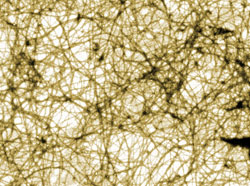
Amyloid fibrils
To help shed light on the process, Olaf Rolinski and colleagues at the University of Strathclyde monitored the decay of tyrosine fluorescence (tyrosine is an amino acid present in beta-amyloid) as the peptides started to self-associate. The decay happens in stages as tyrosine’s surroundings change, producing three different forms, or conformers, of tyrosine. The three forms give different fluorescent signals that can be picked up with a fluorescence spectrometer. Using the peptide’s intrinsic fluorescence avoids introducing a bulky, unnatural fluorophore, which could affect the aggregation process.

Fluorescence is sensitive to interactions on the Ångström to nanometre scale so it can be used to monitor processes between individual molecules at the early stages of amyloid aggregation,’ explains Rolinski.

The team measured the decay in tyrosine fluorescence at eight different peptide concentrations enabling them to detect early single peptide-peptide interactions, which are invisible in conventional fluorescence experiments. They found that the initial peptide concentration influences what conformation is adopted by individual peptides and determines the rate of their aggregation.

Read the rest of the Chemistry World story by Russell Johnson

Or read the PCCP paper in full:

Beta-amyloid oligomerisation monitored by intrinsic tyrosine fluorescence
Mariana Amaro, David J. S. Birch and Olaf J. Rolinski
Phys. Chem. Chem. Phys., 2011, DOI: 10.1039/c0cp02652b

Digg This
Reddit This
Stumble Now!
Share on Facebook
Bookmark this on Delicious
Share on LinkedIn
Bookmark this on Technorati
Post on Twitter
Google Buzz (aka. Google Reader)

US Energy Secretary talks biophysics

Stephen Chu, Secretary of Energy for the US government, gave a plenary lecture at the Annual Biophysical Society meeting earlier today.

Dr Chu began his scientific career as a physicist and went on to win the Nobel Prize for his biophysics research. Today he talked about his group’s current research interests into sub-wavelength imaging and detecting protein binding events in real-time. 

He then went on to discuss the influence fundamental biophysics is having on the search for future energy sources, including new metabolic pathways for biofuels synthesis and Li-ion batteries.  

Chu then went on to say that if new alternative energy sources are really going to take off – then the government need to set directives that will force the current energy industries to make these changes happen – just like they did in the 50’s with frost-free refrigerators!!     

Take a look at the great energy research published in both PCCP and Energy & Environmental Science today

Digg This
Reddit This
Stumble Now!
Share on Facebook
Bookmark this on Delicious
Share on LinkedIn
Bookmark this on Technorati
Post on Twitter
Google Buzz (aka. Google Reader)

Annual Biophysical Society Meeting

The 55th Annual Biophysical Society Meeting got off to a great start yesterday in Baltimore, USA

There was a very interesting session on Protein Dynamics – Experimental & Simulations covering a range of topics, but all the speakers agreed on the point that it is the use of computational methods alongside experimental evidence that is the key to solving the intricate details of protein folding. Each lecture also highlighted the importance of solid state NMR in this field…

…Take a look at the PCCP solid state structure prediction themed issue today!

Also watch out for our collection of high profile articles on protein folding coming soon, including  Perspective review articles covering the areas of theory, modelling and experimental studies in this fast moving area.

Digg This
Reddit This
Stumble Now!
Share on Facebook
Bookmark this on Delicious
Share on LinkedIn
Bookmark this on Technorati
Post on Twitter
Google Buzz (aka. Google Reader)

Themed issue: Materials innovation through interfacial physics and chemistry

PCCP is delighted to present its high profile themed issue on Materials innovation through interfacial physics and chemistry

The issue is Guest Edited by Professor Katsuhiko Ariga, new PCCP Editorial Board member, and highlights some of the great work in this exciting area of chemistry.

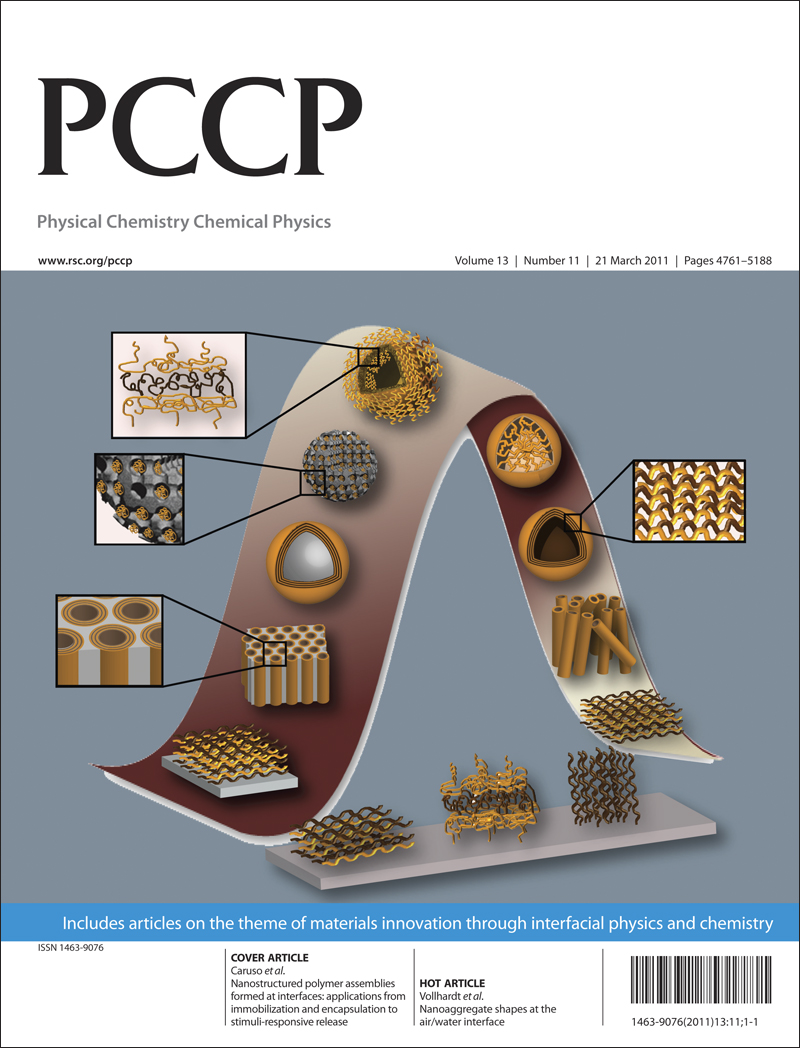
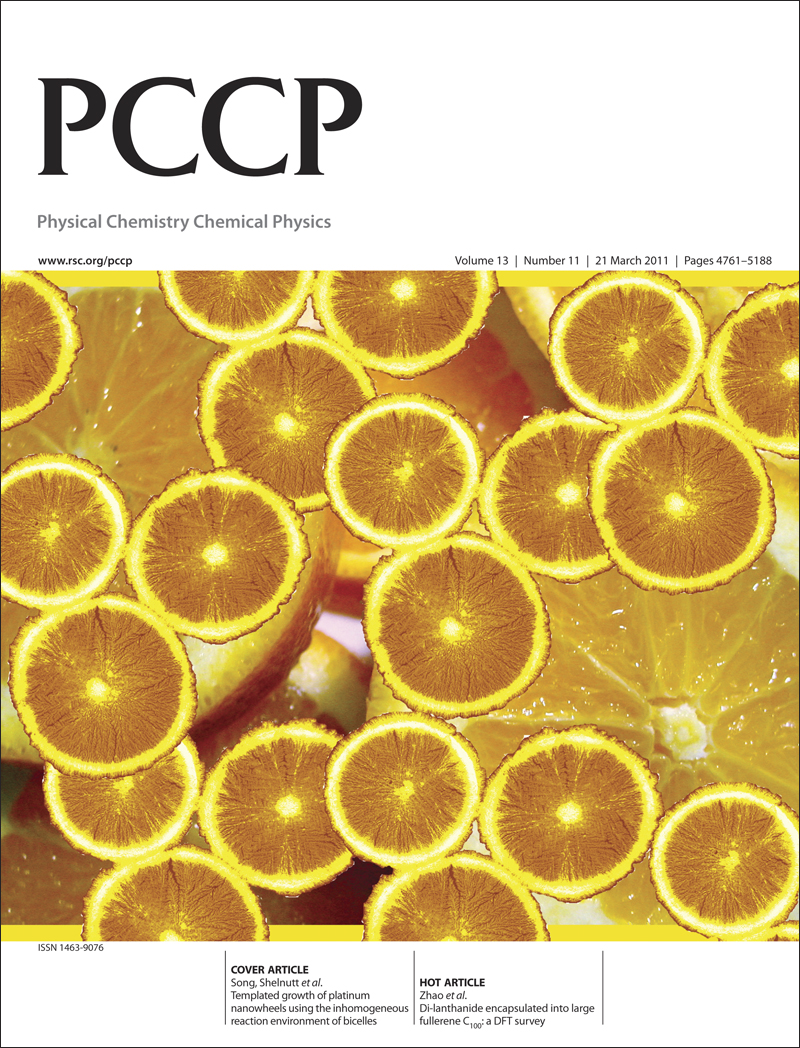
The two eye-catching covers feature the work of Frank Caruso and colleagues (DOI: 10.1039/C0CP02287J) and Song, Shelnutt et al. (DOI: 10.1039/C0CP01930E).

The issue hosts an array of articles, including Communications, papers and these Perspective review articles:

Nanostructured polymer assemblies formed at interfaces: applications from immobilization and encapsulation to stimuli-responsive release
Yajun Wang, Leticia Hosta-Rigau, Hannah Lomas and Frank Caruso
Phys. Chem. Chem. Phys., 2011, 13, 4782

Operation of micro and molecular machines: a new concept with its origins in interface science
Katsuhiko Ariga, Shinsuke Ishihara, Hironori Izawa, Hong Xia and Jonathan P. Hill
Phys. Chem. Chem. Phys., 2011, 13, 4802

Nanoaggregate shapes at the air/water interface
D. Vollhardt, N. Nandi and S. Dutta Banik
Phys. Chem. Chem. Phys., 2011, 13, 4812

Take a look at the whole themed issue today!

Digg This
Reddit This
Stumble Now!
Share on Facebook
Bookmark this on Delicious
Share on LinkedIn
Bookmark this on Technorati
Post on Twitter
Google Buzz (aka. Google Reader)

Investigating light-harvesting complexes

HOT’ PCCP paper – electronic spectra of light-harvesting complex II

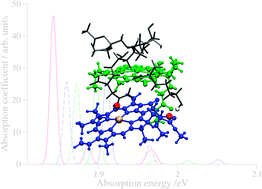
light-harvestingSubsystem TDDFT calculations allow us to investigate structural, environmental, and excitonic effects in optical spectra of (mutated) light-harvesting complexes.

The authors report on a fully quantum chemical investigation of important structural and environmental effects on the site energies of chlorophyll pigments in green-plant light-harvesting complex II – which is very important for future energy research.

Read the ‘HOT’ paper today:

First-principles calculation of electronic spectra of light-harvesting complex II
Carolin König and Johannes Neugebauer
Phys. Chem. Chem. Phys., 2011, DOI: 10.1039/C0CP02808H

Digg This
Reddit This
Stumble Now!
Share on Facebook
Bookmark this on Delicious
Share on LinkedIn
Bookmark this on Technorati
Post on Twitter
Google Buzz (aka. Google Reader)

Going to the Biophysical Society Meeting?

Then come and see us at the RSC Publishing booth 742!

Let us know if you are going to be there and visit our booth, where you can find out the latest news from PCCP and RSC Publishing – plus pick up some journal freebies!

I will be at the Biophysical Society Meeting in Baltimore and it would be great to meet you there!

Jane

Deputy Editor, PCCP

Digg This
Reddit This
Stumble Now!
Share on Facebook
Bookmark this on Delicious
Share on LinkedIn
Bookmark this on Technorati
Post on Twitter
Google Buzz (aka. Google Reader)

Skin: the ultimate interface

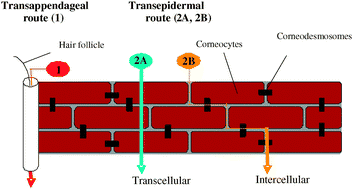
HOT’ PCCP Perspective – evaluating the current pharmaceutical strategies used to overcome the ultimate interface: the human skin barrier

The outer layer of the skin, the stratum corneum, is a unique barrier membrane. On average it is only 20 μm thick (about a quarter the thickness of a normal sheet of paper) but it prevents us from losing excessive water and it protects us from our environment. It forms a special interface between our body, the air, water and various solids.

In order to understand the barrier properties of the skin we need to determine its structure at various levels ranging from the macroscopic scale to the molecular level. This has been made easier by the advances that there have been over the recent decade. However, the amount of a material that is capable of penetrating this excellent barrier and reaching the underlying systemic circulation is still only of the order of 1 or 2 per cent of the total applied dose.

skin barrierThe authors explore the strategies currently employed to promote skin permeation and to consider the most exciting approaches currently under investigation. The limitations of current methodology to examine the problem are discussed. New opportunities to fill the gaps in our current knowledge are identified and the importance of interdisciplinary research in the field is emphasised.
Read this exciting Perspective article:

Skin: the ultimate interface
Jonathan Hadgraft and Majella E. Lane
Phys. Chem. Chem. Phys., 2011, DOI: 10.1039/C0CP02943B


PCCP special collection

This Perspective is part of a special collection of articles in PCCP on Interfacial processes and mechanisms in celebration of John Albery’s 75th birthday. Watch out for this exciting collection which will be published in a few weeks!

Digg This
Reddit This
Stumble Now!
Share on Facebook
Bookmark this on Delicious
Share on LinkedIn
Bookmark this on Technorati
Post on Twitter
Google Buzz (aka. Google Reader)

Misinterpretation of the nano-size effect?

HOT’ PCCP article – ‘Illusional’ high conductivity in nano-scale thin films

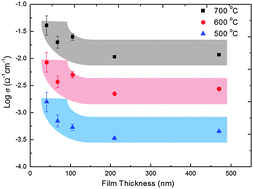
The nano-size effect, which indicates a drastic increase in conductivity in solid electrolyte materials of nano-scale microstructures, has drawn substantial attention in various research fields including in the field of solid oxide fuel cells (SOFCs).

 ‘Illusional’ nano-size effect However, especially in the cases of the conductivity of ultra-thin films measured in an in-plane configuration, it is highly possible that the ‘apparent’ conductivity increase originates from electrical current flowing through other conduction paths than the thin film. As a systematic study to interrogate those measurement artifacts, we report various sources of electrical current leaks regarding in-plane conductivity measurements, specifically insulators in the measurement set-up.
We have observed a ‘great conductivity increase’ up to an order of magnitude at a very thin thickness of a single layer yttria-stabilized zirconia (YSZ) film in a set-up with an intentional artifact current flow source. Here we propose that the nano-size effect, reported to appear in ultra-thin single layer YSZ, can be a result of misinterpretation.

‘Illusional’ nano-size effect due to artifacts of in-plane conductivity measurements of ultra-thin films
Hae-Ryoung Kim, Jong-Cheol Kim, Kyung-Ryul Lee, Ho-Il Ji, Hae-Weon Lee, Jong-Ho Lee and Ji-Won Son
Phys. Chem. Chem. Phys., 2011, DOI: 10.1039/C0CP02673E

Digg This
Reddit This
Stumble Now!
Share on Facebook
Bookmark this on Delicious
Share on LinkedIn
Bookmark this on Technorati
Post on Twitter
Google Buzz (aka. Google Reader)

Mystery of natural sunscreen solved

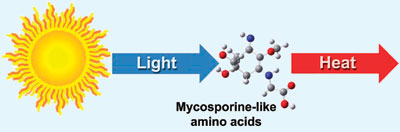
Spanish scientists have established how natural products protect plants from sun damage. The compounds could be used as active ingredients in sunscreens.

Using computational techniques on palythine – a compound found in coral – as a model compound, Diego Sampedro at the University of La Rioja, Logroño, investigated what happens to the molecule after it absorbs UV light.

Mystery of natural sunscreen solved

Sampedro found that when UV light was shone on palythine, the molecule rapidly dissipated the light energy into heat energy without forming reactive, harmful, photoproducts. He looked at the mechanism in detail on both the protonated and neutral forms of palythine, as scientists were unsure which form was active in the coral. He found that both forms underwent a bond rotation to transform light into heat energy, but the protonated form was responsible for the main absorption of the radiation.

Mike Robb of Imperial College, London, an expert in computational chemistry, praises the timeliness of the study. “MAAs are already being studied as industrial photostabilisers. Understanding the details of the mechanism should help in the design of such species”.

Want to find out more?

Read the rest of the Chemistry World story by Yuandi Li

Or view the PCCP article by Diego Sampedro:
Computational exploration of natural sunscreens
Diego Sampedro, Phys. Chem. Chem. Phys., 2011
DOI: 10.1039/c0cp02901g

Digg This
Reddit This
Stumble Now!
Share on Facebook
Bookmark this on Delicious
Share on LinkedIn
Bookmark this on Technorati
Post on Twitter
Google Buzz (aka. Google Reader)