Mattanjah de Vries joins PCCP Advisory Board

Mattanjah de Vries photoPhysical Chemistry Chemical Physics (PCCP) is delighted to announce that Professor Mattanjah de Vries, of the University of California Santa Barbara, has joined the Advisory Board of the journal.

Professor de Vries received his BSc in Physics, Mathematics, and Astronomy from the University of Amsterdam in 1971 and his Masters in Nuclear Physics from the Hebrew University, Jerusalem in 1975. He returned to the University of Amsterdam to study for his PhD in Chemical Physics, graduating in 1980.

His current research covers the use of gas phase techniques to study isolated molecules and the study of fragile organic molecules using laser mass spectrometry.

Professor de Vries latest PCCP article appeared in the themed issue on the Molecular mechanisms of the photostability of life.

Read his exciting research article today:

The effect of C5 substitution on the photochemistry of uracil
Dana Nachtigallová, Hans Lischka, Jaroslaw J. Szymczak, Mario Barbatti, Pavel Hobza, Zsolt Gengeliczki, Gustavo Pino, Michael P. Callahan and Mattanjah S. de Vries
DOI: 10.1039/B925803P

Digg This
Reddit This
Stumble Now!
Share on Facebook
Bookmark this on Delicious
Share on LinkedIn
Bookmark this on Technorati
Post on Twitter
Google Buzz (aka. Google Reader)

Top Ten most-read PCCP articles in November

This month sees the following articles in PCCP that are in the top ten most accessed in November:

Urine utilisation by microbial fuel cells; energy fuel for the future 
Ioannis Ieropoulos, John Greenman and Chris Melhuish 
Phys. Chem. Chem. Phys., 2012, 14, 94-98 
DOI: 10.1039/C1CP23213D 

Physics and chemistry of water and ice 
Carlos Vega, Jose Luis F. Abascal and Pablo G. Debenedetti 
Phys. Chem. Chem. Phys., 2011, 13, 19660-19662 
DOI: 10.1039/C1CP90177J 

Do we fully understand what controls chemical selectivity?
 
Julia Rehbein and Barry K. Carpenter 
Phys. Chem. Chem. Phys., 2011, 13, 20906-20922 
DOI: 10.1039/C1CP22565K 

Nanoconfinement effects in energy storage materials 
Maximilian Fichtner 
Phys. Chem. Chem. Phys., 2011, 13, 21186-21195 
DOI: 10.1039/C1CP22547B 

Graphene-based electrochemical energy conversion and storage: fuel cells, supercapacitors and lithium ion batteries 
Junbo Hou, Yuyan Shao, Michael W. Ellis, Robert B. Moore and Baolian Yi 
Phys. Chem. Chem. Phys., 2011, 13, 15384-15402 
DOI: 10.1039/C1CP21915D 

Simulating water with rigid non-polarizable models: a general perspective 
Carlos Vega and Jose L. F. Abascal 
Phys. Chem. Chem. Phys., 2011, 13, 19663-19688 
DOI: 10.1039/C1CP22168J 

On the nature and signatures of the solvated electron in water 
B. Abel, U. Buck, A. L. Sobolewski and W. Domcke 
Phys. Chem. Chem. Phys., 2012, 14, 22-34 
DOI: 10.1039/C1CP21803D 

Glass transition and phase state of organic compounds: dependency on molecular properties and implications for secondary organic aerosols in the atmosphere 
Thomas Koop, Johannes Bookhold, Manabu Shiraiwa and Ulrich Pöschl 
Phys. Chem. Chem. Phys., 2011, 13, 19238-19255 
DOI: 10.1039/C1CP22617G 

Perspectives of relativistic quantum chemistry: the negative energy cat smiles 
Wenjian Liu 
Phys. Chem. Chem. Phys., 2012, 14, 35-48 
DOI: 10.1039/C1CP21718F 

Density functional theory for transition metals and transition metal chemistry
 
Christopher J. Cramer and Donald G. Truhlar 
Phys. Chem. Chem. Phys., 2009, 11, 10757-10816 
DOI: 10.1039/B907148B 

Why not take a look at the articles today and blog your thoughts and comments below.

Fancy submitting an article to PCCP? Then why not submit to us today!

Digg This
Reddit This
Stumble Now!
Share on Facebook
Bookmark this on Delicious
Share on LinkedIn
Bookmark this on Technorati
Post on Twitter
Google Buzz (aka. Google Reader)

Physical Chemistry Prizes and Awards

Nominations close on the 15 January 2012

Our Prizes and Awards recognise achievements by individuals in advancing the chemical sciences.

Do you know someone who has made an outstanding and innovative contribution to the fields of physical or theoretical chemistry?

Physical Chemistry Prizes and Awards being presented in 2012 are:

Harrison-Meldola Memorial Prizes
Corday-Morgan Prizes
Tilden Prizes
Centenary Prizes
Interdisciplinary Prizes
Faraday Lectureship Prize
Bourke Award
Marlow Award
Chemical Dynamics Award
Surfaces and Interfaces Award
Soft Matter and Biophysical Chemistry Award
Liversidge Award

Showcase inspiring science and gain the recognition deserved – Nominate now

Closing date for nominations is 15 January 2012

Digg This
Reddit This
Stumble Now!
Share on Facebook
Bookmark this on Delicious
Share on LinkedIn
Bookmark this on Technorati
Post on Twitter
Google Buzz (aka. Google Reader)

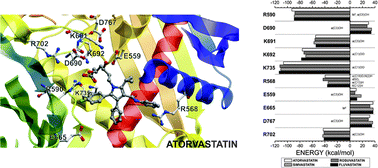
Cheap way to discover new cholesterol drugs

A computational method to design drugs has been developed to design a new range of statins to lower cholesterol.

Patents covering the leading statins have recently expired, including atorvastatin (Lipitor), with more to follow in 2012, so there is a pressure to develop new and more effective statin derivatives for the drug market.

The new method involves using density functional theory to analyse the binding energies of new statins when they are bound to an enzyme involved in cholesterol biosynthesis.

The analysis correlates well with thermodynamic studies and clinical data as these point to rosuvastatin (Crestor) and atorvastatin as the best available statins on the market, say the researchers.

Reference:

Explaining Statin Inhibition Effectiveness of HMG-CoA Reductase by Quantum Biochemistry Computations
R F da Costa, V N Freire, E M Bezerra, B S Cavada, E W S Caetano, J L de Lima Filho and E L Albuquerque
Phys. Chem. Chem. Phys., 2011
DOI: 10.1039/c1cp22824b

PCCP

Digg This
Reddit This
Stumble Now!
Share on Facebook
Bookmark this on Delicious
Share on LinkedIn
Bookmark this on Technorati
Post on Twitter
Google Buzz (aka. Google Reader)

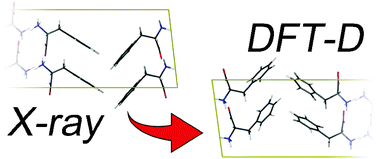
Revealing true crystal structure

‘HOT’ PCCP Communication

In this exciting PCCP Communication dispersion-corrected solid-state density functional theory provides new insights for elucidation of complex organic crystal structures.

Read the ‘HOT’ article now:

Revealing the true crystal structure of L-phenylalanine using solid-state density functional theory
Matthew D. King, Thomas N. Blanton and Timothy M. Korter
Phys. Chem. Chem. Phys., 2012, DOI: 10.1039/C1CP22831E

Digg This
Reddit This
Stumble Now!
Share on Facebook
Bookmark this on Delicious
Share on LinkedIn
Bookmark this on Technorati
Post on Twitter
Google Buzz (aka. Google Reader)

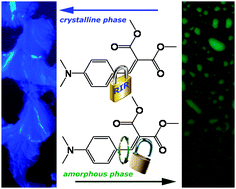
Emissive crystalline materials are worthy of note!

imageWork by Dario Pasini and co-workers on materials which are more emissive in the solid state than in solution, recently published in PCCP has been highlighted in ACS Noteworthy.

The authors believe the compound’s interesting properties can be exploited for sensing and optoelectronic applications.

Read the full exciting article today:

Efficient crystallization induced emissive materials based on a simple push–pull molecular structure
Elena Cariati, Valentina Lanzeni, Elisa Tordin, Renato Ugo, Chiara Botta, Alberto Giacometti Schieroni, Angelo Sironi and Dario Pasini
DOI: 10.1039/C1CP22267H

Digg This
Reddit This
Stumble Now!
Share on Facebook
Bookmark this on Delicious
Share on LinkedIn
Bookmark this on Technorati
Post on Twitter
Google Buzz (aka. Google Reader)

We don’t want you to miss out . . .

Tribology: Faraday Discussion 156
2 – 4 April 2012
University of Southampton, UK

We know a very busy festive season is coming up shortly so this is a gentle reminder that you haven’t taken any action yet about attending Tribology : FD156.

Poster abstract and bursary applications are now invited, and registration is open.

Chemists, physicists, theoreticians, engineers and biomedical researchers will all benefit from joining this forum for exploring advances in all the diverse aspects of experimental techniques which bear directly on the topic of tribology.

To keep up with the way tribology directly affects our lives you need to be part of our wide-ranging discussion. So please don’t miss out – act now before the end of year rush.

P.S. Don’t forget that registering early lets you make savings!

Tribology Faraday Discussion 156 2-4 April 2012 University of Southampton, UK

Digg This
Reddit This
Stumble Now!
Share on Facebook
Bookmark this on Delicious
Share on LinkedIn
Bookmark this on Technorati
Post on Twitter
Google Buzz (aka. Google Reader)

PCCP issue 48 out now!

The latest issue of PCCP has now been published online – take a look today!

Aromaticity, electron delocalisation, and related molecular propertiesIssue 48 features a broad range of papers and Communications and includes the following Perspective articles:

Take a look at the issue today!

Digg This
Reddit This
Stumble Now!
Share on Facebook
Bookmark this on Delicious
Share on LinkedIn
Bookmark this on Technorati
Post on Twitter
Google Buzz (aka. Google Reader)

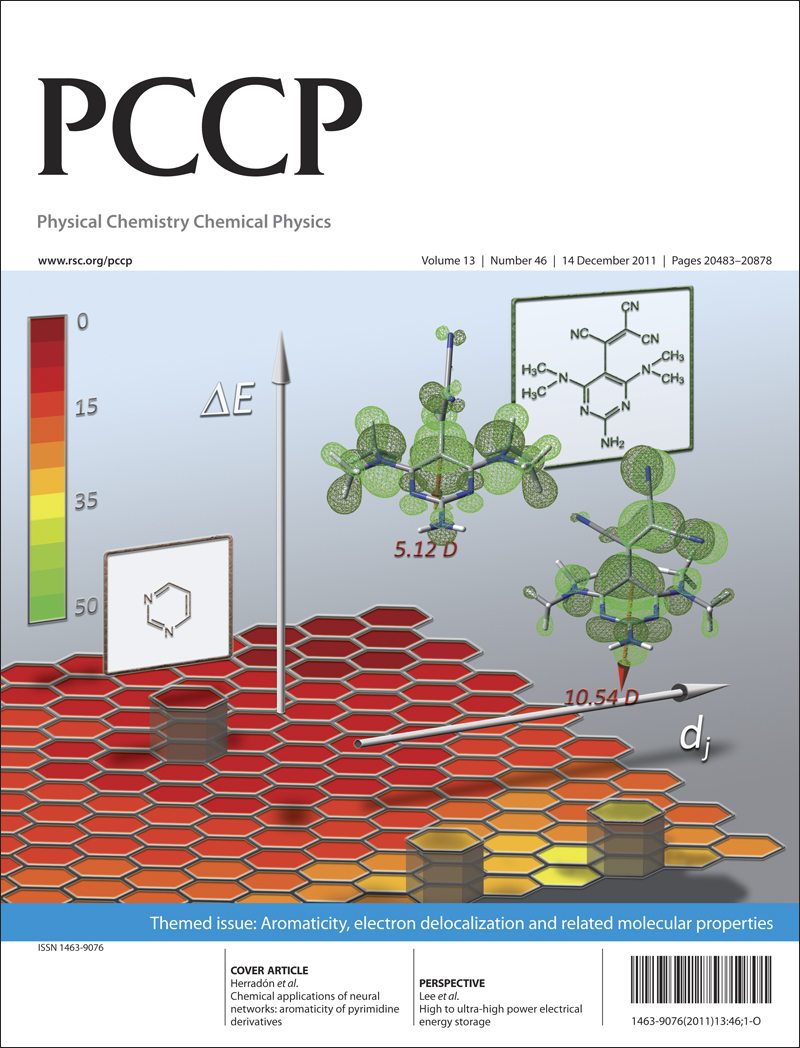
Aromaticity, electron delocalisation, and related molecular properties themed issue out now!

We are delighted to announce that the PCCP themed issue on Aromaticity, electron delocalisation, and related molecular properties has now been published online – take a look today!

The issue was Guest Edited by Professor Dage Sundholm of the University of Helsinki.

The Aromaticity, electron delocalisation, and related molecular properties  themed issue features a broad range of papers and Communications and includes the following Perspective articles:

Take a look at the issue today!

Digg This
Reddit This
Stumble Now!
Share on Facebook
Bookmark this on Delicious
Share on LinkedIn
Bookmark this on Technorati
Post on Twitter
Google Buzz (aka. Google Reader)

Interfaces with Ionic Liquids themed issue – deadline 30 November

The deadline is now approaching for submissions to the high-profile PCCP themed collection on “Interfaces with Ionic Liquids“, with Guest Editor Frank Endres.

Submission Deadline : 30 November 2011

This will be the official themed issue of the international Bunsentagung 2012 meeting on the theme of “Ionic Liquids” organised by the Deutsche Bunsen-Gesellschaft which takes place from 17-19 May 2012 in Leipzig, Germany.  We will be freely distributing the printed themed issue at this meeting, maximising the visibility and profile of all published papers.

We invite you to submit a high quality manuscript of original, unpublished research with a focus on the interfaces of ionic liquids with gas/vacuum, solid surfaces and other liquids, both experimental and theoretical aspects. All submissions will be subject to rigorous peer review to meet the high standards of PCCP. Further details about PCCP can be found on our website www.rsc.org/pccp.

When you submit your article, please indicate that it is for the themed issue.

Digg This
Reddit This
Stumble Now!
Share on Facebook
Bookmark this on Delicious
Share on LinkedIn
Bookmark this on Technorati
Post on Twitter
Google Buzz (aka. Google Reader)