The UK-Asia International Symposium on Organic Optoelectronics will be held at the Institute of Chemistry, Chinese Academy of Sciences, Beijing on the 9-11 December 2013. More details of the excellent speakers on the website. Free online registration here.
This week’s HOT articles
You can take a look at the excellent articles we have selected this week by clicking on the links below:
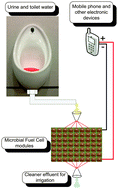
Waste to real energy: the first MFC powered mobile phone
Ioannis A. Ieropoulos, Pablo Ledezma, Andrew Stinchcombe, George Papaharalabos, Chris Melhuish and John Greenman
DOI: 10.1039/C3CP52889H
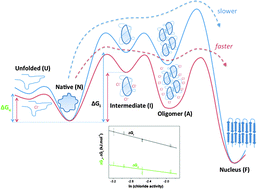
Modulation of the stability of amyloidogenic precursors by anion binding strongly influences the rate of amyloid nucleation
David Ruzafa, Francisco Conejero-Lara and Bertrand Morel
DOI: 10.1039/C3CP52313F
Electron transfer with azurin at Au–SAM junctions in contact with a protic ionic melt: impact of glassy dynamics
Dimitri E. Khoshtariya, Tina D. Dolidze, Tatyana Tretyakova, David H. Waldeck and Rudi van Eldik
DOI: 10.1039/C3CP51896E
Stabilizing effect of electrostatic vs. aromatic interactions in diproline nucleated peptide β-hairpins
Kamlesh Madhusudan Makwana, Srinivasarao Raghothama and Radhakrishnan Mahalakshmi
DOI: 10.1039/C3CP52770K
Accurate adsorption energies of small molecules on oxide surfaces: CO–MgO(001)
A. Daniel Boese and Joachim Sauer
DOI: 10.1039/C3CP52321G
Solution-processed small molecule:fullerene bulk-heterojunction solar cells: impedance spectroscopy deduced bulk and interfacial limits to fill-factors
Antonio Guerrero, Stephen Loser, Germà Garcia-Belmonte, Carson J. Bruns, Jeremy Smith, Hiroyuki Miyauchi, Samuel I. Stupp, Juan Bisquert and Tobin J. Marks
DOI: 10.1039/C3CP52363B
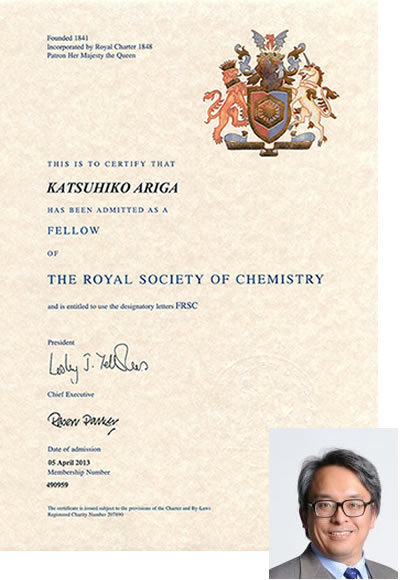
Katsuhiko Ariga Admitted as a Fellow of the Royal Society of Chemistry
PCCP Associate Editor Katsuhiko Ariga has been admitted as a Fellow of the Royal Society of Chemistry.

Professor Ariga is a Principal Investigator at MANA and is the Director of Supermolecules Group at the National Institute for Materials Science (NIMS) in Japan. His research covers supermolecular chemistry and surface science, including the boundaries between organic chemistry, physical chemistry, biochemistry, and materials chemistry. He is well-known for his work on supramolecular recognition at interfaces and on biomimetic systems.
Submit your work to Professor Ariga’s Editorial Office.
Check out Ariga’s recent Perspective article in PCCP:
Amphiphile nanoarchitectonics: from basic physical chemistry to advanced applications
Muruganathan Ramanathan, Lok Kumar Shrestha, Taizo Mori, Qingmin Ji, Jonathan P. Hill and Katsuhiko Ariga
Phys. Chem. Chem. Phys., 2013,15, 10580-10611
DOI: 10.1039/C3CP50620G, Perspective
This week’s HOT articles
These articles are HOT as recommended by the referees…
You can take a look at the excellent articles we have selected this week by clicking on the links below:
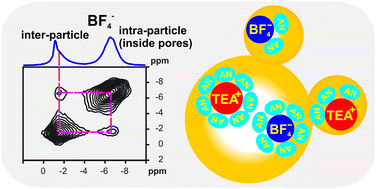
Interaction of electrolyte molecules with carbon materials of well-defined porosity: characterization by solid-state NMR spectroscopy
Lars Borchardt, Martin Oschatz, Silvia Paasch, Stefan Kaskel and Eike Brunner
DOI: 10.1039/C3CP52283K
CuOx–TiO2 junction: what is the active component for photocatalytic H2 production?
Zhonglei Wang, Yuanxu Liu, David James Martin, Wendong Wang, Junwang Tang and Weixin Huang
DOI: 10.1039/C3CP52496E
The surprising truth about the dominance of hardness in acid-base reactions

Victoria Wilton is a guest web-writer for PCCP. She is currently studying for a PhD at the University of Nottingham, UK.
When I was perusing the ‘recently published’ pages for something to write about, I was moderately surprised to stumble on this article. It immediately caught my eye as being unlike anything I’d ever seen in PCCP before and I was curious. My curiosity was well rewarded. Cardenas and Ayers have taken one of the more infamously qualitative principles of synthetic chemistry and relatively successfully attempted to quantify and assess its validity, something I have no doubt that the synthetic community will be thrilled to hear.
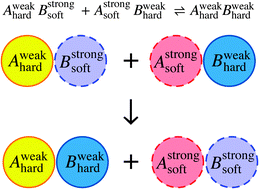
Although the broad concept of acid-base chemistry is familiar to anyone with a science GCSE, it’s more subtle nuances tend only to be revealed at a higher level. Acids and bases are described as having both a strength and an independent hardness, both of which are purely qualitative. Traditionally, strong acids and bases displace their weak counterparts, and hard acids and bases stick together. So far so good, but because these two traits are independent of one another, the two principles can sometimes be conflicting. Strong acids tend to be hard, and strong bases tend to be soft, but this does not always hold true.
Cardenas and Ayers characterise all acid-base reactions into four cases. In two of these, the hardness and strength principles reinforce each other, and in the other two they are opposed. They investigate which rule wins out in each case, and to what extent it dominates. Their findings are surprising and exciting, and could really have a serious impact as they provide a good deal of clarity to this issue. Reading this is highly recommended.
How reliable is the hard–soft acid–base principle? An assessment from numerical simulations of electron transfer energies
Carlos Cárdenas and Paul W. Ayers
Phys. Chem. Chem. Phys., 2013, 15, 13959-13968
DOI: 10.1039/C3CP51134K
by Victoria Wilton
This week’s HOT articles
These articles are HOT as recommended by the referees…
You can take a look at the excellent articles we have selected this week by clicking on the links below:
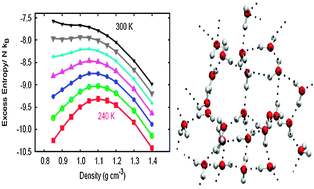
Water and water-like liquids: relationships between structure, entropy and mobility
Divya Nayar and Charusita Chakravarty
DOI: 10.1039/C3CP51114F

Self assembled materials: design strategies and drug delivery perspectives
Gunjan Verma and P. A. Hassan
DOI: 10.1039/C3CP51207J

Resonance optical manipulation of nano-objects based on nonlinear optical response
Tetsuhiro Kudo and Hajime Ishihara
DOI: 10.1039/C3CP51969D
If everything is chemistry then I need to do chemistry
Chemistry World Editor Jennifor Newton interviewed Cafer Yavuz from KAIST about his career in Chemistry including his exciting research on materials for carbon dioxide capture.
Read the interview in Chemistry World here: http://www.rsc.org/chemistryworld/2013/08/interview-cafer-yavuz-carbon-dioxide-capture
Read Yavuz’s recent article in PCCP:
Limitations and high pressure behavior of MOF-5 for CO2 capture
Joo Young Jung, Ferdi Karadas, Sonia Zulfiqar, Erhan Deniz, Santiago Aparicio, Mert Atilhan, Cafer T. Yavuz and Seung Min Han
DOI: 10.1039/C3CP51768C, Paper
PCCP themed issue: Fundamental Processes in Semiconductor Nanocrystals
Fundamental Processes in Semiconductor Nanocrystals
Guest Editors: Efrat Lifshitz (Technion) and Laurens Siebbeles (TU Delft)
PCCP is delighted to announce a high-profile themed issue ‘Fundamental Processes in Semiconductor Nanocrystals’.
The themed issue will be published in Physical Chemistry Chemical Physics (PCCP) in 2014, and will receive great exposure. The issue will get significant promotion at the NanoGe meeting “Fundamental Processes in semiconductor nanocrystals” to be held from 8 to 10 September 2014 in Oxford, UK.
Semiconductor nanocrystals (NCs), known for their tuneable electronic band structure, have been at the centre of significant interest over two decades, owing to potential application in various opto-electronic devices and biological platforms.
Please contact the PCCP Editorial Office (pccp-rsc@rsc.org) if you are interested in contributing to this themed issue. The deadline for submissions to the themed issue is 31st March 2014
This week’s HOT articles
These articles are HOT as recommended by the referees…
You can take a look at the excellent articles we have selected this week by clicking on the links below:
14 N solid-state NMR: a sensitive probe of the local order in zeolites
Eddy Dib, Tzonka Mineva, Philippe Gaveau and Bruno Alonso
DOI: 10.1039/C3CP51845K
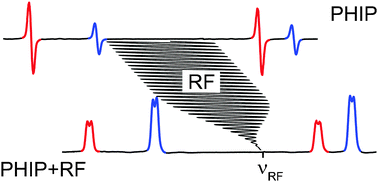
Manipulating spin hyper-polarization by means of adiabatic switching of a spin-locking RF-field
Alexey S. Kiryutin, Konstantin L. Ivanov, Alexandra V. Yurkovskaya, Hans-Martin Vieth and Nikita N. Lukzen
DOI: 10.1039/C3CP52061G
This week’s HOT articles
These articles are HOT as recommended by the referees…
You can take a look at the excellent articles we have selected this week by clicking on the links below:
DNA photoreacts by nucleobase ring cleavage to form labile isocyanates
Laura Buschhaus, Josefin Rolf and Karl Kleinermanns
DOI: 10.1039/C3CP51552D
Emerging applications of conjugated polymers in molecular imaging
Junwei Li, Jie Liu, Chen-Wei Wei, Bin Liu, Matthew O’Donnell and Xiaohu Gao
DOI: 10.1039/C3CP51763B
Sensitized excited free-radical processes as read–write tools: impact on non-linear lithographic processes
Stefania Impellizzeri, Kevin G. Stamplecoskie and Juan. C. Scaiano
DOI: 10.1039/C3CP51723C