This week’s HOT articles

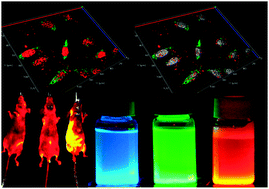
Take a look at this week’s HOT articles, which are free to access for a limited time: Graphical abstract: A primer on the synthesis, water-solubilization, and functionalization of quantum dots, their use as biological sensing agents, and present status

A primer on the synthesis, water-solubilization, and functionalization of quantum dots, their use as biological sensing agents, and present status
Christina Marie Tyrakowski and Preston Todd Snee
DOI: 10.1039/C3CP53502A, Perspective

Hydrogen defects in tetragonal ZrO2 studied using density functional theory
Mostafa Youssef and Bilge Yildiz
DOI: 10.1039/C3CP54153C, Paper

Mode-specific vibrational relaxation of photoexcited guanosine 5′-monophosphate and its acid form: a femtosecond broadband mid-IR transient absorption and theoretical study
Yuyuan Zhang, Roberto Improta and Bern Kohler
DOI: 10.1039/C3CP53815J, Paper

The binding mechanisms of intrinsically disordered proteins
Jakob Dogan, Stefano Gianni and Per Jemth
DOI: 10.1039/C3CP54226B, Perspective

Digg This
Reddit This
Stumble Now!
Share on Facebook
Bookmark this on Delicious
Share on LinkedIn
Bookmark this on Technorati
Post on Twitter
Google Buzz (aka. Google Reader)

This week’s HOT articles

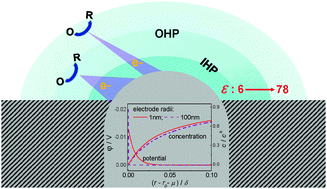
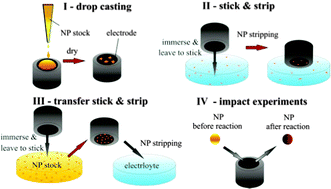
Take a look at this week’s HOT articles, which are free to access for a limited time: Graphical abstract: Electrochemistry at nanometer-sized electrodes

Electrochemistry at nanometer-sized electrodes
Shengli Chen and Yuwen Liu
DOI: 10.1039/C3CP53773K, Perspective

Nanoscale resolution scanning thermal microscopy using carbon nanotube tipped thermal probes
Peter D. Tovee, Manuel E. Pumarol, Mark C. Rosamond, Robert Jones, Michael C. Petty, Dagou A. Zeze and Oleg V. Kolosov
DOI: 10.1039/C3CP53047G, Paper

Digg This
Reddit This
Stumble Now!
Share on Facebook
Bookmark this on Delicious
Share on LinkedIn
Bookmark this on Technorati
Post on Twitter
Google Buzz (aka. Google Reader)

Advancing the chemistry of the f-elements (Dalton Discussion 14) – final chance to submit

Advancing the Chemistry of the Actinides:DD14

Advancing the chemistry of the f-elements (Dalton Discussion 14) – final chance to submit

The oral abstract deadline for Advancing the chemistry of the f-elements (Dalton Discussion 14) is almost upon us. Take advantage of this exceptional opportunity to showcase your work at this truly interactive event and submit before Monday 2 December 2013.

For full details on Advancing the chemistry of the f-elements (Dalton Discussion 14), please visit the dedicated website.

Digg This
Reddit This
Stumble Now!
Share on Facebook
Bookmark this on Delicious
Share on LinkedIn
Bookmark this on Technorati
Post on Twitter
Google Buzz (aka. Google Reader)

PCCP themed issue: Size Selected Clusters and Particles: From Physical Chemistry to Catalysis

PCCP themed issue: Size Selected Clusters and Particles: From Physical Chemistry to Catalysis

Guest Editors: Stefan Vajda (Argonne National Laboratory) and Jeroen van Bokhoven (ETH Zürich)

Deadline for Submissions: 16th May 2014

Physical Chemistry Chemical Physics (PCCP) is delighted to announce a high-profile themed issue ‘Size Selected Clusters and Particles: From Physical Chemistry to Catalysis’.

Please do let us know if you are interested in contributing to this themed issue by emailing the PCCP Editorial Office (pccp-rsc@rsc.org). We look forward to hearing from you.

The themed issue will be published in PCCP in 2014. It will receive great exposure, and get significant promotion.

PCCP is a high-impact, community spanning, international journal publishing work of the highest quality in the broad fields of physical chemistry, chemical physics and biophysical chemistry.
Ultrasmall clusters and particles consist of dominantly under-coordinated surface atoms, but the ratio of facet to corner and edge atoms increases with growing size. The variety and controllability of surface or binding-site atoms offers an excellent tuning knob to optimize binding, reactivity and catalytic properties. Moreover, small particles facilitate reaction pathways that are not feasible on extended rigid surfaces, because they can undergo dynamical structural changes.

This themed issue aims to address the need for the fundamental understanding of the evolution of physicochemical and catalytic properties of matter starting with small subnanometer size clusters that consist of only a handful of atoms, up to particles nanometers in size. Both experimental and computational contributions are welcome.

Please note that:

  • Submissions must contain new physical insight and should be high quality manuscripts of original, unpublished research.
  • Communications and full papers can be submitted for consideration.
  • If you are interested in submitting a ‘PCCP Perspective-review’ article this themed issue, please get in touch with the Editorial Office for more information about Perspective articles.
  • Manuscripts can be submitted in any reasonable format using our online submissions service.
  • You should indicate upon submission that your manuscript is intended for this themed issue.
  • All submissions will be subject to an initial assessment by the editors and, if appropriate, rigorous peer review.

The deadline for submissions to the themed issue is 16th May 2014, although submissions before this date are of course welcomed.

Digg This
Reddit This
Stumble Now!
Share on Facebook
Bookmark this on Delicious
Share on LinkedIn
Bookmark this on Technorati
Post on Twitter
Google Buzz (aka. Google Reader)

This week’s HOT article

Take a look at this week’s HOT article, which is free to access for a limited time: Graphical abstract: Electrochemical studies of silver nanoparticles: a guide for experimentalists and a perspective

Electrochemical studies of silver nanoparticles: a guide for experimentalists and a perspective
Kristina Tschulik, Christopher Batchelor-McAuley, Her-Shuang Toh, Emma J. E. Stuart and Richard G. Compton
DOI: 10.1039/C3CP54221A, Perspective

Digg This
Reddit This
Stumble Now!
Share on Facebook
Bookmark this on Delicious
Share on LinkedIn
Bookmark this on Technorati
Post on Twitter
Google Buzz (aka. Google Reader)

This week’s HOT articles

Take a look at this week’s HOT article, which is free to access for a limited time:
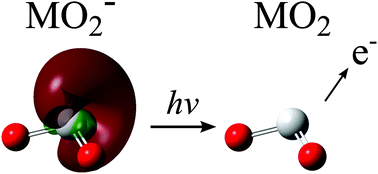
Graphical abstract: High-resolution anion photoelectron spectra of TiO2−, ZrO2−, and HfO2− obtained by slow electron velocity-map imaging

High-resolution anion photoelectron spectra of TiO2−, ZrO2−, and HfO2− obtained by slow electron velocity-map imaging
Jongjin B. Kim, Marissa L. Weichman and Daniel M. Neumark
DOI: 10.1039/C3CP54084G, Paper

A conformational factorisation approach for estimating the binding free energies of macromolecules
Kenji Mochizuki, Chris S. Whittleston, Sandeep Somani, Halim Kusumaatmaja and David J. Wales
DOI: 10.1039/C3CP53537A, Paper

Detection of a charge-separated catalyst precursor state in a linked photosensitizer-catalyst assembly
Anusree Mukherjee, Oleksandr Kokhan, Jier Huang, Jens Niklas, Lin X. Chen, David M. Tiede and Karen L. Mulfort
DOI: 10.1039/C3CP54420F, Paper

Free energy barriers for CO2 and N2 in zeolite NaKA: an ab initio molecular dynamics approach
Amber Mace, Kari Laasonen and Aatto Laaksonen
DOI: 10.1039/C3CP52821A, Paper

Digg This
Reddit This
Stumble Now!
Share on Facebook
Bookmark this on Delicious
Share on LinkedIn
Bookmark this on Technorati
Post on Twitter
Google Buzz (aka. Google Reader)

New Insight into Surface Charge Behaviour in C60

Victoria Parkes is a guest web-writer for PCCP. She is currently studying for a PhD at the University of Nottingham, UK.

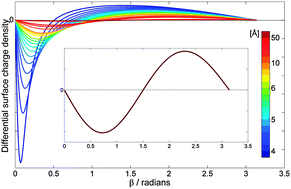
There can be no doubt that fullerene research is both interesting and varied; we have created carbon nanotubes from them, we can put things inside them, they have diverse medical uses, and recently evidence has been presented suggesting that they are found in space.  In this paper, Raggi et al. take a computational approach to investigate the dielectric properties of C60, the smallest of the fullerene family, and the first to be predicted and discovered.

Table of contents imageThe results of their study are quite striking. They found that by varying the distance between the fullerene and the point charge, the surface charge density of C60 can be manipulated. In other words, they predict that one could selectively polarise a fullerene molecule to a greater or lesser extent. They were also able to predict the separation parameters necessary in order to achieve this, including identifying the tipping point at which the charge distribution is expressed as a purely positive hemisphere and a purely negative hemisphere.
This study has important implications for future studies into fullerenes as it demonstrates that assuming a uniform surface charge density can only be valid above a certain threshold separation from the point charge. As well as being important to the understanding of fullerene-ion collisions, this new insight could potentially lead towards an understanding of fullerene fission mechanisms.

by Victoria Parkes

Read the full details of this exciting research in PCCP:

Surface-charge distribution on a dielectric sphere due to an external point charge: examples of C60 and C240 fullerenes
Gerardo Raggi, Anthony J. Stace and Elena Bichoutskaia
DOI: 10.1039/C3CP53522C

Digg This
Reddit This
Stumble Now!
Share on Facebook
Bookmark this on Delicious
Share on LinkedIn
Bookmark this on Technorati
Post on Twitter
Google Buzz (aka. Google Reader)

This week’s HOT article

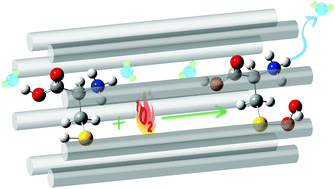
Take a look at this week’s HOT article, which is free to access for a limited time: Oxidation of gas-phase hydrated protonated/deprotonated cysteine: how many water ligands are sufficient to approach solution-phase photooxidation chemistry?

Oxidation of gas-phase hydrated protonated/deprotonated cysteine: how many water ligands are sufficient to approach solution-phase photooxidation chemistry?
Fangwei Liu, Rifat Emre, Wenchao Lu and Jianbo Liu
DOI: 10.1039/C3CP53736F, Paper

Digg This
Reddit This
Stumble Now!
Share on Facebook
Bookmark this on Delicious
Share on LinkedIn
Bookmark this on Technorati
Post on Twitter
Google Buzz (aka. Google Reader)

PCCP themed collection: Recent Developments in Metal-Enhanced Fluorescence – out now!

Metal Enhanced Fluorescence Editoral CoverWe are delighted to announce that the PCCP themed collection on Recent Developments in Metal-Enhanced Fluorescence has now been published online – take a look today!

The themed collection was Guest Edited by Chris D. Geddes.

The cover article is an editorial on Metal-enhanced fluorescence by Chris D. Geddes.

Recent Developments in Metal-Enhanced Fluorescence themed collection features a broad range of Papers and Communications and features the following Perspective articles:

Take a look at the collection today!

Digg This
Reddit This
Stumble Now!
Share on Facebook
Bookmark this on Delicious
Share on LinkedIn
Bookmark this on Technorati
Post on Twitter
Google Buzz (aka. Google Reader)

A focus on Canada

Physical Chemistry Chemical Physics (PCCP) is proud to be a Society journal and is co-owned by 18 national chemical societies, including the Canadian Society for Chemistry (CSC). The journal is published by the Royal Society of Chemistry on a not-for-profit basis for the benefit of the whole scientific community.

Did you know that owner Societies receive a royalty every time the journal publishes an article by a researcher based in the Owner Society’s country?

PCCP is committed to publishing the best Canadian research in the broad fields of physical chemistry, chemical physics and biophysical chemistry. We have leading Canadian scientists on our international Advisory, Honorary and Ownership Boards: John Polanyi, Roman Krems, Ruth Signorell and Bruce Lennox.

On behalf of all our Board Members we invite you to submit your best work to PCCP.

Why publish in PCCP?

  • Large community-spanning international readership
  • Very efficient, rigorous and fair peer review procedure
  • High impact factor: 3.83
  • No author page charges
  • No colour charges

So you can see for yourself the quality of work appearing in PCCP, we have collected together some recently published articles from authors based in Canada, with a selection available to read for free for a limited period.

Perspectives:

FREE: Organic n-type materials for charge transport and charge storage applications
Monika Stolar and Thomas Baumgartner
DOI: 10.1039/C3CP51379C

FREE: Adsorption of DNA onto gold nanoparticles and graphene oxide: surface science and applications
Juewen Liu
DOI: 10.1039/C2CP41186E

FREE: Computational methodologies and physical insights into electronic energy transfer in photosynthetic light-harvesting complexes
Leonardo A. Pachón and Paul Brumer
DOI: 10.1039/C2CP40815E

FREE: Plasmon enhanced spectroscopy
Ricardo F. Aroca
DOI: 10.1039/C3CP44103B

FREE: A critical perspective on molecular electronic junctions: there is plenty of room in the middle
Richard L. McCreery, Haijun Yan and Adam Johan Bergren
DOI: 10.1039/C2CP43516K

Original research:

FREE: Anharmonic vibrations of the carboxyl group in acetic acid on TiO2: implications for adsorption mode assignment in dye-sensitized solar cells
Matthew Chan, Tucker Carrington and Sergei Manzhos
DOI: 10.1039/C3CP00065F

FREE: Sodium-doping as a reference to study the influence of intracluster chemistry on the fragmentation of weakly-bound clusters upon vacuum ultraviolet photoionization
Jessica H. Litman, Bruce L. Yoder, Bernhard Schläppi and Ruth Signorell
DOI: 10.1039/C2CP43098C

FREE: Unraveling the internal dynamics of the benzene dimer: a combined theoretical and microwave spectroscopy study
Melanie Schnell, Undine Erlekam, P. R. Bunker, Gert von Helden, Jens-Uwe Grabow, Gerard Meijer and Ad van der Avoird
DOI: 10.1039/C3CP51181B

FREE: pH in atomic scale simulations of electrochemical interfaces
Jan Rossmeisl, Karen Chan, Rizwan Ahmed, Vladimir Tripković and Mårten E. Björketun
DOI: 10.1039/C3CP51083B

FREE: Quantitative investigations of quantum coherence for a light-harvesting protein at conditions simulating photosynthesis
Daniel B. Turner, Rayomond Dinshaw, Kyung-Koo Lee, Michael S. Belsley, Krystyna E. Wilk, Paul M. G. Curmi and Gregory D. Scholes
DOI: 10.1039/C2CP23670B

FREE: Solvatochromic investigation of highly fluorescent 2-aminobithiophene derivatives
Andréanne Bolduc, Yanmei Dong, Amélie Guérin and W. G. Skene
DOI: 10.1039/C2CP40293A

FREE: Vibrational cooling, heating, and instability in molecular conducting junctions: full counting statistics analysis
Lena Simine and Dvira Segal
DOI: 10.1039/C2CP40851A

Digg This
Reddit This
Stumble Now!
Share on Facebook
Bookmark this on Delicious
Share on LinkedIn
Bookmark this on Technorati
Post on Twitter
Google Buzz (aka. Google Reader)