Archive for the ‘Themed Issue’ Category

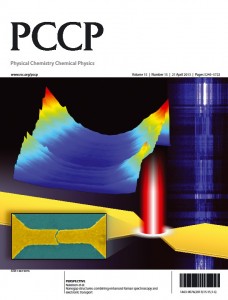
PCCP themed collection: Plasmonics and spectroscopy – out now!

We are delighted to announce that the PCCP themed collection on Plasmonics and spectroscopy now been published online – take a look today!

The themed collection was Guest Edited by Pablo G. Etchegoin – read his Editorial for this issue.

The outside front cover features a perspective article on Nanogap structures: combining enhanced Raman spectroscopy and electronic transport by Douglas Natelson, Yajing Li and Joseph B. Herzog.

Plasmonics and spectroscopy themed collection features a broad range of Papers and Communications and includes the following Perspective articles:

Single-molecule surface-enhanced Raman spectroscopy: a perspective on the current status
Hae Mi Lee, Seung Min Jin, Hyung Min Kim and Yung Doug Suh
DOI: 10.1039/C3CP44463E

Towards low-cost flexible substrates for nanoplasmonic sensing
Lakshminarayana Polavarapu and Luis M. Liz-Marzán
DOI: 10.1039/C2CP43642F

Persistent misconceptions regarding SERS
Martin Moskovits
DOI: 10.1039/C2CP44030J

Recent developments and future directions in SERS for bioanalysis
Mhairi M. Harper, Kristy S. McKeating and Karen Faulds
DOI: 10.1039/C2CP43859C

Medical applications of surface-enhanced Raman scattering
Wei Xie and Sebastian Schlücker
DOI: 10.1039/C3CP43858A

Super-resolution imaging of interactions between molecules and plasmonic nanostructures
Katherine A. Willets
DOI: 10.1039/C3CP43882A

Plasmon enhanced spectroscopy
Ricardo F. Aroca
DOI: 10.1039/C3CP44103B

Take a look at the issue today!

Digg This
Reddit This
Stumble Now!
Share on Facebook
Bookmark this on Delicious
Share on LinkedIn
Bookmark this on Technorati
Post on Twitter
Google Buzz (aka. Google Reader)

PCCP themed issue: Superresolution imaging and fabrication with light – deadline approaching

Superresolution imaging and fabrication with light
Guest Editors: Françisco M. Raymo (University of Miami, USA)

Deadline for Submissions: 8 April 2013

Submit using our online submission service

There is still time to contribute to the high-profile themed issue ‘Superresolution imaging and fabrication with light’.

The themed issue will be published in PCCP in  2013. It will receive great exposure, and get significant promotion.

It is essential that all submissions to PCCP should contain new physical insight and contributions to this themed collection will be assessed on this basis.

  • Manuscripts can be submitted in any reasonable format using our online submissions service
  • Submissions should be high quality manuscripts of original, unpublished research
  • Communications and full papers can be submitted for consideration, which will be subject to rigorous peer review
  • Please indicate upon submission that your manuscript is intended for this themed is intended for the themed issue

Please contact the PCCP Editorial Office to let us know you plan to contribute an article.

Digg This
Reddit This
Stumble Now!
Share on Facebook
Bookmark this on Delicious
Share on LinkedIn
Bookmark this on Technorati
Post on Twitter
Google Buzz (aka. Google Reader)

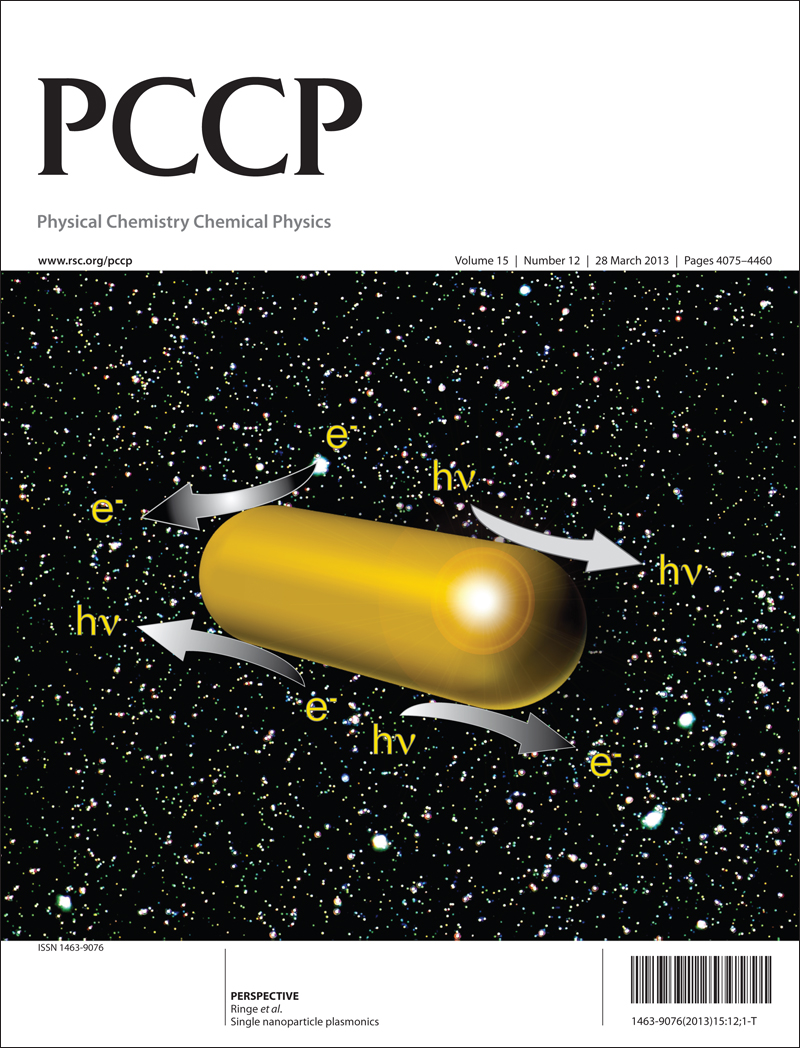
Optical studies of single metal nanoparticles themed collection out now!

We are delighted to announce that the PCCP themed collection on Optical studies of single metal nanoparticles has now been published online – take a look today!

The themed collection was Guest Edited by Greg Hartland, Hiromi Okamoto, Michel Orrit and Peter Zijlstra – read their Editorial for this issue.

Optical studies of single metal nanoparticles themed collection features a broad range of Papers and Communications and includes the following Perspective and Hot articles:

Spectral properties and electromagnetic field enhancement effects on nano-engineered metallic nanoparticles
Kosei Ueno and Hiroaki Misawa

Optical properties of single coupled plasmonic nanoparticles
Lianming Tong, Hong Wei, Shunping Zhang, Zhipeng Li and Hongxing Xu

Single nanoparticle plasmonics
Emilie Ringe, Bhavya Sharma, Anne-Isabelle Henry, Laurence D. Marks and Richard P. Van Duyne

Surface plasmon coupling in end-to-end linked gold nanorod dimers and trimers
Jatish Kumar ,  Xingzhan Wei ,  Steven Barrow ,  Alison M. Funston ,  K. George Thomas and Paul Mulvaney 
 
Damping of the acoustic vibrations of a suspended gold nanowire in air and water environments
Todd A. Major ,  Aurélien Crut ,  Bo Gao ,  Shun Shang Lo ,  Natalia Del Fatti ,  Fabrice Vallée and Gregory V. Hartland

Nanoparticle surface electromagnetic fields studied by single-particle nonlinear optical spectroscopy
Manabendra Chandra and Kenneth L. Knappenberger 

Hyperspectral darkfield microscopy of single hollow gold nanoparticles for biomedical applications
Natasha Fairbairn ,  Agathi Christofidou ,  Antonios G. Kanaras ,  Tracey A. Newman and Otto L. Muskens

Take a look at the issue today!

Digg This
Reddit This
Stumble Now!
Share on Facebook
Bookmark this on Delicious
Share on LinkedIn
Bookmark this on Technorati
Post on Twitter
Google Buzz (aka. Google Reader)

The surprising chemistry of the noble gases

The inherent lack of reactivity of the noble gases is so entrenched in the collective mind of the population, that even though noble gas containing compounds have been known for decades, the identification of new ones is still extremely exciting. I was therefore delighted to come across this particular article in PCCP.

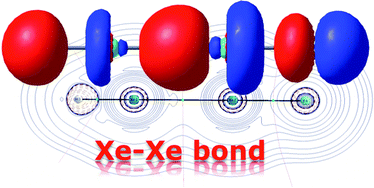
Fernández and Frenking conducted a theoretical investigation into the stability and nature of the bonding involved in two classes of compounds containing a Xe-Xe bond. No species from either of the two groups, HXeXeX (where X=halogen) and RXeXeR’ (where R and R’ are both halogens), have ever been observed experimentally, and based on their results, several compounds for which this might be possible were identified.

The strong correlation observed between Xe-Xe bond length and the energy barrier to decomposition suggests that the strength of this bond plays a vital role in the stability of the molecule. Both of these characteristics were shown to decrease with increasing halogen mass, and generally indicated stronger bonding and greater stability in the RXeXeR’ molecules compared with HXeXeX. On this basis, HXeXeF and FXeXeF were proposed as the most viable compounds for experimental isolation.

The former was shown to be the result of two electrostatically bonded fragments, HXeXe+ –F, with a strong covalent H-Xe bond. The positive charge is shared over the two Xe atoms, with the smaller proportion on the Xe next to the F atom. The Xe-Xe bond in this case is thought to be primarily electrostatic, and involve only the px orbital. By analogy, FXeXeF could either be formed of similar electrostatically bonded fragments, or through the interaction of two FXe· radicals. The calculations pointed to contributions from both mechanisms, with a small but significant bias toward radical interaction.

This research represents another step in unravelling and understanding the complicated and often surprising chemistry of the noble gases. It would therefore be marvellous to see experimental confirmation of their findings in the future.

By Victoria Wilton

Read the full details of this fascinating article which was published as part of the PCCP themed issue on Predicting new molecules by quantum chemical methods:

Neutral noble gas compounds exhibiting a Xe–Xe bond: structure, stability and bonding situation
Israel Fernández and Gernot Frenking
DOI: 10.1039/C2CP41244F

Digg This
Reddit This
Stumble Now!
Share on Facebook
Bookmark this on Delicious
Share on LinkedIn
Bookmark this on Technorati
Post on Twitter
Google Buzz (aka. Google Reader)

PCCP themed issue: Superresolution imaging and fabrication with light

Superresolution imaging and fabrication with light
Guest Editors: Françisco M. Raymo (University of Miami, USA)

PCCP is delighted to announce the high-profile themed issue ‘Superresolution imaging and fabrication with light’. It is our pleasure to invite you to submit to this themed issue.

The themed issue will be published in PCCP in  2013 and will be promoted to the community throughout the year to maximise the visibility of the work published.

Deadline for Submissions: 8 April 2013

Diffraction prevents the focusing of light within volumes of subwavelength dimensions. As a result, this unavoidable physical phenomenon limits the resolution of imaging and lithographic techniques based on far-field optics. In order to overcome these stringent limitations, significant research efforts have been directed, over the past decade, to the identification of protocols to overcome diffraction.

Some of these methods rely on the photochemical and photophysical properties of engineered chromophores to circumvent diffraction. These clever operating principles have already succeeded in bringing the resolution of fluorescence imaging and photolithography down to the nanoscale. Indeed, they are starting to impact biomedical research and, presumably, will soon have similar implications in information technology.

Thus it is timely to publish a themed collection in PCCP on this emerging and extremely promising area of research. The themed collection will provide a general overview of the fundamental principles of these strategies as well as covering optical imaging and fabrication at the nanoscale.

It is essential that all submissions to PCCP should contain new physical insight and contributions to this themed collection will be assessed on this basis.

  • Manuscripts can be submitted in any reasonable format using our online submissions service
  • Submissions should be high quality manuscripts of original, unpublished research
  • Communications and full papers can be submitted for consideration, which will be subject to rigorous peer review
  • Please indicate upon submission that your manuscript is intended for this themed is intended for the themed issue

Please contact the PCCP Editorial Office to let us know you plan to contribute an article.

Digg This
Reddit This
Stumble Now!
Share on Facebook
Bookmark this on Delicious
Share on LinkedIn
Bookmark this on Technorati
Post on Twitter
Google Buzz (aka. Google Reader)

Physical-chemistry at the cross-road of advanced oxide materials

PCCP themed issue: call for papers

Physical-chemistry at the cross-road of advanced oxide materials
Guest Editors: Flora Boccuzzi (University of Torino), Leonardo Marchese (University of Piemonte Orientale “A. Avogadro”) and Gianmario Martra (University of Torino)

PCCP is delighted to announce the high-profile themed issue on advanced oxide materials. It is our pleasure to invite you to submit to this themed issue.

The themed issue will be published in PCCP in  2013 and will be promoted to the community throughout the year to maximise the visibility of the work published.

Deadline for Submissions: 18 March 2013

Oxide-based materials have been largely studied for their catalytic, electronic or adsorbent properties. Since the early 1960’s, when studies of high surface area oxides and metal dispersed on oxides of interest for catalysis and sensing were mostly developed, their interest has been extended along the years to other technological applications such as energy production, biotechnology and nanomedicine. In general, the broad range of emerging applications has pushed the preparation of new functional oxide-based materials, with expected tailored smart properties.

This themed issue is intended to highlight the central role of experimental and theoretical physical-chemical investigations of bulk and surface structural and functional properties of these materials to target actual, knowledge-based breakthroughs.

Topics covered by this themed issue include experimental and/or theoretical studies of:

  • structure of surface sites of heterogeneous catalysts by in-situ/in-operando methods;
  • mechanisms of reactions of interest for sustainable chemical processes and catalyzed by oxide-based materials;
  • molecular or photophysical events occurring at the surface/interface of nanomaterials for energy production;
  • understanding physico-chemical phenomena of oxide-based materials for energy production, storage and emission;
  • physico-chemical characterization of functional-oriented materials for sensing;
  • physico-chemical studies of the interaction of oxide-based materials with biomolecules;
  • unconventional spectroscopic studies.

Contributions on oxide-based materials outside the above list of topics will be also accepted provided that they are within the scope of PCCP and contain sufficient new physical insight.

  • Manuscripts can be submitted in any reasonable format using our online submissions service
  • Submissions should be high quality manuscripts of original, unpublished research
  • Communications and full papers can be submitted for consideration, which will be subject to rigorous peer review
  • Please indicate upon submission that your manuscript is intended for this themed is intended for the themed issue

Please contact the PCCP Editorial Office to let us know you plan to contribute an article.

Digg This
Reddit This
Stumble Now!
Share on Facebook
Bookmark this on Delicious
Share on LinkedIn
Bookmark this on Technorati
Post on Twitter
Google Buzz (aka. Google Reader)

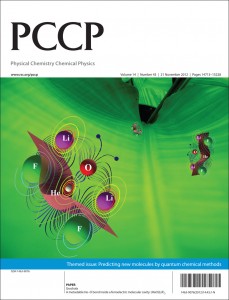
Predicting New Molecules by Quantum Chemical Methods themed issue out now!

We are delighted to announce that the PCCP themed issue – Predicting New Molecules by Quantum Chemical Methods has now been published online – take a look today!

The themed issue was Guest Edited by Gabriel Merino (Unidad Merida) and Thomas Heine (Jacobs University).

The Predicting New Molecules by Quantum Chemical Methods themed issue features a broad range of perspective and papers and includes the following Hot articles:

Take a look at the issue today!

Digg This
Reddit This
Stumble Now!
Share on Facebook
Bookmark this on Delicious
Share on LinkedIn
Bookmark this on Technorati
Post on Twitter
Google Buzz (aka. Google Reader)

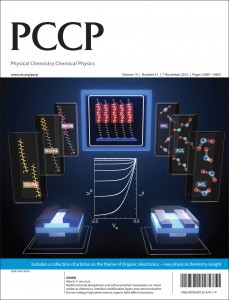
Organic electronics – new physical chemistry insight themed collection out now!

We are delighted to announce that the PCCP themed collection on Organic electronics – new physical chemistry insight has now been published online – take a look today!

CP014041_ofcThe themed issue was Guest Edited by Wenping Hu, Yu-Tai Tao and Henning Sirringhaus – read their Editorial for this issue.

The Organic electronics – new physical chemistry insight themed collection features a broad range of papers and Communications and includes:

Take a look at the issue today!
Digg This
Reddit This
Stumble Now!
Share on Facebook
Bookmark this on Delicious
Share on LinkedIn
Bookmark this on Technorati
Post on Twitter
Google Buzz (aka. Google Reader)

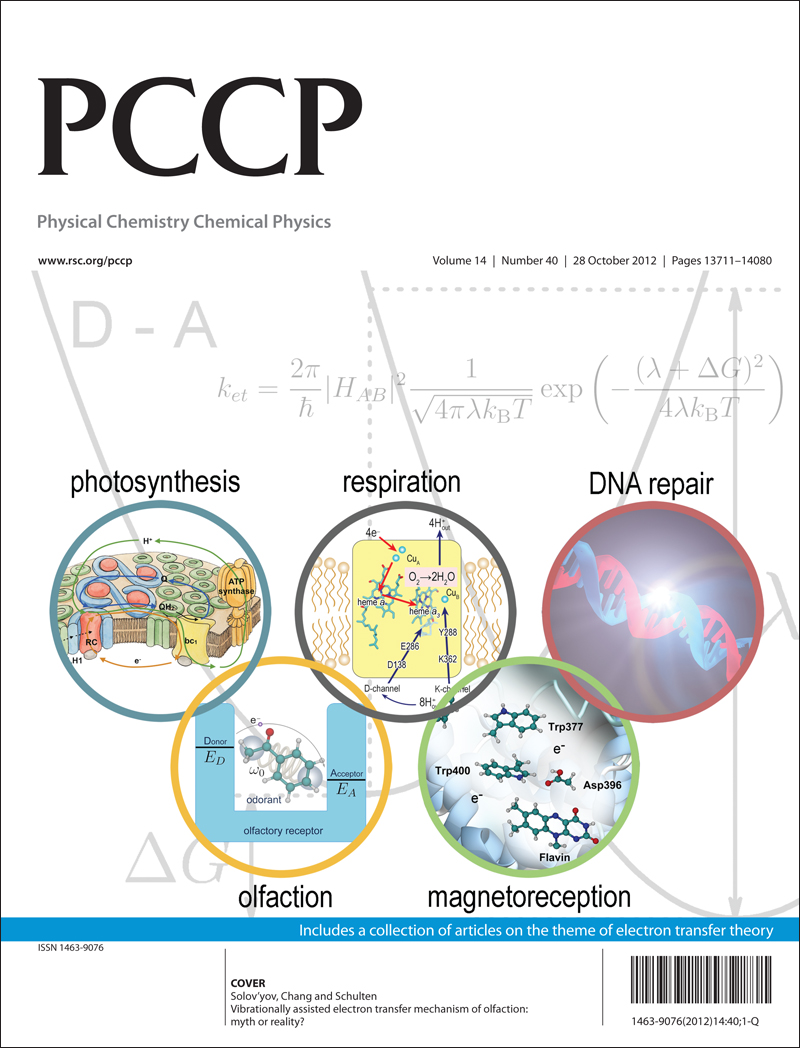
Electron Transfer Theory themed issue out now!

We are delighted to announce that the PCCP themed issue on Electron Transfer Theory has now been published online – take a look today!

CP014040_ofc

The themed issue was Guest Edited by David N. Beratan (Duke University) and José Onuchic (UCSD), and features an editorial commentary by Nobel Laureate and father of the field, Rudy Marcus.

The Electron Transfer Theory themed issue features a broad range of papers and Communications and includes the following Perspective articles:

Take a look at the issue today!
Digg This
Reddit This
Stumble Now!
Share on Facebook
Bookmark this on Delicious
Share on LinkedIn
Bookmark this on Technorati
Post on Twitter
Google Buzz (aka. Google Reader)

Scanning tunneling microscopy: revealing new physical chemistry insight

PCCP themed issue: call for papers

Scanning tunneling microscopy: revealing new physical chemistry insight
Guest Editors: Professors Li-Jun Wan and Dong Wang (Institute of Chemistry, Chinese Academy of Sciences)

PCCP is delighted to announce the high-profile themed issue on scanning tunneling microscopy. It is our pleasure to invite you to submit to this themed issue.

The themed issue will be published in PCCP in summer 2013 and will be promoted to the community throughout the year to maximise the visibility of the work published.

Deadline for Submissions: 22 February 2013

 It has been 30 years since the invention of Scanning Tunnelling Microscopy (STM); allowing scientist to directly image the nano-world at atomic resolution and fuelling the development of a large family of probe-based microscopy. More importantly, STM has opened new avenues to explore the fascinating properties associated with the nano-sized objects, and has stimulated the growth of nanoscience and nanotechnology. As a powerful surface characterization technique, STM is particularly important for surface and interface physical chemistry research.

 This themed issue will highlight the role of STM techniques at the interface of chemistry, physics, biology, and material sciences, focusing especially on surface physical chemistry. Topics covered by the issue include:

  • Single molecular science by STM
  • Supramolecular assembly on surfaces
  • Experimental and theoretical description of surface science by STM
  • Heterogenous catalysis mechanisms by STM
  • Energy and electron transfer at surfaces and interfaces 

The deadline for submissions to the themed issue is 22 February 2013, although submissions before this date are of course welcomed. Please do let us know if you are able to accept this invitation by contacting the PCCP Editorial Office.

With our best wishes,

Li-Jun Wan and Dong Wang
Guest Editors 

Jane Hordern
Deputy Editor, PCCP

  • Manuscripts can be submitted in any reasonable format using our online submissions service
  • Submissions should be high quality manuscripts of original, unpublished research
  • Communications and full papers can be submitted for consideration, which will be subject to rigorous peer review
  • Please indicate upon submission that your manuscript is intended for this themed issue
Digg This
Reddit This
Stumble Now!
Share on Facebook
Bookmark this on Delicious
Share on LinkedIn
Bookmark this on Technorati
Post on Twitter
Google Buzz (aka. Google Reader)