Archive for the ‘Themed Issue’ Category

PCCP themed issue: Physical Chemistry of Nanoparticles

Physical Chemistry Chemical Physics (PCCP) is delighted to announce a forthcoming high-profile themed issue on “Physical Chemistry of Nanoparticles”, with Guest Editors Jochen Küpper (Center for Free-Electron Laser Science, DESY and University of Hamburg) Alf Mews and Horst Weller (University of Hamburg).

This will be the official themed issue of the international Bunsentagung 2014 meeting on the same theme organised by the Deutsche Bunsen-Gesellschaft (DBG) which takes place in 2014 in Hamburg, Germany.  Free copies of the themed issue will be available at the meeting, maximising the visibility and profile of all published papers.

Deadline for submissions: 20th December 2013

If you wish to contribute to this themed issue, please contact the PCCP Editorial Office: pccp-rsc@rsc.org

Digg This
Reddit This
Stumble Now!
Share on Facebook
Bookmark this on Delicious
Share on LinkedIn
Bookmark this on Technorati
Post on Twitter
Google Buzz (aka. Google Reader)

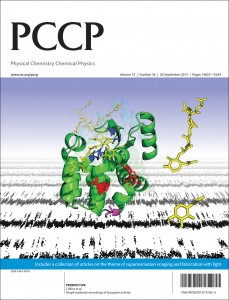
Superresolution imaging and fabrication with light – PCCP themed collection, Issue 36

PCCP is delighted to present its current issue which includes an excellent collection of articles on the theme of Superresolution imaging and fabrication with light, Guest Edited by Françisco M. Raymo. Read his Perspective article to find out more about some of the latest developments in this exciting field.

The outside front cover features a Single molecule recordings of lysozyme activity article by Yongki Choi, Gregory A. Weiss and Philip G. Collins.

Highlights of this issue include:

Activation of BODIPY fluorescence by the photoinduced dealkylation of a pyridinium quencher
Sherif Shaban Ragab, Subramani Swaminathan, James D. Baker and Françisco M. Raymo

Understanding super-resolution nanoscopy and its biological applications in cell imaging
Dehong Hu, Baoming Zhao, Yumei Xie, Galya Orr and Alexander D. Q. Li     

Radical diffusion limits to photoinhibited superresolution lithography
Darren L. Forman, Michael C. Cole and Robert R. McLeod  

Determination of two-photon photoactivation rates of fluorescent proteins
Tobias M. P. Hartwich, Fedor V. Subach, Lynn Cooley, Vladislav V. Verkhusha and Joerg Bewersdorf  

Sensitized excited free-radical processes as read–write tools: impact on non-linear lithographic processes
Stefania Impellizzeri, Kevin G. Stamplecoskie and Juan. C. Scaiano

Keep up to date with the latest PCCP articles and news: sign up to receive our free table of contents e-alerts and follow us on twitter.

Digg This
Reddit This
Stumble Now!
Share on Facebook
Bookmark this on Delicious
Share on LinkedIn
Bookmark this on Technorati
Post on Twitter
Google Buzz (aka. Google Reader)

PCCP themed issue: Fundamental Processes in Semiconductor Nanocrystals

Fundamental Processes in Semiconductor Nanocrystals
Guest Editors: Efrat Lifshitz (Technion) and Laurens Siebbeles (TU Delft)

PCCP is delighted to announce a high-profile themed issue ‘Fundamental Processes in Semiconductor Nanocrystals’.

The themed issue will be published in Physical Chemistry Chemical Physics (PCCP) in 2014, and will receive great exposure. The issue will get significant promotion at the NanoGe meeting “Fundamental Processes in semiconductor nanocrystals” to be held from 8 to 10 September 2014 in Oxford, UK.

Semiconductor nanocrystals (NCs), known for their tuneable electronic band structure, have been at the centre of significant interest over two decades, owing to potential application in various opto-electronic devices and biological platforms.

Please contact the PCCP Editorial Office (pccp-rsc@rsc.org) if you are interested in contributing to this themed issue. The deadline for submissions to the themed issue is 31st March 2014

Digg This
Reddit This
Stumble Now!
Share on Facebook
Bookmark this on Delicious
Share on LinkedIn
Bookmark this on Technorati
Post on Twitter
Google Buzz (aka. Google Reader)

PCCP themed issue: Electrocatalysis – fundamental insights for sustainable energy

Electrocatalysis – fundamental insights for sustainable energy
Guest Editors: Marc Koper (Leiden University) and Yasuhiro Iwasawa (The University of Tokyo)

PCCP is delighted to announce a high-profile themed issue ‘Electrocatalysis – fundamental insights for sustainable energy’. This will be guest edited by Marc Koper (Leiden University) and Yasuhiro Iwasawa (The University of Tokyo). The themed issue will be published in Physical Chemistry Chemical Physics (PCCP) in 2014.

With the projected future “electrification” of our society through solar and wind power, the conversion of electricity to chemical bonds and vice versa will be an essential field of physical chemistry in the decades to come. Basic fundamental understanding of these processes, both in model studies and at a more device level, requires detailed quantitative physical-chemistry approaches. This themed issue will deal with the physical chemistry approach to electrocatalysis, balancing fundamental and more applied studies, and aims to have a significant impact on the future directions of this important field.

Please contact the PCCP Editorial Office (pccp-rsc@rsc.org) if you are interested in contributing to this themed issue. The deadline for submissions to this themed issue is the 17th January 2014.


Catalysis Science & TechnologyPCCP is a sister journal to Catalysis Science and Technology. Catalysis Science & Technology brings together the best quality research from the heterogeneous, homogeneous, organocatalysis and bio-catalysis communities.

We thought you might be interested to read these recent articles published in Catalysis Science & Technology in the area of electrocatalysis:

Electrocatalytic effect of ZnO nanoparticles on reduction of nitroaromatic compounds
Her Shuang Toh, Adriano Ambrosi and Martin Pumera
Catal. Sci. Technol., 2013,3, 123-127
DOI: 10.1039/C2CY20253K, Paper

Recent progress in the electrochemical conversion and utilization of CO2
Neil S. Spinner, Jose A. Vega and William E. Mustain
Catal. Sci. Technol., 2012,2, 19-28
DOI: 10.1039/C1CY00314C, Perspective

Graphene support for enhanced electrocatalytic activity of Pd for alcohol oxidation
Ravindra Nath Singh and Rahul Awasthi
Catal. Sci. Technol., 2011,1, 778-783
DOI: 10.1039/C1CY00021G, Paper

Shape-controlled synthesis of Pt nanostructures and evaluation of catalytic and electrocatalytic performance
Sourov Ghosh and C. Retna Raj
Catal. Sci. Technol., 2013,3, 1078-1085
DOI: 10.1039/C2CY20652H, Paper

Digg This
Reddit This
Stumble Now!
Share on Facebook
Bookmark this on Delicious
Share on LinkedIn
Bookmark this on Technorati
Post on Twitter
Google Buzz (aka. Google Reader)

Computational chemistry: predicting or understanding measurements?

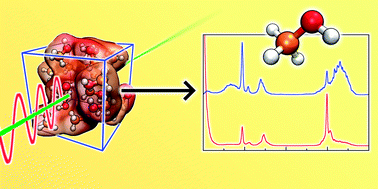
Table of contents imageIn my understanding, science is the search for answers. The validity of the research is then defined by the nature of the question.

Computational chemistry is a two-headed scientist, where one head is constantly trying to find cost-effective methods for screening molecular interactions, lock-and-key matches of drug candidates etc. While the other head is busy creating a theoretical model able to emulate nature as close as possible. Either head is plagued by the need to understand nature and benchmark against experimental data. The computational results must constantly be contrasted to experiments, as not to lose the contact with reality and be caught in the virtual world. This is highlighted in the excellent report by Vöhringer and Kirchner on the computing of vibrational spectra.

Martin Thomas and co-workers makes a thorough review of the field of calculating vibrational spectra, followed by an easily approached walk-through of the theory they use when generating vibrational spectra from MD simulations. Reading the paper, I must admit I gained high expectations as to the results. I have been away from the field a couple of years. So instead of the being impressed by the results, I was slightly disappointed, which is completely unfair. Not only does the work move from the static system and the harmonic approximation, it also takes us from the gas phase to solvated molecules. Well, the experimental data is not matched, but we are getting closer.

by Dr Thomas Just Sørensen

Read more details of this fascinating article which is part of the themed collection “Theory meets spectroscopy“:

Computing vibrational spectra from ab initio molecular dynamics

Martin Thomas, Martin Brehm, Reinhold Fligg, Peter Vöhringer and Barbara Kirchner
DOI: 10.1039/C3CP44302G

Digg This
Reddit This
Stumble Now!
Share on Facebook
Bookmark this on Delicious
Share on LinkedIn
Bookmark this on Technorati
Post on Twitter
Google Buzz (aka. Google Reader)

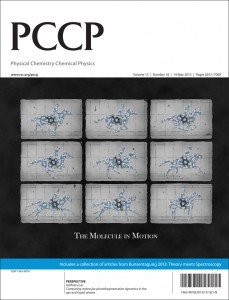
PCCP themed collection: Theory meets spectroscopy – out now!

We are delighted to announce that the PCCP themed collection on Theory meets spectroscopy has now been published online – take a look today!

The themed collection was Guest Edited by Manfred Kappes and Wim Klopper.

The outside front cover features a perspective article on Comparing molecular photofragmentation dynamics in the gas and liquid phases by Stephanie J. Harris, Daniel Murdock, Yuyuan Zhang, Thomas A. A. Oliver, Michael P. Grubb, Andrew J. Orr-Ewing, Gregory M. Greetham, Ian P. Clark, Michael Towrie, Stephen E. Bradforth and Michael N. R. Ashfold.

Theory meets spectroscopy themed collection features a broad range of Papers and Communications and includes the following Perspective articles:

Take a look at the issue today!

Digg This
Reddit This
Stumble Now!
Share on Facebook
Bookmark this on Delicious
Share on LinkedIn
Bookmark this on Technorati
Post on Twitter
Google Buzz (aka. Google Reader)

The reach of surface plasmons

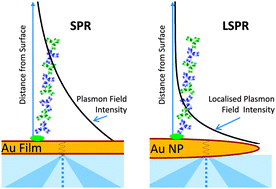
Table of contents imageTechnology based on surface plasmon resonances and localised surface plasmon resonances is surging. And so is the research into SPR effects, see for instance the recent PCCP themed collection: Plasmonics and spectroscopy.

In this paper from University of Exeter, Thomas Read and co-workers determine the propagation of plasmon fields in biological media. They make as stack immunoglobulin molecules and determine the critical parameter (β for us who grew up with reading electron transfer literature) for a plasmonic gold surface and a gold nanoparticle. The numbers are 17.5 nm and 90 nm, respectively. As the number goes in the denominator in an exponential, this is a significant difference in the reach of the plasmon fields.

I find it enticing that, in a field dominated by physicists, a chemical approach using biomolecules is the experimentalists answer to measure the extent of the plasmon fields. By building a tower of molecules it is possible to see the step wise change in the read-out from the SPR platform. For a person outside the field, the paper contain an advert for the home-build LSPR platform the authors use in their experiments. The data from this set-up completely outshines the data from the commercial SPR platform.

If your curiosity has been aroused, the full paper is published in PCCP under the title:

Measurement of the localised plasmon penetration depth for gold nanoparticles using a non-invasive bio-stacking method
Thomas Read, Rouslan V. Olkhov and Andrew M. Shaw
DOI: 10.1039/C3CP50758K

by Dr Thomas Just Sørensen

Digg This
Reddit This
Stumble Now!
Share on Facebook
Bookmark this on Delicious
Share on LinkedIn
Bookmark this on Technorati
Post on Twitter
Google Buzz (aka. Google Reader)

“The free energy landscape: from folding to cellular function”

PCCP themed issue: The free energy landscape: from folding to cellular function

Guest Editors: Ruth Nussinov (National Cancer Institute, SAIC-Frederick, and Tel Aviv University) and Peter Wolynes (Rice University)

Submission Deadline: 7th October 2013

PCCP is delighted to announce a high-profile themed issue ‘The free energy landscape: from folding to cellular function’.  The themed issue will be published in Physical Chemistry Chemical Physics (PCCP) in 2014. It will receive great exposure, and get significant promotion.

In 1991, Frauenfelder, Sligar and Wolynes proposed the free energy landscape description for the ensemble of folded protein states.  The free energy landscape’s funnel-like shape indicated that folding is driven by the hydrophobic effect; that proteins can populate a large number of conformational substates; and that strong energetic conflicts are minimized in the most populated, native states, satisfying the principle of minimal frustration.

Eight years later, Nussinov and her colleagues suggested that this concept can help explain protein function, including functional binding events, aggregation, catalysis, allostery, and signalling across the cell, via ‘conformational selection and population shift’.  Population shift emphasized that all conformational substates pre-exist, and that evolution has exploited them for function. Population shift is now broadly recognized as the origin of allostery, and thus of signaling across multimolecular complexes; pathways and the entire cellular network. The propagation pathways may help explain the effects of allosteric, gain-of-function mutations.

This themed issue aims to underscore the linkage between fundamental physicochemical principles to the cellular network, regulation, function and misfunction in disease.

The issue will broadly cover research relating the free energy landscape to function including:

  • Protein and RNA folding, allostery, the shift in the equilibrium between the inactive and active protein states as governed by the cellular environment, and catalysis
  • How the free energy concept can account for signalling, from the extracellular environment, through the cytoplasm to turn genes ON and OFF, and for network rewiring
  • How the landscape description can help in understanding drug resistant mutations and  in allosteric drug discovery

Manuscripts can be submitted in any reasonable format using our online submissions service. Submissions should be high quality manuscripts and will be subject to rigorous peer review.

Please indicate upon submission that your manuscript is intended for this themed issue.

The deadline for submissions to the themed issue is 7th October 2013, although submissions before this date are of course welcomed.


Follow us on twitter

Digg This
Reddit This
Stumble Now!
Share on Facebook
Bookmark this on Delicious
Share on LinkedIn
Bookmark this on Technorati
Post on Twitter
Google Buzz (aka. Google Reader)

Astrochemistry of Dust, Ice and Gas: call for papers

PCCP themed issue: call for papers

PCCP themed issue: Astrochemistry of Dust, Ice and Gas
Guest Editor: Wendy Brown (University of Sussex)

PCCP is delighted to announce a high-profile themed issue ‘Astrochemistry of Dust, Ice and Gas’. It is our pleasure to invite you to submit an original research article for this themed issue.

The themed issue will be published in Physical Chemistry Chemical Physics (PCCP) in 2014. It will receive great exposure, and get significant promotion, including promotion at Faraday Discussion 168, which will also cover the astrochemistry of dust, ice and gas, in April 2014, Leiden, The Netherlands.

PCCP is a high-impact, community spanning, international journal publishing work of the highest quality in the broad fields of physical chemistry, chemical physics and biophysical chemistry.

Deadline for Submissions: 27th September 2013

  • Manuscripts can be submitted in any reasonable format using our online submissions service
  • Submissions should be high quality manuscripts of original, unpublished research and must contain new physical insight
  • Communications and full papers can be submitted for consideration, which will be subject to rigorous peer review
  • Please indicate upon submission that your manuscript is intended for this themed issue

Please contact the PCCP Editorial Office to let us know you plan to contribute an article.

The young interdisciplinary science of Astrochemistry, lying at the interface of Astronomy, Astrophysics, Physics and Chemistry, has become a critical science in not only elucidating the products, mechanisms and rates of the chemistry that dominates the Universe but also for determining the physical properties of the molecular gas clouds that form stars and planets. Therefore, it is timely to publish a themed collection in PCCP on this emerging and exciting area of research. It is envisaged that the themed collection will bring together work from leading computational and experimental scientists, astronomers, chemists and biologists that addresses the cyclic role of dust in the chemical evolution of the Universe.

Digg This
Reddit This
Stumble Now!
Share on Facebook
Bookmark this on Delicious
Share on LinkedIn
Bookmark this on Technorati
Post on Twitter
Google Buzz (aka. Google Reader)

PCCP themed collection: Plasmonics and spectroscopy – out now!

We are delighted to announce that the PCCP themed collection on Plasmonics and spectroscopy now been published online – take a look today!

The themed collection was Guest Edited by Pablo G. Etchegoin – read his Editorial for this issue.

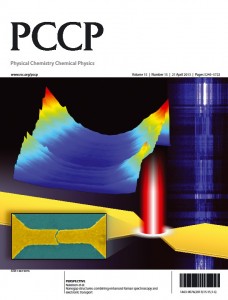
The outside front cover features a perspective article on Nanogap structures: combining enhanced Raman spectroscopy and electronic transport by Douglas Natelson, Yajing Li and Joseph B. Herzog.

Plasmonics and spectroscopy themed collection features a broad range of Papers and Communications and includes the following Perspective articles:

Single-molecule surface-enhanced Raman spectroscopy: a perspective on the current status
Hae Mi Lee, Seung Min Jin, Hyung Min Kim and Yung Doug Suh
DOI: 10.1039/C3CP44463E

Towards low-cost flexible substrates for nanoplasmonic sensing
Lakshminarayana Polavarapu and Luis M. Liz-Marzán
DOI: 10.1039/C2CP43642F

Persistent misconceptions regarding SERS
Martin Moskovits
DOI: 10.1039/C2CP44030J

Recent developments and future directions in SERS for bioanalysis
Mhairi M. Harper, Kristy S. McKeating and Karen Faulds
DOI: 10.1039/C2CP43859C

Medical applications of surface-enhanced Raman scattering
Wei Xie and Sebastian Schlücker
DOI: 10.1039/C3CP43858A

Super-resolution imaging of interactions between molecules and plasmonic nanostructures
Katherine A. Willets
DOI: 10.1039/C3CP43882A

Plasmon enhanced spectroscopy
Ricardo F. Aroca
DOI: 10.1039/C3CP44103B

Take a look at the issue today!

Digg This
Reddit This
Stumble Now!
Share on Facebook
Bookmark this on Delicious
Share on LinkedIn
Bookmark this on Technorati
Post on Twitter
Google Buzz (aka. Google Reader)