Archive for the ‘Themed Issue’ Category

Call for papers: Spectroscopy and dynamics of medium-sized molecules and clusters

PCCP themed issue:
Spectroscopy and dynamics of medium-sized molecules and clusters
Guest Editors: Majdi Hochlaf, Roberto Linguerri (Université Paris-Est) and David Lauvergnat (CNRS)

PCCP is delighted to announce the high-profile themed issue on Spectroscopy and dynamics of medium-sized molecules and clusters: Theory, experiment and applications. It is our pleasure to invite you to submit to this themed issue.

The themed issue will be published in PCCP in summer 2013 and will be promoted to the community throughout the year to maximise the visibility of the work published.

Deadline for Submissions: 21 January 2013

This themed issue will tackle new and still unresolved challenges in molecular science with particular emphasis on experimental and theoretical spectroscopy and/or quantum dynamics. One of the principal topics is the treatment of anharmonicity in medium-sized molecules and clusters.

Applications include, for instance, accurate description of highly excited states of molecules (including electronic, vibrational and rotational excitation), weakly bound aggregated systems, dynamics of molecules undergoing conformational changes, dynamics of molecules adsorbed on nanostructures, molecules at cold and ultracold temperatures, molecules in unusual environments (e.g., interstellar space), atmospheric molecules and long-range particle transfers.

It is envisaged that articles in the themed issue will discuss different approaches to overcome the difficulties associated with the numerical treatment of anharmonicity in complex molecular systems. In addition, there will be articles exploring new experimental techniques devoted for the investigation of such systems beyond the harmonic approximation and beyond the Franck-Condon principle. The proposal of new strategies and the combination of existing approaches which deal with the analysis and interpretation of recent experimental studies of highly excited molecular systems and astrophysical observations are welcomed.

We hope you can take part in this exciting issue.

With our best wishes,

Majdi Hochlaf, Roberto Linguerri and David Lauvergnat
Guest Editors

Jane Hordern
Deputy Editor, PCCP

Submission details:

  •  Manuscripts can be submitted in any reasonable format using our online submissions service
  • Submissions should be high quality manuscripts of original, unpublished research
  • Communications and full papers can be submitted for consideration, which will be subject to rigorous peer review
  • Please indicate upon submission that your manuscript is intended for this themed issue
  • Further information can be found in our author guidelines 

Submit your paper to this themed issue

Digg This
Reddit This
Stumble Now!
Share on Facebook
Bookmark this on Delicious
Share on LinkedIn
Bookmark this on Technorati
Post on Twitter
Google Buzz (aka. Google Reader)

Highlights from themed issues on ionic liquids

Crystal engineering with ionic liquids CrystEngComm CollectionIonic liquids ChemComm web themed issueInterfaces of ionic liquids PCCP Themed issue

The field of ionic liquids has seen phenomenal growth in recent years, with the topic spanning a variety of disciplines across the chemical sciences. The recent themed issues from ChemComm, PCCP and CrystEngComm showcase some of the latest developments from a range of scientific subjects utilising the unique properties of ionic liquids.

Highlights from these themed issues include the articles below, which are free to download until the 24th August. You can also access the full themed issues by clicking on the buttons above.

Click here to access the full list of articles

Digg This
Reddit This
Stumble Now!
Share on Facebook
Bookmark this on Delicious
Share on LinkedIn
Bookmark this on Technorati
Post on Twitter
Google Buzz (aka. Google Reader)

Call for papers: Interfacial Phenomena in (De)hydrogenation Reactions

Themed Collection: Interfacial Phenomena in (De)hydrogenation Reactions
Guest Editors: Professor Jinlong Gong (Tianjin University), Professor Zhihong Nie (University of Maryland) and Professor Xinbin Ma (Tianjin University)

PCCP is pleased to announce a high profile online themed collection on Interfacial Phenomena in (De)hydrogenation Reactions. It is our pleasure to invite you to submit to this themed collection.

All accepted papers will be published both online and in print and featured as part of a themed collection on the PCCP website, highlighting work from this fast-developing field to the community.

Deadline for Submissions: 31 January 2013

In recent years numerous exciting developments on catalytic (de)hydrogenation have emerged specifically aimed at understanding the nature of active sites of heterogeneous catalysts and at rational design of novel catalytic materials. The intent of the special themed collection is to highlight recent advances in catalytic (de)hydrogenation reactions on solid surfaces. A particular emphasis is placed on the understanding of the interfacial phenomena of adsorbents with well established solid surfaces with the help of advanced characterization tools and theoretical modeling.

Topics covered by this themed collection include:

  • Microscopy techniques for interfacial reactions of (de)hydrogenation
  • In situ/Operando characterizations of (de)hydrogenation reactions
  • Kinetics
  • Nanotechnology for functionalizing catalytic materials
  • Interfacial understanding of water splitting

Submission details:

  •  Manuscripts can be submitted in any reasonable format using our online submissions service
  • Submissions should be high quality manuscripts of original, unpublished research
  • Communications and full papers can be submitted for consideration, which will be subject to rigorous peer review
  • Please indicate upon submission that your manuscript is intended for this themed issue
  • Further information can be found in our author guidelines 

Submit your paper to this themed issue

Digg This
Reddit This
Stumble Now!
Share on Facebook
Bookmark this on Delicious
Share on LinkedIn
Bookmark this on Technorati
Post on Twitter
Google Buzz (aka. Google Reader)

Call for papers: Theory meets Spectroscopy- Bunsentagung 2013

Physical Chemistry Chemical Physics (PCCP) is delighted to announce a forthcoming high-profile themed issue on “Theory meets Spectroscopy”, with Guest Editors Manfred M. Kappes and Willem M. Klopper, Karlsruhe Institute of Technology (KIT).

This will be the official themed issue of the international Bunsentagung 2013 meeting on the same theme organised by the Deutsche Bunsen-Gesellschaft (DBG) which takes place in May 2013, Karlsruhe, Germany. Free copies of the themed issue will be available at the meeting, maximising the visibility and profile of all published papers.

We invite you to submit a high quality manuscript of original, unpublished research with a focus on quantum chemical methodology for spectroscopy or on the interplay between theory and experiment in spectroscopic studies in the gas or condensed phase.

Deadline for submissions: 30 November 2012

All submissions will be subject to rigorous peer review to meet the high standards of PCCP. When you submit your article, please indicate that it is for the themed issue.

The invited speakers at the meeting include Mike Ashfold (Bristol), Tobias Brixner (Würzburg), Dominik Marx (Bochum), Frank Neese (Mülheim) and Martin Wolf (Berlin). For further speakers and details about the meeting visit the website.

PCCP has very strong links with the Bunsentagung and the DBG is a co-owner of PCCP. PCCP has published a themed issue on the Bunsentagung hauptthema for the past several years:

We hope you will be able to contribute to this exciting issue.

With our best wishes

Manfred Kappes and Wim Klopper
Guest Editors

Jane Hordern
Deputy Editor, PCCP

Digg This
Reddit This
Stumble Now!
Share on Facebook
Bookmark this on Delicious
Share on LinkedIn
Bookmark this on Technorati
Post on Twitter
Google Buzz (aka. Google Reader)

Call for papers: Very hard x-rays and the frontiers of materials chemistry

PCCP themed issue: Very hard x-rays and the frontiers of materials chemistry
Guest Editor: Mark A. Newton (ESRF, France)

PCCP is delighted to announce the high-profile themed issue ‘very hard x-rays and the frontiers of materials chemistry’. It is our pleasure to invite you to submit to this themed issue.

The themed issue will be published in PCCP in spring 2013 and will be promoted to the community throughout the year to maximise the visibility of the work published.

Deadline for Submissions: 03 December 2012

Application of hard X-rays (>30 keV) to fundamental and industrially applicable materials chemistry, covering length scales from the atomic to the long-range. Our emphasis will be on in-situ and time-resolved studies in demanding sample environments: catalysts, synthesis, fuel cells, gas storage, battery materials and operation: though this is not to rule out more traditional solid state structural chemistry wherein very hard X-rays, and their potential crossover with neutron studies, leads to a number of new possibilities and/or more profound insight into the structure/function of a range of materials.

This themed issue will take a holistic view of capabilities/resources currently available worldwide, and aim to showcase what may be achieved using them. This is a rapidly developing area which we believe will be of great interest to the communities involved.

Submission details:

  •  Manuscripts can be submitted in any reasonable format using our online submissions service
  • Submissions should be high quality manuscripts of original, unpublished research
  • Communications and full papers can be submitted for consideration, which will be subject to rigorous peer review
  • Please indicate upon submission that your manuscript is intended for this themed issue

Submit your paper to this themed issue

Digg This
Reddit This
Stumble Now!
Share on Facebook
Bookmark this on Delicious
Share on LinkedIn
Bookmark this on Technorati
Post on Twitter
Google Buzz (aka. Google Reader)

Themed issue of PCCP: New Insights into Organic Chemistry from Forefront Physical Measurements now online!

PCCP is delighted to announce the online publication of Issue 30 which includes a themed collection on New Insights into Organic Chemistry from Forefront Physical Measurements, guest edited by Barry Carpenter, Cardiff University, UK.

The outside front cover features an article on the Direct measurement of Criegee intermediate (CH2OO) reactions with acetone, acetaldehyde, and hexafluoroacetone by Craig A. Taatjes, Oliver Welz, Arkke J. Eskola, John D. Savee, David L. Osborn, Edmond P. F. Lee, John M. Dyke, Daniel W. K. Mok, Dudley E. Shallcross and Carl J. Percival.

OFC_30

This themed collection contains a broad range of articles including the highlighted Editorial and Perspective below:

New insights into organic chemistry from forefront physical measurements
Barry K. Carpenter
Phys. Chem. Chem. Phys., 2012, 14, 10376-10376
DOI: 10.1039/C2CP90109A

Ultrafast time resolved studies of the photochemistry of acyl and sulfonyl azides
Jacek Kubicki ,  Yunlong Zhang ,  Jiadan Xue ,  Hoi Ling Luk and Matthew Platz
Phys. Chem. Chem. Phys., 2012, 14, 10377-10390
DOI: 10.1039/C2CP40226B

Issue 30 also includes these additional high-profile Perspectives from PCCP’s broad scope:

Take a look at the issue today!

Digg This
Reddit This
Stumble Now!
Share on Facebook
Bookmark this on Delicious
Share on LinkedIn
Bookmark this on Technorati
Post on Twitter
Google Buzz (aka. Google Reader)

Incredible ionic liquids: an article collection

Image of liquidIonic liquids are pretty self explanatory; they are ionic materials in a liquid state. In a ‘normal’ liquid, interactions are usually governed by Van de Waals or H-bonding forces. In ionic liquids it is ionic bonding interactions which dominate, meaning ionic liquids possess some interesting and unique properties.

The field of ionic liquids grew after Paul Walden’s observations of ethylammonium nitrate in 1914,1 since then the study and use of ionic liquids has grown phenomenally, with applications in analytics, biology, electrochemistry, physical chemistry, engineering, solvents and catalysis.

The academic and industrial interest in ionic liquids has thrown up some remarkable discoveries, particularly in recent years, so to keep you up to date with latest break-through research in the field we have collected these high quality articles which are free to access!*

Click here for the full list of free articles

Digg This
Reddit This
Stumble Now!
Share on Facebook
Bookmark this on Delicious
Share on LinkedIn
Bookmark this on Technorati
Post on Twitter
Google Buzz (aka. Google Reader)

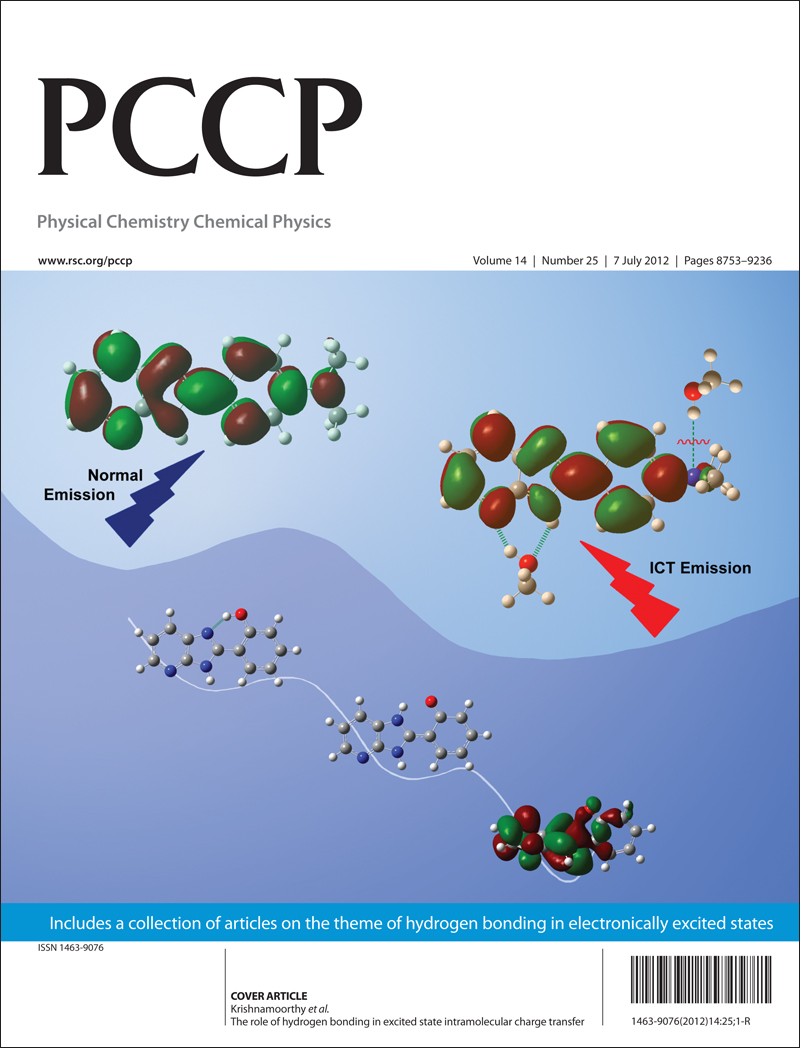
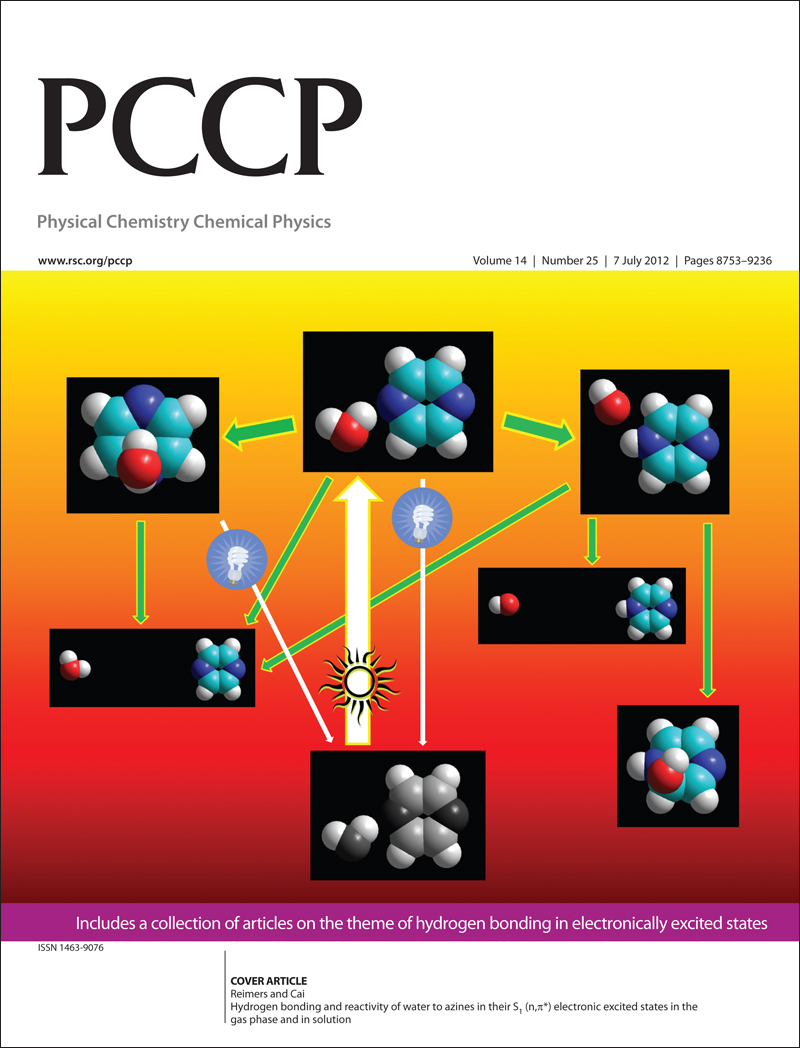
Hydrogen bonding in electronically excited states – themed issue now published

PCCP is delighted to present issue 25 which includes a collection of articles on the theme of Hydrogen bonding in electronically excited states, Guest Edited by Guang-Jiu Zhao and Ke-Li Han (Dalian Institute of Chemical Physics, China).

Hydrogen bonding has been recognized as an important interest in recent research due to its prevalence and fundamental importance in various branches of science in the past century.

To complement the 2011 PCCP themed issue on ‘Weak Hydrogen Bonds – Strong Effects?‘, this themed issue will focus on hydrogen bonding in electronically excited states, which play an increasingly important role in many photo-physical processes and photochemical reactions.

The two cover images were provided by Krishnamoorthy and colleagues with the Perspective on excited state intramolecular charge transfer and Jeffrey Reimers and Zheng-Li Cai highlighting their Perspective on the hydrogen bonding and reactivity of water to azines.

As well as high quality new research, the issue also contains a collection of high-profile Perspective review articles:

The role of hydrogen bonding in excited state intramolecular charge transfer
Francis A. S. Chipem, Anasuya Mishra and G. Krishnamoorthy
DOI: 10.1039/C2CP23879A

Hydrogen bonding and reactivity of water to azines in their S1 (n,π*) electronic excited states in the gas phase and in solution
Jeffrey R. Reimers and Zheng-Li Cai
DOI: 10.1039/C2CP24040H

Excited state intramolecular proton transfer (ESIPT): from principal photophysics to the development of new chromophores and applications in fluorescent molecular probes and luminescent materials
Jianzhang Zhao, Shaomin Ji, Yinghui Chen, Huimin Guo and Pei Yang
DOI: 10.1039/C2CP23144A

Excited state dynamics and catalytic mechanism of the light-driven enzyme protochlorophyllide oxidoreductase
Nigel S. Scrutton, Marie Louise Groot and Derren J. Heyes
DOI: 10.1039/C2CP23789J

Hydrogen bonding of excited states in supramolecular host–guest inclusion complexes
Brian D. Wagner
DOI: 10.1039/C2CP40310B

Digg This
Reddit This
Stumble Now!
Share on Facebook
Bookmark this on Delicious
Share on LinkedIn
Bookmark this on Technorati
Post on Twitter
Google Buzz (aka. Google Reader)

PCCP themed issue: Plasmonics and Spectroscopy

PCCP themed issue: Plasmonics and Spectroscopy

Guest Editors: Pablo Etchegoin (Victoria University of Wellington, New Zealand), Richard Van Duyne (Northwestern University, USA)

PCCP is delighted to announce the high-profile themed issue ‘Plasmonics and Spectroscopy”. It is our pleasure to invite you to submit an article for this themed issue.

The themed issue will be published in PCCP in 2013. It will receive great exposure, and get significant promotion.

Deadline for Submissions: 1st November 2012

The symbiosis between plasmonics and spectroscopy has seen an enormous progress in the last ten years. The ability to produce tailor-made plasmonic substrates to enhance different types of spectroscopic signals (from small changes in optical absorption in surface-plasmon resonance spectroscopy, to controlled nano-gaps for single molecule detection in SERS) is ever increasing in breadth and sophistication. This experimental progress is accompanied and supplemented by large amount of theoretical work, which is aimed at understanding the enhancement factors, propagation, localisation, and coupling of plasmon resonances in nano-structures. This issue will cover all aspects (experimental and theoretical) where plasmonics is used as an aid to optical spectroscopy in its broadest definition.

Topics covered by this themed issue include:
• Surface plasmon resonance spectroscopy (SPR)
• Surface-enhanced fluorescence (SEF)
• Surface-enhanced Raman scattering (SERS)
• Design and characterisation of plasmonic structures for spectroscopy
• Theoretical aspects of plasmonics for spectroscopy
• Biological applications
• Applied topics of ultra-sensitive spectroscopy via plasmonics.

Manuscripts can be submitted in any reasonable format using our online submissions service.

Submissions should be high quality manuscripts and will be subject to rigorous peer review.

Please indicate upon submission that your manuscript is intended for this themed issue.

Digg This
Reddit This
Stumble Now!
Share on Facebook
Bookmark this on Delicious
Share on LinkedIn
Bookmark this on Technorati
Post on Twitter
Google Buzz (aka. Google Reader)

PCCP Themed issue on Electronic Structure Theory is now online!

OFC_21

IFC_21 

We are pleased to announce the online publication of our PCCP themed issue on Fragment and localized orbital methods in electronic structure theory.

The issue was Guest Edited by Gregory J. O. Beran from the University of California and So Hirata from the University of Illinois at Urbana-Champaign

This themed issue on Fragment and localized orbital methods in electronic structure theory contains a broad range of articles including the following Perspectives:

 Take a look at the issue today!

Digg This
Reddit This
Stumble Now!
Share on Facebook
Bookmark this on Delicious
Share on LinkedIn
Bookmark this on Technorati
Post on Twitter
Google Buzz (aka. Google Reader)