Archive for the ‘News’ Category

FD150: Frontiers in Spectroscopy – conference highlights

Faraday Discussion 150: Frontiers in Spectroscopy took place in Basel, Switzerland from the 6th-8th April 2011.

Takeshi Oka from the University of Chicago gave an insightful introductory lecture on spectroscopy and astronomy commenting on how spectroscopy has grown hand-in-hand with astronomy.  Session 1, focussing on precision spectroscopy and chaired by Gerard Meijer, got everything off to a good start and everyone quickly got into the swing of the unique way in which Faraday Discussions work!  That evening we had a drinks reception at the Hotel Bildungszentrum 21 to accompany the poster session.  With more than 80 posters on display it was a great turn-out and an electrifying atmosphere!
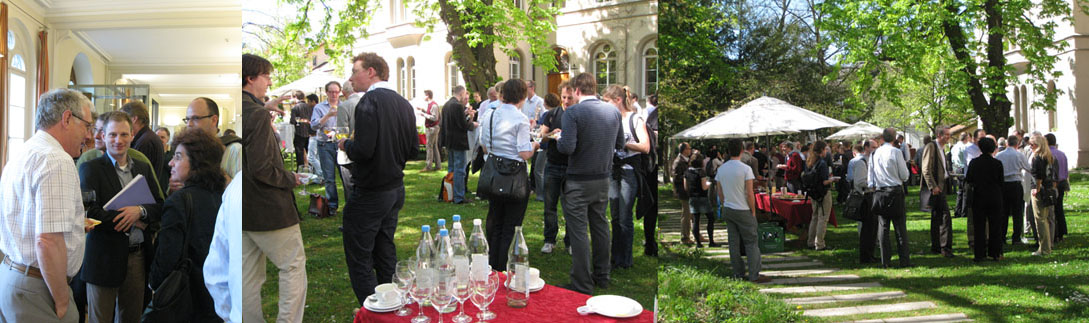
lunch
(Left) Stefan Willitsch and co at the poster session. (Centre and right) Glorious weather at lunchtime in the gardens at Hotel Bildungszentrum 21.

Thursday was an early start for the biomolecules session chaired by John Simons and included a fascinating conversation over ways in which gas-phase and condensed-phase scientists could work together.  Another notable dialogue was between Klaas Wynne and Martina Havenith over her paper.  We returned to the Hotel Bildungszentrum 21 for a lovely lunch in the garden before beginning session 3 on theoretical spectroscopy, chaired by Casey Hynes.
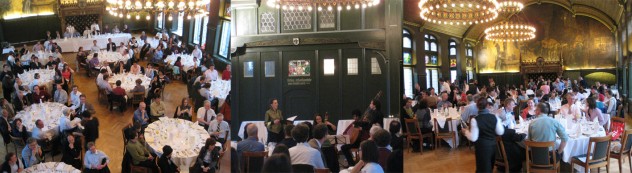
dinner
The large guild hall at Safran Zunft was a fantastic location for the concert and conference dinner.
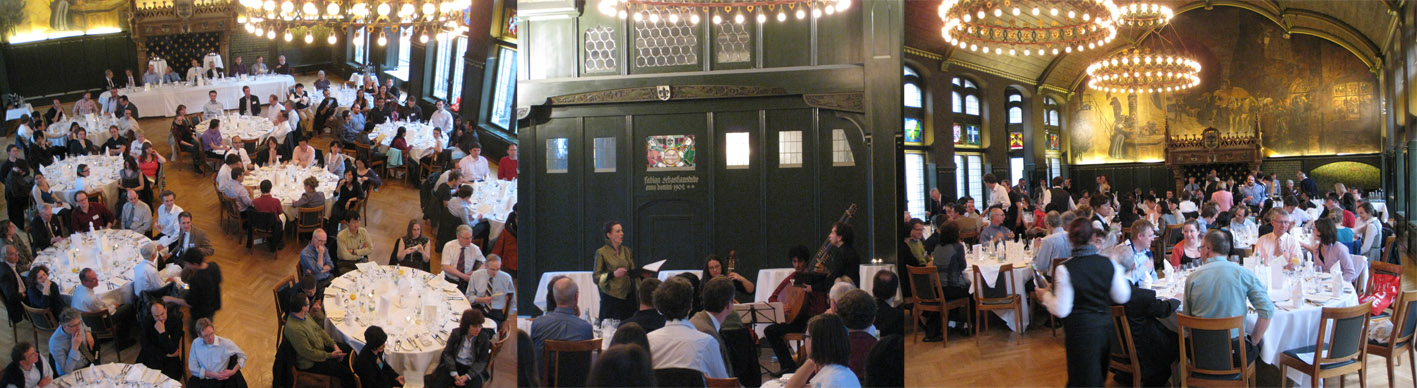
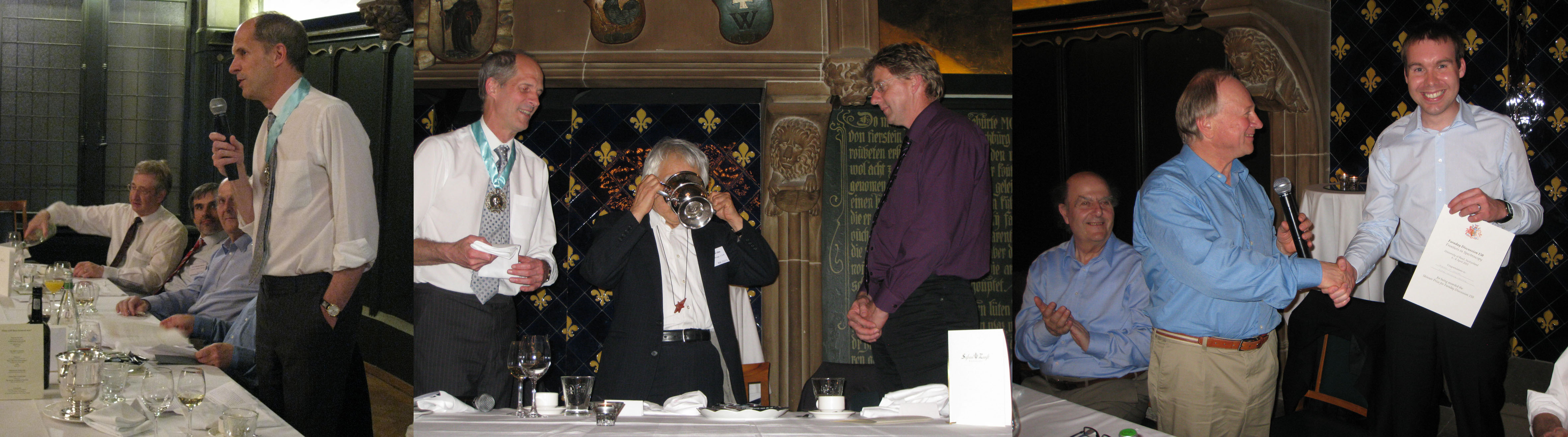
The conference dinner was held at Safran Zunft and before the meal began we were treated to a concert of English and Italian duets blending the comic and tragic sides of love.  The food was exceptional and after dinner the Faraday Loving Cup was circulated around the entire room.  Mike Ashfold, the current President of the Faraday Division was sporting the spectacular badge of office and gave a tremendous speech despite claiming that ‘speeches weren’t his thing‘!  The Skinner Poster Prize was awarded to Andreas Messmer, from Goethe-University, for his poster on structure determination of reactive catalyst-substrate complexes by 2D infrared spectroscopy.
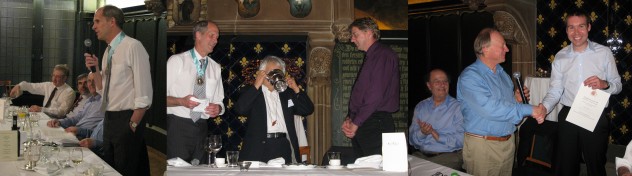
Committee
(Left) Mike Ashfold giving his speech as President of the Faraday division at the conference dinner. (Centre) Takeshi Oka drinking from the Loving cup with Gerard Meije getting ready for his turn. (Right) FD150 scientific committee chair John Maier presenting the Skinner poster prize to Andreas Messmer.
Luckily Friday’s session on spectroscopy for dynamics, chaired by Mike Ashfold, wasn’t quite such an early start. John Muenter was keen to point out that David Nesbitt’s paper referenced his daughter’s PhD thesis! Martin Quack summed up the conference very thoroughly in his concluding remarks, stating that it was “by far the best organised meeting I’ve seen thanks to John Maier and the organising committee“.  We think everyone who attended the conference would concur that John Maier and Stefan Willitsch, along with everyone else involved, certainly did a fantastic job.

Jennifer Newton and Tina Hodkinson

Keep an eye out for the published volume of this Faraday Discussion, which will be going online this summer – or sign-up to our free contents e-alerts to have Faraday Discussion 150 delivered straight to your inbox!

We welcome your ideas, contact Faraday Discussions with your topic proposal for a future Discussion

Digg This
Reddit This
Stumble Now!
Share on Facebook
Bookmark this on Delicious
Share on LinkedIn
Bookmark this on Technorati
Post on Twitter
Google Buzz (aka. Google Reader)

Nano Fit-ness: Helping Enzymes Stay Active and Keep in Shape

Researchers at Rensselaer Polytechnic Institute Discover New Method To Boost Enzymatic Activity

Proteins are critically important to life and the human body. They are also among the most complex molecules in nature, and there is much we still don’t know or understand about them.

One key challenge is the stability of enzymes, a particular type of protein that speeds up, or catalyzes, chemical reactions. Taken out of their natural environment in the cell or body, enzymes can quickly lose their shape and denature. Everyday examples of enzymes denaturing include milk going sour, or eggs turning solid when boiled.

Rensselaer researchers confined lysozyme and other enzymes inside carefully engineered nanoscale holes. Instead of denaturing, these embedded enzymes mostly retained their 3-D structure and exhibited a significant increase in activity. Copyright Rensselaer Polytechnic Institute

Rensselaer Polytechnic Institute Professor Marc-Olivier Coppens has developed a new technique for boosting the stability of enzymes, making them useful under a much broader range of conditions. Coppens confined lysozyme and other enzymes inside carefully engineered nanoscale holes, or nanopores. Instead of denaturing, these embedded enzymes mostly retained their 3-D structure and exhibited a significant increase in activity.

Read full press release: http://news.rpi.edu/update.do?artcenterkey=2851

Read the PCCP paper:
Effects of surface curvature and surface chemistry on the structure and activity of proteins adsorbed in nanopores

Lung-Ching Sang and Marc-Olivier Coppens
Phys. Chem. Chem. Phys., 2011, 13, 6689-6698

Digg This
Reddit This
Stumble Now!
Share on Facebook
Bookmark this on Delicious
Share on LinkedIn
Bookmark this on Technorati
Post on Twitter
Google Buzz (aka. Google Reader)

FD150: Frontiers in Spectroscopy conference kicks off!

Faraday Discussion 150 started today in Basel, Switzerland.

This Discussion is titled ‘Frontiers in Spectroscopy’ and aims to review recent advances in spectroscopy and identify current frontiers of research and future directions. The meeting brings together both experimentalists and theoreticians, and scientists from different fields including chemistry, physics, the biosciences and related disciplines.

Check out the Faraday Discussions twitter feed (@Faraday_D) this week for latest news from the FD150!

Sign-up to the Faraday Discussions free e-alert to be notified when this volume is published online in summer 2011!

Plenary Speakers:

  • Takeshi Oka (Introductory)
    University of Chicago, USA
  • Martin Quack (Closing)
    ETH Zürich, Switzerland
  • Martin Head-Gordon
    University of California, Berkeley, USA
  • David Klug
    Imperial College London, UK
  • Todd Martínez
    Stanford University, USA
  • Frédéric Merkt
    ETH Zürich, Switzerland
  • David Nesbitt
    JILA / University of Colorado, Boulder, USA
  • Albert Stolow
    National Research Council, Ottawa, Canada
  • Jun Ye
    JILA / University of Colorado, Boulder, USA
  • Timothy Zwier
    Purdue University, USA
Digg This
Reddit This
Stumble Now!
Share on Facebook
Bookmark this on Delicious
Share on LinkedIn
Bookmark this on Technorati
Post on Twitter
Google Buzz (aka. Google Reader)

Top Ten most-read PCCP articles in February

The latest top ten most accessed PCCP articles

See the most-read papers of February 2011 here;

Ekaterina I. Izgorodina, Phys. Chem. Chem. Phys., 2011, 13, 4189-4207
DOI: 10.1039/C0CP02315A
 
Ferdi Schüth, Phys. Chem. Chem. Phys., 2011, 13, 2447-2448
DOI: 10.1039/C1CP90005F
 
Sandra Engelskirchen and Chandrashekhar V. Kulkarni, Phys. Chem. Chem. Phys., 2011, 13, 3003-3003
DOI: 10.1039/C1CP90008K
 
Christopher J. Cramer and Donald G. Truhlar, Phys. Chem. Chem. Phys., 2009, 11, 10757-10816
DOI: 10.1039/B907148B
 
Chandrashekhar V. Kulkarni, Wolfgang Wachter, Guillermo Iglesias-Salto, Sandra Engelskirchen and Silvia Ahualli, Phys. Chem. Chem. Phys., 2011, 13, 3004-3021
DOI: 10.1039/C0CP01539C
 
Katsuhiko Ariga, Phys. Chem. Chem. Phys., 2011, 13, 4780-4781
DOI: 10.1039/C1CP90016A
 
Matthew B. Boucher, Simone Goergen, Nan Yi and Maria Flytzani-Stephanopoulos, Phys. Chem. Chem. Phys., 2011, 13, 2517-2527
DOI: 10.1039/C0CP02009E
 
Stephen Berkebile, Thomas Ules, Peter Puschnig, Lorenz Romaner, Georg Koller, Alexander J. Fleming, Konstantin Emtsev, Thomas Seyller, Claudia Ambrosch-Draxl, Falko P. Netzer and Michael G. Ramsey, Phys. Chem. Chem. Phys., 2011, 13, 3604-3611
DOI: 10.1039/C0CP01458C
 
Chun-Jiang Jia and Ferdi Schüth, Phys. Chem. Chem. Phys., 2011, 13, 2457-2487
DOI: 10.1039/C0CP02680H
 
Ilkeun Lee, Manuel A. Albiter, Qiao Zhang, Jianping Ge, Yadong Yin and Francisco Zaera, Phys. Chem. Chem. Phys., 2011, 13, 2449-2456
DOI: 10.1039/C0CP01688H

Digg This
Reddit This
Stumble Now!
Share on Facebook
Bookmark this on Delicious
Share on LinkedIn
Bookmark this on Technorati
Post on Twitter
Google Buzz (aka. Google Reader)

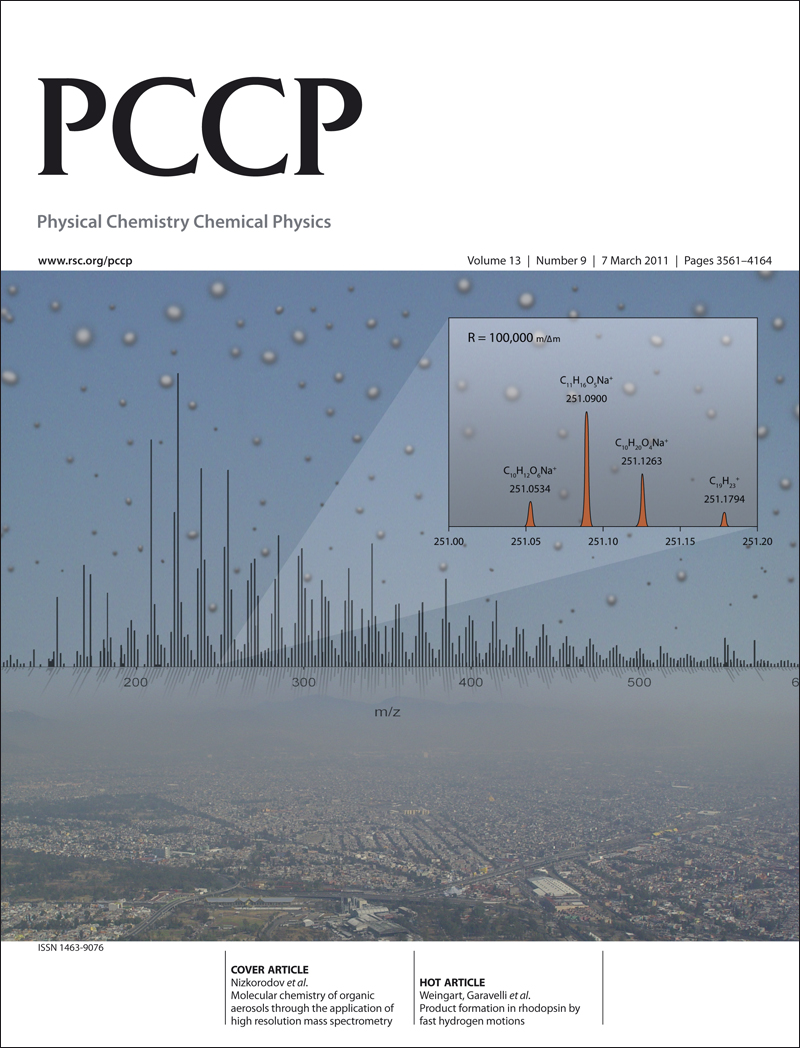
PCCP on PhysOrg.com: organic aerosol chemistry

The Perspective article which was a joint collaboration by PNNS and the University of California, Irvine reviews the use of high resolution mass spectrometry (HR-MS) for studying the fundamental chemistry of organic aerosols.

PCCP cover 9Read the full PhysOrg.com article: Molecular-level analysis of organic particles put in perspective

This Perspective article also featured on the cover of PCCP issue 9!

Full PCCP article:
Molecular chemistry of organic aerosols through the application of high resolution mass spectrometry

Sergey A. Nizkorodov, Julia Laskin and Alexander Laskin
Phys. Chem. Chem. Phys., 2011, 13, 3612-3629
DOI: 10.1039/C0CP02032J

Digg This
Reddit This
Stumble Now!
Share on Facebook
Bookmark this on Delicious
Share on LinkedIn
Bookmark this on Technorati
Post on Twitter
Google Buzz (aka. Google Reader)

Studying liquid atom interactions

Paul Popelier and his team have used quantum chemical topology (QCT) to reveal the dynamics of atom–atom interactions in a liquid.

Liquid mixtures, such as ethanol–water and methanol–water, are useful for research into molecular studies of the hydrophobic effect, which governs biological structures and plays a role in protein folding. Also, in the case of ethanol, its specific use as a bio-fuel creates an interest in understanding its interaction with water.

The team studied the behaviour of water and ethanol molecules in terms of O-H…O, C-H…O and H…H interactions. They found that the water molecule formed one to six C-H…O and one to four O-H…O interactions as a proton acceptor.

Also, the more localised a dynamical bond critical point distribution, the higher the average electron density at its bond critical points. The formation of multiple C-H…O interactions affected the shape of the oxygen basin of the water molecule. They also found that the hydrogen atoms of water strongly preferred to form H…H interactions with ethanol’s alkyl hydrogen atoms over its hydroxyl hydrogen.

Reference:
The dynamic behavior of a liquid ethanol-water mixture: a perspective from Quantum Chemical Topology
Paul L. A. Popelier et al, Phys. Chem. Chem. Phys., 2011, DOI: 10.1039/c0cp02869j

Digg This
Reddit This
Stumble Now!
Share on Facebook
Bookmark this on Delicious
Share on LinkedIn
Bookmark this on Technorati
Post on Twitter
Google Buzz (aka. Google Reader)

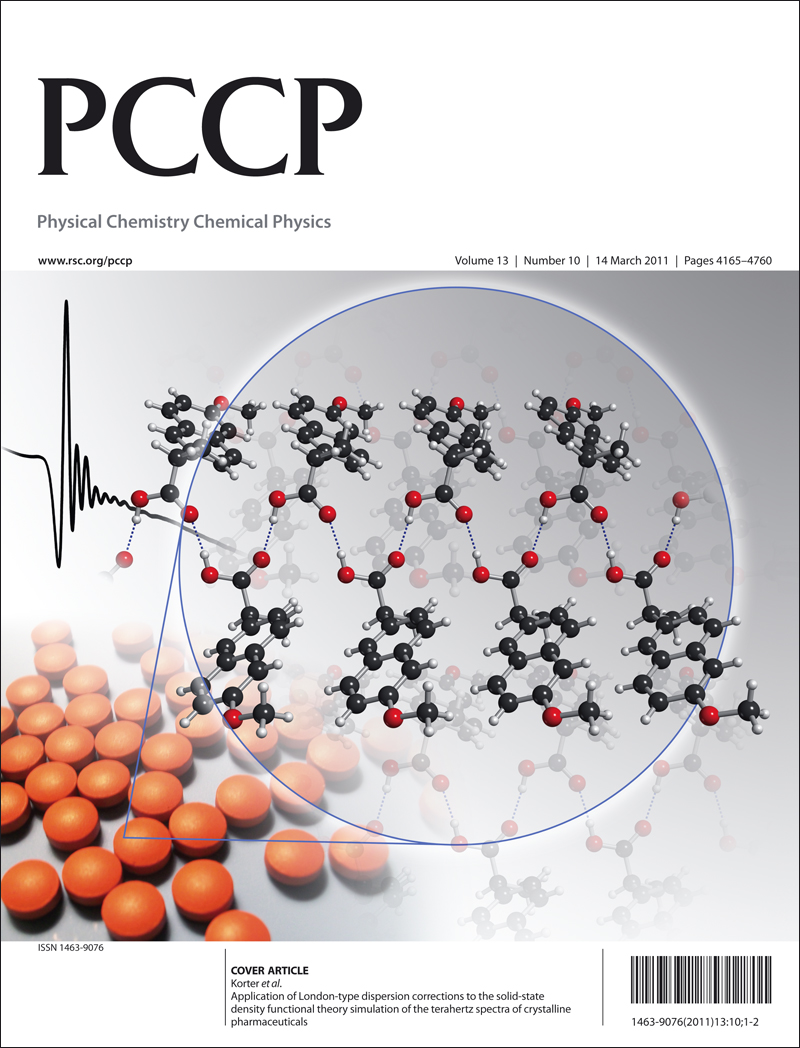
PCCP article featured in Science Daily

A recent PCCP article about a new way to use light to predict molecular crystal structure has featured in Science Daily this week.

coverIn the paper, Timothy Korter and colleagues use low-frequency light to predict London-type dispersion forces using solid-state density functional theory.

This work also featured on the cover of issue 10 of PCCP earlier this month.

Read the Science Daily article

See the PCCP paper in full:
Application of London-type dispersion corrections to the solid-state density functional theory simulation of the terahertz spectra of crystalline pharmaceuticals
Matthew D. King, William D. Buchanan and Timothy M. Korter
Phys. Chem. Chem. Phys., 2011, 13, 4250-4259

Digg This
Reddit This
Stumble Now!
Share on Facebook
Bookmark this on Delicious
Share on LinkedIn
Bookmark this on Technorati
Post on Twitter
Google Buzz (aka. Google Reader)

A database of new zeolite-like materials – with over 2.6 million structures

US scientists have described a database of computationally predicted zeolite-like materials

Positions of Si atoms as well as unit cell, space group, density, and number of crystallographically unique atoms were explored in the construction of this database. The database contains over 2.6 M unique structures. Roughly 15% of these are within +30 kJ mol-1 Si of α-quartz, the band in which most of the known zeolites lie.

These structures have topological, geometrical, and diffraction characteristics that are similar to those of known zeolites. The database is the result of refinement by two interatomic potentials that both satisfy the Pauli exclusion principle. The database has been deposited in the publicly available PCOD database.

Read the PCCP article in full:

A Database of New Zeolite-Like Materials
R Pophale, P A Cheeseman and M W Deem
Phys. Chem. Chem. Phys., 2011, DOI: 10.1039/ c0cp02255a

Digg This
Reddit This
Stumble Now!
Share on Facebook
Bookmark this on Delicious
Share on LinkedIn
Bookmark this on Technorati
Post on Twitter
Google Buzz (aka. Google Reader)

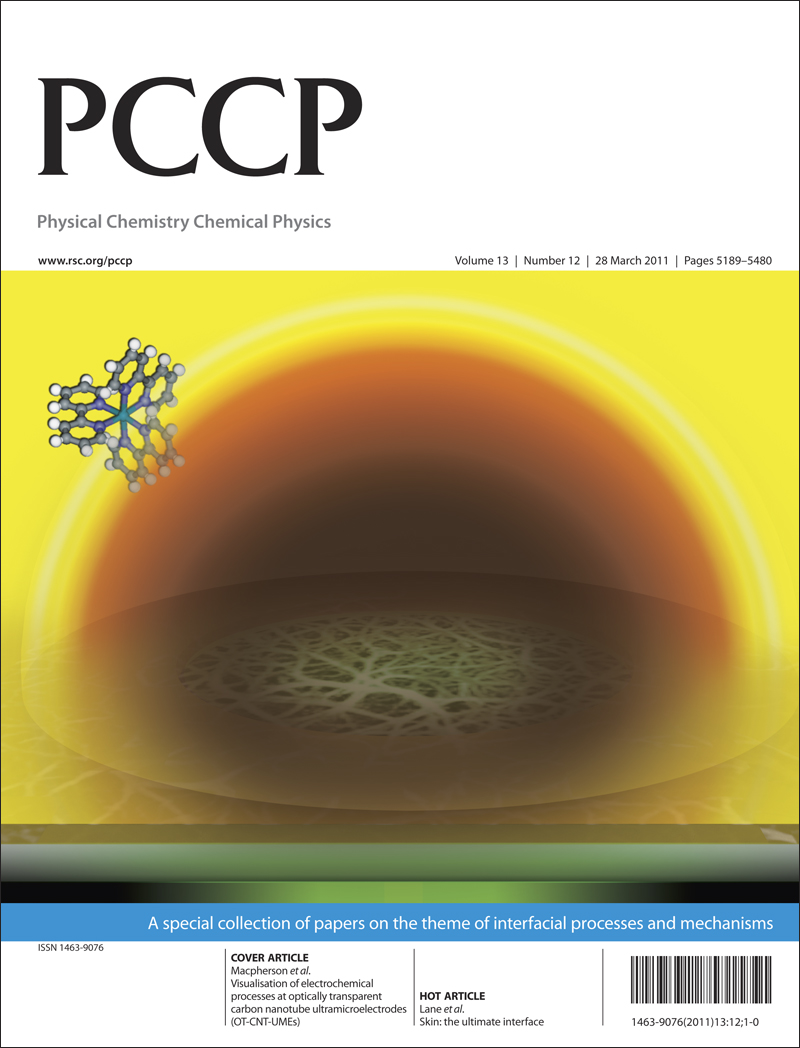
Interfacial processes and mechanisms – special collection

cover2cover1PCCP is delighted to present issue 12 as a special collection on Interfacial processes and mechanisms in celebration of John Albery’s 75th birthday, Guest Edited by PCCP Advisory Board member,  Professor Rob Hillman.

The issue includes a great collection of Perspectives, Communications and papers on this exciting area of chemistry:

The mechanism of hydrazine electro-oxidation revealed by platinum microelectrodes: role of residual oxides
Leigh Aldous and Richard G. Compton
Phys. Chem. Chem. Phys., 2011, 13, 5279-5287

Stochastic electrochemistry with electrocatalytic nanoparticles at inert ultramicroelectrodes—theory and experiments
Seong Jung Kwon, Hongjun Zhou, Fu-Ren F. Fan, Vasily Vorobyev, Bo Zhang and Allen J. Bard
Phys. Chem. Chem. Phys., 2011, 13, 5394-5402

Microscopic structure and dynamics of air/water interface by computer simulations—comparison with sum-frequency generation experiments

Yanting Wang, Nathan O. Hodas, Yousung Jung and R. A. Marcus
Phys. Chem. Chem. Phys., 2011, 13, 5388-5393

Take a look at the whole issue today!

Digg This
Reddit This
Stumble Now!
Share on Facebook
Bookmark this on Delicious
Share on LinkedIn
Bookmark this on Technorati
Post on Twitter
Google Buzz (aka. Google Reader)

Seong Keun Kim Interview – Inspirational science

Recently I interviewed new PCCP Editorial Board member Professor Seong Keun Kim, we talked about his latest research, how he was inspired by a comic book character and the importance of science in Korea.

Read on to find out more…

Seong Keun Kim is head of the Molecular Reaction Dynamics Laboratory at Seoul National University, Korea. He uses spectroscopic, microscopic and computational methods to investigate a wide range of subjects from molecular physics and nanoscience to cell biology.

S K Kim

Korea is becoming a major player in chemical research. How important is chemistry to the future development of the country?

Korea is very strong in the electronics, automobile, ship building and steel industries, but it is also the world’s fifth largest producer of chemicals by volume. So chemistry plays a critical role in the day-to-day operations of virtually every Korean industry, and strong chemical research is compulsory for innovation and product development.

Why did you choose to specialise in the nano-bio area?

I am a physical chemist by training but have always been interested in what goes on in other areas, within and beyond chemistry. The nano-bio area serves as a good window through which we can probe nature in a broader sense at a manageable level. And it turns out that my chemical knowledge, and the array of powerful techniques from the physical chemistry toolbox, can be very handy for nano-bio research.

What projects are you working on?

We have been working on a wide range of topics, from atomic and molecular physics to surface science to genetic assays. Lately, however, we have been focusing on elucidating the molecular interactions and reaction mechanisms for biologically relevant problems.

What’s going to be the next big thing in your field?

‘Seeing’ the chemical transformation of molecules, such as DNA and proteins, in a cell in real time.

What’s the trickiest problem you’ve had to overcome in your research? How did you solve it?

I’ve had my share of puzzles, but the trickiest one happens to be the one I am wrestling with now. A well-known, simple, non-fluorescing compound becomes highly fluorescent upon photoirradiation. We are trying to understand the photochemical reaction pathway, which has so far been quite evasive.

Who or what inspired you to become a scientist?

A Korean comic book character from the early 1960s that depicted a Mr Know-It-All scientist. Later, the Apollo mission and the vivid, flaming images of a rocket launch left an indelible impression.

In high school, a short film shown in the classroom about molecules moving, jittering and bouncing off each other was taken as a providential sign pointing in the direction of my calling. Six years later, I found myself running a crossed molecular beam experiment between ‘flaming’ Rb and CO2 clusters in Dudley Herschbach’s lab at Harvard in the US. It felt like déjà vu.

What is the most rewarding aspect of your career?

Teaching students of all ages and backgrounds. At the end of the summer vacation or during sabbaticals, I invariably find myself bored and defunct because I don’t get to teach. I never turn down invitations for extramural lectures, which are mostly for non-scientific audiences, because the general public are just as susceptible as scientists to the wonder and awe that nature inspires.

Can you tell us a little known fact about yourself?

In every aptitude test I took as a student, I was never predicted to become a scientist. Instead, I was supposed to be a journalist, painter, psychiatrist, pilot or soldier. I now realise that the life of a scientist involves being all of these!

What do you do in your spare time?

Listening to Mahler and Ludwig van Beethoven in my car while it’s going at 150 km per hr (and ending up with a speeding ticket half the time!).

And finally, if you weren’t a scientist, what would you do?

Be a John Horgan.


Check out the themed issue series that Seong Keun Kim Guest Edited on Biophysics and Biophysical Chemistry

Digg This
Reddit This
Stumble Now!
Share on Facebook
Bookmark this on Delicious
Share on LinkedIn
Bookmark this on Technorati
Post on Twitter
Google Buzz (aka. Google Reader)