Archive for the ‘Hot Article’ Category

Nanocubic silver gives enhanced SERS effect

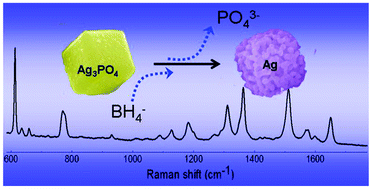
In this HOT article, Shengchun Yang and co-workers describe the preparation of porous Ag nanocubes by synthesizing Ag3PO4 nanocubes and using them as hard templates. With the addition of strong reducing agents, Ag is reduced in situ to form porous Ag.  The resulting Ag showed good SERS (surface enhanced Raman scattering) properties by detecting nanomolar concentrations of Rhodamine 6G.
Volume shrinkage induced formation of porous Ag sub-microcubes via solid–liquid reaction for SERS

Volume shrinkage induced formation of porous Ag sub-microcubes via solid–liquid reaction for SERS

Find out more by downloading the full paper now:

Volume shrinkage induced formation of porous Ag sub-microcubes via solid–liquid reaction for SERS
Xiao Luo, Shaomin Lian, Liqun Wang, Shengchun Yang, Zhimao Yang, Bingjun Ding and Xiaoping Song
CrystEngComm, 2013, Advance Article
DOI: 10.1039/C3CE27089K

You may also be interested in other publications concerning SERS and noble metals from recent studies by the same author:

A new route for the synthesis of polyhedral gold mesocages and shape effect in single-particle surface-enhanced Raman spectroscopy
Jixiang Fang, Sergei Lebedkin, Shengchun Yang and Horst Hahn
Chem. Commun., 2011, 47, 5157-5159
DOI: 10.1039/C1CC10328H

Interface synthesis of gold mesocrystals with highly roughened surfaces for surface-enhanced Raman spectroscopy
Hongjun You, Yuetian Ji, Liang Wang, Shengchun Yang, Zhimao Yang, Jixiang Fang, Xiaoping Song and Bingjun Ding
J. Mater. Chem., 2012, 22, 1998-2006
DOI: 10.1039/C1JM13211C, Paper

Also, keep up to date and follow us on twitter: @crystengcomm

Digg This
Reddit This
Stumble Now!
Share on Facebook
Bookmark this on Delicious
Share on LinkedIn
Bookmark this on Technorati
Post on Twitter
Google Buzz (aka. Google Reader)

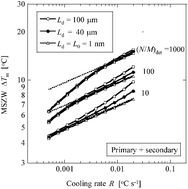
Modelling metastable zone width

Modelling metastable zone widthNoriaki Kubota and colleagues have modelled the effects of sensitivity and resolution of a nucleation detector on metastable zone width. 

The metastable zone width has been somewhat ambiguously defined as “the supercooling at which the first crystals or uncontrolled spontaneous crystallisation is detected when the solution temperature is lowered at a constant rate”. In order to pin down the specifics, a couple of groups have defined the metastable zone width as the supercooling that occurs when the number density of crystals reaches a fixed value – which in effect is determined by the sensitivity of the detection method.

To find out what effect the sensitivity and resolution of a detector has on metastable zone width readings, the team have employed analytical and numerical methods. A deeper understanding of this is neccesary to enable better control of crystallisation processes.

Download the article today to find out more…

Analytical and numerical study of detector sensitivity and resolution effects on metastable zone width
Noriaki Kubota, Masanori Kobari and Izumi Hirasawa
CrystEngComm, 2013, 15, 2091-2098
DOI: 10.1039/C2CE26968F, Paper

Digg This
Reddit This
Stumble Now!
Share on Facebook
Bookmark this on Delicious
Share on LinkedIn
Bookmark this on Technorati
Post on Twitter
Google Buzz (aka. Google Reader)

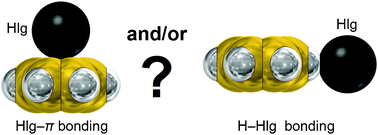
Halogen bonding: competitive and directional?

Hydrogen versus halogen bonding in the solid state


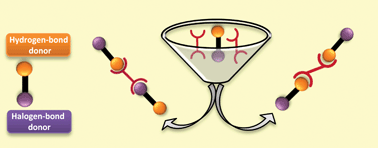
The Gamez group have analyzed halogen–π interactions by a statistical study of the occurrence and directionality of the interactions in the solid-state.  They used structures from the Cambridge Structural Database (CSD) in combination with an analytical procedure developed and used previously by the authors for other important interactions like lone pair–π and anion–π interactions. The results clearly demonstrate that halogen bonding to a phenyl ring are directional, and could compete with hydrogen bonding. Read more about competition and directionality in the solid state for FREE at:

Halogen-phenyl supramolecular interactions in the solid state: hydrogen versus halogen bonding and directionality
Tiddo J. Mooibroek and Patrick Gamez
CrystEngComm, 2013, 15, 1802-1805
DOI: 10.1039/C2CE26853A 

Other related reading from the same group includes:

Anion–arene and lone pair–arene interactions are directional
Tiddo J. Mooibroek and Patrick Gamez
CrystEngComm, 2012, 14, 1027-1030
DOI: 10.1039/C1CE05946G

How directional are D–H phenyl interactions in the solid state (D = C, N, O)?
Tiddo J. Mooibroek and Patrick Gamez
CrystEngComm, 2012, 14, 8462-8467
DOI: 10.1039/C2CE26205C

You may also be interested in: 

Competing hydrogen-bond and halogen-bond donors in crystal engineering
Christer B. Aakeröy,  Sheelu Panikkattu,  Prashant D. Chopade and John Desper
CrystEngComm, 2013, Advance Article
DOI: 10.1039/C2CE26747K 

or also on our blog 

Follow us on Twitter:  @crystengcomm

Digg This
Reddit This
Stumble Now!
Share on Facebook
Bookmark this on Delicious
Share on LinkedIn
Bookmark this on Technorati
Post on Twitter
Google Buzz (aka. Google Reader)

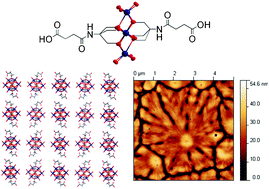
Acid-terminated hybrid POMs

Using linear, rather than cyclic, anhydrides was key to synthesising the carboxylic acid functionalised hybrid polyoxometalates.

Using linear, rather than cyclic, anhydrides was key to synthesising the carboxylic acid functionalised hybrid polyoxometalates

Leroy Cronin and colleagues at the University of Glasgow report a high yield synthesis of carboxylic acid functionalised clusters by reacting Mn-Anderson hybrid polyoxometalates, substituted by an amine group, with anhydride precursors. The terminal acid groups make it possible for the clusters to bind to hydrophilic glass surfaces. Developing understanding of the surface interactions of these hybrids may have potential implications in the development of hybrid based thin films for solar cells.

Download the paper today to find out more…

Programming the assembly of carboxylic acid-functionalised hybrid polyoxometalates

Marie Hutin, Carine Yvon, Jun Yan, Andrew Macdonell, De-Liang Long and Leroy Cronin
CrystEngComm, 2013
DOI: 10.1039/C3CE26816K, Paper

You may also be interested in the 2012 Dalton Transactions Polyoxometalates themed issue, that was guest edited by De-Liang Long and Leroy Cronin.Dalton Transactions Polyoxometalates themed issue

Digg This
Reddit This
Stumble Now!
Share on Facebook
Bookmark this on Delicious
Share on LinkedIn
Bookmark this on Technorati
Post on Twitter
Google Buzz (aka. Google Reader)

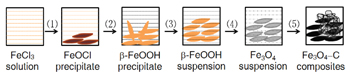
Small crystals with big prospects – magnetite composites as candidates for energy storage

In their Hot Article, Qiang Shen and colleagues from Shandong University report the generation of Fe3O4–C composites via the evolution of orthorhombic FeOCl. The crystals display some interesting electrochemical properties which make them potential candidates for next generation lithium ion batteries (LIBs).

We use LIBS in portable electronic devices such as phones and computers and LIB development has sparked a great deal of interest among materials scientists and crystal engineers alike.

Take a look at the results of the team’s research by downloading the article below, which is free to access for 4 weeks.

A chemical composition evolution for the shape-controlled synthesis and energy storage applicability of Fe3O4–C nanostructures
Fenfen Xu, Wenpei Kang, Xinxin Wang, Rui Liu, Chenhao Zhao and Qiang Shen


Interested in crystal engineering? Follow us on twitter @CrystEngComm

Digg This
Reddit This
Stumble Now!
Share on Facebook
Bookmark this on Delicious
Share on LinkedIn
Bookmark this on Technorati
Post on Twitter
Google Buzz (aka. Google Reader)

Halogen vs. hydrogen bonding

Competing hydrogen-bond and halogen-bond donors in crystal engineering

Competing hydrogen-bond and halogen-bond donors in crystal engineering

In this HOT article by Aakeröy et al, relevant hydrogen-bond and halogen-bond acceptors and donors were selected to study the competition between these two molecular interactions in supramolecular assembly.  Twelve co-crystals were synthesized based on two different azobipyridines as acceptors and six donor molecules possessing both hydrogen-bond and halogen-bond moieties.  The key conclusions which could be drawn from the study were: (i) the hydrogen-bond is the principal driving force in the formation of 3,3′-azabipyridine co-crystals whereas hydrogen and halogen bonds do indeed compete in the formation of the 4,4′-azabipyridine co-crystals; (ii) the iodine donor appears to be a better halogen-bond donor than bromine; and  (iii) the three different hydrogen-bond donors studied (–COOH, –OH and –CN(R)OH) behave similarly.

Read more for FREE at:

Competing hydrogen-bond and halogen-bond donors in crystal engineering
Christer B. Aakeröy ,  Sheelu Panikkattu ,  Prashant D. Chopade and John Desper
CrystEngComm, 2013, Advance Article
DOI: 10.1039/C2CE26747K

This article will be published in a forthcoming themed issue on Halogen bonding, other highlights include:

Iodo-imidazolium salts: halogen bonding in crystals and anion-templated pseudorotaxanes
Antonio Caballero,  Sam Bennett,  Christopher J. Serpell and Paul D. Beer
CrystEngComm, 2013, Advance Article
DOI: 10.1039/C2CE26020D

Halogen bonding at work: recent applications in synthetic chemistry and materials science
Franck Meyer and Philippe Dubois
CrystEngComm, 2013, Advance Article
DOI: 10.1039/C2CE26150B

Digg This
Reddit This
Stumble Now!
Share on Facebook
Bookmark this on Delicious
Share on LinkedIn
Bookmark this on Technorati
Post on Twitter
Google Buzz (aka. Google Reader)

Releasing the electronic potential in aluminium nitride

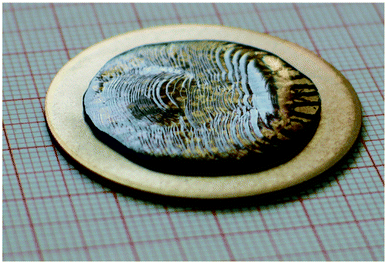
Photo of free-standing AlN wafer

Photo of free-standing AlN wafer

The use of aluminium nitride in solid-state optoelectronic devices has been hindered by high defect levels limiting the output power, efficiency and lifetimes of mid-UV LEDs. Now, there is a possible solution, thanks to the method described in this HOT CrystEngComm paper.

R. Radhakrishnan Sumathi from Ludwig Maximilians University reports a physical vapour transport growth method using silicon carbide as a foreign substrate. The result is a more homogeneous structure than afforded by previous methods with uniform levels of defects and impurities across the wafer.

Read more now…

Bulk AlN single crystal growth on foreign substrate and preparation of free-standing native seeds
R. Radhakrishnan Sumathi
CrystEngComm, 2013
DOI: 10.1039/C2CE26599K

Are you following us on Twitter?  @crystengcomm

Digg This
Reddit This
Stumble Now!
Share on Facebook
Bookmark this on Delicious
Share on LinkedIn
Bookmark this on Technorati
Post on Twitter
Google Buzz (aka. Google Reader)

Guanidinium-based building blocks

Guanidinium-based synthons are useful for building ordered supramolecular structures due to their large number of charge-assisted hydrogen bonds (the guanidinium cation has 6 active H bonds). However, due to this plethora of potential intermolecular interactions, it can be a tricky to predict and design resultant structures – which is what crystal engineering is all about…

In their latest CrystEngComm Communication, Yadav and Gorbitz have endeavoured to restrict the modes of hydrogen bonding by substituting with TBD (see below). TBD has only 2 N-H donors which is much more manageable for these purposes! They partnered the TBD with dicarboxylic acid, 2,2′-bipyridine-5,5′ dicarboxylic acid (BPDA) to form a 2:1 complex. Additional acceptor sites at the carboxylate lone pairs means that 4 water molecules can co-crystallise along with the structure, leading to extended water channels or open organic networks containing clusters of water.

Guanidinium-carboxylate building block

Read more now…

A supramolecular 2:1 guanidinium–carboxylate based building block for generation of water channels and clusters in organic materials
Vitthal N. Yadav and Carl Henrik Görbitz
CrystEngComm, 2013, DOI: 10.1039/C2CE26572A

Digg This
Reddit This
Stumble Now!
Share on Facebook
Bookmark this on Delicious
Share on LinkedIn
Bookmark this on Technorati
Post on Twitter
Google Buzz (aka. Google Reader)

Polymorphism co-crystal screening

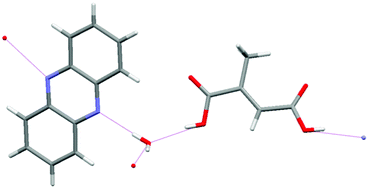
In their HOT article, Jones and co-workers at the University of Cambridge present a comprehensive crystal form screen for the phenazine:mesaconic acid system, employing a variety of different co-crystallisation methods.
 
Phenazine:mesaconic acid system

The researchers identified and characterised three anhydrous co-crystal polymorphs, one co-crystal hydrate and one DMSO co-crystal solvate, and also highlighted a novel co-crystallisation technique at the interface between two immiscible solutions, yielding a pure phenazine:mesaconic acid co-crystal form.   Traditional solvent-based methods usually used for polymorphism screening were inappropriate for this system due to the large differences in solubility of phenazine and mesaconic acid.

Read more about this study for FREE at:

Screening for polymorphs of cocrystals: a case study
Mark D. Eddleston, Saranja Sivachelvam and William Jones
CrystEngComm, 2012, Advance Article
DOI: 10.1039/C2CE26496J

You may also be interested in other recent work on co-crystals by the Jones group:

Cocrystal dissociation and molecular demixing in the solid state
Mark D. Eddleston, Gareth O. Lloyd and William Jones
Chem. Commun., 2012, 48, 8075-8077
DOI: 10.1039/C2CC33412G, Communication

A hydrogen bonded cocrystal with an unusual interweaving between the adjacent triple-helices
Amit Delori and William Jones
CrystEngComm, 2011, 13, 6315-6318
DOI: 10.1039/C1CE05534H, Communication

Observation of a two-dimensional halogen-bonded cocrystal at sub-monolayer coverage using synchrotron X-ray diffraction
Stuart M. Clarke, Tomislav Frišcic, William Jones, Anasuya Mandal, Chenguang Sun and Julia E. Parker
Chem. Commun., 2011, 47, 2526-2528
DOI: 10.1039/C0CC04400H, Communication

Digg This
Reddit This
Stumble Now!
Share on Facebook
Bookmark this on Delicious
Share on LinkedIn
Bookmark this on Technorati
Post on Twitter
Google Buzz (aka. Google Reader)

Role of aspartic acid in regulating the growth of common kidney stones

Yu Huang, S. Roger Qiu and colleagues have used in situ atomic force microscopy to investigate how the growth of calcium oxalate monohydrate is inhibited by 6-residue linear aspartic acid peptides. 

Analysis of the step speed data showed that the aspartic acid enantiomers block active kink sites through step-pinning.

 
Calcium oxalate monohydrate is the main inorganic component in the most common types of kidney stones, so preventing their formation is of great clinical importance.

Read more for FREE at:

Growth inhibition of calcium oxalate monohydrate crystal by linear aspartic acid enantiomers investigated by in situ atomic force microscopy
Kang R. Cho, E. Alan Salter, James J. De Yoreo, Andrzej Wierzbicki, Selim Elhadj, Yu Huang and S. Roger Qiu
CrystEngComm, 2013
DOI: 10.1039/C2CE25936B, Paper

Digg This
Reddit This
Stumble Now!
Share on Facebook
Bookmark this on Delicious
Share on LinkedIn
Bookmark this on Technorati
Post on Twitter
Google Buzz (aka. Google Reader)