Archive for the ‘Hot Article’ Category

Hot Article: Controlling the size of nanocrystals

In this new CrystEngComm Hot Article, a team of Italian scientists led by M. Lucia Curri have demonstrated that monomodal or bimodal PbS nanocrystals can be produced in a single experiment.  The group were able to shed light on the mechanism of self organization in these assemblies with an aim to predict the the formation of the solid crystal phases.
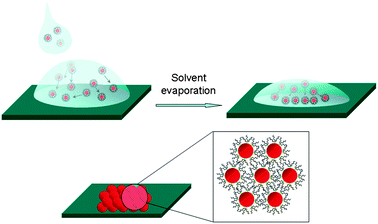
It was found that the effect of several parameters, including solvent composition, nanocrystal concentration, size ratio of the two populations, strongly influenced the formation of the superlattice and the final geometry.

The ability in engineering nanocrystal building blocks is essential for designing novel architectured materials.

Find out more about this work here. FREE to read until 10th March 2011!

Self-organization of mono- and bi-modal PbS nanocrystal populations in superlattices
Michela Corricelli, Davide Altamura, Liberato De Caro, Antonella Guagliardi, Andrea Falqui, Alessandro Genovese, Angela Agostiano, Cinzia Giannini, Marinella Striccoli and M. Lucia Curri
CrystEngComm, 2011, Advance Article, DOI: 10.1039/C0CE00874E

Digg This
Reddit This
Stumble Now!
Share on Facebook
Bookmark this on Delicious
Share on LinkedIn
Bookmark this on Technorati
Post on Twitter
Google Buzz (aka. Google Reader)

HOT article: Investigating disappearing polymorphs using 50 year old progesterone samples

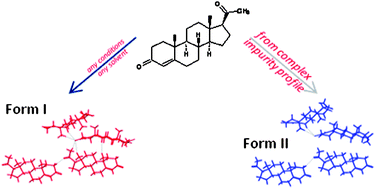
Robert W. Lancaster and colleagues from University College London, have investigated the phenomenon of ‘disappearing polymorphs’, using a 50 year old progesterone sample obtained from the University of Innsbruck archive.

Disappearing polymorphs are an unusual occurance, where a form that was previously considered to be stable and easy to make, suddenly becomes very difficult to obtain. The reasons for this are poorly understood, and here Lancaster looks into the case of the hormone progesterone, where the modern version suffers from a ‘disappearing polymorph’, which can be found in the 50 year old archived sample.

Read the full article for FREE to find out more.

Fifty-year old samples of progesterone demonstrate the complex role of synthetic impurities in stabilizing a metastable polymorph
Robert W. Lancaster, Lisa D. Harris and David Pearson
CrystEngComm, 2011, Advance Article
DOI: 10.1039/C0CE00858C, Communication

Digg This
Reddit This
Stumble Now!
Share on Facebook
Bookmark this on Delicious
Share on LinkedIn
Bookmark this on Technorati
Post on Twitter
Google Buzz (aka. Google Reader)

HOT Article: A non-linear optical crystal

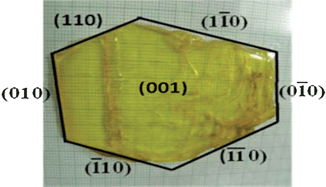
In this CrystEngComm Hot article, Sunil Verma and co-workers have produced a large single crystal of lithium pnitrophenolate trihydrate, which can be used as a non-linear optical material.

Non-linear optical materials can be used in lasers, and organic NLO materials are particularly desirable because they have higher non-linearity and better laser damage resistance when compared to inorganic materials.

This article is significant because the authors have managed to grow a large size crystal, which is normally difficult due to the weakness of the van der Waals and hydrogen bonds holding the molecules together.

Read the full article to find out more about the slow cooling solution growth method used…

Solubility, crystal growth, morphology, crystalline perfection and optical homogeneity of lithium p-nitrophenolate trihydrate, a semiorganic NLO crystal
S. Dinakaran, Sunil Verma and S. Jerome Das
CrystEngComm, 2011, Advance Article
DOI: 10.1039/C0CE00663G, Paper

READ FOR FREE until 3rd March 2011

Digg This
Reddit This
Stumble Now!
Share on Facebook
Bookmark this on Delicious
Share on LinkedIn
Bookmark this on Technorati
Post on Twitter
Google Buzz (aka. Google Reader)

Top Ten most-read CrystEngComm articles in December

Read the most-read CrystEngComm articles of December 2010, listed below:


Hailong Sun, Haibo Mei, Guanghui An, Jianlin Han and Yi Pan, CrystEngComm, 2011, 13, 734-737
DOI: 10.1039/C0CE00471E
 
Yun Ling, Lei Zhang, Jing Li and Miao Du, CrystEngComm, 2011, 13, 768-770
DOI: 10.1039/C0CE00775G
 
Michael J. Turner, Joshua J. McKinnon, Dylan Jayatilaka and Mark A. Spackman, CrystEngComm, 2011, Advance Article
DOI: 10.1039/C0CE00683A
 
Kai Jiang, Lu-Fang Ma, Xiao-Yuan Sun and Li-Ya Wang, CrystEngComm, 2010, Advance Article
DOI: 10.1039/C0CE00190B
 
Xiu-Li Wang, Hong-Yan Lin, Bao Mu, Ai-Xiang Tian, Guo-Cheng Liu and Ning-Hai Hu, CrystEngComm, 2011, Advance Article
DOI: 10.1039/C0CE00400F
 
Wenzhong Wang, Ya Tu, Pengcheng Zhang and Guling Zhang, CrystEngComm, 2011, Advance Article
DOI: 10.1039/C0CE00563K
 
Yun-Liang Jiang, Yu-Ling Wang, Jing-Xiang Lin, Qing-Yan Liu, Zhang-Hui Lu, Na Zhang, Jia-Jia-Wei and Li-Qin Li, CrystEngComm, 2011, Advance Article
DOI: 10.1039/C0CE00431F
 
Shunshun Xiong, Sujing Wang, Xinjun Tang and Zhiyong Wang, CrystEngComm, 2011, Advance Article
DOI: 10.1039/C0CE00422G
 
Zuo-Xi Li, Xin Chu, Guang-Hua Cui, Yu Liu, Le Li and Gang-Lin Xue, CrystEngComm, 2011, Advance Article
DOI: 10.1039/C0CE00865F
 

To keep up-to-date with all the best crystal engineering research articles, sign up for the journal’s e-alerts here.

Digg This
Reddit This
Stumble Now!
Share on Facebook
Bookmark this on Delicious
Share on LinkedIn
Bookmark this on Technorati
Post on Twitter
Google Buzz (aka. Google Reader)

HOT Article: Nanofibre mats remineralize tooth enamel

Free to access until Tuesday 15th February 2011!

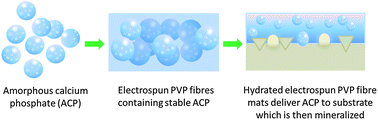
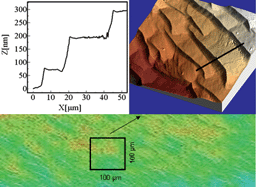
In this CrystEngComm Hot Article, Stephen Mann and co-workers demonstrate the use of electrospun mats of amorphous calcium phosphate (ACP)/poly(vinylpyrrolidone) (PVP) nano- and microfibres to promote in vitro remineralization of dental enamel and dentine tubule occlusion.

The method is performed under clinically relevant conditions and holds the potential for a new approach to the regeneration of enamel and the alleviation of dentine hypersensitivity.

Read more:
Electrospun mats of PVP/ACP nanofibres for remineralization of enamel tooth surfaces
Jane Fletcher, Dominic Walsh, Christabel Emma Fowler and Stephen Mann,
CrystEngComm, 2011, Advance Article
DOI: 10.1039/C0CE00806K, Paper

Digg This
Reddit This
Stumble Now!
Share on Facebook
Bookmark this on Delicious
Share on LinkedIn
Bookmark this on Technorati
Post on Twitter
Google Buzz (aka. Google Reader)

HOT Article: Use of DFT for physisorption

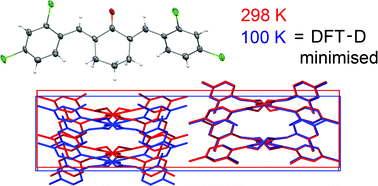
This latest work from Marcus A. Neumann’s group uses dispersion-corrected density functional theory to look at the energy minimisation of 2,6-bis(2,4-dichlorobenzylidene)cyclohexanone. In this CrystEngComm Hot article they discover that this method predicts the low-temperature phase transition seen in experiment.

As the authors state ‘we believe that DFT-D energy minimisation provides a valuable tool since the calculations have now been shown to be sufficiently reliable to guide experimental studies towards targets most likely to exhibit interesting temperature dependent variation’

READ the full article for free until 18th February

Experimental verification of a subtle low-temperature phase transition suggested by DFT-D energy minimisation
Andrew D. Bond, Katarzyna A. Solanko, Jacco van de Streek and Marcus A. Neumann
CrystEngComm, 2011, Advance Article
DOI: 10.1039/C0CE00676A, Communication

Digg This
Reddit This
Stumble Now!
Share on Facebook
Bookmark this on Delicious
Share on LinkedIn
Bookmark this on Technorati
Post on Twitter
Google Buzz (aka. Google Reader)

HOT article: Micropeonies from nanocrystals

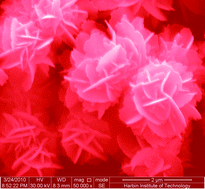
In this HOT article, in CrystEngComm, Chen and co-workers from Harbin Institute of Technology, China report on the morphology and assembly-controlled synthesis of PbTe 3D nanostructures via a facile solvothermal method. They found that the addition of different amounts of glucose can mediate the nucleation and growth of PbTe, resulting in the formation of 3D architectures from 2D nanosheets and nanocrystals. Other factors affecting the morphology such as the amount of NaOH and the volume ratio of ethanol to water, were  systematically investigated. The electrical conductivity was also dependent on the morphology.

Read more for FREE!

PbTe hierarchical nanostructures: solvothermal synthesis, growth mechanism and their electrical conductivities
Rencheng Jin, Gang Chen,* Qun Wang, Jian Pei, Jingxue Sun and Yang Wang
CrystEngComm, 2011, Advance Article
DOI: 10.1039/C0CE00455C, Paper

Digg This
Reddit This
Stumble Now!
Share on Facebook
Bookmark this on Delicious
Share on LinkedIn
Bookmark this on Technorati
Post on Twitter
Google Buzz (aka. Google Reader)

HOT Article: Turkey tendons as collagen scaffolds

Read this CrystEngComm HOT article by Gower et al. for FREE until 7th February 2011

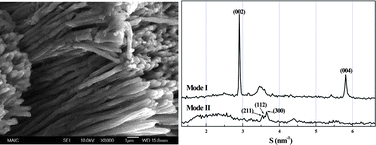
A multinational team of scientists have demonstrated that biogenic collagen scaffolds obtained from turkey tendon, which consist of densely packed and oriented collagen fibrils, can also be mineralized by a polymer-induced liquid-precursor (PILP) process.

Synthetic collagen scaffolds have previously been used to demonstrate that intrafibrillar mineralization can be achieved with the PILP process which enables the unique nanostructured architecture of bone to be reproduced in vitro.

Turkey tendon is an excellent model of secondary bone formation because it mineralizes in response to increased stresses from the weight of the growing bird. The collagen is directly mineralized, leading to a collagen–mineral phase that resembles secondary bone.

Oriented hydroxyapatite in turkey tendon mineralized via the polymer-induced liquid-precursor (PILP) process

Sang Soo Jee, Rajendra Kumar Kasinath, Elaine DiMasi, Yi-Yeoun Kimae and Laurie Gower

CrystEngComm, 2011, Advance Article DOI: 10.1039/C0CE00605J, Paper

Digg This
Reddit This
Stumble Now!
Share on Facebook
Bookmark this on Delicious
Share on LinkedIn
Bookmark this on Technorati
Post on Twitter
Google Buzz (aka. Google Reader)

Hot Article: Waveguiding with Yb crystals

Scientists from the Universitat Rovira i Virgili in Tarragona, Spain invesitgate the crystal growth of Rb, Ti, Yb, Nb mixed epitaxial layers in order to optimise them to act as waveguides in photonics. Read more about their work in this CrystEngComm Hot Paper.

Crystal growth and characterization of RbTi1−x−yYbxNbyOPO4/RbTiOPO4 (001) non-linear optical epitaxial layers 
Jaume Cugat, Rosa Maria Solé, Joan J. Carvajal, Maria Cinta Pujol, Xavier Mateos, Francesc Díaz and Magdalena Aguiló
CrystEngComm, 2011, Advance Article DOI: 10.1039/C0CE00647E, Paper

Digg This
Reddit This
Stumble Now!
Share on Facebook
Bookmark this on Delicious
Share on LinkedIn
Bookmark this on Technorati
Post on Twitter
Google Buzz (aka. Google Reader)

HOT Article: Using supercritical water to make hybrid ceria nanoparticles

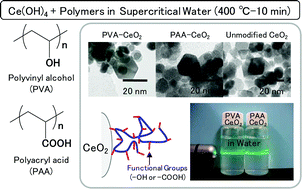
In this CrystEngComm Hot article, Minori Taguchi and colleagues make CeO2 nanoparticles with hydrophilic polymers attached to the surface. Hybrid nanoparticles like these are especially useful as they allow the physical properties of the metal oxide to be combined with the desirable tunablity of the organic molecules.

Ceria nanoparticles are used in many applications from three-way catalysts to oxygen ion conductors, and also in cosmetics, for their UV shielding.

Read the full article to see how these researchers used an efficient supercritical hydrothermal method to make these interesting particles…

READ FOR FREE until 5th February

Supercritical hydrothermal synthesis of hydrophilic polymer-modified water-dispersible CeO2 nanoparticles
Minori Taguchi, Seiichi Takami, Tadafumi Adschiri, Takayuki Nakane, Koichi Sato and Takashi Naka
CrystEngComm, 2011, Advance Article
DOI: 10.1039/C0CE00467G, Paper

Digg This
Reddit This
Stumble Now!
Share on Facebook
Bookmark this on Delicious
Share on LinkedIn
Bookmark this on Technorati
Post on Twitter
Google Buzz (aka. Google Reader)