


CrystEngComm Tutorial Reviews are aimed at researchers who are new to the field or are embarking on a new direction of research, giving insight into how crystal engineering techniques underpin certain research areas.
They are focused on the application of crystal engineering techniques and should be comprehensive enough to be used for teaching purposes. They comment on best practice techniques for a given research methodology and how understanding crystal engineering can best serve researchers’ progress on a given topic.
Each Tutorial Review includes up to five ‘key learning points’ that a reader should expect to gain from reading the review.
See our most recent Tutorial Review by Patrick C. Hillesheim and Arsalan Mirjafari
|
The anti-crystal engineering principles of imidazolium cations for ionic liquids |
 |
Key learning points in this Tutorial review:
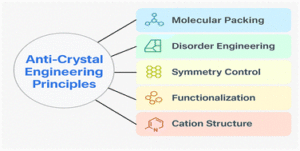
1. Crystal engineering provides a structural framework for understanding ionic liquids. Crystallographic analysis reveals how molecular geometry, packing motifs, and intermolecular forces govern melting points and phase behavior.
2. Disorder can be deliberately engineered. Anti-crystal engineering principles, such as cation asymmetry, conformational flexibility, and weak interactions, show how structural frustration suppresses crystallization to yield stable liquids.
3. Symmetry and shape control lattice energy. Variations in chain length, branching, or methylation alter molecular symmetry and steric balance, tuning lattice enthalpy and entropy to direct solid–liquid transitions.
4. Functionalization of the alkyl chains can lower crystallinity. Addition of functional groups can disrupt chain packing, lower melting points. However, the functional groups can also introduce new interactions which may, conversely, increase cohesion.
5. The parts of the imidazolium cation. The imidazolium cation can be viewed as comprising three regions—the charge-rich heterocycle, the symmetry-breaking domain, and the hydrophobic tail—each serving as a modular platform for introducing anti-crystal engineering features.
Meet the authors
 |
Patrick Hillesheim is an Assistant Professor of Chemistry at Illinois State University. He earned his Ph.D. at the University of Florida in 2010 and completed postdoctoral research with Prof. Sheng Dai at Oak Ridge National Laboratory (2010–2013). His research focuses on the development and fundamental studies of novel ionic liquids, with an emphasis on studying the bulk properties. His research combines organic chemistry, materials science, X-ray crystallography, and computational studies to investigate how non-covalent interactions and molecular structure influence macroscopic properties. |
 |
Arsalan Mirjafari is the Dr. Richard S. Shineman Endowed Chair and Professor of Chemistry at the State University of New York at Oswego. His research focuses on property-driven design of functional ionic liquids through click-enabled and click-like synthesis. Applications include vaccine preservation, gene delivery, bioinspired organic materials, and thermally robust materials. He earned his Ph.D. in Organic Chemistry from University of Isfahan (2009) and completed postdoctoral training with Prof. Jim Davis at University of South Alabama (2010–2012). His work advances ionic liquid design for biotechnological and materials applications.
|
Tutorial Reviews are normally invited by the Editorial Board, however suggestions are welcome and enquiries, along with a brief synopsis and author credentials, should be directed to the Editors-in-Chief at CrystEngComm-rsc@rsc.org. Readers may nominate themselves, or others, to write a Tutorial Review.
We hope you enjoy reading this Tutorial review and keep an eye out for the next one in the series coming soon: A beginner’s guide to spin crossover by Phimphaka Harding and David J. Harding.


