

Welcome to the first RSC Chemical Biology newsletter of 2026! We are excited to share a recap of the journal’s progress in 2025, and our most recent updates. We wish all of our readers, authors, reviewers and editors a successful year ahead. Get future updates directly to your inbox with our email alerts. Sign up here.
Latest News

We’re pleased to welcome Professor Boris Vauzeilles to the Editorial Board as an Associate Editor. Prof. Vauzeilles is a CNRS Research Director and Director of the Institut de Chimie des Substances Naturelles (ICSN, CNRS, France). His research sits at the interface of organic chemistry and chemical biology, with a strong emphasis on the development of chemical tools to investigate biological systems at the molecular level.
His group designs reactive molecular probes and chemical reporters to study biological processes, with particular interests in bacterial detection strategies, diagnostic approaches, and the chemistry of disease-related reactive oxygen species and redox processes. His work combines synthetic chemistry with mechanistic insight to enable new ways of interrogating complex biological environments.
In parallel with his research activities, he is actively involved in supporting and structuring the chemical biology community. He is the founder and President of SCF-ChemBio, the Chemical Biology Division of the French Chemical Society, and serves as President of the International Chemical Biology Society (ICBS).
As a member of the Editorial Board of RSC Chemical Biology, he is committed to promoting rigorous, high-quality research and to supporting the journal as a platform for innovative and mechanistically grounded studies at the chemistry–biology interface.
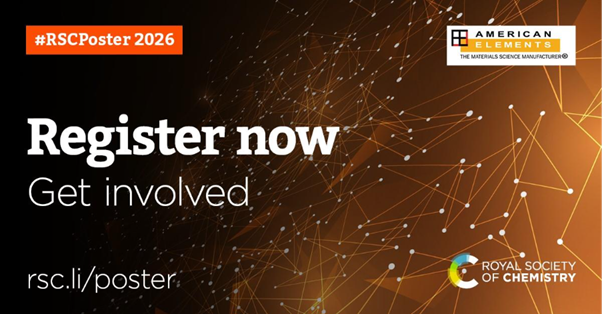
We are very excited to announce that the 2026 #RSCPoster Conference will be taking place for 24 hours starting 3rd March 2026, 12:00 UTC.
The #RSCPoster conference is an annual event that has become a staple on many scientific community calendars. Held entirely online on LinkedIn over 24 hours, the unique format removes the environmental and financial costs of attending a traditional conference, and helps scientific researchers share their work and network across disciplines, wherever they are in the world. Find out more and join in: https://rsc.li/poster
2025 in Review
Our 2024 Outstanding Early Career Researcher Award was granted to a team comprising Kilian Roßmann, Ramona Birke, Joshua Levitz, Ben Jones and Johannes Broichhagen, for their paper “Red and far-red cleavable fluorescent dyes for self-labelling enzyme protein tagging and interrogation of GPCR co-internalization”. Find out more about the team and their paper at our blog post.
We published a themed collection on “Biomolecular Technologies”, Guest Edited by Prof. Sheel Dodani (The University of Texas at Dallas) and Prof. Ariel Furst (Massachusetts Institute of Technology), which brought together engineered biomolecule-based technologies spanning small molecules, nucleic acids, and proteins, with applications in biocatalysis, biosensing, and synthetic biology. Read the completed collection here. We also recognised our 2024 Emerging Investigators, whose contributions can be read here.
Our editors were pleased to meet the community at the ICBS & ECBS ChemBioParis2025, the 5th Young Investigator Workshop of the EuChemS Division of Chemical Biology and Chemistry in Life Sciences, the RSC Chemical Biology symposium and the EMBO “The Epitranscriptome” workshop. We look forward to connecting with more of you throughout 2026!
Collections

We are delighted to announce the 2025 RSC Chemical Biology Emerging Investigators collection is now online! Read the collection here. This collection highlights invited contributions from early career researchers who are making significant contributions to the field of chemical biology. Congratulations to all of the featured researchers!
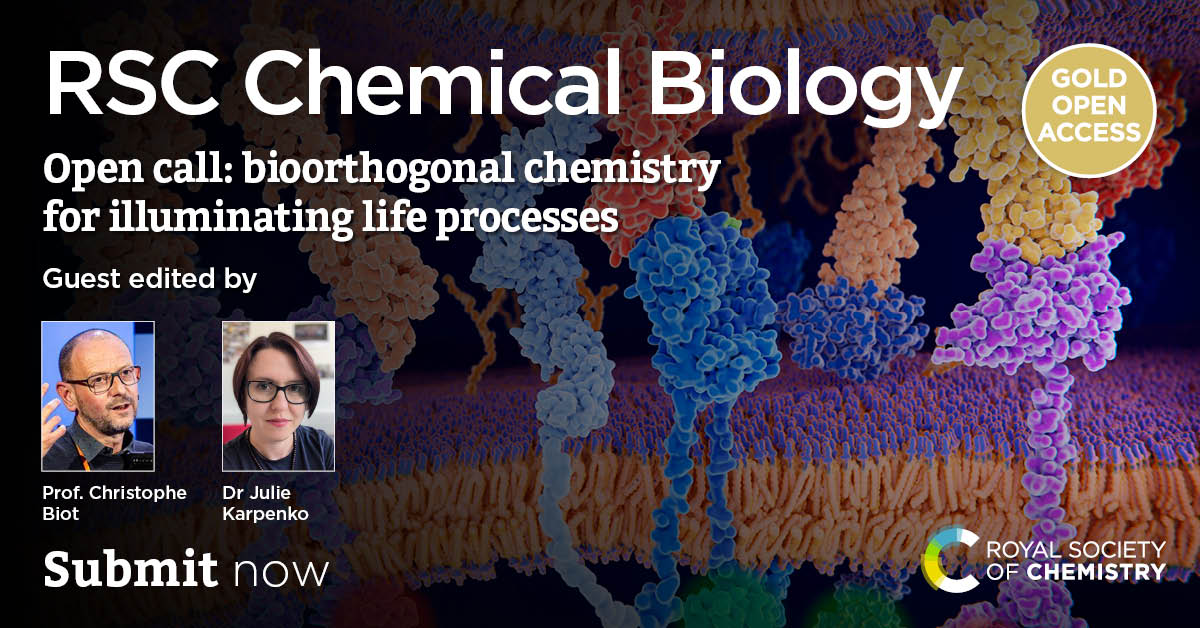
RSC Chemical Biology is delighted to welcome papers for a themed collection on ‘Bioorthogonal chemistry for illuminating life processes’. Bioorthogonal chemistry has revolutionised our ability to see the invisible by capturing the fleeting molecular events that sustain life. From single-molecule tracking to whole-organism imaging, bioorthogonal tools now bridge chemistry and biology to illuminate processes once beyond reach.
This themed collection aims to highlight the most recent advances in chemical probe design, imaging methodologies, and applications that reveal the living world in action. We welcome contributions that showcase how bioorthogonal chemistry empowers molecular imaging and spatiotemporal analysis in living systems. The deadline for submissions is 30 June 2026 Find out more, including how to contribute your article, on our blog post.
Upcoming events
RSC Chemical Biology is proud to sponsor poster awards at the 38th Irsee Natural Product Symposium taking place 25-27 February in Kloster Irsee, Germany; and at the Biochemistry 2026 meeting in Wurzburg, Germany on 16-18 March. Our Associate Editor Andrea Rentmeister looks forward to meeting you at both of these exciting events!
Follow our channels below to keep up to date on the events we’re supporting in 2026.
Submit your work to RSC Chemical Biology
Find out more about RSC Chemical Biology on our webpage, where you can also find our author guidelines. RSC Chemical Biology has received a 2024 Impact Factor of 3.1, has an article acceptance rate of 52%, and provides a first decision on articles sent to peer review in an average of 40 days.
Publishing open access with RSC journals unlocks the full potential of your research – bringing increased visibility, wider readership and higher citation potential to your work. As a not-for-profit organisation serving the chemical sciences community, we ensure that our article processing charge (APC) remains the most competitive of major publishers. More details can be found here and the APC for RSC Chemical Biology is £2200. You can also use our journal finder tool to check if your institution currently has an agreement with the RSC that may entitle you to a discount of the APC.
Stay Connected
Follow us on LinkedIn and Bluesky for new articles and the latest news from RSC Chemical Biology and related journals at the Royal Society of Chemistry.