HOT Articles from Analyst

Check out some of the HOT articles that have been published with Analyst this month!
A solution-based nano-plasmonic sensing technique by using gold nanorods

Ho & Imae et al., Analyst, 2012, Advance Article

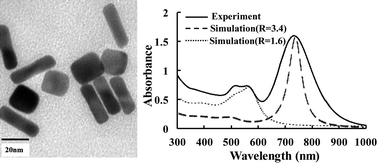
Fu Han Ho, Toyoko Imae and co-workers from the National Taiwan University of Science and Technology have successfully developed a unique sensing technique for monitoring the variation of solution concentrations and measuring the effective dielectric constant in a medium by using an ultra-small and label-free nanosensor.

A solution-based nano-plasmonic sensing technique by using gold nanorods
Fu Han Ho, Yung-Han Wu, Masaki Ujihara and Toyoko Imae
Analyst, 2012, Advance Article
DOI: 10.1039/C2AN35101C
Upconversion emission of fluorescent silver nanoclusters and in situ selective DNA biosensing

Shao et al., Analyst, 2012, Advance Article

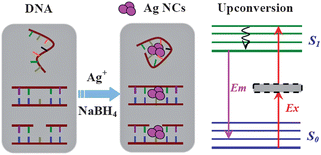
Yong Shao and colleagues from Zhejiang Normal University have studied the upconversion emission of Ag nanoclusters templated by single- and double-stranded DNAs in their investigation of sensor design.

Upconversion emission of fluorescent silver nanoclusters and in situ selective DNA biosensing
Qinghua Cui, Yong Shao, Kun Ma, Shujuan Xu, Fei Wu and Guiying Liu
Analyst, 2012, Advance Article
DOI: 10.1039/C2AN00025C

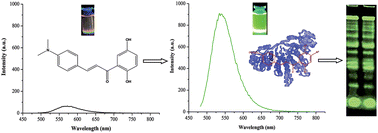
Jin Ouyang from Beijing Normal University and fellow Chinese scientists have made a simple small-molecule fluorescent probe, designed for the detection of human serum proteins via hydrophobic interactions after polyacrylamide gel electrophoresis. The new probe proved to be a good protein reporter due to its fast staining procedure. It also had low detection limits and high resolution.
The development of simple and sensitive small-molecule fluorescent probes for the detection of serum proteins after native polyacrylamide gel electrophoresis

Ouyang et al., Analyst, 2012, Advance Article

The development of simple and sensitive small-molecule fluorescent probes for the detection of serum proteins after native polyacrylamide gel electrophoresis
Fangfang Wang, Lingyun Huang, Na Na, Dacheng He, Dezhi Sun and Jin Ouyang
Analyst, 2012, Advance Article
DOI: 10.1039/C2AN35265F

A team from Canada have tackled the issue of the detection of contamination of jet fuels with aero-turbine lubricating oil in a paper from Hans-Peter Loock, from Queen’s University.
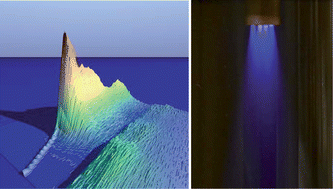
Fluorescence excitation–emission matrix (EEM) spectroscopy and cavity ring-down (CRD) absorption spectroscopy of oil-contaminated jet fuel using fiber-optic probes

Loock et al., Analyst, 2012, Advance Article

Fluorescence excitation–emission matrix (EEM) spectroscopy and cavity ring-down (CRD) absorption spectroscopy of oil-contaminated jet fuel using fiber-optic probes
Hengameh Omrani, Jack A. Barnes, Alexander E. Dudelzak, Hans-Peter Loock and Helen Waechter
Analyst, 2012, Advance Article
DOI: 10.1039/C2AN35091B

Digg This
Reddit This
Stumble Now!
Share on Facebook
Bookmark this on Delicious
Share on LinkedIn
Bookmark this on Technorati
Post on Twitter
Google Buzz (aka. Google Reader)

HOT Article: Point-of-care blood analysis

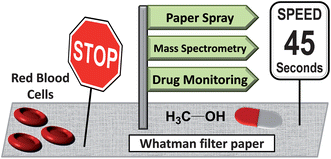
This month we have a HOT article from our Analyst Editorial Board member, Graham Cooks. Working with his colleagues from Purdue University, USA, they have developed a rapid, point-of-care method to test whole blood samples that have been supported on filter paper using paper spray mass spectrometry. Addition of a coagulant called alum allowed the sample to be tested right away. The technique was tested on the analysis of therapeutic drugs in blood samples. Click through here to read more. The paper will be free to access for 2 weeks!

Rapid analysis of whole blood by paper spray mass spectrometry for point-of-care therapeutic drug monitoring

Cooks et al., Analyst, 2012, Advance Article

Rapid analysis of whole blood by paper spray mass spectrometry for point-of-care therapeutic drug monitoring
Ryan D. Espy, Nicholas E. Manicke, Zheng Ouyang and R. Graham Cooks
Analyst, 2012, Advance Article
DOI: 10.1039/C2AN35082C

Digg This
Reddit This
Stumble Now!
Share on Facebook
Bookmark this on Delicious
Share on LinkedIn
Bookmark this on Technorati
Post on Twitter
Google Buzz (aka. Google Reader)

Biosensors 2012

Biosensors World Congress 2012, Cancun, Mexico, 15-18 May

The Biosensors World Congress 2012 is now only a few weeks away; it takes place in Cancun, Mexico, 15-18 May.  The last meeting, which took place in Glasgow, UK, in 2010, attracted 1100 delegates and this is sure to be another great opportunity to see some of the best new work in biosensors.  We’re disappointed not to be attending this time, but look out for flyers from Analyst and Analytical Methods with the latest information on the journal: you can even use the QR code to access more online!

Chair of the conference is Professor Anthony Turner of Linköping University, Sweden, who was recently presented with the RSC Theophilus Redwood Award.  Take a look at Tony’s paper in Analyst in our web theme on Materials for Detection:

Development of a piezoelectric sensor for the detection of methamphetamine
Maria Romero Guerra, Iva Chianella, Elena V. Piletska, Kal Karim, Anthony P. F. Turner and Sergey A. Piletsky
Analyst, 2009, 134, 1565-1570
DOI: 10.1039/B819351G

One of the invited speakers at the meeting is Till Bachmann of the University of Edinburgh; you can Dr Bachmann’s recent papers in Analyst below:

Communication: Alkaline phosphatase enzymatic signal amplification for fast, sensitive impedimetric DNA detection
Miriam Kaatz, Holger Schulze, Ilenia Ciani, Fred Lisdat, Andrew R. Mount and Till T. Bachmann
Analyst, 2012, 137, 59-63
DOI: 10.1039/C1AN15767A
From web theme: Future Electroanalytical Developments

Electrochemical detection of interaction between Thioflavin T and acetylcholinesterase
Vladimir Dounin, Andrea Constantinof, Holger Schulze, Till T. Bachmann and Kagan Kerman
Analyst, 2011, 136, 1234-1238
DOI: 10.1039/C0AN00743A

Digg This
Reddit This
Stumble Now!
Share on Facebook
Bookmark this on Delicious
Share on LinkedIn
Bookmark this on Technorati
Post on Twitter
Google Buzz (aka. Google Reader)

HOT articles from Issue 9

Electroanalysis for metal-based impurities in graphenes

Chee & Pumera, Analyst, 2012, 137, 2039-2041

It’s hot hot hot in the latest issue of Analyst, with 14 HOT articles featuring the best in analytical science.  Including: a review on the detection of α-amino-β-methylaminopropionic acid, mid-IR spectroscopy for salivary calculi, fluorescent chemosensing of Ag+, and an artificial nose.

Read more »

Digg This
Reddit This
Stumble Now!
Share on Facebook
Bookmark this on Delicious
Share on LinkedIn
Bookmark this on Technorati
Post on Twitter
Google Buzz (aka. Google Reader)

Analyst Issue 9: now online

Analyst, 2012, Vol. 137, Issue 9, front cover

Front cover: Taira et al., Analyst, 2012, 137, 2006-2010

The latest issue of Analyst is now available for you to browse, and we head east for all three covers.

There’s nanoparticle-assisted laser desorption/ionisation MS from Japan, electrochemical biosensing from Korea, and microextraction from Taiwan.

Read more »

Digg This
Reddit This
Stumble Now!
Share on Facebook
Bookmark this on Delicious
Share on LinkedIn
Bookmark this on Technorati
Post on Twitter
Google Buzz (aka. Google Reader)

Symposium on Advances in Raman Spectroscopy in Pharmaceutical Analysis – Registration now open!

Federation of Analytical Chemistry and Spectroscopy SocietiesFACSS in conjunction with JPAG, RSC MSG & the IRDG present a Joint Symposium
on “Advances in Raman Spectroscopy in Pharmaceutical Analysis” on 17 May 2012: London, UK.

Registration is now open!

Jointly organised with: Federation of Analytical Chemistry and Spectroscopy Societies (FACSS), the Joint Pharmaceutical Analysis Group (JPAG), the Royal Society of Chemistry Molecular Spectroscopy Group (MSG) and the Infrared & Raman Discussion Group (IRDG).

Raman spectroscopy has found favor in pharmaceutical analysis because it is nondestructive, requires minimal sample preparation, and gives clear spectra for identification.  This 1-day symposium demonstrates a breadth of successful Raman applications spanning the R&D field, API development, scale-up, and manufacturing, as well as drug product formulation development, characterization, and product assay.  Poster presentations, a student prize, and an exhibition of Raman instruments add to the value of the symposium.

Additional information about this symposium is available here.

This meeting represents one of the first “FACSS present” events.  FACSS participation in this meeting is in support of several of the member organizations of FACSS and the charter of FACSS.

Programme topics include:
• The use of Raman in characterising amorphous and crystalline forms of APIs
• Moving PAT from laboratory to production and getting FDA approval
• Raman spectral imaging to characterise individual particles
• Removing the effects of packaging to identify raw materials with Spatially Offset Raman Spectroscopy [SORS]
• Reverse engineering studies with Raman imaging to defend patents
• Why transmission Raman spectroscopy is the future: case studies
• Comparison of NIR, Raman backscattering and transmission spectroscopy for the analysis of polymorphs
• Laboratory vs hand-held instruments: what you gain and what you lose
• Vendors’ showcase exhibition

Digg This
Reddit This
Stumble Now!
Share on Facebook
Bookmark this on Delicious
Share on LinkedIn
Bookmark this on Technorati
Post on Twitter
Google Buzz (aka. Google Reader)

HOT Article: Electrochemical determination of glutathione

Electrochemical determination of glutathione: a review

Compton et al., Analyst, 2012, Advance Article

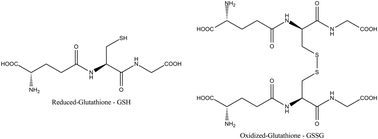
In this HOT review paper, Richard Compton and co-workers from Oxford University discuss the importance of glutathione determination, which has been shown to have physiological importance in diseases such as Parkinson’s, diabetes and cancer. Because of its medical significance, it is important to have quick and easy assays to aid clinical diagnostics and treatment. Click here to read more!

Electrochemical determination of glutathione: a review
John C. Harfield, Christopher Batchelor-McAuley and Richard G. Compton
Analyst, 2012, Advance Article
DOI: 10.1039/C2AN35090D

Digg This
Reddit This
Stumble Now!
Share on Facebook
Bookmark this on Delicious
Share on LinkedIn
Bookmark this on Technorati
Post on Twitter
Google Buzz (aka. Google Reader)

HOT Article: Solvation-based screening for metabolite arrays

A solvation-based screening approach for metabolite arrays

Vaidyanathan et al., Analyst, 2012, Advance Article

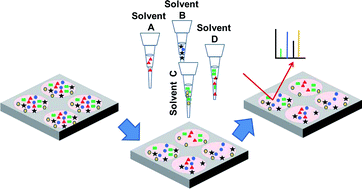
In this HOT paper Seetharaman Vaidyanathan and colleagues from the University of Sheffield explore a new method for screening metabolites based on an array format, using relative polarity and selective solvent dissolution. This approach has the potential to be a successful way of rapidly screening metabolomes and it will allow the simultaneous screening and profiling of multiple samples.

A solvation-based screening approach for metabolite arrays
Malinda Salim, Phillip C. Wright and Seetharaman Vaidyanathan
Analyst, 2012, Advance Article
DOI: 10.1039/C2AN16318G

Digg This
Reddit This
Stumble Now!
Share on Facebook
Bookmark this on Delicious
Share on LinkedIn
Bookmark this on Technorati
Post on Twitter
Google Buzz (aka. Google Reader)

HOT Article: Real time separation of natural products

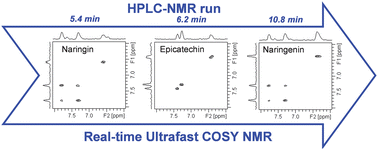
Real-time separation of natural products by ultrafast 2D NMR coupled to on-line HPLC In this HOT paper Patrick Giraudeau, from the Université de Nantes and colleagues, shows the first implementation of an on-line ultrafast HPLC-NMR. Ultrafast COSY spectra were recorded every 12 s in the course of a chromatographic run performed on a mixture of natural aromatic compounds. Click through here to read more!

Real-time separation of natural products by ultrafast 2D NMR coupled to on-line HPLC
Luiz H. K. Queiroz Júnior, Darlene P. K. Queiroz, Liene Dhooghe, Antonio G. Ferreira and Patrick Giraudeau
Analyst, 2012, Advance Article
DOI: 10.1039/C2AN16208C

Digg This
Reddit This
Stumble Now!
Share on Facebook
Bookmark this on Delicious
Share on LinkedIn
Bookmark this on Technorati
Post on Twitter
Google Buzz (aka. Google Reader)

Miniaturising disease diagnosis tool

Miniaturising disease diagnosis tool

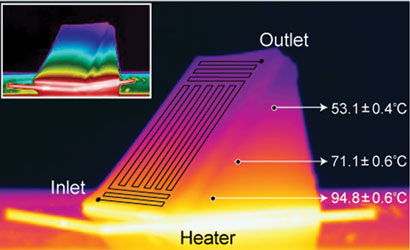
A height-dependent linear temperature gradient established on the inclined surface of a 3D qiandu (right triangular prism)-shaped PDMS microdevice enables flow-through PCR employing a single heater

South Korean scientists have created a temperature cycle for the on-chip flow-through polymerase chain reaction (PCR) using a single heater.

PCR is used to make copies of a piece of  DNA for genetic research, disease analysis and diagnosis. It consists of four main steps – initialisation; denaturation (melting the DNA template to yield single-stranded DNA); annealing primers to the single-stranded DNA template; and extension, in which the DNA polymerase synthesises a new DNA strand complementary to the DNA template.

On-chip flow-through PCR typically has a short reaction time due to rapid thermal equilibrium allowing quick temperature transitions; however, it normally requires several separate heating blocks to create the different temperatures. Reducing the number of heaters will help make the whole system smaller and more portable. ‘Analysing samples on site could help prevent degradation and contamination,’ explains Nae Yoon Lee from Gachon University, South Korea, who led the research.

Read the full story here in Chemistry World.

Link to journal article:

Flow-through PCR on a 3D qiandu-shaped polydimethylsiloxane (PDMS) microdevice employing a single heater: toward microscale multiplex PCR
Wenming Wu,  Kieu The Loan Trinh and Nae Yoon Lee
Analyst, 2012, Advance Article
DOI: 10.1039/C2AN35077G

Digg This
Reddit This
Stumble Now!
Share on Facebook
Bookmark this on Delicious
Share on LinkedIn
Bookmark this on Technorati
Post on Twitter
Google Buzz (aka. Google Reader)