Emerging Investigators Series: Dandan Gao

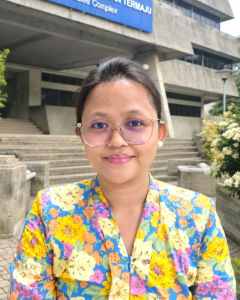
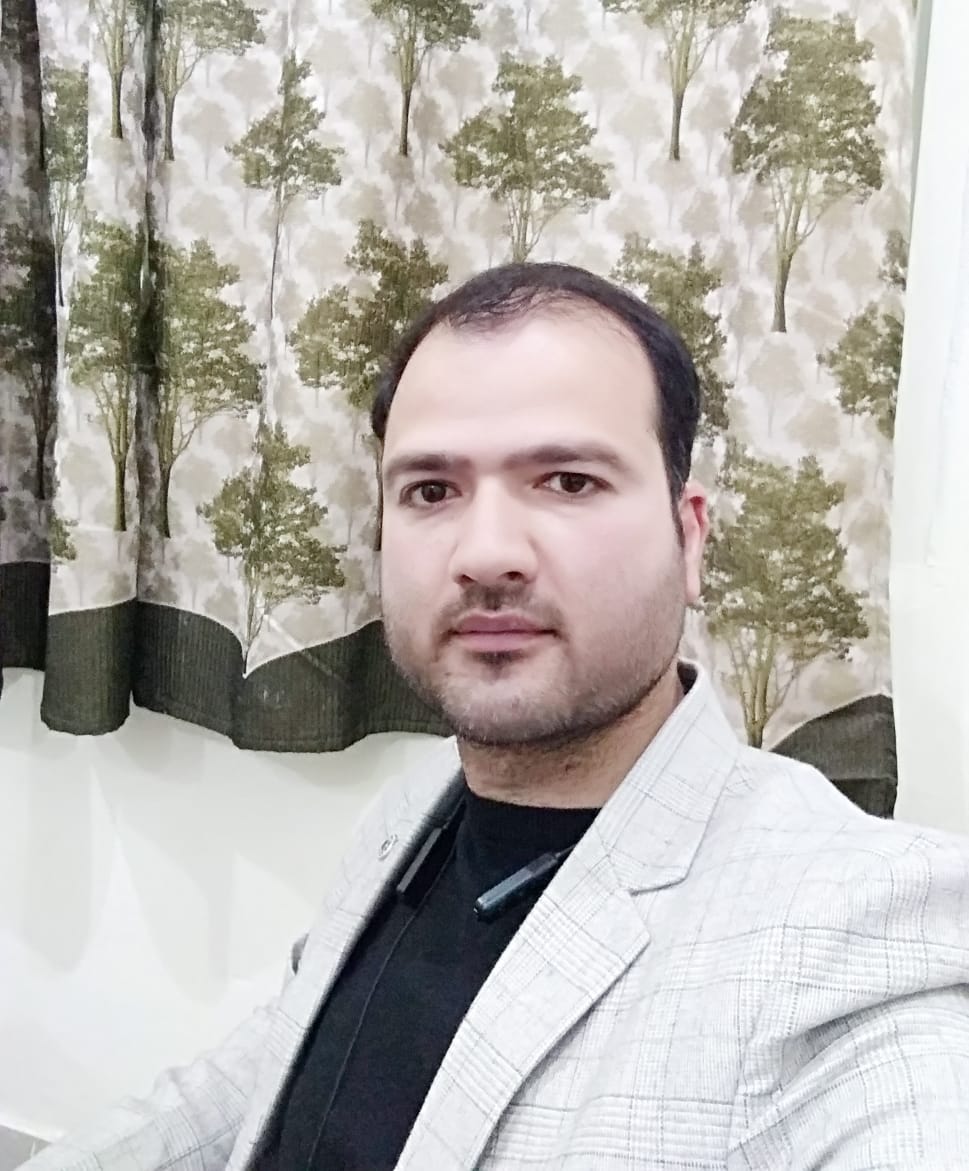
Dandan Gao is an independent research group leader and Walter Benjamin Fellow (funded by DFG) at the Department of Chemistry, Johannes Gutenberg University Mainz, Germany. She received her MSc in metal materials engineering from Shandong University, China. In 2021, she completed her PhD (supervisor: Prof. Dr. Carsten Streb) at Ulm University. Her current research is focused on functional material systems for sustainable chemistry and revealing the reaction mechanisms at both atomic and molecular levels.


Read Dandan’s Emerging Investigators Series article “Design of nanostructured 2D (photo-)electrocatalysts for biomass valorization coupled with H2 production” and read more about her in the interview below:


Your recent Emerging Investigators Series article focuses on Design of nanostructured 2D (photo-)electrocatalysts for biomass valorization coupled with H2 production. How has your research evolved from your first article?

My early work focused on establishing structure – activity relationships in electrocatalytic materials, with an emphasis on understanding how composition and morphology influence performance. Over time, my research has evolved toward a more holistic, systems-level perspective, integrating advanced characterization, operando studies, and data-driven optimization to design catalysts that are not only active but also stable, scalable, and sustainable. This evolution reflects a shift from observing performance to actively steering it through rational and adaptive design principles.

What aspect of your work excites you most right now?

What excites me most is the opportunity to move beyond static catalyst design toward dynamic and self-optimizing systems. In particular, exploring how electrochemical environments can be used as active design parameters, rather than passive operating conditions, opens up new ways to access non-equilibrium structures and reaction pathways. This has strong implications for sustainable fuel production and resource-efficient chemical transformations.

Which profession would you choose if you weren’t a scientist?

If I weren’t a scientist, I would likely pursue a career in design or architecture. The process of balancing creativity with constraints, and translating abstract ideas into functional systems, closely mirrors how I approach research, just at a different scale.

What one piece of career advice would you share with other early career scientists?

Keep standing. Never forget why you started, and your objective can be achieved then.  Invest time in developing a strong scientific intuition, but don’t be afraid to evolve your research direction as new questions emerge. Careers are rarely linear, and some of the most impactful work comes from embracing uncertainty and interdisciplinary thinking rather than following a predefined path.

How do you feel about Sustainable Energy & Fuels as a place to publish research on this topic?

Sustainable Energy & Fuels provides an excellent platform for this type of research because it values both fundamental insight and real-world relevance. The journal’s interdisciplinary scope encourages dialogue between chemists, materials scientists, and energy researchers, which is essential for addressing complex sustainability challenges. I also appreciate its emphasis on rigor, transparency, and long-term impact in the energy landscape.

Digg This
Reddit This
Stumble Now!
Share on Facebook
Bookmark this on Delicious
Share on LinkedIn
Bookmark this on Technorati
Post on Twitter
Google Buzz (aka. Google Reader)

Emerging Investigators Series: Hao-Cheng Yang

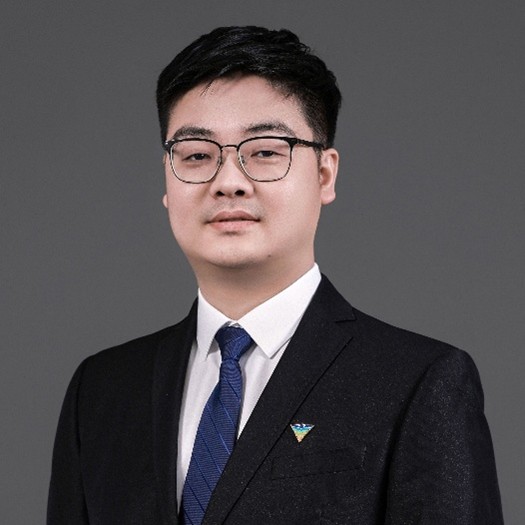
Hao-Cheng Yang received his BSc and PhD degrees in Polymer Science from Zhejiang University. He then conducted postdoctoral research at Argonne National Laboratory (USA). In 2018, he joined Sun Yat-sen University as an Associate Professor, and in 2021 he joined Zhejiang University as a ZJU-100 Young Professor. His research focuses on surface & interface engineering of polymer membranes and membrane processes for environmental and energy applications. 


Read Hao-Cheng’s Emerging Investigators Series article “Solar Energy Technologies for Desalination and Utilization of Hypersaline Brines” and read more about him in the interview below:


Your recent Emerging Investigators Series paper focuses on Solar Energy Technologies for Desalination and Utilization of Hypersaline Brines. How has your research evolved from your first article?

My first article focused on the phase separation processes of polymer membranes. During my PhD, my research shifted toward surface engineering of membrane materials. I later expanded my interests to membrane processes for environmental and energy-related applications. Currently, my research focuses on membrane material and device design for advanced separation and solar-powered processes.

What aspect of your work excites you most right now?

I am particularly excited by the concept of Janus configurations in my current research. Starting from Janus membranes, we found that constructing opposing properties on each side of a membrane can outperform uniform materials and, in some cases, reconcile conflicting material requirements for specific applications. This concept is not limited to membranes and shows promise for a wide range of energy-related applications.

Which profession would you choose if you weren’t a scientist?

If possible, I would choose to be an artist, a dream I have had since childhood. I spent many years practicing sketching when I was young. In a way, scientific research allows me to fulfil part of that dream, especially when preparing visual schemes for research papers.

What one piece of career advice would you share with other early career scientists?

I would advise early career scientists not to give up easily, even when their ideas are not widely supported. Although the line between persistence and stubbornness can be thin, solitary persistence can sometimes be more valuable than pursuing research topics that are immediately popular.

How do you feel about Sustainable Energy & Fuels as a place to publish research on this topic?

It has been a pleasure to publish our work in Sustainable Energy & Fuels. This journal is a highly suitable and impactful venue for research in this field. The journal’s emphasis on sustainable energy and fuels aligns well with our research interests, and its interdisciplinary readership helps bridge fundamental science with practical energy applications.


Digg This
Reddit This
Stumble Now!
Share on Facebook
Bookmark this on Delicious
Share on LinkedIn
Bookmark this on Technorati
Post on Twitter
Google Buzz (aka. Google Reader)

Emerging Investigators Series: Manzoor A. Dar

Manzoor Ahmad Dar is an Assistant Professor in the Department of Chemistry, Islamic University of Science and Technology (IUST), J&K, India. He completed his Master’s degree in Physical Chemistry from the University of Kashmir and PhD from CSIR-National Chemical Laboratory, Pune. He later worked as a postdoctoral fellow in the Department of Chemistry at IISER Bhopal after which he joined IUST. His research focusses on data-driven approaches, including high-throughput first principles simulation based screening and machine learning for accelerating the discovery of stable single and double atom catalysts for energy conversion processes such as CO2RR and NRR while accounting for stability, aggregation resistance, and competitive reactions such as HER. 


Read Manzoor’s Emerging Investigators Series article “Nickel single atom catalyst supported on the gallium nitride monolayer: first principles investigations on the decisive role of support in the electrocatalytic reduction of CO2” and read more about him in the interview below:


Your recent Emerging Investigators Series article focuses on Nickel single atom catalyst supported on the gallium nitride monolayer: first principles investigations on the decisive role of support in the electrocatalytic reduction of CO2. How has your research evolved from your first article?

My research in computational catalyst design for single-atom catalysts (SACs) has evolved from simple activity screening toward a more holistic, mechanism-driven and materials-realistic framework for energy conversion reactions such as CO₂ reduction (CO₂RR) and nitrogen reduction (NRR). Early studies from our group largely focused on identifying SACs on ideal supports using adsorption energies and limiting potentials as descriptors, establishing structure–activity relationships for key intermediates (*CO₂⁻, *COOH, *N₂, *N₂H). More recently, our efforts have expanded to double-atom catalysts (DACs), where synergistic electronic and geometric interactions between adjacent metal sites offer enhanced catalytic activity and improved reaction selectivity. In parallel, we have increasingly incorporated solvent effects to bridge the gap between idealized theoretical models and realistic electrochemical operating conditions. Furthermore, we employ data-driven strategies, including high-throughput screening and machine-learning approaches, to accelerate the discovery of stable and aggregation-resistant SAC/DAC motifs while explicitly accounting for competitive pathways such as the hydrogen evolution reaction (HER). Collectively, these advances reflect a clear transition from simple descriptor-based screening toward predictive, operando-relevant computational design of atomic-scale catalysts for sustainable energy conversion.

What aspect of your work excites you most right now?

The most exciting aspect of computational catalyst design for energy conversion reactions is the unprecedented ability to rationally engineer catalytic sites at the atomic level. First-principles simulations allow us to precisely correlate coordination environment, electronic structure, and reaction energetics, revealing how isolated metal atoms or synergistic bimetallic pairs break traditional scaling relationships and selectively stabilize key intermediates (*COOH, *CO, *N₂H, *NH₂). Coupled with machine learning and high-throughput screening, computational design is transforming catalyst discovery from trial-and-error to predictive, mechanism-driven optimization, accelerating the development of highly selective, low-overpotential catalysts for sustainable CO₂ conversion and ammonia synthesis.

Which profession would you choose if you weren’t a scientist?

If I weren’t a scientist, I would choose to be a teacher of poetry, a profession that blends the joy of guiding minds with the freedom of creative expression. Teaching would allow me to nurture curiosity, critical thinking, and a love for learning, much like science does, but through stories, discussions, and shared reflection. Poetry, on the other hand, would give me a language to explore emotions, nature, and human experiences beyond equations and data. Together, teaching and poetry would let me inspire others not only to understand the world, but also to feel it deeply, turning knowledge into meaning and learning into a lifelong conversation.

What one piece of career advice would you share with other early career scientists?

I would advise early career scientists to be patient and persistent, and to focus on developing a strong fundamental understanding rather than chasing trends. Building depth in one’s expertise, maintaining curiosity, and embracing interdisciplinary collaborations can lead to more meaningful and sustained research contributions. Rejections and setbacks are part of the process; treat them as feedback rather than failure.

How do you feel about Sustainable Energy & Fuels as a place to publish research on this topic?

Sustainable Energy & Fuels is an excellent platform for publishing research on energy conversion processes, as it sits at the intersection of fundamental science and real-world sustainability challenges. The journal values mechanistic insight, rigorous theory–experiment synergy, and clear relevance to low-carbon energy technologies, which aligns well with studies on electrocatalytic pathways, active-site engineering, and reaction selectivity in CO₂ and N₂ conversion. Its broad readership across chemistry, materials science, and energy research ensures strong visibility, while the emphasis on sustainability encourages authors to frame catalytic performance in terms of efficiency, scalability, and environmental impact rather than isolated metrics. Overall, it provides a credible and high-impact platform for advancing and contextualizing fundamental advances in CO₂RR and NRR within the global energy transition.


Digg This
Reddit This
Stumble Now!
Share on Facebook
Bookmark this on Delicious
Share on LinkedIn
Bookmark this on Technorati
Post on Twitter
Google Buzz (aka. Google Reader)

Highlighting our Themed Collection on Hybrid, Organic and Perovskite Photovoltaic Stability

We are delighted to showcase the latest Sustainable Energy & Fuels themed collection on Hybrid, Organic and Perovskite Photovoltaics Stability, guest edited by Francesca Brunetti, Vida Engmann, Morten Madsen and David M. Tanenbaum.

This collection showcases recent progress and challenges in the field of stability for hybrid, organic and perovskite photovoltaics and includes some of the excellent research presented at the ISOS-XIII conference, held in Sønderborg, Denmark. In addition to the Open Access articles in this issue, all articles are free to access until 31st March 2025.

We’ve highlighted some of the excellent articles featured in the collection below:

Passivation mechanism of the perovskite upper interface based on MAPbBr3 quantum dots for efficient and stable perovskite solar cells Yan Feng, Huilin Li, Zhitao Shen, Fumin Li*, Mengqi Jin, Yanjing Rong, Xingyuan Tian, Rong Liu* and Chong Chen*

Measuring metal halide perovskite single cell degradation consistent with module-based conditions Robert Tirawat*, Amy E. Louks, Mengjin Yang, Severin N. Habisreutinger, Jao van de Lagemaat, Soňa Uličná, Ross A. Kerner, Kai Zhu, Laura T. Schelhas, Axel F. Palmstrom and Joseph J. Berry*

Aging of quinoxaline-based polymer solar cells under UV-free white light Shahidul Alam*, Md Moidul Islam, Rico Meitzner, Martin Hager, Ulrich S. Schubert, Frédéric Laquai, Harald Hoppe and  Yingping Zou

The water-dipping effect of branched poly(ethylene imine) interfacial layers on the performance and stability of polymer:nonfullerene solar cells Hyunji Son, Woongki Lee, Sooyong Lee, Hwajeong Kim* and Youngkyoo Kim*

An efficient approach for controlling the crystallization, strain, and defects of the perovskite film in hybrid perovskite solar cells through antisolvent engineering Nikolaos Tzoganakis, Konstantinos Chatzimanolis, Emmanuel Spiliarotis, George Veisakis, Dimitris Tsikritzis* and Emmanuel Kymakis

Understanding the role of interfacial layers in the photostability of PM6:Y7-based organic solar cells under different degradation conditions Magaly Ramírez-Como, Enas Moustafa, Mohamed Samir, Alfonsina Abat Amelenan Torimtubun, José G. Sánchez, Josep Pallarès* and Lluis F. Marsal*

We hope that you enjoy reading the great research featured in this collection


Digg This
Reddit This
Stumble Now!
Share on Facebook
Bookmark this on Delicious
Share on LinkedIn
Bookmark this on Technorati
Post on Twitter
Google Buzz (aka. Google Reader)

Introducing Sustainable Energy & Fuels’s newest Associate Editor, Fuxiang Zhang

We are delighted to introduce our newest Associate Editor for Sustainable Energy & Fuels, Professor Fuxiang Zhang.

Fuxiang Zhang received his PhD degree from Nankai University, China in 2004, and became a full professor of physical chemistry at Dalian Institute of Chemical Physics (DICP), Chinese Academy of Sciences in 2013. Prior to this appointment he worked as a postdoc at Pierre and Marie Curie University and the University of Tokyo. As leader of a research group focused on materials and catalysis for solar hydrogen production and storage at DICP, Fuxiang is now working with his colleagues for solar-to-chemical conversion involving photocatalysis for overall water splitting, electrocatalysis, precise synthesis of materials and in situ characterization as well as understanding of catalytic reaction mechanisms. His team has assembled a series of powder-suspended systems for visible-light-driven overall water splitting to produce hydrogen with high quantum efficiency, and have published ~200 peer-reviewed papers in the fields of material science and heterogeneous photo/electrocatalysis.

As well as his role with Sustainable Energy & Fuels, Fuxiang is an Associate Editor for Journal of Energy Chemistry, and an Editorial Board member for journals such as National Science Review, Science China Chemistry and eScience. He was elected as a Fellow of the Royal Society of Chemistry in 2020.

Please join us in welcoming Professor Zhang to his new role with Sustainable Energy & Fuels!

Digg This
Reddit This
Stumble Now!
Share on Facebook
Bookmark this on Delicious
Share on LinkedIn
Bookmark this on Technorati
Post on Twitter
Google Buzz (aka. Google Reader)

Themed Collection on ‘Next-generation battery technologies beyond lithium’ now open for submissions

Our latest Sustainable Energy & Fuels themed collection, Next-generation battery technologies beyond Lithium, is now open for submissions.

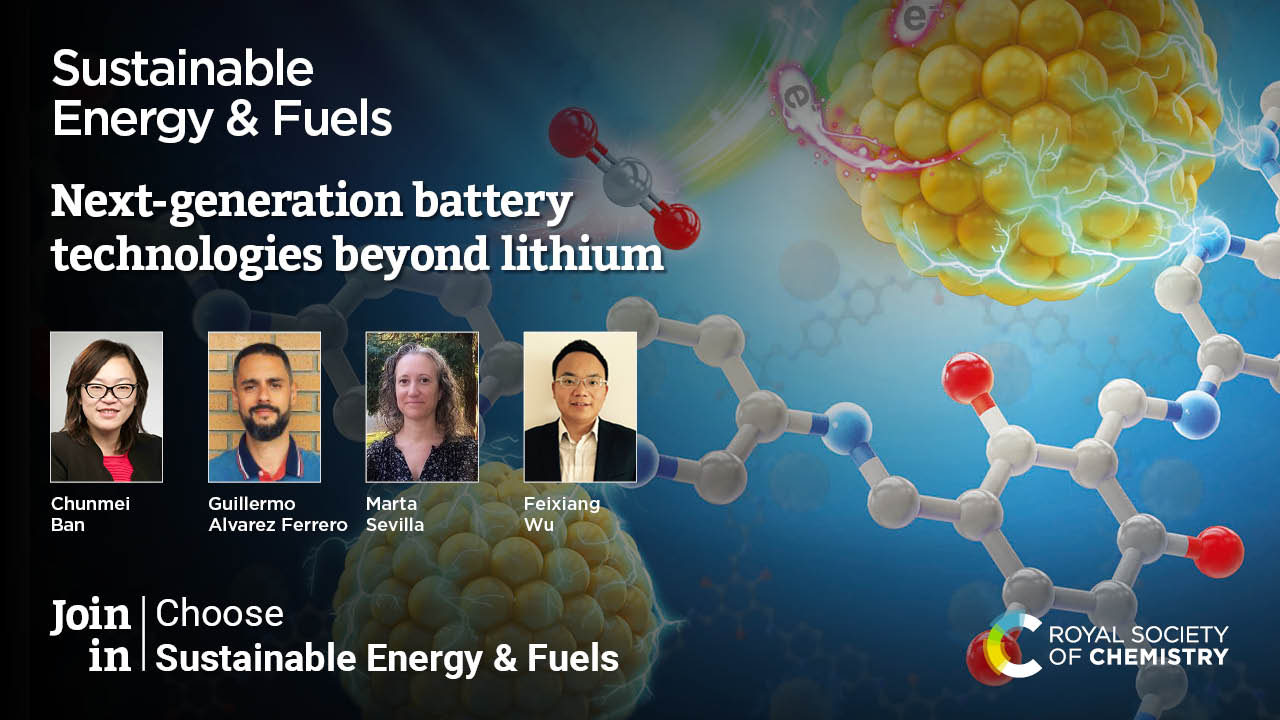
This Sustainable Energy & Fuels themed collection, guest edited by Chunmei Ban (University of Colorado Boulder, USA), Guillermo Alvarez Ferrero (Humboldt University, Germany), Marta Sevilla (Instituto Nacional del Carbón – CSIC, Spain) and Feixiang Wu (Central South University, China) will highlight alternatives to lithium-based battery designs and technologies

Lithium-ion based batteries are an essential part of the world’s energy infrastructure, however lithium-based energy storage systems have challenges in terms of safety, global demand for lithium, energy intensive production and ease of recycling. This collection aims to highlight alternative materials, electrolytes and technologies to develop the next generation of non-lithium batteries

Topics in scope for this collection include, but are not limited to, alternative alkali and alkali-earth metal batteries (including metal-ion, metal-air and sulfur-based systems), all solid-state batteries, multivalent batteries, and other technologies for non-lithium ion energy storage (e.g., redox flow batteries or dual-ion batteries). We especially value studies that prioritize sustainability as a central focus and encourage life cycle assessment studies.

The deadline for submissions is 30th April 2025.

Manuscripts should be submitted via the Royal Society of Chemistry’s online submission service and the Editorial Office informed by email. Please add the themed collection code “SEBeyond24” when prompted at submission. The Editorial Office reserves the right to check the suitability of submissions in relation to the scope of the collection and the inclusion of accepted articles in the collection is not guaranteed. Please also note that all submissions will be subject to initial assessment and rigorous peer review to meet the usual high standards of Sustainable Energy & Fuels. All manuscripts will be subject to the journal’s usual peer-review process. Accepted manuscripts will be added to the online collection as soon as they are online and they will be published in a regular issue of Sustainable Energy & Fuels.

Authors are welcome to submit original research as a Communication article or Full Paper or contribute a Review or Perspective article. If you have any questions about the collection, please do get in touch with the Editorial Office.

Digg This
Reddit This
Stumble Now!
Share on Facebook
Bookmark this on Delicious
Share on LinkedIn
Bookmark this on Technorati
Post on Twitter
Google Buzz (aka. Google Reader)

Announcing our newest Sustainable Energy & Fuels Advisory Board Member, Wenming Yang

We are delighted to announce that Wenming Yang (National University of Singapore) has joined the Sustainable Energy & Fuels Advisory Board!

Wenming has been an Associate Professor at the National University of Singapore since 2017. His research interests include internal combustion engines fuelled by biofuels and blend fuels, development of advanced platform for boilers with high efficiency and low emissions, incinerators and micro power generators, as well as similar areas.

For more information about Sustainable Energy & Fuels and our Board Members click here

Digg This
Reddit This
Stumble Now!
Share on Facebook
Bookmark this on Delicious
Share on LinkedIn
Bookmark this on Technorati
Post on Twitter
Google Buzz (aka. Google Reader)

Themed Collection on ‘Metal-Free Photo/Electrocatalysts for Sustainable Energy Solutions’ is now open for submissions

Announcing Metal-Free Photo/Electrocatalyts Themed Collection for Sustainable Energy & Fuels

We are delighted to open our latest Sustainable Energy & Fuels themed collection titled ‘Metal-Free Photo/Electrocatalysts for Sustainable Energy Solutions‘ to submissions. Guest edited by Menny Shalom (Ben-Gurion University of the Negev, Israel), Sebastian Sprick (University of Strathclyde, UK) and Xinchen Wang (Fuzhou University, China), it will showcase metal-free photo- and electrocatalytic materials for sustainable energy applications.

Photo- and electrocatalysis are promising research areas for sustainable energy applications and chemicals production. Metal-free photo- and electrocatalysts for energy conversion potentially offer a low-cost and efficient solution. These materials include carbon nitrides, boron carbon nitrides, triazine-based frameworks, covalent organic frameworks, conjugated materials as well as composites and biohybrid systems. This collection aims to highlight the unique properties of metal-free photo- and electrocatalysts and their important energy applications such as photocatalytic water splitting, carbon dioxide reduction, hydrogen peroxide production and organic transformation reactions.

The deadline for submissions is 20th December 2024.

Manuscripts should be submitted via the Royal Society of Chemistry’s online submission service and the Editorial Office informed by email. Please add the themed collection code “SEMFree23” when prompted at submission. The Editorial Office reserves the right to check the suitability of submissions in relation to the scope of the collection and the inclusion of accepted articles in the collection is not guaranteed. Please also note that all submissions will be subject to initial assessment and rigorous peer review to meet the usual high standards of Sustainable Energy & Fuels. All manuscripts will be subject to the journal’s usual peer-review process. Accepted manuscripts will be added to the online collection as soon as they are online and they will be published in a regular issue of Sustainable Energy & Fuels.

Authors are welcome to submit original research as a Communication article or Full Paper or contribute a Review or Perspective article. If you have any questions about the collection, please do get in touch with the Editorial Office.

Digg This
Reddit This
Stumble Now!
Share on Facebook
Bookmark this on Delicious
Share on LinkedIn
Bookmark this on Technorati
Post on Twitter
Google Buzz (aka. Google Reader)

Introducing Sustainable Energy & Fuels’ newest Editorial Board members Wooyul Kim and Carol Lin

We are delighted to introduce the newest members of the Sustainable Energy & Fuels Editorial Board, Professor Carol Sze Ki Lin and Professor Wooyul Kim.

Carol Sze Ke Lin, new Editorial Board Member

Portrait of Carol Lin

Carol Lin is currently a Professor at the School of Energy and Environment at City University of Hong Kong (CityU). She received her Bachelor’s degree in Chemical and Materials Engineering with 1st class honours from The University of Auckland, New Zealand. She was awarded her PhD in 2008 in Chemical Engineering at The University of Manchester, England. After one year as a postdoctoral researcher at Ghent University in Belgium, she returned to Hong Kong and joined the Hong Kong University of Science and Technology (HKUST) as a Visiting Assistant Professor.  In July 2011, she began her academic career in School of Energy and Environment at CityU.

Her research interests lie in technological advancement and development of circular waste-based biorefinery for sustainable production of chemicals, materials and fuels, that contributes to reduction of environmental burden of waste disposal and enhancement of resource efficiency. Her research covers the following areas: (i) Biosynthesis of high value-added products and organic pollutant removal via microalgae-based biorefinery; (ii) Development of Yarrowia lipolytica yeast as a promising host; (iii) Novel bioprocess for recycling textile waste for sustainable production of high value-added products; (iv) Biosurfactants production from industrial food waste feedstocks; (v) Identification of microplastics in municipal solid waste landfill leachates.

Carol is a recipient of a number of innovation awards, including two Gold Medals in Geneva Invention Exhibition (2018, 2024), Gold Medal with Jury’s Commendation in Geneva Invention Exhibition (2016), and the President’s Awards (2017). She was awarded the Milliporesigma Green Chemistry Education Challenge Awards 2024 by Beyond Benign, Inc. in Wilmington, Massachusetts, USA. She has also been selected for the High-end Foreign Experts Program in Tongji University, Shanghai, China 2023-2024.

Wooyul Kim, new Editorial Board Member

Portrait of Prof Wooyul Kim

Wooyul Kim received his PhD from POSTECH in 2012. During his PhD, he also conducted research at Osaka University as a visiting researcher in 2009, 2010, and 2012. Following that, he spent over 3 years (2012-2015) at Lawrence Berkeley National Laboratory as a Postdoctoral Fellow. From 2016 to 2022, he joined the Department of Chemical and Biological Engineering at Sookmyung Women’s University as an Assistant and Associate Professor. Since 2022, he has been a faculty member in the Department of Energy Engineering at KENTECH.

Recently, his research has primarily focused on revealing both structural identity of the key intermediates and their cites in the catalytic cycle (i.e., their kinetic relevancy) to overcome the kinetic barriers for photo (or electro) catalysis. Based on these accomplishments, he has received several prestigious awards, including the 2023 KENTECH Award for Research Excellence, the 2022 Energy & Fuels Rising Stars recognition, the 2021 Journal of Materials Chemistry A Emerging Investigators honor, and the 2020 EES Lectureship Award, among others.

Please join us in welcoming them both to the Sustainable Energy & Fuels Editorial Board!

Digg This
Reddit This
Stumble Now!
Share on Facebook
Bookmark this on Delicious
Share on LinkedIn
Bookmark this on Technorati
Post on Twitter
Google Buzz (aka. Google Reader)

Hybrid Ion Capacitors: new themed collection in Sustainable Energy & Fuels

A collection showcasing the latest developments towards hybrid ion capacitors

Sustainable Energy & Fuels is pleased to present our Hybrid Ion Capacitors themed collection. Guest edited by Marta Sevilla (Instituto Nacional del Carbón – CSIC, Spain), Vanchiappan Aravindan (Indian Institute of Science Education and Research (IISER) Tirupati, India), Martin Oschatz (Friedrich-Schiller-Universität Jena, Germany) and Konstantin Schutjajew (Friedrich-Schiller-Universität Jena, Germany), Sustainable Energy & Fuels is proud to highlight the latest developments in this area.

Hybrid ion capacitors are considered a promising next-generation charge-storage device owing to their combined features of both rechargeable batteries and supercapacitors, i.e., high energy and high-power capability. These devices stand out by their tunable performance characteristics and a broad range of possibly applicable materials. Many congratulations to all the featured researchers!

Read the collection

The Guest Editors introduce this collection in their Editorial titled “Shaping the future of hybrid ion capacitors”.

Read the introductory editorial

All of the articles in the collection are free to access until the end of January 2024. We hope you enjoy reading this collection and look forward to seeing how this field progresses! Please continue to submit your impactful work to Sustainable Energy & Fuels.

Digg This
Reddit This
Stumble Now!
Share on Facebook
Bookmark this on Delicious
Share on LinkedIn
Bookmark this on Technorati
Post on Twitter
Google Buzz (aka. Google Reader)