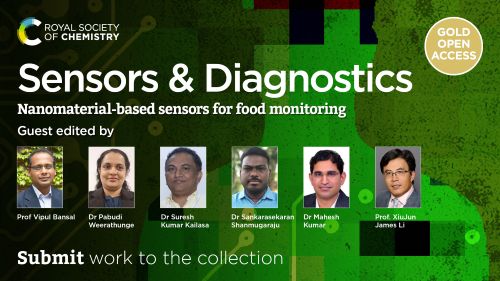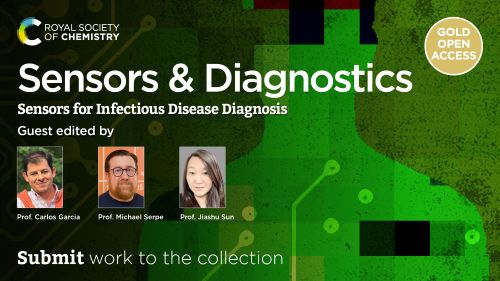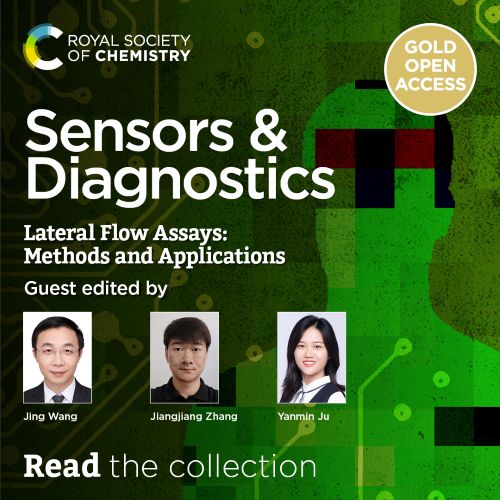

Welcome to the latest Sensors & Diagnostics newsletter! We’re pleased to share a round-up of the latest journal news, as well as information on our themed collections and upcoming events.
Get future updates directly to your inbox with our email alerts. Sign up here.
Latest News
In scientific research, acknowledging methodological limitations is essential for responsible reporting. To uphold these principles, authors submitting to Sensors & Diagnostics are now required to clearly outline the limitations of their study in the Discussion section, emphasising the need for further research and transparency in reporting. To assist authors in this process, we encourage them to read our “Discussion of study limitations strengthens research through transparency” Editorial, which outlines our expectations and provides helpful examples. We welcome comments and questions, which can be sent in reply to this email.

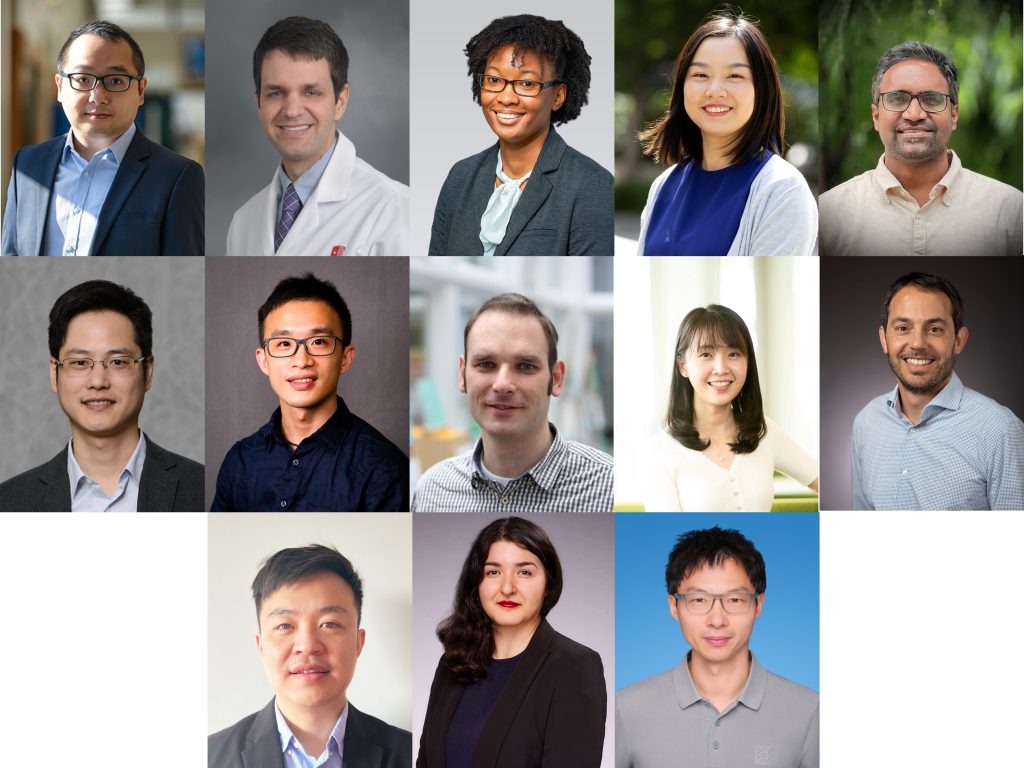
We were delighted to announce the recipients of the Outstanding Early Career Research Award 2025 from Sensors & Diagnostics: a team comprising Tao Yu, Aditi Dey Poonam, Amy Halbing, Shengwei Zhang, Yingmiao Liu, Zheng Li, William Marx, Andrew B. Nixon and principal investigator Qingshan Wei.
Their award-winning paper, “A digital nonenzymatic nucleic acid amplification assay for ultrasensitive detection of cell-free microRNA in human serum“, introduces a simpler and more compact tool than PCR for amplifying diagnostically-important nucleic acid fragments, which they have dubbed sequential nonenzymatic amplification or SENA. Find out more about the winners and their work at our earlier blog post.
Our latest Journal Impact Factor, for 2025, has increased to 5.9! We would like to thank our authors for contributing their best work to the journal, and our editors and reviewers for their prompt and professional handling of these contributions. We’d particularly like to highlight our Outstanding Reviewers for 2025 who can be found in our recent Editorial.
We are pleased to announce that the Editor in Chief of Sensors & Diagnostics Prof. Dr Xueji Zhang has been selected as the Chair of the International Engineering and Technology Institute Strategic Advisory Committee. This is a fantastic achievement, and we would like to congratulate Prof. Zhang on this well‑deserved honour and wish him every success in this important role.

Research Spotlight
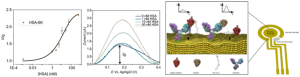
“A molecular switch framework for reagentless electrochemical detection of proteins”, Shirzadi, Poudineh et al., Sens. Diagn., 2026, 5, 837–847, DOI: 10.1039/d6sd00048g
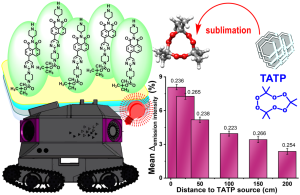
“A multilayer fluorogenic material for the ultrasensitive detection of TATP in air, suitable for implementation on a mechanized semi-autonomous robotic platform”, Torroba et al., Sens. Diagn., 2026, 5, 828–836, DOI: 10.1039/d5sd00218d
Themed Collections
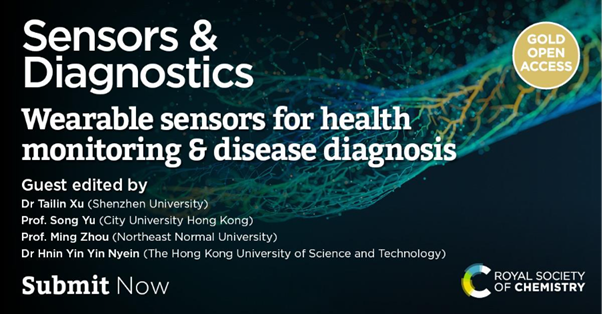
The submission deadline for our Wearable Sensors for Health Monitoring and Disease Diagnosis themed collection has been extended to 30th September 2026. This collection is Guest Edited by Tailin Xu, Yu Song, Ming Zhou and Hnin Yin Yin Nyein, and will highlight cutting-edge research on wearable sensors for health monitoring and disease diagnosis, with an emphasis on innovations in materials, device engineering, multimodal sensing platforms, data analytics, and clinical translation. Find out more on the collection’s web page.

Events
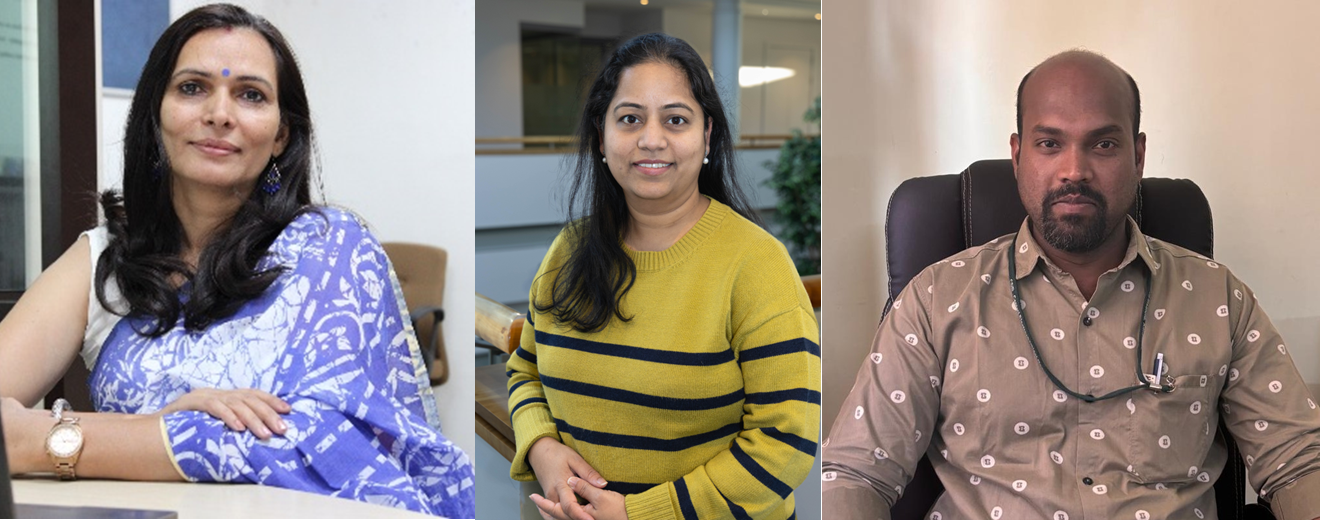
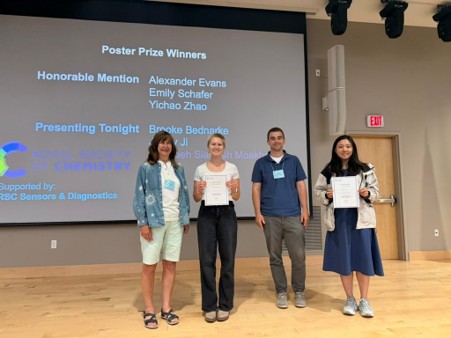
Sensors & Diagnostics proudly sponsored awards at 2027 Gordon Research Conference on Bioanalytical sensors, “Applying the Fundamentals of Recognition and Amplification to Current Challenges”. Our congratulations to the prize winners, Brooke Bendarke (Tufts University,United States), Jenny Ji (Stanford University, United States), and Roozbeh Moakhar (McGill University, Canada).
We were also pleased to sponsor the best poster prize at the 13th Royal Society of Chemistry Analytical Biosciences Group Early Career Researcher Meeting, along with Analyst and RSC Advances. Brian van’t Veer of Da Vinci Laboratory Solutions received the Sensors & Diagnostics prize. Congratulations to Dr. van’t Deer!

Sensors & Diagnostics is proud to support the upcoming Asilomar Bioelectronics Symposium 2026, taking place 1-4 September in Pacific Grove, CA, USA. Our Editorial Board member Sahika Inal is helping organise this year’s meeting which draws together research at the interface of materials, biology, engineering and much more. Find out more and register here: https://www.asilomarbioelectronics.com/
Follow our channels below to keep up to date on the events we’re supporting later in 2026.
Submit your work to Sensors & Diagnostics
Find out more about Sensors & Diagnostics on our webpage, where you can also find our author guidelines. Sensors & Diagnostics has received a 2025 Impact Factor of 5.9, and provides a first decision on articles sent to peer review in an average of 41 days.
Publishing open access with RSC journals unlocks the full potential of your research – bringing increased visibility, wider readership and higher citation potential to your work. As a not-for-profit organisation serving the chemical sciences community, we ensure that our article processing charge (APC) remains the most competitive of major publishers. More details can be found here and the APC for Sensors & Diagnostics is £2200. You can also use our journal finder tool to check if your institution currently has an agreement with the RSC that may entitle you to a discount of the APC.
Stay Connected
Follow us on LinkedIn and Bluesky for new articles and the latest news from Sensors & Diagnostics and related journals at the Royal Society of Chemistry.