


Self-powered and biocompatible polymer sensors
Sensors are everywhere in our daily life, enabling technology by translating changes in our environment into physical or digital outcomes. Polymer-based sensors offer benefits like flexibility, low production costs, and easy customization for different applications.
Explore the collection of papers published in below and discover how polymer scientists are developing practical solutions to real-world challenges.
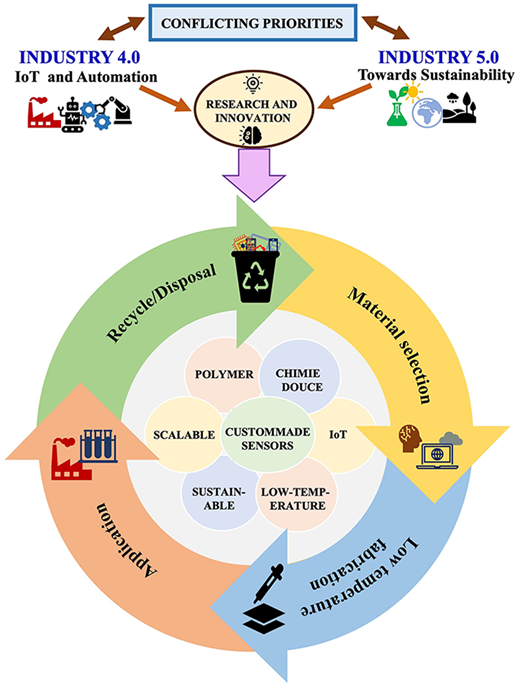
Sustainable, circular, and scalable polymer sensors
A growing challenge is that wearable electronics generate significant electronic waste. It is essential to develop biodegradable, recyclable, low-energy-manufactured and environmentally benign sensor materials without sacrificing performance.
- Polymeric sensors at the crossroads of sustainability and scalability: low-temperature fabrication for environmental and health monitoring Suvitha S. Kumar, Berly Robert, Sreeram K. Kalpathy, Tiju Thomas
Self-powered wearable sensors
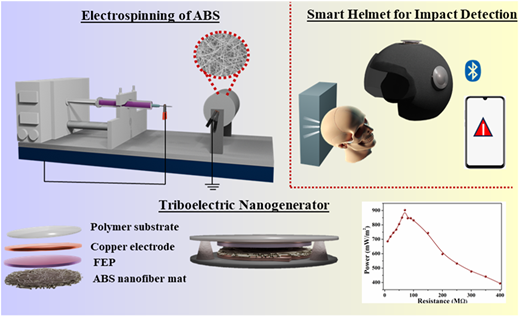
One of the biggest limitations of wearable devices remains power supply. Researchers are increasingly developing sensors that simultaneously harvest and sense mechanical, thermal, or biochemical energy from the body using triboelectric, piezoelectric, piezoionic, and biofuel-cell approaches. These recent publications demonstrate examples of triboelectric nanogenerators and piezoionic materials for self-powered sensors.
- Self-powered impact sensors based on electrospun acrylonitrile butadiene styrene triboelectric nanogenerators for wearable helmet applications Mathew Sunil, E. J. Jelmy, Rinku Mariam Thomas, K. J. Saji, Honey John
- 3D printed modular piezoionic sensors using dynamic covalent bonds Julian Smith-Jones, Nathan Ballinger, Naroa Sadaba, Xabier Lopez de Pariza, Yunxin Yao, Stephen L. Craig, Haritz Sardon, Alshakim Nelson
Biocompatible wearable sensors
The field is moving beyond measuring only motion or temperature and now sensors can monitor increasingly subtle chemical biomarkers in sweat, saliva, tears, or interstitial fluid. Incorporating these sensing capabilities into wearable devices promises to be a major advance for precision medicine and digital healthcare.
- Polydiacetylene/copolymer sensors to detect lung cancer breath volatile organic compounds Angie Davina Tjandra, Rona Chandrawati
- Improving the in vivo stability and sensor lifetime with new blend membranes on CGM sensors Yinxiu Zuo, Lanjie Lei, Ke Huang, Qing Hao, Chao Zhao, Hong Liu
- A simple approach to determining the efficacy of antiperspirants using paper-based colorimetric paper sensors: SweatSENSE Rachel A. Hand, Spyridon Efstathiou, Alan M. Wemyss, Maria Grypioti, Gavin Kirby, Tammie Barlow, Emmett Cullen Tinley, Jane Ford, Andy Jamieson, Janette Reynolds, Jean Miller, Susan Bates, Ezat Khoshdel, David M. Haddleton

Keep up to date with RSC Applied Polymers
We hope you enjoy reading through this selection of articles and that they are of particular interest to you and your research. If you would like to contribute your work to RSC Applied Polymers, click here.