


To celebrate the growth and development of the RSC Applied Polymers community and to highlight the remarkable authors who continue to contribute their high quality work to the journal, we would like to share the opinions and insights of these authors through this introductory blog post. Once dubbed #RSCAppliedfirst50, our blog posts aim to give a voice to the authors behind the research and hope that their insights might shed light upon growing challenges and progress in polymer science and its applications.
In this post, we hear from Adam T. Caridi, Amelia Kurowska, Dr. Erlantz Lizundia and Dr. Joshua C. Worch who have developed polyester biocomposites containing fungal nanochitin using an industrially scalable melt-compounding process. This innovative work supports the transition towards biobased and sustainable materials with enhanced mechanical functionality and performance.
An interview with the authors
Where do you see your own research going in future?
Based on this work, which is the first demonstrating the melt compounding of nanochitin fibrils with thermoplastic materials, we envisage further developments on the industrially scalable processing of biobased materials. We plan to expand the substrate scope and explore other natural materials via extrusion methods.
What aspect of your work are you most excited about at the moment?
Precise modification of nanochitin (and other biopolymer) surfaces is an area where significant improvements in performance might be obtained. We are also excited about the general area of reactive extrusion as a streamlined approach for biomaterial processing.
In your opinion, what are the most important questions to be asked/answered in your field of research?
Coupling these studies with advanced life cycle assessment (LCA) modeling such as prospective LCA, dynamic biogenic carbon accounting, or absolute LCA, could help to get a more accurate picture on the real-world sustainability of these processes and materials. Technoeconomic analyses are also critical since economic feasibility, especially compared to current products, is a key requirement for commercialization of new technologies and materials.
What do you find most challenging about your research?
Meeting the often stringent trade-offs among performance, biodegradability, cost, and overall sustainability is always a challenge in biobased materials. Feedstock composition (i.e. source of the natural polymer) is changeable and can lead to differences in properties (e.g. molecular weight, other biomolecular components present, etc.). This is a significant challenge in the field that can hinder commercial translation of many materials. However, at the same time, renewable materials provide a lot of room to play with and tune material properties when compared to synthetic materials.
Meet the authors
 Adam T. Caridi |
Adam T. Caridi is a Ph.D. candidate in the Department of Chemistry at Virginia Tech. His work in the Worch Lab focuses on extrusion-based manufacturing methods to develop more sustainable biocomposites. In parallel, he is advancing the design of recyclable photopolymer resins to support circular additive manufacturing and promote more sustainable materials lifecycles. His Ph.D. aims to advance more sustainable material solutions by exploring greener feedstocks and dynamic material systems that enable a more circular approach to manufacturing.
|
 Amelia Kurowska |
Amelia Kurowska conducted undergraduate research in the Worch Lab where her research focused on polymer processing and biocomposite materials. She is now pursuing her PhD in the Department of Chemistry at Texas A&M University beginning Fall 2026 where she will focus on polymer chemistry.
|
 Erlantz Lizundia |
Erlantz Lizundia is Full Professor at the Bilbao School of Engineering, University of the Basque Country (Spain). He received his PhD in 2011 on Advanced Materials Engineering. He is the Principal Investigator of the Life Cycle Thinking Group, where he develops environmentally sustainable materials and technologies based on renewable materials using green chemistry, bioeconomy, circularity, and eco-design approaches for biopolymer valorization, batteries, or recycling/upcycling through life cycle assessment (LCA).
|
 Josh Worch |
Josh Worch is an Assistant Professor in the Department of Chemistry at Virginia Tech (USA) since 2022. He received his PhD in Organic Chemistry from Carnegie Mellon University under Kevin Noonan where he synthesized organic semi-conducting materials. He then completed postdoctoral training with Andrew Dove at the University of Warwick/University of Birmingham focusing on manipulating polymer properties with stereochemistry and developing synthetic biomaterials. At Virginia Tech, the Worch Lab develops sustainable polymers with an integrated approach, encompassing synthesis, processing, and application to end-of-life while incorporating green chemistry concepts. Materials of interest include dynamic adhesive materials, high-performance composites from native biomass, sustainable resins for additive manufacturing, and degradable elastomers.
|
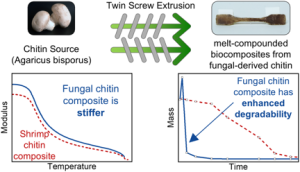
Tunable enhancement of polyester biocomposites via extrusion with fungi-derived chitin
Adam T. Caridi, Amelia Kurowska, Erlantz Lizundia, Joshua C. Worch
RSC Appl. Polym. (2026). https://doi.org/10.1039/d5lp00403a
 |
RSC Applied Polymers is a leading international journal for the application of polymers, including experimental and computational studies on both natural and synthetic systems. In this journal, you can discover cross-disciplinary scientific research that leverages polymeric materials in a range of applications. This includes high impact advances made possible with polymers across materials, biology, energy applications and beyond. |