



To celebrate the growth and development of the RSC Applied Polymers community and to highlight the remarkable authors who continue to contribute their high quality work to the journal, we would like to share the opinions and insights of these authors through this introductory blog post. Once dubbed #RSCAppliedfirst50, our blog posts aim to give a voice to the authors behind the research and hope that their insights might shed light upon growing challenges and progress in polymer science and its applications.
In this edition, we hear from Eric Chia, Jayesh M. Sonawane, Trevor L. Woodard, Meng-Chen Chiang, Jessica D. Schiffman and Stephen S. Nonnenmann as they discuss their recently published article, ‘Mechanical properties of individual conductive protein nanowires and their percolation behavior in elastomer nanocomposites‘.
An introduction from the authors
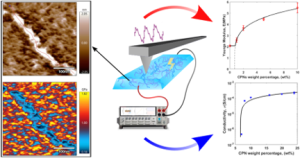
Conductive protein nanowires (CPNs) from Geobacter sulfurreducens garner growing interest as a biologically derived, electrically conductive material for soft electronics. CPNs can be produced aerobically from bacteria and are intrinsically more flexible than conventional carbon nanotube or silver nanowire fillers. Despite this, fundamental questions about their mechanical properties and behavior as incorporated into nanocomposites remained open.
Here we report the first experimental elastic modulus for an individual CPN, measured at 1.3 ± 0.1 GPa by atomic force microscopy. This is orders of magnitude lower than CNTs or AgNWs, confirming that CPNs are genuinely compliant fillers, thus bridging the mechanical mismatch between filler and matrix that often limits device performance in soft electronics applications.
Dispersed in PDMS, CPN/PDMS nanocomposites exhibit a rheological percolation threshold of 0.8 wt% and an electrical percolation threshold of 6.7 wt%. The gap between these values reflects CPN behavior in an apolar matrix: their hydrophilic character and short persistence length promote bundling, which reduces effective aspect ratio and requires higher loading for electrical conduction. Confining CPNs within anodic aluminum oxide nanochannel templates reduces the electrical threshold to 0.1 wt%, showing that geometric confinement may partially compensate for dispersion challenges inherent to this filler. Pilot strain sensing structures at 20 wt% CPN loading show linear resistive response to 50% strain, establishing a proof of concept for flexible sensing applications. This work lays the mechanical and electrical groundwork for CPNs as a sustainable nanofiller platform for compliant, functional electronics.
Meet the authors
 |
Dr Eric Chia earned his Ph.D. in Mechanical and Industrial Engineering from the University of Massachusetts Amherst. His research focuses on the synthesis and application of nanomaterials within polymer nanocomposites, with expertise in advanced atomic force microscopy techniques for characterizing the mechanical properties of materials ranging from soft matter to refractory metals.
|
 |
Dr Jayesh M. Sonawane is an Assistant Professor in the Department of Microbiology, School of Life Sciences, Central University of Rajasthan, India, where he leads the SENSE Lab. His research focuses on bioelectronics, protein nanowires, biosensors, bioenergy, and sustainable environmental technologies. He previously held research positions at the University of Toronto, Université Laval, and the University of Massachusetts Amherst as a Fulbright Fellow, and his work bridges microbiology, materials science, and electrochemical sensing.
|
 |
Trevor L. Woodard is a technical assistant at the Electron Microscopy Core Facility at the University of Massachusetts Amherst. He holds a B.S. in Biological Chemistry from Bates College and an M.S. in Plant and Soil Science from the University of Massachusetts Amherst, and spent more than two decades conducting research in environmental microbiology at UMass Amherst, contributing to foundational work on electrically conductive protein nanowires.
|
 |
Dr Meng-Chen Chiang is a postdoctoral researcher in Chemical and Biomolecular Engineering at the University of Massachusetts Amherst. He earned his Ph.D. in Chemical and Biomolecular Engineering from the University of Massachusetts Amherst. His research in the Schiffman Lab focuses on studying biomaterials that can effectively prevent bacterial adhesion to surfaces.
|
 |
Dr Jessica D. Schiffman is the Armstrong-Siadat Endowed Professor in Materials Science and Engineering, a Professor in Chemical and Biomolecular Engineering and a Faculty member in the Materials Science and Engineering Graduate Program at the University of Massachusetts Amherst. She is the Deputy Editor of ACS Applied Engineering Materials. Research in the Schiffman lab uses green engineering to design next-generation materials that improve human health and the environment.
|
 |
Dr Stephen S. Nonnenmann is a Professor in the Department of Mechanical and Industrial Engineering at the University of Massachusetts Amherst, and a Faculty member in the Materials Science and Engineering Interdisciplinary Graduate Research Program. Research in the NITE laboratory explores nanoscale transport and mechanical phenomena in complex nanomaterial designs using advanced nanocharacterization methods.
|
Mechanical properties of individual conductive protein nanowires and their percolation behavior in elastomer nanocomposites
Eric Chia; Jayesh M. Sonawane; Trevor L. Woodard; Meng-Chen Chiang; Jessica D. Schiffman; Stephen S. Nonnenmann
RSC Appl. Polym. (2026) 4 (4): 1347–1354. https://doi.org/10.1039/d6lp00122j
 |
|