


To celebrate the growth and development of the RSC Applied Polymers community and to highlight the remarkable authors who continue to contribute their high quality work to the journal, we would like to share the opinions and insights of these authors through this introductory blog post. Once dubbed #RSCAppliedfirst50, our blog posts aim to give a voice to the authors behind the research and hope that their insights might shed light upon growing challenges and progress in polymer science and its applications.
In this edition, we hear from Christian Gonzalez, Arijit Ghorai and Hoyong Chung as they discuss their recently published article, ‘Sustainable synthesis methods of lignin-based copolymers: recyclable non-carbodiimide catalytic systems in aqueous solvent‘.
An introduction from the authors
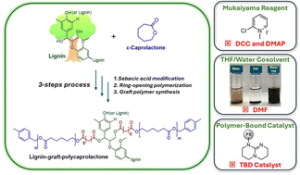
Our work reports the sustainable synthesis of lignin-graft-polycaprolactone (lignin-graft-PCL), through the development of three environmentally improved reaction systems: a tetrahydrofuran (THF)/water cosolvent system, a non-carbodiimide esterification route using the Mukaiyama reagent, and a recyclable polymer-bound catalyst, 1,3,4,6,7,8-Hexahydro-2H-pyrimido[1,2-a] pyrimidine, polymer-bound (PS-TBD) for ring-opening polymerization.
Lignin is one of the most abundant renewable biopolymers and represents a promising alternative to petroleum-derived feedstocks due to its aromatic structure, biodegradability, and broad availability as an industrial byproduct. However, conventional lignin modification methods commonly rely on toxic organic solvents such as dimethylformamide (DMF), as well as carbodiimide-based catalysts including N,N′-dicyclohexylcarbodiimide (DCC) and 4-dimethylaminopyridine (DMAP), which generate hazardous byproducts and reduce the overall sustainability of polymer synthesis processes.
The first innovation of this work is the establishment of a THF/water cosolvent system for lignin modification and graft copolymerization. Traditional lignin esterification reactions are typically performed in high-boiling, toxic solvents such as DMF because of lignin’s challenging solubility behavior. In contrast, the THF/water cosolvent system enabled effective lignin processing while reducing solvent-related environmental concerns and simplifying solvent removal due to the lower boiling point of THF. The new solvent system also resulted in improved product yields and favorable reaction characteristics compared to conventional approaches.
The second innovation is the implementation of the Mukaiyama reagent as a greener esterification system for lignin functionalization and copolymer formation. Conventional carbodiimide chemistry produces the hazardous byproduct N,N′-dicyclohexylurea (DCU), which creates environmental and purification challenges. By replacing traditional DCC/DMAP chemistry with the Mukaiyama reagent, esterification reactions were successfully achieved while avoiding DCU formation and maintaining high reaction efficiency.
The third major innovation is the application of a recyclable polymer-bound catalyst, PS-TBD, for the ring-opening polymerization of ε-caprolactone. Unlike conventional TBD catalysts that are typically discarded after use, PS-TBD can be separated by simple filtration and reused in subsequent reactions. The catalyst demonstrated sustained polymerization activity over four consecutive recycling cycles while maintaining relatively narrow molecular weight distributions and strong polymer yields. This approach highlights the potential of polymer-supported organocatalysts to reduce catalyst waste, simplify purification procedures, and improve the overall sustainability of polymer synthesis.
The findings of this work demonstrate that lignin-based copolymers can be synthesized through greener solvents, reduced hazardous byproduct formation, and reusable catalytic systems while still maintaining effective polymerization performance and favorable material properties. More broadly, this work improves renewable biomass accessibility and usefulness, including lignin, to serve as viable feedstocks for next-generation sustainable polymeric materials.
Meet the authors
Christian Gonzalez is a graduate researcher in the Department of Chemical and Biomedical Engineering at the FAMU-FSU College of Engineering in Dr. Hoyong Chung’s laboratory. His research focuses on sustainable polymer chemistry, biomass-derived materials, and lignin-based polymers. Dr Ghorai is a postdoctoral scholar in Dr. Hoyong Chung’s lab. Dr Chung is the corresponding author of the paper.

Sustainable synthesis methods of lignin-based copolymers: recyclable non-carbodiimide catalytic systems in aqueous solvent
Christian Gonzalez, Arijit Ghorai and Hoyong Chung
RSC Appl. Polym., 2026, 4, 823-838. DOI: 10.1039/D5LP00387C
This article is part of our Sustainable Development Goal 6: Clean Water and Sanitation collection – explore the full collection here!
 |
|