Wearable sensors in RSC Applied Polymers

Self-powered and biocompatible polymer sensors

Sensors are everywhere in our daily life, enabling technology by translating changes in our environment into physical or digital outcomes. Polymer-based sensors offer benefits like flexibility, low production costs, and easy customization for different applications.

Explore the collection of papers published in below and discover how polymer scientists are developing practical solutions to real-world challenges.
Sustainable, circular, and scalable polymer sensors

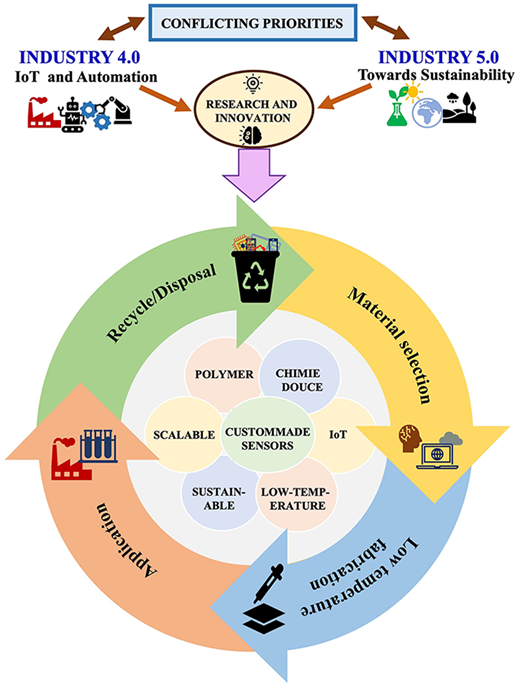
A growing challenge is that wearable electronics generate significant electronic waste. It is essential to develop biodegradable, recyclable, low-energy-manufactured and environmentally benign sensor materials without sacrificing performance.


Self-powered wearable sensors

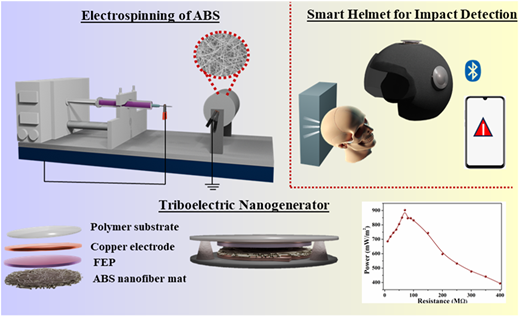
One of the biggest limitations of wearable devices remains power supply. Researchers are increasingly developing sensors that simultaneously harvest and sense mechanical, thermal, or biochemical energy from the body using triboelectric, piezoelectric, piezoionic, and biofuel-cell approaches. These recent publications demonstrate examples of triboelectric nanogenerators and piezoionic materials for self-powered sensors.

Biocompatible wearable sensors

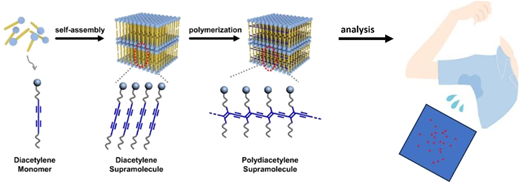
The field is moving beyond measuring only motion or temperature and now sensors can monitor increasingly subtle chemical biomarkers in sweat, saliva, tears, or interstitial fluid. Incorporating these sensing capabilities into wearable devices promises to be a major advance for precision medicine and digital healthcare.

Keep up to date with RSC Applied Polymers

We hope you enjoy reading through this selection of articles and that they are of particular interest to you and your research. If you would like to contribute your work to RSC Applied Polymers, click here.
Hear from the authors of ‘Tunable enhancement of polyester biocomposites via extrusion with fungi-derived chitin’

To celebrate the growth and development of the RSC Applied Polymers community and to highlight the remarkable authors who continue to contribute their high quality work to the journal, we would like to share the opinions and insights of these authors through this introductory blog post. Once dubbed #RSCAppliedfirst50, our blog posts aim to give a voice to the authors behind the research and hope that their insights might shed light upon growing challenges and progress in polymer science and its applications.

In this post, we hear from Adam T. Caridi, Amelia Kurowska, Dr. Erlantz Lizundia and Dr. Joshua C. Worch who have developed polyester biocomposites containing fungal nanochitin using an industrially scalable melt-compounding process. This innovative work supports the transition towards biobased and sustainable materials with enhanced mechanical functionality and performance.


Read more »

Hear from the authors of ‘Mechanical properties of individual conductive protein nanowires and their percolation behavior in elastomer nanocomposites’

To celebrate the growth and development of the RSC Applied Polymers community and to highlight the remarkable authors who continue to contribute their high quality work to the journal, we would like to share the opinions and insights of these authors through this introductory blog post. Once dubbed #RSCAppliedfirst50, our blog posts aim to give a voice to the authors behind the research and hope that their insights might shed light upon growing challenges and progress in polymer science and its applications.

In this edition, we hear from Eric Chia, Jayesh M. Sonawane, Trevor L. Woodard, Meng-Chen Chiang, Jessica D. Schiffman and Stephen S. Nonnenmann as they discuss their recently published article, ‘Mechanical properties of individual conductive protein nanowires and their percolation behavior in elastomer nanocomposites‘.


Read more »

Hear from the authors of ‘Perspective: ion transport mechanisms and the significance of glass transition temperature in PEO-based polymer blend electrolytes for next-generation Li-batteries’


To celebrate the growth and development of the RSC Applied Polymers community and to highlight the remarkable authors who continue to contribute their high quality work to the journal, we would like to share the opinions and insights of these authors through this introductory blog post. Once dubbed #RSCAppliedfirst50, our blog posts aim to give a voice to the authors behind the research and hope that their insights might shed light upon growing challenges and progress in polymer science and its applications.

In this edition, we hear from Marissa Gallmeyer, Thorfinnur A. H. Baldvinsson and RSC Applied Polymers Emerging Investigator Whitney S. Loo as they discuss their recently published article ‘Perspective: ion transport mechanisms and the significance of glass transition temperature in PEO-based polymer blend electrolytes for next-generation Li-batteries‘.


Read more »

Ren Liu: New Advisory Board Member

We are delighted to introduce to you our new RSC Applied Polymers Advisory Board member, Professor Ren Liu (Jiangnan University, China).   

Image of Professor Ren Liu

Professor Ren Liu currently holds the positions of Dean of the School of Chemistry and Materials Engineering at Jiangnan University and Director of the International Research Center for Photoresponsive Molecules and Materials. His primary research interests cover fundamental studies on photopolymerization, as well as the research, development and industrialization of photosensitive materials for coatings, microelectronic chemicals, and additive manufacturing applications. Dr. Liu has published over 100 peer-reviewed journal articles and holds more than 50 granted national patents. He has won the China Patent Excellence Award, the Second Prize of the Ministry of Education Science and Technology Progress Award, and the Youth Science and Technology Award from the Chinese Society for Imaging Science and Technology.                                                                                                                                                                                                                                                                                                                                                                                                                                                                                                                                                                                     


Discover Prof. Liu’s recent work 

 One-step preparation of hydrophilic–hydrophobic asymmetric bilayer microcapsules via photopolymerization 

Kaiyun Wu, Yongbin He, Jiangqing Liu, Guanqing Sun, Ren Liu and Jing Luo 

Polym. Chem., 2024 


Photothermal synergy mechanism in near-infrared photopolymerization for 3D printing acceleration and mechanical enhancement 

Wei Wu, Hang Xu, Jia-Tao Miao, Xiucheng Zou and Ren Liu

Mater. Chem. C, 2024


A facile one-pot strategy for the preparation of porous polymeric microspheres via UV irradiation-induced polymerization in emulsions 

Junjie Tao, Kaiyun Wu, Yaxin Chen, Wei Li, Yao Gu, Ren Liu and Jing Luo 

Soft Matter, 2023 


Explore related works in RSC Applied Polymers 


Thermoplastic-like mechanical performance of heterogeneous photopolymers for additive manufacturing with tailored hyperbranched rubbers 

Vojtěch Musil, Dominik Laa, Mojtaba Ahmadi, Jürgen Stampfl, Robert Liska, Jan Merna and Katharina Ehrmann 

RSC Appl. Polym., 2025 


Toward sustainable SLA 3D printing: glycerol-based 1,3-diether-2-methacrylates with solvent capability for in situ polymer blend formation 

Zahra Sekhavat Pour, Pravin S. Shinde, Jun Wang, Mustapha Iddrisu, Tibor Szilvási and Jason E. Bara 

RSC Appl. Polym., 2026 


Sustainable and efficient preparation of eugenol-based resin and its application in UV-thermally cured 3D printing 

Jieyuan Zheng, Xingfen Huang, Pingwei Liu, Wenjun Wang and Hong Fan 

RSC Appl. Polym., 2025 


Please join us in welcoming Professor Liu to the RSC Applied Polymers Advisory Board! 

Hear from the authors of ‘Chloroform outperforms chlorobenzene for enhanced mobility in amphiphilic polymer OFETs’

To celebrate the growth and development of the RSC Applied Polymers community and to highlight the remarkable authors who continue to contribute their high quality work to the journal, we would like to share the opinions and insights of these authors through this introductory blog post. Once dubbed #RSCAppliedfirst50, our blog posts aim to give a voice to the authors behind the research and hope that their insights might shed light upon growing challenges and progress in polymer science and its applications.

In this edition, we hear from Preeti Yadav, from the Okinawa Institute of Science and Technology Graduate University, as they discuss their recently published article, ‘Chloroform outperforms chlorobenzene for enhanced mobility in amphiphilic polymer OFETs‘.


Read more »

Hear from the authors of ‘Multi-responsive polymers with degradable side-chain functionality for controlled hydrolysis and tunable thermal transition’

To celebrate the growth and development of the RSC Applied Polymers community and to highlight the remarkable authors who continue to contribute their high quality work to the journal, we would like to share the opinions and insights of these authors through this introductory blog post. Once dubbed #RSCAppliedfirst50, our blog posts aim to give a voice to the authors behind the research and hope that their insights might shed light upon growing challenges and progress in polymer science and its applications.

In this edition, we hear from Maryam Behzad Khoshgoee, Mithun Kumar Debnath, Griffin Pardo, Yichun (Lucia) Yuan, Muhammad Zeeshan, Erqian Mao, Burcu (Eksioglu) Gurkan, Matthew Bertin and Metin Karayilan as they discuss their recently published article, ‘Multi-responsive polymers with degradable side-chain functionality for controlled hydrolysis and tunable thermal transition‘.


Read more »

Hear from the authors of ‘A thiophene-based and sulfur-enriched highly conjugated hyper-crosslinked polymer for efficient sequestration of iodine from various media’

To celebrate the growth and development of the RSC Applied Polymers community and to highlight the remarkable authors who continue to contribute their high quality work to the journal, we would like to share the opinions and insights of these authors through this introductory blog post. Once dubbed #RSCAppliedfirst50, our blog posts aim to give a voice to the authors behind the research and hope that their insights might shed light upon growing challenges and progress in polymer science and its applications.

In this edition, we hear from Sk Abdul Wahed, Mustafa Maqbool, Atikur Hassan and Neeladri Das as they discuss their recently published article, ‘A thiophene-based and sulfur-enriched highly conjugated hyper-crosslinked polymer for efficient sequestration of iodine from various media‘.


Read more »

Hear from the authors of ‘Sustainable synthesis methods of lignin-based copolymers: recyclable non-carbodiimide catalytic systems in aqueous solvent’

To celebrate the growth and development of the RSC Applied Polymers community and to highlight the remarkable authors who continue to contribute their high quality work to the journal, we would like to share the opinions and insights of these authors through this introductory blog post. Once dubbed #RSCAppliedfirst50, our blog posts aim to give a voice to the authors behind the research and hope that their insights might shed light upon growing challenges and progress in polymer science and its applications.

In this edition, we hear from Christian Gonzalez, Arijit Ghorai and Hoyong Chung as they discuss their recently published article, ‘Sustainable synthesis methods of lignin-based copolymers: recyclable non-carbodiimide catalytic systems in aqueous solvent‘.


Read more »

Hear from the authors of ‘Poly(ethyl glyoxylate)-derived self-immolative elastomers’

To celebrate the growth and development of the RSC Applied Polymers community and to highlight the remarkable authors who continue to contribute their high quality work to the journal, we would like to share the opinions and insights of these authors through this introductory blog post. Once dubbed #RSCAppliedfirst50, our blog posts aim to give a voice to the authors behind the research and hope that their insights might shed light upon growing challenges and progress in polymer science and its applications.

In this edition, we hear from Anna L. Watson, Chuanfeng Li, Adnan Sharif, Elizabeth R. Gillies and Helen Tran as they discuss their recently published article, ‘Poly(ethyl glyoxylate)-derived self-immolative elastomers‘.


Hear from our authors: Anna L. Watson, Chuanfeng Li, Adnan Sharif, Elizabeth R. Gillies & Helen Tran


Read more »