



RSC Applied Interfaces publishes interdisciplinary work with an applied focus, which can be read for free here. To celebrate the excellent articles that have been published so far in our journal, we asked some of our authors to discuss their work in more detail.
In this post, we hear from Subhashree Mohanty, Bibekananda Marai and Sushanta Kumar Badamali as they discuss their recently published article entitled ‘Solar light driven type-II heterojunction TiO2@ZIF-8 nanocomposite for sustainable chlorpyrifos detoxification: physicochemical insights, mineralization pathways and antibacterial performance‘.
Insights from the authors
Water contamination by pesticides is a growing global concern, and chlorpyrifos (CP) is one of the stubborn organophosphate pesticides which pose risks to ecosystems and human health alike. Such contaminants demands not only effective removal strategies but also sustainable solutions. In our recent work, we present an efficient sunlight-driven photocatalytic system based on TiO2@ZIF-8 nanocomposite to address this pressing environmental challenge.
Summary of the Research
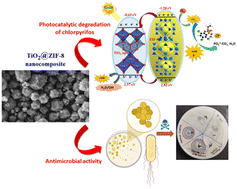
This study introduces a hybrid nanomaterial synthesized through a combined hydrothermal-ultrasonication approach. The material integrates titanium dioxide (TiO2) nanoparticle, known for its significant photocatalytic properties, with ZIF-8, a metal–organic framework offering high surface area and tunable porosity. The resulting TiO2@ZIF-8 nanocomposite demonstrates remarkable performance under natural sunlight, achieving nearly 90% degradation of chlorpyrifos within 90 minutes followed by type-II heterojunction. Optimization using statistical modeling further confirms its high efficiency and reproducibility. Mechanistic investigations reveal that the degradation process is driven by reactive species such as photogenerated holes, superoxide radicals, and hydroxyl radicals, which effectively break down the pesticide molecules. Beyond efficiency, stability is crucial for real world applications. Encouragingly, the nanocomposite maintained around 85% of its activity even after four cycles of reuse, indicating good durability. The material also demonstrated significant antibacterial activity against common pathogens like Staphylococcus aureus and Escherichia coli.
How do interfaces play a key role in this application?
The enhanced performance of the TiO2@ZIF-8 system is primarily governed by type-II heterojunction interface. Under solar irradiation, TiO2 nanoparticle generates electron–hole pairs, while ZIF-8 facilitates efficient interfacial electron transfer due to its more negative conduction band position. In addition, interfacial ligand-to-metal charge transfer (LMCT) and defect states in ZIF-8 slightly extend light absorption by solar light. Overall, the superior photocatalytic efficiency of TiO2@ZIF-8 is attributed to the formation of interfacial type II heterojunction structure, which promotes charge carrier dynamics, reduces the recombination and broadens visible-light utilization.
Highlights of the Study
- Development of a TiO2@ZIF-8 nanocomposite via a simple and scalable synthesis route
- Efficient degradation (~90%) of chlorpyrifos under natural sunlight within 90 minutes
- Formation of a type-II heterojunction enabling enhanced charge separation
- Identification of key reactive species governing the degradation mechanism
- Good stability with ~85% efficiency retained after four reuse cycles
- Additional significant antibacterial activity against Staphylococcus aureus and Escherichia coli.
Future Perspectives and Next Steps
Future research will focus on:
- Scaling up the synthesis for pilot-scale water treatment systems
- Testing performance in real wastewater matrices containing mixed contaminants
- Exploring long-term stability and regeneration strategies
- Designing advanced heterostructures with improved solar absorption and durability
Such advancements could pave the way for practical, sustainable, and multifunctional solutions for water purification.
Meet the authors

Subhashree Mohanty
Subhashree Mohanty is a PhD scholar in PG Department of Chemistry at Utkal University, Odisha, India under the supervision of Prof. Sushanta Kumar Badamali. She completed her M.Phil. and M.Sc. from Sambalpur University specializing in Physical Chemistry. Her research focuses on removing persistent organophosphate pesticides from water using a combination of adsorption and photocatalytic strategies. In recent years, her research has expanded into the synthesis and functionalization of metal-organic frameworks (MOFs), exploring their potential as next-generation materials for water decontamination and beyond. By integrating adsorption, photocatalysis, and other applications into single systems, she aims to develop multifunctional solutions that go beyond conventional treatment methods into practical environmental technologies.

Bibekananda Marai
Bibekananda Marai completed his Masters degree in Chemistry from Department of Chemistry, Utkal University, Odisha. He completed his masters’ research project under the supervision of Prof. Sushanta Kumar Badamali. His work focused on the development of photocatalytic materials, MOFs, etc. for environmental pollutant degradation and water treatment.

Sushanta Kumar Badamali
Prof. Sushanta Kumar Badamali is a Professor in PG Department of Chemistry at Utkal University, Odisha, India. He obtained his Ph.D. in Chemistry from the Indian Institute of Technology Bombay, where his research focused on mesoporous materials and heterogeneous catalysis. He has also gained international research experience as a Visiting Research Fellow at the University of York, UK and K.S. Krishnan Research fellow at Bhabha Atomic Research Center, Mumbai. His work focuses on the development of advanced functional materials, including nanostructures and hybrid composites, for applications in photocatalysis, adsorption, and sustainable water treatment. In addition to photocatalysis, Prof. Badamali has contributed to green chemistry approaches, including catalytic transformation of biomass-derived compounds such as lignin, highlighting his interest in sustainable chemical processes and renewable resource utilization. Through his work and mentorship, he continues to contribute to advancing next-generation materials for clean energy and water remediation.
Solar light driven type-II heterojunction TiO2@ZIF-8 nanocomposite for sustainable chlorpyrifos detoxification: physicochemical insights, mineralization pathways and antibacterial performance
Subhashree Mohanty, Bibeka Nanda Marai and Sushanta Kumar Badamali
RSC Appl. Interfaces, 2026, 3, 807-823. DOI: 10.1039/D5LF00405E
 |
RSC Applied Interfaces is a dedicated, interdisciplinary reference journal for cutting-edge research on the applications of surfaces and interfaces. In addition to the applied focus, work considered for publication in RSC Applied Interfaces is expected to be highly original and of top quality. The journal seeks to report major scientific advances beyond the state of the art, at the cutting edge of this interdisciplinary field. |