


RSC Applied Interfaces publishes interdisciplinary work with an applied focus, which can be read for free here. To celebrate the excellent articles that have been published so far in our journal, we asked some of our authors to discuss their work in more detail.
In this post, we hear from Shubham B. Upadhye, Gopal K. Pradhan and Pranati Nayak from Institute of Chemical Technology-Indian Oil Odisha Campus as they discuss their recently published article entitled ‘Edge vs. basal plane of Ti3C2Tx MXene: enhanced inherent electrochemistry, electron transfer, and catalytic activity at the edge‘.
An introduction from the authors
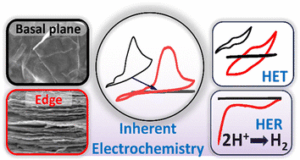
This research explores the development of a simple and scalable fabrication technique to prepare edge and basal plane oriented Ti3C2Tx MXene electrodes and reveals their fundamental, electrochemical and electrocatalytic properties. Using a combination of localized electrochemical measurements and electron-transfer studies, this work validates that MXene edges exhibit:
- Faster electron-transfer kinetics
- Stronger inherent electrochemical responses
- Enhanced catalytic activity compared to basal planes
These differences arise from the distinct atomic and electronic structure at the edges, where unsaturated bonds and altered surface terminations provide more favorable pathways for charge transfer and redox reactions. Our findings suggest that engineering MXenes with a higher proportion of exposed edges could be a powerful strategy to boost functionality. We believe that these findings validate the ever-interesting debate on the enhanced performance of edge of 2D materials compared to basal planes and establish a simple fabrication technique to study the edge electrochemistry of 2D materials.
Meet the authors

Shubham Upadhye
Shubham Upadhye is a PhD candidate at the Institute of Chemical Technology, Indian Oil Odisha Campus (ICT-IOCB), under the supervision of Dr. Pranati Nayak. He completed his master’s in Physics with a specialization in Material Science at the Institute of Chemical Technology in 2023. His research focuses on exploring the electrochemical properties of the 2D transition metal carbides nanomaterials. His primary research explores the inherent electrochemistry of transition metal carbides & their electron transfer kinetics, specifically distinguishing between the catalytic activities of the edge & basal orientation of Ti3C2Tx MXene. Recently, he expanded his research to exploring the viability of these 2D materials for biosensing, energy storage and production applications.

Gopal K. Pradhan
Dr. Gopal K. Pradhan is an Associate Professor of Physics at the KIIT School of Applied Sciences, Bhubaneswar, India. His current research is centered on the use of Raman spectroscopy as a powerful and versatile probe to investigate structure–property relationships, thermal transport, defects, strain, and electronic interactions in two-dimensional and low-dimensional materials. His work has provided important insights into the local structure and functionality of emerging 2D layered systems, including transition metal dichalcogenides (TMDs), MXenes, and related quantum materials, with direct relevance to energy storage, functional nanoelectronics, and quantum device applications.

Pranati Nayak
Dr. Pranati Nayak is an Assistant Professor of Physics at the Institute of Chemical Technology, Indian Oil Odisha Campus (ICT-IOCB), Bhubaneswar, India. Her scientific interest includes development of new advanced materials, their characterization and exploring their viability for electrochemical applications. Her current work focuses on investigating the innate electrochemistry and charge transfer properties 2D MXenes and their composites. Additionally, she finds interest on single entity electrochemistry (Nano impact), a contemporary appealing technique for studying electrochemical events at single entity level, particularly metal carbide nanoparticles.
Edge vs. basal plane of Ti3C2Tx MXene: enhanced inherent electrochemistry, electron transfer, and catalytic activity at the edge
Shubham B. Upadhye, Gopal K. Pradhan and Pranati Nayak
RSC Appl. Interfaces, 2026, Advance Article. DOI: 10.1039/D5LF00354G
RSC Applied Interfaces is a dedicated, interdisciplinary reference journal for cutting-edge research on the applications of surfaces and interfaces. In addition to the applied focus, work considered for publication in RSC Applied Interfaces is expected to be highly original and of top quality. The journal seeks to report major scientific advances beyond the state of the art, at the cutting edge of this interdisciplinary field.