


 We are delighted to share a selection of “must read” articles published in RSC Applied Interfaces in the field of organic semiconductors. The articles explore the application of organic semiconductor materials in photovoltaics, transistors, neuromorphic computing, and sensing.
Organic photovoltaics
There are different strategies to improve organic photovoltaic performance through interface engineering. The papers below show how the charge-state formation at interfaces affect charge-transfer properties and ultimately device performance, as well as more sustainable processing methods.
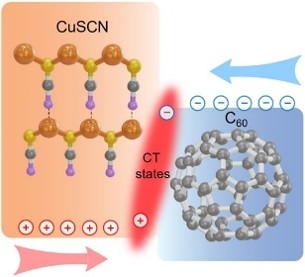 |
Solution treatment controls charge-transfer states and energy-level alignment at hybrid CuSCN-organic interfaces
Yingying Li, Zhewei Chen, Wenjie Zhou, Qi Wang, Yuan Zhang, Tao Song, Baoquan Sun, Steffen Duhm |
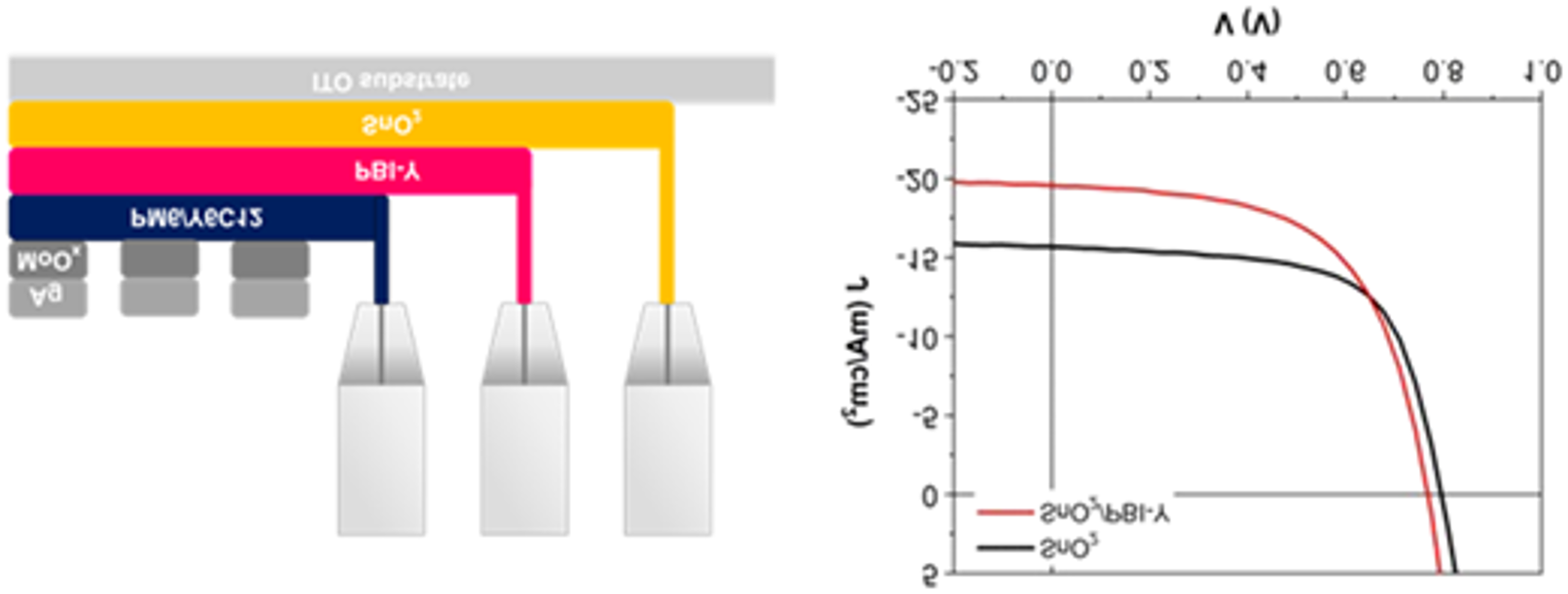 |
All slot-die coated organic solar cells using an amine processed cathode interlayer based upon an amino acid functionalised perylene bisimide
Rebecca E. Ginesi, Muhammad R. Niazi, Gregory C. Welch, Emily R. Draper |
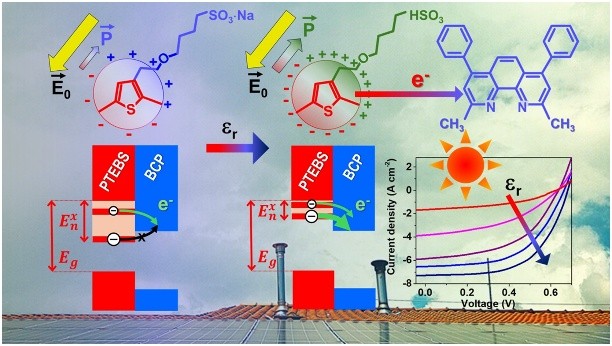 |
Dielectric-constant effects on the exciton dissociation and photovoltaic conversion efficiency of water-soluble green conducting polymers
Xin Wei, Daniel Williams, Giovanni Fanchini |
Organic transistors for neuromorphic computing
These studies explore organic transistor devices that reproduce aspects of neural and synaptic behaviour. They examine how operating voltage and material properties such as polymer molecular weight and film thickness affect the speed and dynamics of neuromorphic devices.
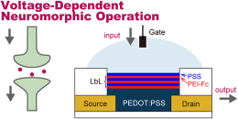 |
Voltage-dependent time constants for neuromorphic organic electrochemical transistor applications
Shunsuke Yamamoto, Nanako Kanazumi, Masaya Mitsuishi |
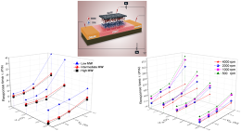 |
Exploring response time and synaptic plasticity in P3HT ion-gated transistors for neuromorphic computing: impact of P3HT molecular weight and film thickness
Ramin Karimi Azari, Zhaojing Gao, Alexandre Carrière, Clara Santato |
Organic semiconductors as sensors
These papers focus on functional sensing devices made using flexible or scalable electronic materials, highlighting practical device functionality and manufacturing scalability.
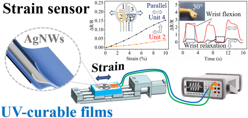 |
Flexible strain sensors based on silver nanowires and UV-curable acrylate elastomers for wrist movement monitoring
Shuhao Li, Wenjin Wu, Yu Chang, Weiquan Chen, Yijie Liu, Zifeng He, Yan Pu, Ivan S. Babichuk, Terry Tao Ye, Zhaoli Gao, Jian Yang |
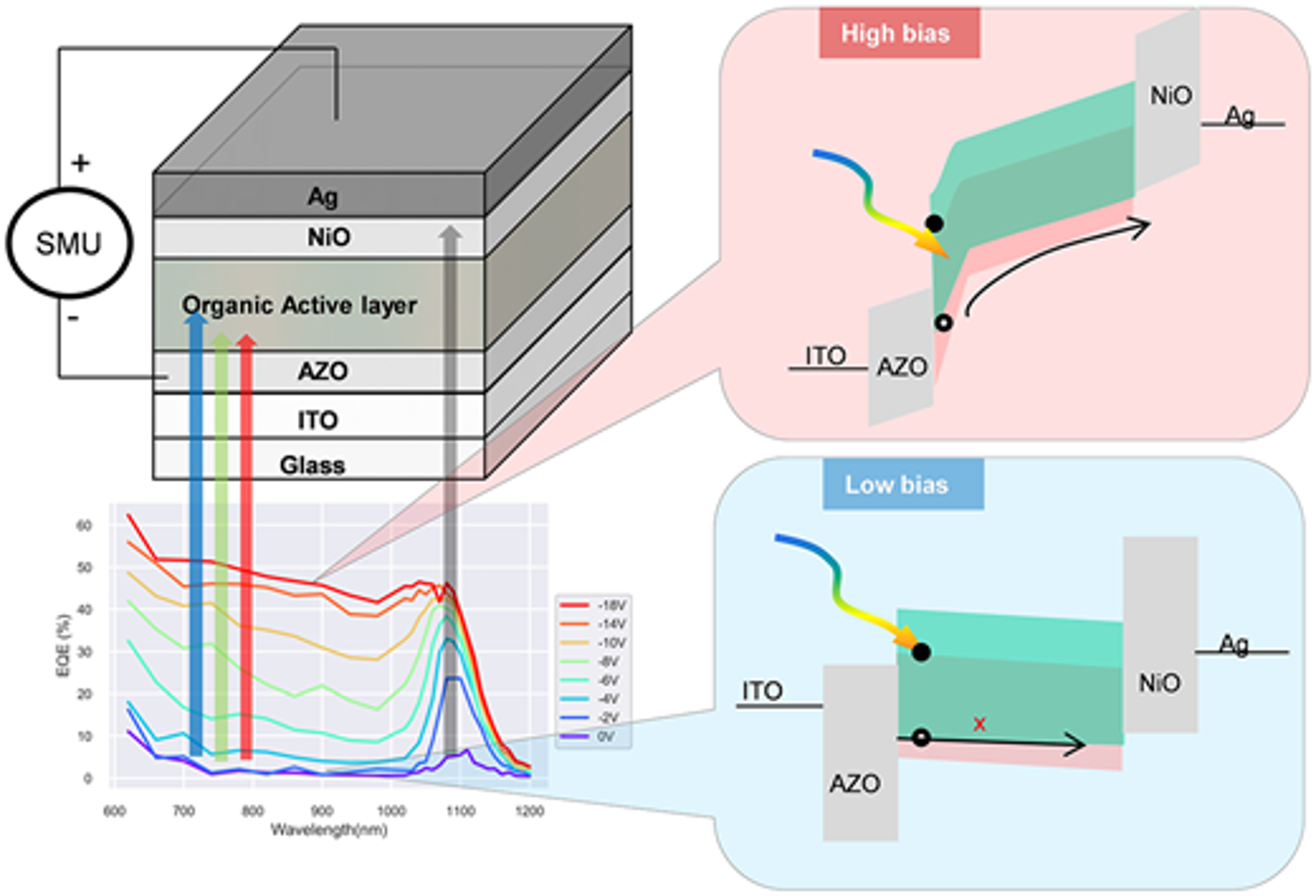 |
Bias switchable narrowband/broadband NIR organic photodetector fabricated with a scalable technique
Lai-Hung Lai, Wei-Hsiang Lin, Chin-Chuan Hsieh, Maria Antonietta Loi |
Thin film optimisation
The articles below explore how important it is to optimise the molecule structure of organic semiconductor materials to enhance their performance. Molecular design, polymer structure and thin-film organisation all influence application-relevant properties like charge mobility. These studies highlight the need to balance electrical performance and other desirable properties like stretchability or stability.
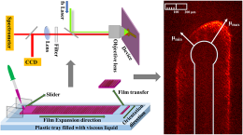 |
Anisotropic charge transport study of highly oriented P4T2F-HD thin film fabricated at air–liquid interface through second harmonic generation (SHG) analysis
Radhe Shyam, Takaaki Manaka, Rajiv Prakash |
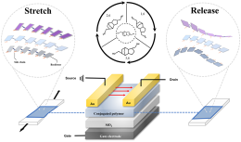 |
N-type semiconducting polymers with an improved isotropic mobility–stretchability stability by using structural isomers as conjugation break spacers
Ming-Han Chen, Yu-Chun Huang, Fu-En Szu, Jung-Yao Chen, Man-kit Leung, Yan-Cheng Lin
|
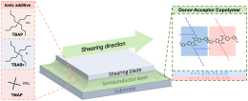 |
Enhancing charge transport in isoindigo-based donor–acceptor copolymers by combining ionic doping with polar alkoxy side chains
Sheng Chuo, Yun-Ching Peng, Thanapon Puangniyom, Qun-Gao Chen, Chu-Chen Chueh,Wen-Ya Lee |
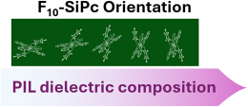 |
Polymerized ionic liquid dielectrics tune molecular orientation and operating voltage in silicon phthalocyanine OTFTs
Bahar Ronnasi, Nicolas Ledos, Benjamin King, Benoît H. Lessard |
Stay up to date with all the latest from RSC Applied Interfaces
To keep up to date with all the latest news and research, sign up for our e-alerts and keep an eye on our journal webpage and social media for more exciting research. Thank you for your ongoing support of RSC Applied Interfaces.