



Explore some of the exciting chemistry enabling the clean-energy transition through better hydrogen technologies, safer and more powerful batteries, and more sustainable recycling processes.
Electrochemistry is playing a central role in solving some of the world’s biggest sustainability and technology challenges because it provides ways to convert, store, and recycle energy using green electricity sources rather than fossil-fuel-based processes. This makes it one of the key technologies for achieving net-zero emissions and a more sustainable energy future.
To showcase some of the exciting research published in RSC Applied Interfaces in the field of sustainable electrochemistry, we have curated a small section of articles that highlight exciting new research in this area.
Explore the collection below and discover how researchers are developing practical solutions to real-world challenges.
Advances in Li-ion batteries
This section explores advances in Li-ion battery technology. The articles report a mixture of experimental and computational studies that explore the introduction of safer solvents, Li diffusion at interfaces and surface functionalisation for improved performance.
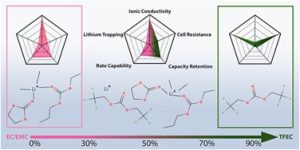 |
M. B. Shemirani, F. Gebert and A. J. Naylor |
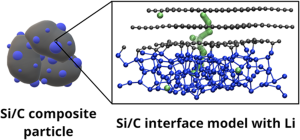 |
Ab initio study of lithium diffusion at a layered carbon/amorphous silicon interface
C. Kirsch and D. Sebastiani |
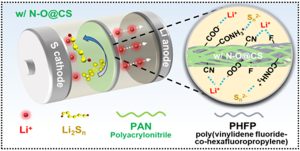 |
Functional separator with a nitrogen/oxygen-rich interlayer for enhancing performance of Li–S batteries
Y. Guo, J. Zhong, J. Liu and W.-H. Zhong |
Green Hydrogen Production
The articles below explore novel energy solutions through green hydrogen production, reporting advances in both the hydrogen and oxygen evolution reactions.
|
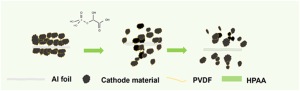
Reaction-passivation-driven delamination of spent LiFePO4 cathodes and their upgrading to highly efficient catalysts for hydrogen evolution
J. Yi, J. Hu, C. Gong, Q. Liu and W. Bi |
 |
Hydrogen evolution reaction by Gd-doped transition metal dichalcogenide VSe2 nanoflowers
A. Parida, B. Dandasena and R. Naik |
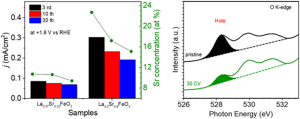 |
Evaluating the electronic structure and stability of epitaxially grown Sr-doped LaFeO3 perovskite alkaline O2 evolution model electrocatalysts
C. Tian, C. Maheu, X. Huang, F. E. Oropeza, M. Major, J. Brötz, M. Einert, W. Donner, K. H. Zhang and J. P. Hoffmann |
Electrochemical applications of graphene oxide materials
The articles in this section explore the use of graphene oxide in sustainable electrochemical applications, including the oxygen evolution reaction, proton conductivity and Li-ion battery storage.
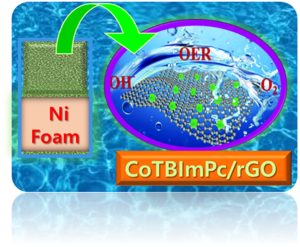 |
Cobalt–benzimidazole swapped metal–organic macrocycle with reduced graphene oxide as a hybrid electrocatalyst for highly efficient oxygen evolution reaction
C. P. K. Prabhu, K. R. Naveen and J. Hur |
 |
Enhanced proton conductivity from phytic acid-intercalated three-dimensional graphene oxide
S. Salehpour, L. I. Ardhayanti, Y. Hidaka, X. Liu, T. Tsugawa, K. Hatakeyama, M. S. Islam, Y. Sekine, S. Ida and S. Hayami |
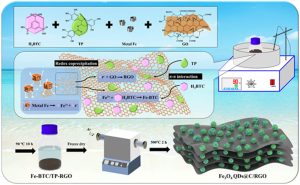 |
Synthesis of a MOF-derived magnetite quantum dots on surface modulated reduced graphene oxide composite for high-rate lithium-ion storage
R. Jia, L. Yu, Z. Han, S. Liu, P. Shang, S. Deng, X. Liu and B. Xu |
 |
With an Impact Factor of 4.6 and time to first decision of 30.5 days, RSC Applied Interfaces is a dedicated, interdisciplinary reference journal for cutting-edge research on the applications of surfaces and interfaces. In addition to the applied focus, work considered for publication in RSC Applied Interfaces is expected to be highly original and of top quality. The journal seeks to report major scientific advances beyond the state of the art, at the cutting edge of this interdisciplinary field. |