


RSC Applied Interfaces publishes interdisciplinary work with an applied focus, which can be read for free here. To celebrate the excellent articles that have been published so far in our journal, we asked some of our authors to discuss their work in more detail.
In this post, we hear from Dr Srabanti Ghosh at CSIR – Central Glass and Ceramic Research Institute, India, as they discuss their recently published article entitled ‘Charge carrier dynamics in semiconductor–cocatalyst interfaces: influence on photocatalytic activities‘.
An introduction from Dr Srabanti Ghosh
This review, authored by Dipendu Sarkar, Jishu Pramanik, Soumita Samajdar, Maitrayee Biswas, and Dr. Srabanti Ghosh (Corresponding Author), presents an in-depth understanding of charge transfer dynamics at semiconductor–cocatalyst interfaces, which are crucial to improving photocatalytic efficiency.
This article is featured in the Sustainable Development Goal 7: Affordable and Clean Energy collection. This prestigious selection recognizes the article as a high-impact contribution advancing global efforts toward clean and renewable energy technologies. The RSC’s SDG Collections highlight pioneering research that aligns with the United Nations’ Sustainable Development Goals (SDGs), and our inclusion underscores the scientific relevance and societal importance of this work.
The paper discusses:
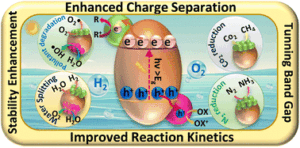
- Recent advancement in the use of co-catalysts for improved photocatalytic materials and sustainable applications by aiding charge separation and preventing charge recombination.
- Investigate charge carrier dynamics at semiconductor-cocatalysts interfaces for solar-driven processes
- Examine how interface structure and co-catalysts architecture through Schottky and ohmic junctions, band alignment affects charge transfer efficiency.
- Advanced experimental insights from ultrafast spectroscopy, in-situ XPS, and theoretical modelling (DFT) to unravel electron transfer pathways.
- Emerging concepts like plasmonic enhancement, dual cocatalyst systems, and single-atom catalysts for efficient photocatalytic water splitting and H2 generation, pollutant removal, CO2 reduction, and ammonia production.
- Future research should explore novel co-catalysts materials, improve system stability and scale up production.
By systematically linking interfacial physics to catalytic performance, the article provides a roadmap for designing next-generation photocatalysts that harness solar energy more efficiently, paving the way for a sustainable future.
Research Significance:
This work bridges the gap between fundamental interfacial charge dynamics and applied photocatalytic engineering, offering strategies for:
- Enhancing charge separation and minimizing recombination losses.
- Boosting solar-to-fuel conversion efficiencies for sustainable hydrogen generation.
- Integrating theory and experiment to guide the rational design of photocatalytic materials.
It contributes directly to achieving UN SDG 7: Affordable and Clean Energy, by fostering innovations in solar-driven water splitting and H2 generation, CO2 reduction and value-added products, N2 fixation and green ammonia production.
About the Lead Scientist:
Dr. Srabanti Ghosh, Principal Scientist, Energy Materials & Devices Division, CSIR–Central Glass and Ceramic Research Institute (CGCRI), Kolkata, has made pioneering contributions to photoelectrocatalysis, semiconductor heterostructures, and energy conversion devices. She received her PhD degree from UGC-DAE CSR, Kolkata Centre, and Jadavpur University. She is a recipient of a Marie Curie Fellowship at the University of Paris SUD, France. She worked as a GOT ENERGY TALENT Marie Curie Fellow at Universidad De Alcalá, Spain. Her research group focuses on semiconductor heterostructures, charge-carrier modulation, generation of clean fuels via photocatalysis. Dr. Ghosh worked as a Marie Curie Fellow (France & Spain). She has co-authored 123 publications, 4 patents, and edited 6 books.
A Proud Moment for CSIR-CGCRI:
This recognition highlights CSIR-CGCRI’s leadership in advanced energy materials research and reaffirms its contribution to achieving sustainable technological solutions through interdisciplinary collaboration. It also marks a milestone for the young researchers in the group, reflecting the institute’s commitment to fostering excellence in clean energy innovation.
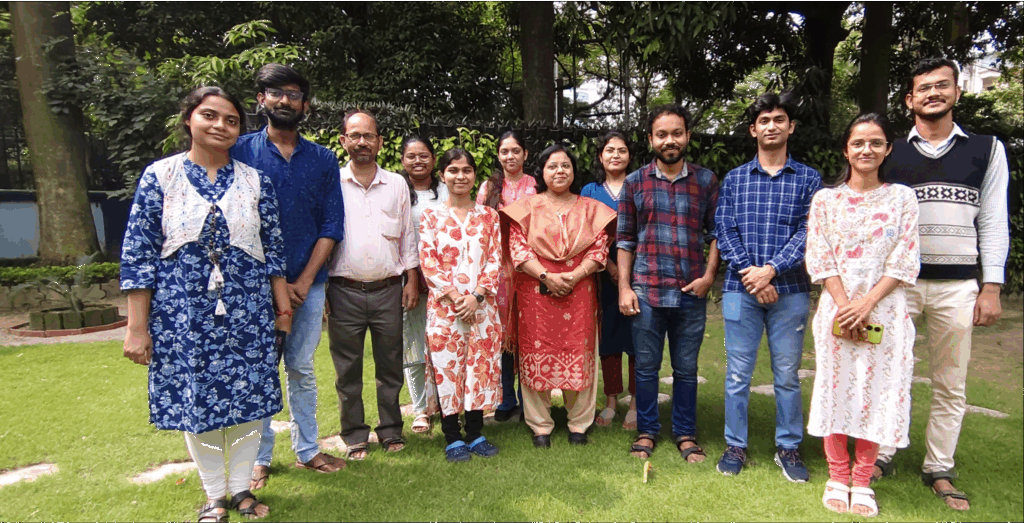
Research group (left to right): Ms. Soumita Samajdar, Mr. Dipendu Sarkar, Dr. Pradip Sekhar Das, Ms. Leena Sonwani, Ms. Tripti Bera, Ms. Anusree Mandal, Dr. Srabanti Ghosh, Mrs. Shaona Chatterjee, Mr. Jishu Pramanik, Mr. Siddhanta Dutta, Ms. Maitrayee Biswas, and Mr. Sankar Samanta.
Charge carrier dynamics in semiconductor–cocatalyst interfaces: influence on photocatalytic activities
Dipendu Sarkar, Jishu Pramanik, Soumita Samajdar, Maitrayee Biswas and Srabanti Ghosh
RSC Appl. Interfaces, 2025, 2, 573-598. DOI: 10.1039/D5LF00044K
RSC Applied Interfaces is a dedicated, interdisciplinary reference journal for cutting-edge research on the applications of surfaces and interfaces. In addition to the applied focus, work considered for publication in RSC Applied Interfaces is expected to be highly original and of top quality. The journal seeks to report major scientific advances beyond the state of the art, at the cutting edge of this interdisciplinary field.