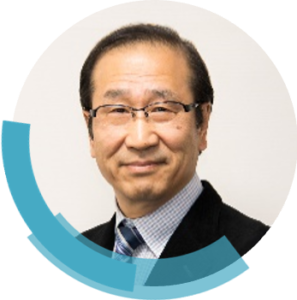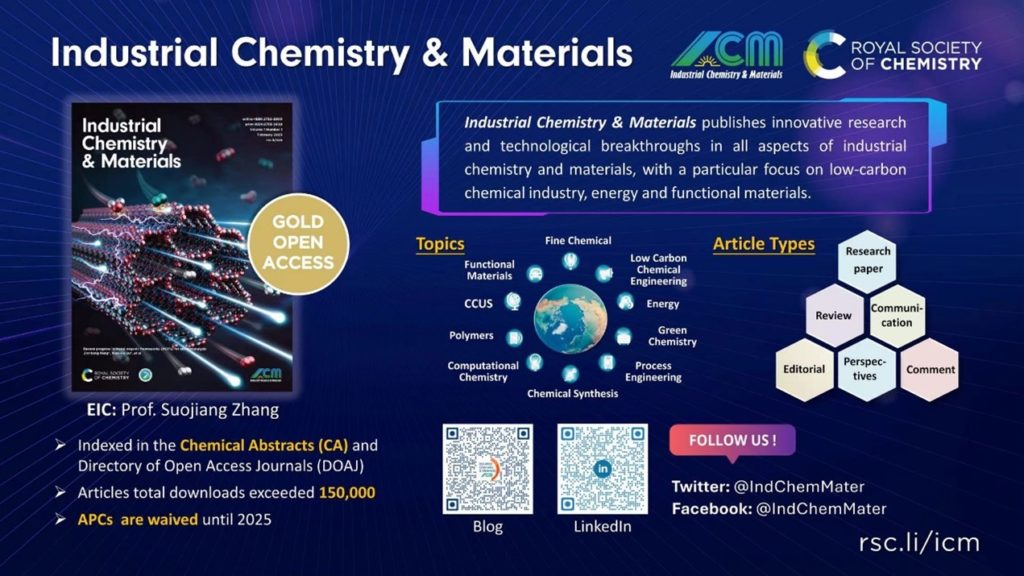

We are delighted to share that Prof. Suojiang Zhang, Editor-in-Chief of Industrial Chemistry & Materials (ICM) has been elected as a Fellow of The World Academy of Sciences (TWAS) in the subject of Chemical Sciences.
On 08 October 2025, the World Academy of Sciences announced its 2026 class of newly elected Fellows, recognizing 63 distinguished scientists across ten major fields, including biological sciences, medical & health sciences, chemical sciences, and engineering sciences. TWAS currently has around 1,500 Fellows worldwide, representing outstanding researchers from diverse disciplines. Its membership includes leading national academy members and Nobel laureates.
 Suojiang Zhang, Professor at the Institute of Process Engineering (IPE), Chinese Academy of Sciences (CAS), President of Henan University, China. He is a leading scientist in ionic liquids (ILs) and green chemical engineering who was elected as a Member of Chinese Academy of Sciences in 2015 and Fellow of the Canadian Academy of Engineering in 2024. He has published over 700 papers in Chemical Reviews, Nature Communications, Angewandte Chemie, Advanced Materials, AIChE Journal, Chemical Engineering Journal, etc., with 40,543 citations and an h-index of 97, 11 books, and 8 chapters. He holds 291 patents, including 6 United States of America/Japan patents. He has developed over 10 IL-based green technologies with successful industrial applications, such as the world’s first 200,000 t/a IL-catalyzed CO2 to dimethyl carbonate industry plant. He is a member of the Chinese Academy of Sciences and has received the TWAS Award in Chemistry, the Ho Leung Ho Lee Foundation Science and Technology Progress Award, and the 2nd Class Award for National Natural Science of China. As head of the CAS–TWAS Centre of Excellence for Green Technology and the International Green Technology Alliance, he has cultivated over 50 graduate students from Pakistan, India, Nigeria, etc., contributing greatly to exchanges and cooperation with developing countries.
 Contact us: icm@rsc.org
Visit our website: rsc.li/icm
Find all the latest developments, research and news from across our portfolio on X (Twitter), LinkedIn, Bluesky, and sign-up to our e-alerts.

 Professor Susumu Kitagawa
 Contact us:

 Contact us:


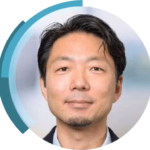 Professor Atsushi Urakawa obtained his PhD in 2006 at ETH Zurich (Switzerland). Then, he worked as a Senior Scientist and Lecturer at ETH Zurich before joining ICIQ (Spain) in 2010 as a Group Leader. In 2019, he took on a new challenge as Professor of Catalysis Engineering at ChemE, TU Delft. His research group is dedicated to developing novel heterogeneous catalysts and catalytic processes that minimize energy usage and reduce negative impacts on the environment and human health. By employing a multidisciplinary approach that integrates material science, reaction engineering, and in situ/operando methodologies, they aim to gain a thorough understanding of active sites and transformation pathways. Their primary target reactions include CO2 conversion to valuable chemicals, methane activation, environmental catalysis (NOx abatement), and hydrogen production through electro- and photocatalytic activation. He was elected Fellow of the Royal Society of Chemistry (FRSC) in 2016 and has received numerous accolades, including the JSPS Prize (2020) and The Japan Academy Medal (2021).
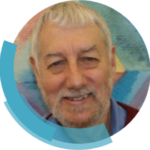 Professor Graham J. Hutchings
 Professor Menachem Elimelech
 Professor Seeram Ramakrishna
 Professor Bart van der Bruggen
 Professor João A. P. Coutinho
 Professor Markus Antonietti
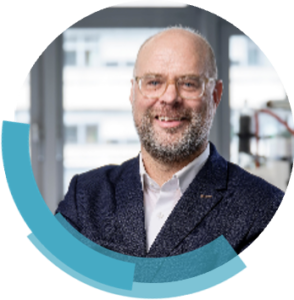 Professor Lutz Ackermann