
Emerging Investigators Series author: Patrick McNamara

Patrick McNamaraPatrick McNamara is in his third year as an Assistant Professor in the Department of Civil, Construction & Environmental Engineering at Marquette University. His research group focuses on the removal of micropollutants from water, wastewater, and biosolids, and on the interactions between microbial communities and micropollutants with a special emphasis on antibiotic resistance. He earned his PhD in 2012 from the University of Minnesota under the guidance of Paige Novak and his MS in 2008 from the University of Texas at Austin with Des Lawler.

Read Patrick’s Emerging Investigators article ‘Pyrolysis removes common microconstituents triclocarban, triclosan, and nonylphenol from biosolids’ here.


– How has your research evolved from your first to your most recent article?
My first work was on the dewaterability of wastewater biosolids. I worked for a physical-chemical treatment expert while earning my master’s, but was drawn to the biological aspects of anaerobic digestion. I grew interested in the interactions between micropollutants and anaerobic treatment processes. My research group now focuses on the impacts of micropollutants in biological systems and investigates ways to remove micropollutants. This most recent article looked at a process to remove micropollutants from biosolids.

– What aspect of your work are you most excited about at the moment?
I am very enthusiastic about our work on consumer product antimicrobials and antibiotic resistance. We have made some interesting findings at Marquette in this area and it will be a fun journey to continue to dive deeper. I am thrilled about a new postdoctoral scholar joining us in January to work in this area, and I am looking to have a PhD student join us in this area as well.

– What was your biggest challenge during this research?
John Ross was my first graduate student. He walked into a lab without established procedures or even an LC-MS at the time. It was a big, but fun challenge to get everything started. John took a risk working for a starting Assistant Professor, but we had a great experience learning from each other. The biggest lab challenge was keeping the reactor system air-tight after multiple experiments.

– How did you find out about Environmental Science: Water Research & Technology?
From David Cwiertny on Twitter! ES:WR&T does a great job getting its name out there on social media, and then the name spreads quickly between colleagues in the field because they put together a great editorial team.

– What are your views on the Environmental Science journals of the Royal Society of Chemistry?
This is my first experience publishing in an Environmental Science journal from the Royal Society of Chemistry. It was terrific. The process was so smooth and clear. The turn-around time was almost unbelievable. They are publishing on a lot of hot topics.

– In which upcoming conferences or events may our readers meet you?
I plan to attend this summer’s Gordon conference on Environmental Sciences: Water. I was also invited to talk at ASM Microbe 2016 that will be held in Boston in June.

– How do you spend your spare time?
I enjoy walks with my wife, going to Marquette Basketball games, fishing, playing piano, traveling, and having coffee or a beer with friends.

– If you could not be a scientist, but could be anything else, what would you be?
Well, with no restrictions I would be a professional soccer player or piano player in a band. But honestly, I cannot believe I get to do this job, I love it.

– Can you share one piece of career-related advice or wisdom with other early career scientists?
Find a mentor, and take advice from people in your field that you respect both scientifically and personally. Don’t be seduced by the people who talk about how they are always working; they might just have poor time management. This is the best job in the world. Do your job well, and take breaks at the end of the day and on weekends. It’s a marathon, but it can be very fun and rewarding. Lastly, learn to delegate and trust others after you have taught them. It is hard to be successful if you need to do everything on your own. Teamwork is very valuable.

Digg This
Reddit This
Stumble Now!
Share on Facebook
Bookmark this on Delicious
Share on LinkedIn
Bookmark this on Technorati
Post on Twitter
Google Buzz (aka. Google Reader)

Improving oil retrieval methods

an article by webwriter Jesper Agrelius (@JesperAgrelius) at Linköping University, Sweden

Environmental impacts of oil spills

Accidental oil spills are unavoidable during the acquisition, processing and distribution of petroleum products. Oil can pollute the oceans through a range of processes, such as land run off, tanker discharges and vessel accidents. Oil spills impact humans, plants and wildlife, including fish, mammals and birds.

In many cases, the environmental recovery after an oil spill is fairly swift and complete within ten years; however, some long-term environmental effects can be measured decades after a large oil spill.

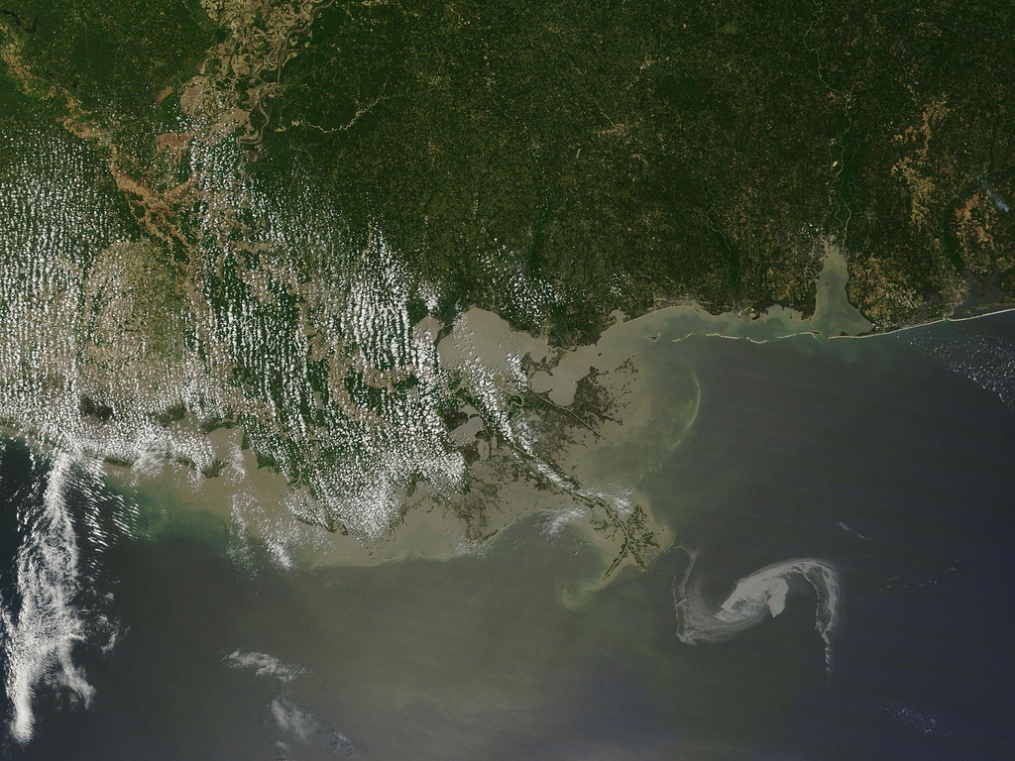
Oil slick in the Gulf of Mexico, April 29th 2010 (Image from NASA Goddard Space Flight Center)

Oil spill remediation techniques

Remediation techniques to manage oil spills are often both expensive and lengthy. Conventional clean-up techniques after oil spills range from in situ burning; mechanical methods, such as booms, vacuums and skimming; chemical dispersants; and/or the use of sorbent materials. Each of these methods presents its own advantages and disadvantages depending on the scenario of the oil spill.

One of the most versatile, cost effective and fruitful methods is to use porous sorbent materials to remove oil from the water surface. We can find natural oil sorbents such as wood, cotton, milkweed, and wool, among others. The efficiency of the sorbent material is related to its hydrophobicity, porosity, sorption capacity and rate, and reusability.

Each oil remediation technique comes with its own environmental impact. Many novel synthetic oil sorbents are currently being developed and there is great need for biodegradable and reusable absorbents to manage oil spills – and to minimize the environmental effect of the oil remediation technique.

New methods to separate oil and water: biodegradable synthetic oil sorbent

A study from Boston University recently published in Environmental Science: Water Research & Technology presents knowledge on biodegradable synthetic oil sorbents, allowing for efficient recovery after accidental oil spills.

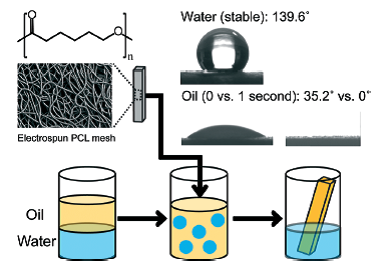
Electrospun non-woven poly(ε-carporlactone) PCL microfiber meshes are mechanically robust, reusable and biodegradable polymeric oil sorbents capable of  retrieving oil from oil spills in both freshwater and seawater.

Schematic diagram of an electrospun hydrophobic PCL mesh that selectively removes oil from a water-in-oil emulsion.

By simulating oil spills in fresh- and seawater scenarios, researchers examined how well the polymeric oil sorbent could retrieve oil. The PCL is hydrophobic and has >99.5% (oil over water) oil selectivity and has oil absorption capacities of approx. 10 grams of oil/gram of sorbent material. Both the absorption capacity and the oil selectivity remained constant over several oil absorption and vacuum assisted retrieval cycles when removing crude oil or mechanical pump oil.

This study shows the need for biodegradable synthetic oil sorbents which balance porosity and mechanical integrity enabling reuse, and allowing for efficient recovery of oil after an oil spill.


Interested in this research? You can read the full paper for free* using the link below:

Poly(ε-caprolactone) microfiber meshes for repeated oil retrieval
J.S Hersey, S.T Yohe and M. W. Grinstaff
Env. Sci: Water Res. Technol. 2015, 1, 779-786
DOI: 10.1039/C5EW00107B

—————-

About the webwriter

Jesper Agrelius is a MSc student in Environmental Science at Linköping University, Sweden. His main interests regards environmental science, especially climate change and biogeochemistry. You can follow him on Twitter @JesperAgrelius.

—————-

*Access is free through a registered RSC account – click here to register

Digg This
Reddit This
Stumble Now!
Share on Facebook
Bookmark this on Delicious
Share on LinkedIn
Bookmark this on Technorati
Post on Twitter
Google Buzz (aka. Google Reader)

International Water Reuse and Desalination Symposium

Potable Reuse of Water themed collection

A two-day International Water Reuse & Desalination Symposium focused on climate resilient water solutions was held in Brisbane, Australia on the 4th and 5th of November.

This specialty conference was focused on practical aspects of water reuse and desalination, as well as relevant research being conducted in the US and Australia, and featured a blue ribbon assemblage of world-class experts on these two vital components of the water supply equation.

The picture shows Stuart Khan (on the right) presenting the Potable Reuse of Water collection

Editorial Board member and Associate Editor Stuart Khan attended this meeting and took this opportunity to present the Potable Reuse of Water collection included in issue 5 of Environmental Science: Water Research & Technology.

“The delegates understood and appreciated that the focus of our journal is specifically targeted toward engineered systems. That focus makes it considerably more specialised than most of the other water research journals in the field.”

Stuart Khan, Associate Editor

The symposium was a success and the themed collection was very well received. Dedicated to recent advances associated with the potable reuse of water, issue 5 includes a comprehensive collection of papers highlighting research technology and engineering development at the leading edge of potable water reuse.

“There was a lot of interest from the conference participants in our journal. A number of them were authors of the papers presented in this potable reuse of water issue, and others had already submitted papers to our regular issues. The fact that the themed issue was so precisely targeted to one of the key conference themes was particularly appreciated, and all complimentary copies were eagerly snapped up,” Stuart added.

The issue to combine a variety of topics relevant to potable reuse of water. This includes but is not limited to technical innovations, human health risk assessments, monitoring strategies, sustainability assessments and novel applications.

Why not read the full collection now?

Digg This
Reddit This
Stumble Now!
Share on Facebook
Bookmark this on Delicious
Share on LinkedIn
Bookmark this on Technorati
Post on Twitter
Google Buzz (aka. Google Reader)

Saving water increases health risks in green buildings

a Chemistry World article by Polly-Anna Ashford

US researchers have found that strategies for conserving water in green buildings can lead to higher levels of bacteria in the plumbing systems, with potentially serious implications for public health.

William Rhoads and colleagues at Virginia Tech conducted a survey of the drinking water quality in different types of green building, from an office to a net-zero energy home. They measured the chlorine levels, temperature and microbial content, including the prevalence of Legionella bacteria, the cause of Legionnaires’ disease. […]

Read the full article in Chemistry World!


Read the original research paper in Environmental Science: Water Research & Technology for free:

Survey of green building water systems reveals elevated water age and water quality concerns
William J. Rhoads, Amy Pruden and Marc A. Edwards
Environ. Sci.: Water Res. Technol.
, 2015, Advance Article
DOI:
10.1039/C5EW00221D, Paper


*Access is free through a registered RSC account
Digg This
Reddit This
Stumble Now!
Share on Facebook
Bookmark this on Delicious
Share on LinkedIn
Bookmark this on Technorati
Post on Twitter
Google Buzz (aka. Google Reader)

Chlorinated compounds form in tea and coffee

an Environmental Science: Water Research & Technology article highlighted in Chemistry World by Philippa Matthews

Tea and coffee are the most consumed beverages in the world, but a new study has discovered some unexpected chemistry occurring in our cups.

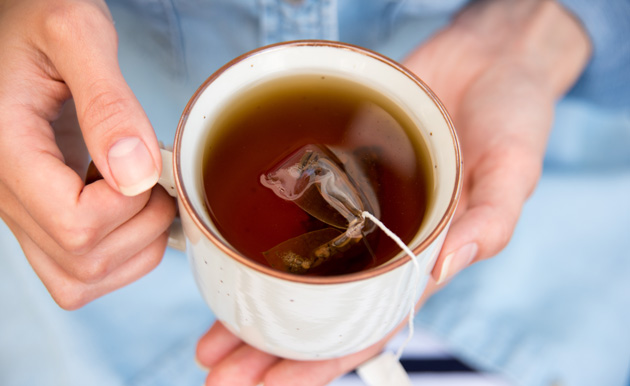
Contrary to popular belief, boiling the water only removes around 20% of chlorine © Shutterstock

Chlorine is added to water as part of the disinfection process, with a residual amount remaining in the treated water to supress microbial growth. This chlorine reacts with organic molecules in the water to produce chlorinated chemicals known as disinfection byproducts (DBPs), such as chloroform.

Nikolai Kuhnert from Jacobs University, Germany, conducts research on compounds in tea and coffee. He advocates further research into the effects processing has on our food. ‘It illustrates further how little we know on the chemistry of food processing that significantly alters the chemical composition of our daily diet, producing both novel compounds with adverse or beneficial properties for human health.’


Read the full article in Chemistry World!

Read the original research paper in Environmental Science: Water Research & Technology:
Emerging investigators series: formation of disinfection byproducts during the preparation of tea and coffee

Tom Bond, Seeheen C. Tang, Nigel Graham and Michael R. Templeton
Environ. Sci.: Water Res. Technol.
, 2016, Advance Article
DOI:
10.1039/C5EW00222B

*Access is free through a registered RSC account

Digg This
Reddit This
Stumble Now!
Share on Facebook
Bookmark this on Delicious
Share on LinkedIn
Bookmark this on Technorati
Post on Twitter
Google Buzz (aka. Google Reader)

Emerging Investigators Series author: Tom Bond

Tom Bond is a Junior Research Fellow (JRF) in the Environmental and Water Resource Engineering (EWRE) section at Imperial College London. His research is focused on the role aquatic chemistry can play in identifying and removing hazardous contaminants during water and wastewater engineering treatment processes.

Although he has spent most of his research career in engineering departments, his first degree was in chemistry and he is interested in synergistic interactions between the two disciplines. He holds a PhD on the treatment of disinfection byproduct precursors and MSc in Water and Wastewater Engineering, both from Cranfield University, and a first class honours degree (MSci) in chemistry from Bristol University.

Read Tom’s Emerging Investigators article ‘formation of disinfection byproducts during the preparation of tea and coffee’ here.


– How has your research evolved from your first to your most recent article?
My first article was on disinfection byproducts, as is this latest one. However, in between I have also worked on lots of different areas, so hopefully I am now knowledgeable about a wider range of research topics then when I started in research.

– What aspect of your research are you most excited about at the moment?
In general, I am excited by having the freedom to work on different topics and pursue things which interest me. If I am able to make any contributions to improving the public health impact of drinking water then that would be even better.

– Your paper discusses an issue that potentially affects most of us. How did you come up with this idea?
I was reading a thesis from a student at Imperial College, in which was made an incidental comment that tea and coffee represent potential sources of disinfection byproducts. And I thought, That’s an interesting idea actually. After looking in the literature, I was quite surprised to find that this was not something that had been looked at much detail previously. This made it seem like something that would be worth proposing as an MSci research project, which turned out to be the case, especially as an excellent student selected it (Seeheen Tang).

– What was your biggest challenge during this research?
We had some technical challenges with the laboratory work along the way. The biggest was that I initially wanted to undertake a liquid-liquid extraction on the chlorinated tea and coffee samples prior to analysing for disinfection byproducts by gas chromatography. This is a standard method in the drinking water research.

However, as we found out, when you try extracting tea or coffee into an organic solvent you get a horrible frothy mess, which is hopeless for extracting anything from. After trying some alternatives, I ended up sending some samples to an external lab for trihalomethane analysis using a headspace gas chromatography method. This relies on heating the sample to separate the volatile trihalomethanes, rather than extracting them.

– How did you find out about Environmental Science: Water Research & Technology and how was your experience?
It was mentioned to me by colleagues at Imperial, while I have also seen it advertised at conferences I have attended. The editorial and peer review process was very efficient in the case of this article.

– How do you spend your spare time?
In no particular order: walking/hiking, going to the pub, eating out and birdwatching. The last of these is my biggest passion, even if I probably spend more time on the other activities mentioned.

– If you could not be a scientist, but could be anything else, what would you be?
A writer, although I am not sure of which type. Of the various enjoyable aspects of working in a university, writing is the part I like most. And it would intrigue me to try writing in a different style to that required by science/academia. As a secondary alternative, being a professional footballer would be ok (!), although I fear that I am already too old, not to mention unskilled, for that possibility.

– Can you share one piece of career-related advice or wisdom with other early career scientists?
Try to improve a variety of aspects of your CV, rather than concentrating on one or two, as this should give you more opportunities in the future. It also helps if you know where you want to go in your career, as then you can plan strategically what is needed to get there.

Digg This
Reddit This
Stumble Now!
Share on Facebook
Bookmark this on Delicious
Share on LinkedIn
Bookmark this on Technorati
Post on Twitter
Google Buzz (aka. Google Reader)

Electrodes enhance H2 production and sludge decomposition in microbial electrolysis

An article by webwriter Jesper Agrelius (@JesperAgrelius) at Linköping University, Sweden

Using microbial electrolysis for hydrogen production

Microbial electrolysis is a method that generates methane or hydrogen from organic material by applying an electric current. Hydrogen is particularly explored as an alternative fuel for passenger vehicles, either in fuel cells to power electric motors or burned in internal combustion engines.

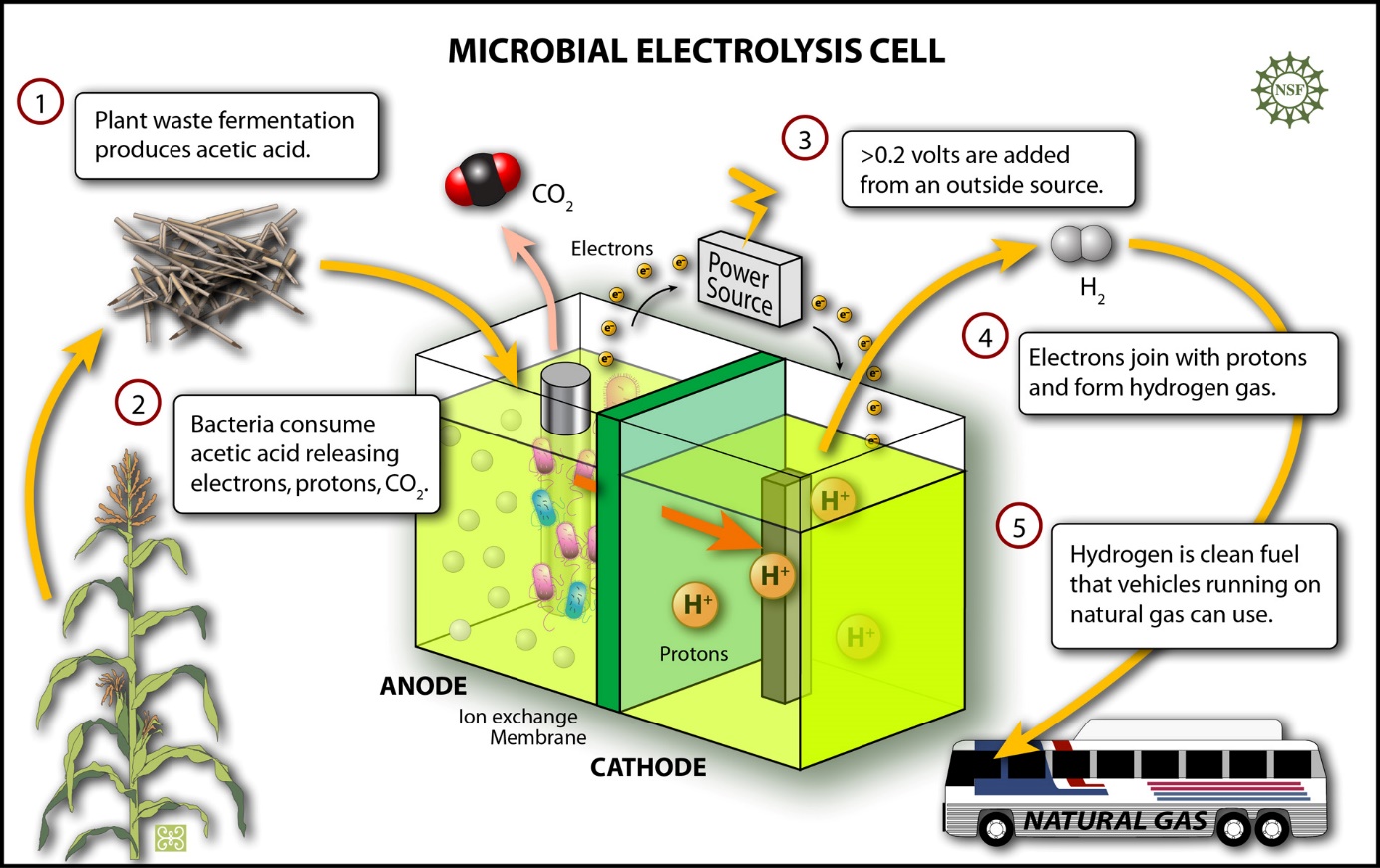
Microbial Electrolysis Cell

A schematic of the general process in a Microbial Electrolysis Cell - here with plant waste as initial resource (Image by Zina Deretsky, National Science Foundation, available as public domain: http://images.dailytech.com/nimage/6590_large_biohydrogen_h.jpg)

Microbial electrolysis and waste activated sludge

A Microbial electrolysis cell is capable of producing hydrogen from waste water or waste biomass. Waste activated sludge (WAS), a byproduct of biological wastewater treatment processes, is an example of how to produce hydrogen (H2) via the method of microbial electrolysis.

The hydrogen from anaerobic fermentation is produced by hydrogen producing bacteria (HPB) and consumed by hydrogen consuming bacteria (HCB) such as methanogens. Unfortunately the H2 production in anaerobic digestion of sludge is often low since the waste sludge have a limited carbohydrate source available for HPB.

The central process of microbial electrolysis cells is when exoelectrogens oxidise the substrates and release an electron to the anode, and then the electron is accepted by H+ to produce hydrogen at the cathode. This process requires a voltage supply to overcome the energy barrier between the two electrodes –although the hydrogen production from waste sludge might increase in a microbial electrolysis cell, the energy efficiency is low because of the extra voltage applied.

Low hydrogen production from anaerobic digestion of sludge has greatly limited the application of biological hydrogen-producing technology.

New research

A recent study published in Environmental Science: Water Research & Technology by Yinghong, Liu and Zhang sheds new light on the topic. By installing a Fe/graphite electrode into an anaerobic digester, the hydrogen production from waste sludge was improved. The electrode accelerated the decomposition of the sludge and also increased the production of short-chain fatty acids. The electric-anaerobic system also inhibited the occurrence of methanogenesis, which led to quite low methane production.

The study by Zhang and colleagues is unique since this was the first time that net energy was harvested from WAS in a hydrogen-producing microbial electrolysis cell with a cost-effective electrode.

Interested in this research? You can read the full paper for free* using the link below:

Enhancement of sludge decomposition and hydrogen production from waste activated sludge in a microbial electrolysis cell with cheap electrodes
Feng Yinghong, Yiwen Liu and Yaobin Zhang
Env. Sci: Water Res. Technol.
2015, advance article
DOI
:10.1039/c5ew00112a

—————-

About the webwriter

Jesper Agrelius is a MSc student in Environmental Science at Linköping University, Sweden. His main interests regards environmental science, especially climate change and biogeochemistry. You can follow him on Twitter @JesperAgrelius.

—————-

*Access is free through a registered RSC account – click here to register

Digg This
Reddit This
Stumble Now!
Share on Facebook
Bookmark this on Delicious
Share on LinkedIn
Bookmark this on Technorati
Post on Twitter
Google Buzz (aka. Google Reader)

Admit it – we already drink recycled water

I heard someone ask recently: Has the same water been going around since the dinosaurs peed into it? Intriguing, especially when we think about it in the context of water reuse. Climate change is causing more extreme droughts and floods. As our growing population struggles for equitable allocation and access to limited freshwater resources, we are faced today with an urgent need to diversify our water portfolio.

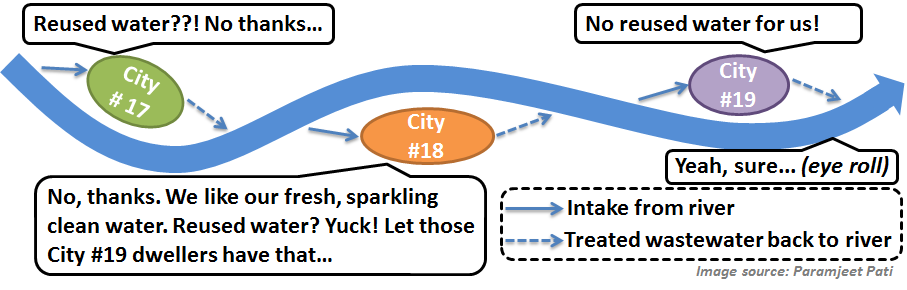
Policy innovations for recycled water – The long view. Effective tackling of water security challenges demands policy innovations. We wholeheartedly endorse policies and technological innovations related to rainwater harvesting, fog catching or decentralized solar-enabled water purification systems (e.g., the Watercone). But using recycled water seems yucky, and efforts to encourage the use of recycled water have received some strong pushback in the past.

The recent droughts in California, however, have resuscitated the discussions about water recycling in the United States. But how successfully do water recycling policies survive the ebbs and flows of environmental stresses, political will, and public memory? Dr. John C. Radcliffe’s recent article gives new insight into this question. The article outlines the successes and shortcomings of Australia’s water recycling over the last two decades, when the prolonged “Millennium Drought” in the 2000s made it necessary for Australia to adopt alternative strategies for water security, and to develop new policies for potable uses of recycled water. Things looked promising for Australia’s long-term water sustainability… but then the droughts ended.

Complacency + the Yuck factor = Terrible, no-good, very bad self-inflicted water crisis. Our resolve to address water sustainability issues and to implement long-term solutions is often tested – ironically – when the threat of water scarcity temporarily fades. As Radcliffe notes, “The end of the drought in eastern Australia has distanced community, industry and government policy focus from strengthening the security of water supply (at almost any cost) to one of pursuing economic efficiency and containing consumers’ water charges and prices.” And the Yuck factor about toilet-to-tap policies doesn’t help.

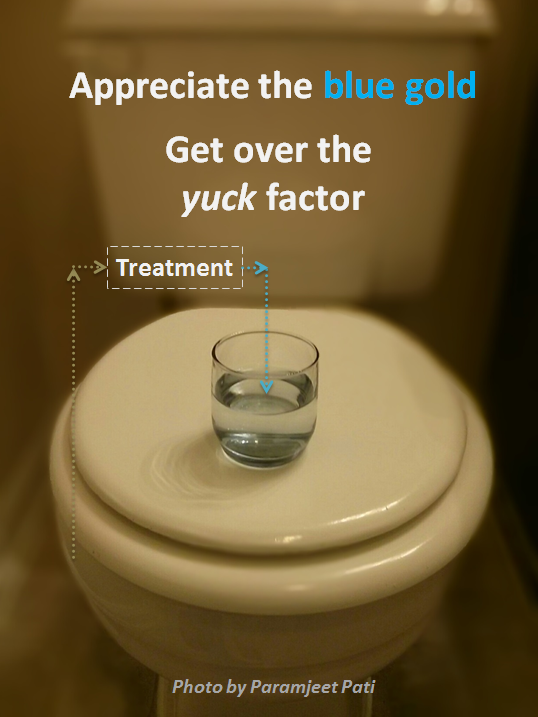
Blue Gold slipping through our fingers. The poignant opening lines of an Urdu ghazal from yesteryears croon: Duniya jise kehte hain / jaadoo ka khilona hai / Mil jae toh mitti hai / kho jae toh sona hai. Meaning: This world is magical. Here, when we are fortunate to have something, we treat it like dirt (mitti). But as it begins to slip away, it becomes precious like gold (sona). Opportunities to successfully meet our water challenges are shrinking. That glass of water sitting on the toilet seat on the right has been rightly called Blue Gold. And it is slipping away.

Today, while reassessing our water policies while threats to our water security loom in the horizon, let us not forget the lessons that hindsight has to offer.

You can access the full paper for free* using the link below:

Water recycling in Australia – during and after the drought
John C. Radcliffe
Environ. Sci.: Water Res. Technol., 2015,1, 554-562
DOI: 10.1039/C5EW00048C


————

About the webwriter

Paramjeet Pati is a PhD Candidate at the Virginia Tech Center for Sustainable Nanotechnology (@VTSuN).
You can find more articles by him in the VTSuN blog, where he writes using the name coffeemug.

————

*Access is free through a registered RSC account – click here to register

Digg This
Reddit This
Stumble Now!
Share on Facebook
Bookmark this on Delicious
Share on LinkedIn
Bookmark this on Technorati
Post on Twitter
Google Buzz (aka. Google Reader)

Flushing advice is flawed

an Environmental Science: Water Research & Technology article highlighted in Chemistry World by Cesar Palmero

Instructions given to the public by water companies and other authorities in the aftermath of chemical contaminations are inconsistent and not validated by science. So say scientists in the US who are developing models to understand complex plumbing systems to ensure consumers get the best guidance on how to regain access to safe drinking water.

In the last two years, more than a million people in Canada and the US have been affected by similar incidents. Large-scale water contamination incidents are not uncommon, yet there has been little research into purification procedures.


Read the full article in Chemistry World!


Read the original research paper in Environmental Science: Water Research & Technology:
Decontaminating chemically contaminated residential premise plumbing systems by flushing

K. S. Casteloes, R. H. Brazeau and A. J. Whelton
Environ. Sci.: Water Res. Technol.
, 2015, Advance Article
DOI:
10.1039/C5EW00118H, Paper


*Access is free through a registered RSC account
Digg This
Reddit This
Stumble Now!
Share on Facebook
Bookmark this on Delicious
Share on LinkedIn
Bookmark this on Technorati
Post on Twitter
Google Buzz (aka. Google Reader)

30th Annual WateReuse Symposium

Celebrating 30 Years of Securing Our Water Future!
Scientifically-proven advances in water technology allow us to treat any water clean enough for any use, including industrial, irrigation, and drinking. For the past 30 years, the Annual WateReuse Symposium has been the place to get the information you need to develop the right water for the right use.

Don’t miss this year’s Symposium to get even more:

  • Case studies of innovative projects
  • Updates on technology innovation
  • Highlights of cutting-edge research
  • Water treatment insight
  • Legislative and regulatory perspective

Come for the experience. Leave with the knowledge you need.

30th Annual WateReuse Symposium
Sheraton Seattle
Seattle, WA
September 13-16, 2015
www.watereuse.org/symposium

Digg This
Reddit This
Stumble Now!
Share on Facebook
Bookmark this on Delicious
Share on LinkedIn
Bookmark this on Technorati
Post on Twitter
Google Buzz (aka. Google Reader)