Archive for June, 2012

Predicting nanoparticle shapes

There is so much research currently being dedicated to nanoparticle catalysts but how can we plan for how they will behave under different temperature conditions?

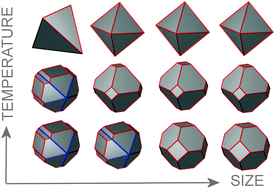
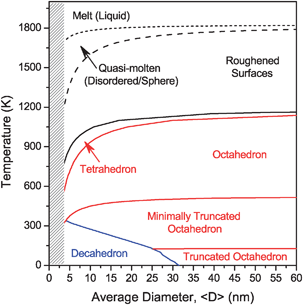
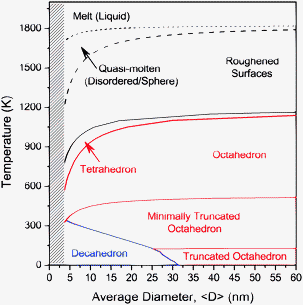
Amanda Barnard at CSIRO, Australia, has performed theoretical modelling, producing a nanoscale phase diagram that predicts the morphologies of a range of palladium nanocatalysts as a function of the number of atoms or diameter, and temperature.

 First nanoscale phase diagram of Pd

It seems that under almost all conditions, monocrystalline shapes are thermodynamically preferred with the exception of particularly small nanoparticles at low temperatures, where multiply-twinned decahedra are stable.

To read more about Barnard’s findings, download the Catalysis Science & Technology article today – it’s free…

Mapping the shape and phase of palladium nanocatalysts
Amanda S. Barnard

Digg This
Reddit This
Stumble Now!
Share on Facebook
Bookmark this on Delicious
Share on LinkedIn
Bookmark this on Technorati
Post on Twitter
Google Buzz (aka. Google Reader)

Co-factor promiscuity

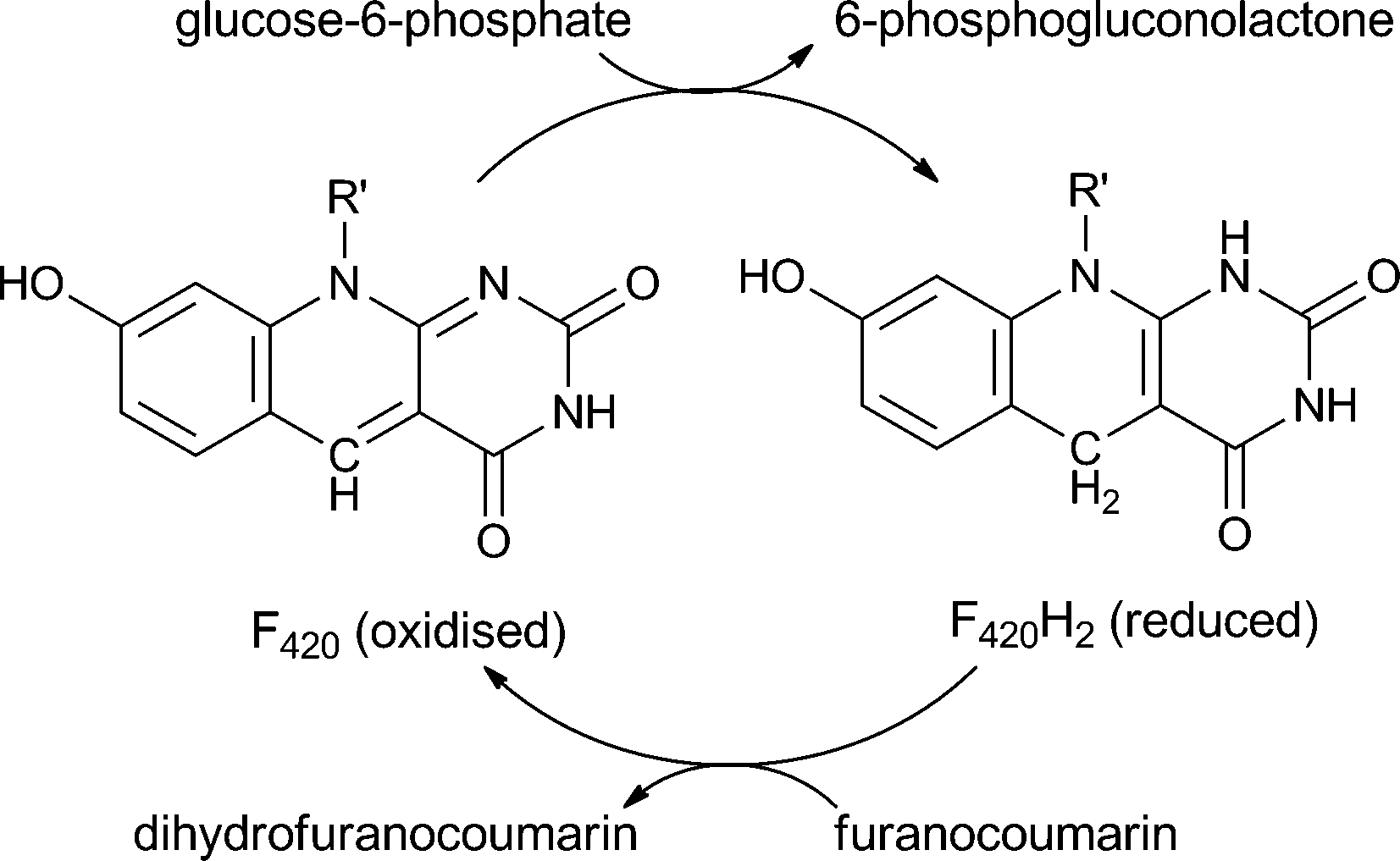
Scientists from Australia have demonstrated that an enzyme can catalyse different chemistries from the same substrate depending on which co-factor is present. This is the first example of an enzyme showing indiscriminate behaviour for a co-factor, resulting in a different biocatalytic reaction.

Co-factors are the non-protein part of an enzyme which are essential for catalysing the reaction. By replacing the co-factor F420 with a different co-factor, FMN, the F420-dependent reductases oxidised the substrate instead of reducing it.


Co-factor, F420, in FDR-catalysed aflatoxin degradation

This finding opens the door to a whole area of study devoted to examining how new co-factors can enable industrially-relevant reactions.

To read more, download the article now:

Cofactor promiscuity among F420-dependent reductases enables them to catalyse both oxidation and reduction of the same substrate
Gauri V. Lapalikar,  Matthew C. Taylor,  Andrew C. Warden,  Hideki Onagi,  James E. Hennessy,  Roger J. Mulder,
Colin Scott,  Susan E. Brown,  Robyn J. Russell,  Chris J. Easton and John G. Oakeshott

Catal. Sci. Technol., 2012, Advance Article
DOI: 10.1039/C2CY20129A

Digg This
Reddit This
Stumble Now!
Share on Facebook
Bookmark this on Delicious
Share on LinkedIn
Bookmark this on Technorati
Post on Twitter
Google Buzz (aka. Google Reader)

Top ten most accessed articles in May

This month sees the following articles in Catalysis Science & Technology that are in the top ten most accessed:-

Graphene-based materials for catalysis
Bruno F. Machado and Philippe Serp
Catal. Sci. Technol., 2012,2, 54-75    DOI: 10.1039/C1CY00361E

A review of controllable synthesis and enhancement of performances of bismuth tungstate visible-light-driven photocatalysts
Liwu Zhang and Yongfa Zhu
Catal. Sci. Technol., 2012,2, 694-706    DOI: 10.1039/C2CY00411A

Conversion of lignocellulose into renewable chemicals by heterogeneous catalysis
Hirokazu Kobayashi ,  Hidetoshi Ohta and Atsushi Fukuoka
Catal. Sci. Technol., 2012,2, 869-883    DOI: 10.1039/C2CY00500J

Role of mixed metal oxides in catalysis science—versatile applications in organic synthesis
Manoj B. Gawande ,  Rajesh K. Pandey and Radha V. Jayaram
Catal. Sci. Technol., 2012,2, 1113-1125    DOI: 10.1039/C2CY00490A

Design of hierarchical zeolite catalysts by desilication

Danny Verboekend and Javier Pérez-Ramírez
Catal. Sci. Technol., 2011,1, 879-890    DOI: 10.1039/C1CY00150G

Fischer–Tropsch reaction–diffusion in a cobalt catalyst particle: aspects of activity and selectivity for a variable chain growth probability

David Vervloet ,  Freek Kapteijn ,  John Nijenhuis and J. Ruud van Ommen
Catal. Sci. Technol., 2012,2, 1221-1233    DOI: 10.1039/C2CY20060K


Rational design of heterogeneous catalysts for biodiesel synthesis
Karen Wilson and Adam F. Lee
Catal. Sci. Technol., 2012,2, 884-897    DOI: 10.1039/C2CY20038D

Asymmetric catalytic carbon–carbon coupling reactions via C–H bond activation
Lei Yang and Hanmin Huang
Catal. Sci. Technol., 2012,2, 1099-1112    DOI: 10.1039/C2CY20111A

Challenge and progress: palladium-catalyzed sp3 C–H activation
Hu Li ,  Bi-Jie Li and Zhang-Jie Shi
Catal. Sci. Technol., 2011,1, 191-206    DOI: 10.1039/C0CY00076K

Structure and catalytic properties of hexagonal molybdenum disulfide nanoplates
Carlos Fernando Castro-Guerrero ,  Francis Leonard Deepak ,  Arturo Ponce ,  Juan Cruz-Reyes ,  Mario Del Valle-Granados ,  Sergio Fuentes-Moyado ,  D. H. Galván and Miguel José-Yacamán
Catal. Sci. Technol., 2011,1, 1024-1031    DOI: 10.1039/C1CY00055A

Why not take a look at the articles today and blog your thoughts and comments below.

Fancy submitting an article to Catalysis Science & Technology? Then why not submit to us today or alternatively email us your suggestions.


Digg This
Reddit This
Stumble Now!
Share on Facebook
Bookmark this on Delicious
Share on LinkedIn
Bookmark this on Technorati
Post on Twitter
Google Buzz (aka. Google Reader)

Generating the intermediates for glutamate antagonists

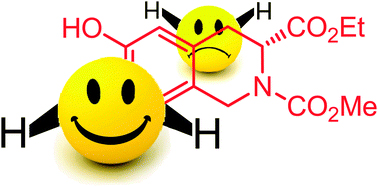
Laurent Lefort and Jared W. Fennell with colleagues had developed a way to improve the diastereoselectivity from 75:25 to 95:5 for a key reaction in generating glutamate antagonists.

The team screened a range of heterogeneous catalysts and found a Pd/C catalyst which should raise the yield by 40% and reduce the costs of the reaction compared to a currently used process involving a rhodium catalyst.

Glutamate acts as a neurotransmitter and antagonists are highly sought in the pharmaceutical industry for development of new drugs and treatments. Improving the yields and selectivity of the reactions to produce these compounds is an important area for catalyst development.

More details can be found in the teams article below, which will be published in our upcoming themed issue focusing on catalysis in industry

l
A detailed study of the diastereoselective catalytic hydrogenation of 6-hydroxytetrahydroisoquinoline-(3R)-carboxylic ester intermediates
Laurent Lefort, Natascha Sereinig, Harrie Straatman, David J. Ager, Johannes G. de Vries, John A. Werner, Roger B. Scherer, Todd D. Maloney, Mark D. Argentine, Kevin A. Sullivan and Jared W. Fennell
Catal. Sci. Technol., 2012, Advance Article
DOI: 10.1039/C2CY20251D

Which will also include,

Advances in conversion of hemicellulosic biomass to furfural and upgrade to biofuels
Basudeb Saha, saikat dutta, Sudipta De and Imteyaz Alam
Catal. Sci. Technol., 2012, Accepted Manuscript
DOI: 10.1039/C2CY20235B

Kinetic aspects and deactivation behaviour of chromia-based catalysts in hydrogen chloride oxidation
Amol P Amrute, Cecilia Mondelli and Javier Pérez-Ramírez
Catal. Sci. Technol., 2012, Accepted Manuscript
DOI: 10.1039/C2CY20185B

Digg This
Reddit This
Stumble Now!
Share on Facebook
Bookmark this on Delicious
Share on LinkedIn
Bookmark this on Technorati
Post on Twitter
Google Buzz (aka. Google Reader)

Outstanding organocatalysis: An article collection

Catalysts are key to some of the most important reactions on the planet; a world without the Haber process or catalysts to crack crude oil is difficult to imagine. Not to mention the enzymatic reactions that are crucial to all life on earth.

Organocatalysts are an important class of catalyst and consist of carbon-based molecules often functionalised with oxygen, sulfur, nitrogen or phosphorus. They have shown promise in a range of reactions including hydrogenation, Diels-Alder, Michael and Mannich reactions, and are of particular interest in asymmetric reactions.

To help keep you up-to-date with the latest in cutting-edge organocatalytic research we have made the following articles free to access until the 9th July. After reading all these there will be little you won’t know about the exciting world of organocatalysis!

Click here for the full list of free articles

Digg This
Reddit This
Stumble Now!
Share on Facebook
Bookmark this on Delicious
Share on LinkedIn
Bookmark this on Technorati
Post on Twitter
Google Buzz (aka. Google Reader)

At last… a route to 2nd generation Grubbs-methylidene complexes

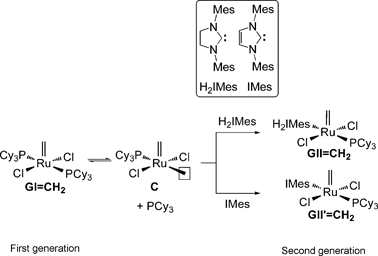
Catalysis Science & Technology Editorial Board member, Deryn Fogg and her team have found a way to synthesise methylidene derivatives of Grubbs-type second generation catalysts – intermediates in cross metathesis and ring-closing metathesis reactions. 

The ability to isolate these complexes (which up until now has only been achieved in relatively low yields) creates an opportunity to gain mechanistic insight into olefin metathesis reactions.

Second generation Grubbs methylidene complexes

Fogg and her team overcame the problematic low yields of the methylidene-second generation catalysts by taking a step backwards – they focused on the first generation Grubbs catalysts. Unlike, the second generation catalysts,  methylidene derivatives of their first generation predecessors can be formed in quantitative yields. Clever ligand exchange of the PCy3 ligand with free carbenes resulted in the desired second generation complex.

Download the full article to read more – it won’t close you a thing!

Targeting an Achilles heel in olefin metathesis: A strategy for high-yield synthesis of second-generation Grubbs methylidene catalysts
Justin A. M. Lummiss, Nicholas J. Beach, Jeffrey C. Smith and Deryn E. Fogg

For more catalysis research direct to your email inbox, register for the Catalysis Science & Technology e-alerts

Digg This
Reddit This
Stumble Now!
Share on Facebook
Bookmark this on Delicious
Share on LinkedIn
Bookmark this on Technorati
Post on Twitter
Google Buzz (aka. Google Reader)