Archive for November, 2012

C-H activation: an article collection

C-H ActivationOne of the simplest and most utilised chemical reactions is the burning of hydrocarbons and while combustion is an excellent way to exploit the energy content of this naturally occurring resource, there is a lot more we can do with the ‘inert’ C-H bond.

C-H activation allows us to convert cheaper hydrocarbon starting materials into more valuable and versatile products; leading to the development of a wide range of reagents and catalysts that activate C-H bonds. To keep you up to date with the latest developments in the field we have created this article collection, where all articles are free to download until 15th December.

Click here for the full list of free articles

Digg This
Reddit This
Stumble Now!
Share on Facebook
Bookmark this on Delicious
Share on LinkedIn
Bookmark this on Technorati
Post on Twitter
Google Buzz (aka. Google Reader)

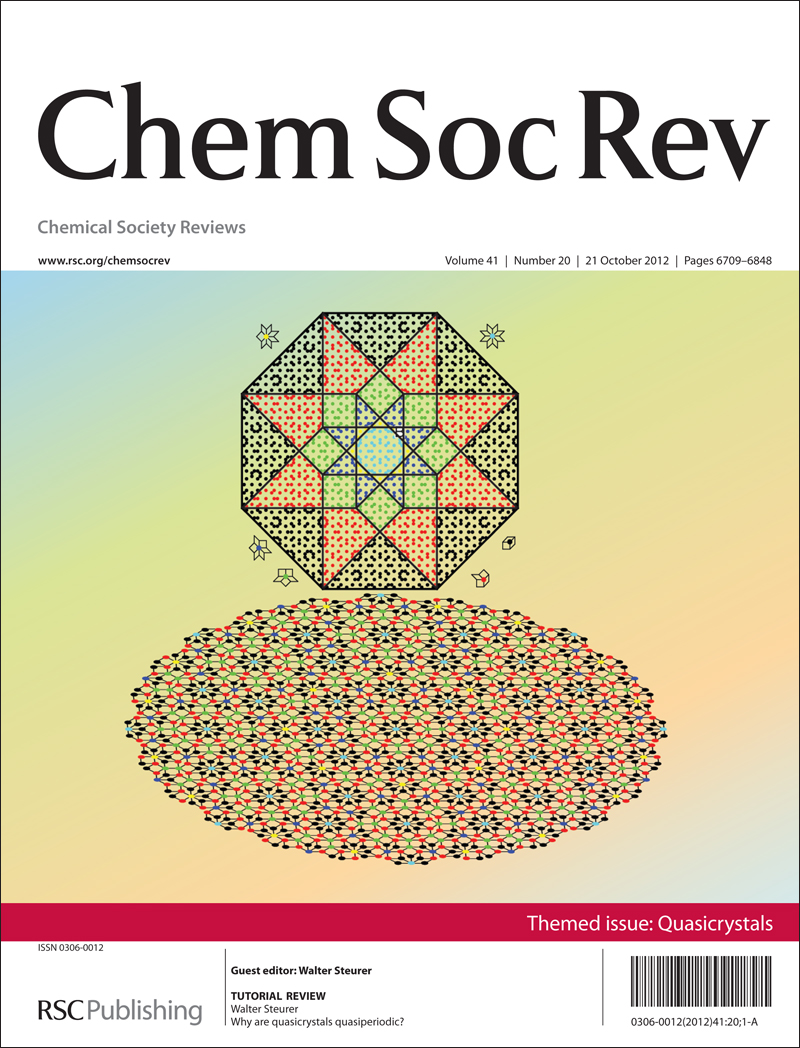
Themed issue: Quasicrystals

Chem. Soc. Rev. is delighted to present its Quasicrystals themed issue, in honour of the 2011 Nobel Prize in Chemistry winner, Professor Dan Shechtman.

Guest editor Professor Walter Steurer introduces this themed issue in his editorial Fascinating Quasicrystals.

This themed issue features a fantastic collection of reviews on the topic of quasicrystals, here is just a snapshot:

Tutorial Reviews:
Why are quasicrystals quasiperiodic
?
Walter Steurer
Chem. Soc. Rev., 2012, 41, 6719-6729
DOI: 10.1039/C2CS35063G

Electrical and thermal transport properties of icosahedral and decagonal quasicrystals
Janez Dolinšek
Chem. Soc. Rev., 2012, 41, 6730-6744
DOI: 10.1039/C2CS35036J

Critical Review:
Mathematical diffraction of aperiodic structures
Michael Baake and Uwe Grimm
Chem. Soc. Rev., 2012, 41, 6821-6843
DOI: 10.1039/C2CS35120J

Browse the whole Quasicrystals themed issue online.

Digg This
Reddit This
Stumble Now!
Share on Facebook
Bookmark this on Delicious
Share on LinkedIn
Bookmark this on Technorati
Post on Twitter
Google Buzz (aka. Google Reader)

Key Learning Points published in Tutorial Reviews

Following last month’s announcement about the relaunch of Tutorial Reviews in Chem. Soc. Rev., we are now pleased to have published our first reviews which contain Key Learning Points.

All Tutorial Reviews will now include a ‘Key Learning Points’ box – where authors succinctly highlight what readers should expect to learn from their review.

We hope this allows Tutorial Reviews to be even more accessible to graduate students and beyond; providing an essential introduction to a field and serving as a springboard to further reading. For more information about Chem. Soc. Rev. review articles, including how to submit a proposal, see our Author Guidelines.

Take a look at our new Key Learning Points in the Tutorial Reviews below:

The calculations of excited-state properties with Time-Dependent Density Functional Theory
Carlo Adamo and Denis Jacquemin
Chem. Soc. Rev., 2013, DOI: 10.1039/C2CS35394F

Homogeneous Palladium Catalyzed Asymmetric Hydrogenation
Qing-An Chen, Zhi-Shi Ye, Ying Duan and Yong-Gui Zhou
Chem. Soc. Rev., 2013, DOI: 10.1039/C2CS35333D

We also encourage you to sign-up to our free contents e-alerts to receive the latest reviews from Chem. Soc. Rev.

Digg This
Reddit This
Stumble Now!
Share on Facebook
Bookmark this on Delicious
Share on LinkedIn
Bookmark this on Technorati
Post on Twitter
Google Buzz (aka. Google Reader)

Top 10 most accessed articles in August

August saw the following articles in the top 10 most accessed list for Chemical Society Reviews:-

Graphene electrochemistry: fundamental concepts through to prominent applications
Dale A. C. Brownson, Dimitrios K. Kampouris and Craig E. Banks
Chem. Soc. Rev., 2012,41, 6944-6976
DOI: 10.1039/C2CS35105F

Colloidal nanoparticle clusters: functional materials by design
Zhenda Lu and Yadong Yin
Chem. Soc. Rev., 2012,41, 6874-6887
DOI: 10.1039/C2CS35197H

Nanocomposites and macroscopic materials: assembly of chemically modified graphene sheets
Dongqing Wu, Fan Zhang, Haiwei Liang and Xinliang Feng
Chem. Soc. Rev., 2012,41, 6160-6177
DOI: 10.1039/C2CS35179J

Cationic polymers and their therapeutic potential
Sangram Keshari Samal, Mamoni Dash, Sandra Van Vlierberghe, David L. Kaplan, Emo Chiellini, Clemens van Blitterswijk, Lorenzo Moroni and Peter Dubruel
Chem. Soc. Rev., 2012,41, 7147-7194
DOI: 10.1039/C2CS35094G

Supramolecular polymers
Feihe Huang and Oren A. Scherman
Chem. Soc. Rev., 2012,41, 5879-5880
DOI: 10.1039/C2CS90071H

Temperature- and light-responsive smart polymer materials
Florian D. Jochum and Patrick Theato
Chem. Soc. Rev., 2013, Advance Article
DOI: 10.1039/C2CS35191A

Photoredox functionalization of C–H bonds adjacent to a nitrogen atom
Lei Shi and Wujiong Xia
Chem. Soc. Rev., 2012,41, 7687-7697
DOI: 10.1039/C2CS35203F

Powering the future of molecular artificial photosynthesis with light-harvesting metallosupramolecular dye assemblies
Peter D. Frischmann, Kingsuk Mahata and Frank Würthner
Chem. Soc. Rev., 2013, Advance Article
DOI: 10.1039/C2CS35223K

Supramolecular polymeric hydrogels
Eric A. Appel, Jesús del Barrio, Xian Jun Loh and Oren A. Scherman
Chem. Soc. Rev., 2012,41, 6195-6214
DOI: 10.1039/C2CS35264H

Covalent organic frameworks
Xiao Feng, Xuesong Ding and Donglin Jiang
Chem. Soc. Rev., 2012,41, 6010-6022
DOI: 10.1039/C2CS35157A

Take a look at the articles then blog your thoughts and comments below.

Fancy submitting an article to Chemical Society Reviews? Then why not have a look at our author guidelines on the web and submit to us today, or alternatively, email us with your suggestions.

Digg This
Reddit This
Stumble Now!
Share on Facebook
Bookmark this on Delicious
Share on LinkedIn
Bookmark this on Technorati
Post on Twitter
Google Buzz (aka. Google Reader)