Archive for the ‘Crystal Clear’ Category

May Crystal Clear: Time to celebrate Spring with crystal champagne

May Crystal Clear: Time to celebrate the spring with crystal champagne

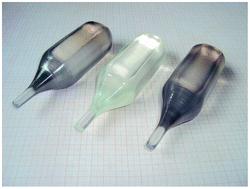
This month’s selection is wine bottled shaped single crystals of CaWO4. Grown by a team working on the CRESST dark matter detection project, these high-purity scintillating CaWO4 single crystals are used as detectors for Weakly Interacting Massive Particles (WIMPs), which are one of  the best candidates for dark matter.

To detect the elusive WIMPs, these crystals have to be of a very high purity and have fairly similar weights (approx. 300g). The high melting temperature (around 1600oC) of the crystal, as well as the fact that it has to be grown in an atmosphere containing oxygen, provided additional challenges to the growth process.

Starting with very high purity CaCO3 and WO3, the team used the Czochralski technique in an industrial furnace to produce these crystals. As the experiment requires the crystals to be transparent to scintillating light, the crystals were oxygenated at high temperatures after growth, which produced very clear crystals. (You can spot which one is the final product in the photo!)

The CRESST team has now adopted this technique to set up an in-house CaWO4 growing facility. This means the number of detectors that they can build has increased significantly. Watch out for interesting experimental results…

Find out more about the use of CaWO4 crystals in the dark matter experiment, and learn how to grow your own CaWO4 wine bottles from the article, which is free to access for 4 weeks.

Growth of high-purity scintillating CaWO4 single crystals for the low-temperature direct dark matter search experiments CRESST-II and EURECA
Andreas Erb and Jean-Côme Lanfranchi
CrystEngComm, 2013, 15, 2301-2304
DOI: 10.1039/C2CE26554K

Digg This
Reddit This
Stumble Now!
Share on Facebook
Bookmark this on Delicious
Share on LinkedIn
Bookmark this on Technorati
Post on Twitter
Google Buzz (aka. Google Reader)

December Crystal Clear: A Crystal Snowflake


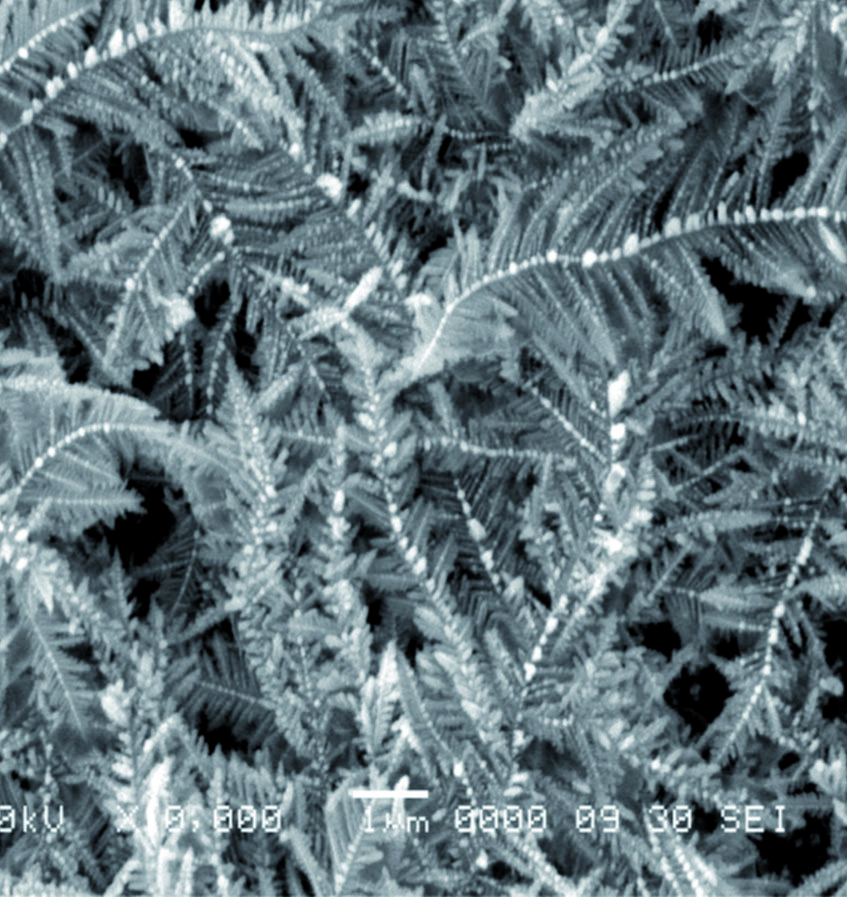
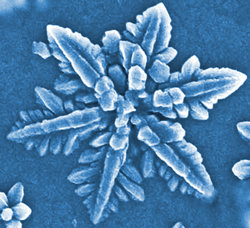
SEM image of a dendritic copper(I) oxide crystal deposited on an ITO substrate in a stirred electrolyte

SEM image of a dendritic copper(I) oxide crystal deposited on an ITO substrate in a stirred electrolyte

Last month’s crystal clear is a wintry image of a Cu2O crystal.

The group from the Taiyuan University of Technology were investigating the growth of Cu2O crystals along the <110> direction. Copper(I) oxide is a p-type semi-conductor with applications from solar-cells to water splitting and catalysis. The physical properties of Cu2O crystals are greatly influenced by their morphology, which has generated considerable interested among crystal engineers.

The study by Wei Liang et al. reports the synthesis of dendritic crystals using a pulsed galvanostatic method and an electrolyte containing only Cu(Ac)2, the controlled growth along the <110> directions produces these eye-catching nano-structures. The team reported the full details of their research in Issue 23 of CrystEngComm. You can download the full article below, which is free to access for 4 weeks.

Are you a budding crystal engineer? Keep up to date with latest developments by following us on twitter @CrystEngComm.

Crystallization behavior and formation mechanism of dendrite Cu2O crystals
Jinbo Xue, Wei Liang, Xuguang Liu, Qianqian Shen and Bingshe Xu

Digg This
Reddit This
Stumble Now!
Share on Facebook
Bookmark this on Delicious
Share on LinkedIn
Bookmark this on Technorati
Post on Twitter
Google Buzz (aka. Google Reader)

November Crystal Clear: Seeing Red

Mid-infrared lasers are of particular interest for a variety of applications including sensing, defence applications and laser surgery tools such as the laser scalpel.

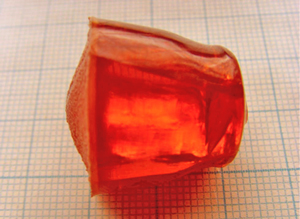
This month’s crystal clear is a very bright image of a CaErAlO4 crystal.

The team from the Fujian Institute of Research on the Structure of Matter, Chinese Academy of Sciences, led by Professor Chaoyang Tu have been investigating new materials for mid-infrared lasers. Lasers in this range of the spectrum are of particular interest for a variety of applications including sensing, defence applications such as heat seeking missile counter measures and laser surgery tools such as the laser scalpel.

The crystal was successfully grown using the Czochralski method and the absorption and emission properties compared to those of existing InGaAs laser diodes and Er:YAG lasers. For more details on the team’s research findings, including the photochemical properties and crystal structure, you can read the full article which was published in Issue 21 of CrystEngComm.

l

l

Growth, structure and spectral properties of a novel crystal CaErAlO4 for 2.7 μm lasers
Zhaojie Zhu, Huiyi Zeng, Jianfu Li, Zhenyu You, Yan Wang, Zixiang Huang and Chaoyang Tu
CrystEngComm, 2012, 14, 7423-7427
DOI: 10.1039/C2CE26013A

Digg This
Reddit This
Stumble Now!
Share on Facebook
Bookmark this on Delicious
Share on LinkedIn
Bookmark this on Technorati
Post on Twitter
Google Buzz (aka. Google Reader)

October Crystal Clear: A Sparkling Crystal

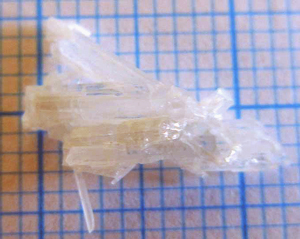
This month’s crystal clear is a barium borate crystal.

Inorganic borates are of interest due to their physical properties in the ultraviolet range of the electromagnetic spectrum, making them potentially useful materials in non-linear optics. The image is of a crystal created by T. B. Bekker et al from the Siberian Branch of Russian Academy of Sciences and published in Issue 20 of CrystEngComm.

The team were studying the BaB2O4–BaF2–BaO system and discovered the new non-centrosymmetric solid-solution series Ba7(BO3)4−xF2+3x. For more information on the group’s discoveries you can download the full paper which is free to access for 4 weeks.

Phase formation in the BaB2O4–BaF2–BaO system and new non-centrosymmetric solid-solution series Ba7(BO3)4−xF2+3x
T. B. Bekker, S. V. Rashchenko, V. V. Bakakin, Yu. V. Seryotkin, P. P. Fedorov, A. E. Kokh and S. Yu. Stonoga
CrystEngComm, 2012, 14, 6910-6915
DOI: 10.1039/C2CE26122G

Digg This
Reddit This
Stumble Now!
Share on Facebook
Bookmark this on Delicious
Share on LinkedIn
Bookmark this on Technorati
Post on Twitter
Google Buzz (aka. Google Reader)

September Crystal Clear: Crystal Flowers

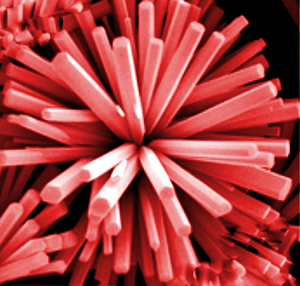
High-magnification SEM image of flower-like ZnO prepared on ITO glass

This month’s crystal clear is a striking image of what looks like a crystal flower!

In fact this is a high-magnification SEM image of a ZnO microstructure prepared on indium-doped tin oxide (ITO) glass. Ping Yang and co-workers from the University of Jinan published their article in Issue 18 of CrystEngComm.

The team were investigating the growth mechanism of ZnO rods using an environmentally friendly synthesis at 70oC, by decreasing the concentration of NaOH they found they could transform the rods into these remarkable flower-like structures!
l
You can read the full details of the groups research, including how to create these impressive crystals, by downloading there article below, which is free to access for 4 weeks!
l
Ruixia Shi, Ping Yang, Jianrong Wang, Aiyu Zhang, Yuanna Zhu, Yongqiang Cao and Qian Ma
CrystEngComm, 2012, 14, 5996-6003
DOI: 10.1039/C2CE25606A
Digg This
Reddit This
Stumble Now!
Share on Facebook
Bookmark this on Delicious
Share on LinkedIn
Bookmark this on Technorati
Post on Twitter
Google Buzz (aka. Google Reader)

August Crystal Clear: A Crystal Hedgehog

This hedgehog is actually a barite crystal, grown for 48 hours at pH 12.5

This hedgehog is actually a barite crystal, grown for 48 hours at pH 12.5 in hydrogen peroxide

This month’s crystal clear looks decidedly like a hedgehog!

In fact this is a BaSO4 particle grown using H2O2 to control particle morphology. Published in Issue 16 of CrystEngComm the paper describes the growth of BaSO4 crystals and proposes an interesting growth mechanism via selective adsorption of intermediates HO2-, O22- and O2, generated from the decomposition of hydrogen peroxide during the reaction.

The team from the Institute of Chemistry, Chinese Academy of Sciences were looking to control the morphology of barite without affecting crystal purity. Barite is a material with a wide range of applications, the largest being in drilling fluids (used during oil and gas exploration) and also as a paint and plastic additive as well as application in medicine.

By changing the concentration of H2O2 and varying reaction pH the team were able to control crystal morphology. Download the article for free to find out how the team achieved the shape control and see their SEM images revealing the growth of the structures.

Hydrogen peroxide triggered morphological evolution of barium sulfate crystals under basic conditions
Xiao-Hui Zhang, Feng-Wen Yan, Cun-Yue Guo, Feng-Bo Li, Zhi-Jun Huang and Guo-Qing Yuan
CrystEngComm, 2012, 14, 5267-5273


Digg This
Reddit This
Stumble Now!
Share on Facebook
Bookmark this on Delicious
Share on LinkedIn
Bookmark this on Technorati
Post on Twitter
Google Buzz (aka. Google Reader)

July Crystal Clear: Crystal Cavern

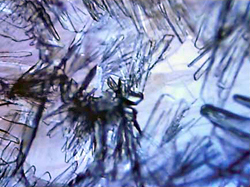
An image taken through an optical microscope of L-arginine acetate grown using a 'Metal-Assisted and Microwave-Accelerated Evaporative Crystallization’ process.

The beautiful image in this month’s crystal clear isn’t actually a crystal cavern. It is crystals of L-arginine acetate grown using a new crystallisation technique. The crystals are of particular interest in non-linear optics given their second harmonic generation properties.

The Aslan Research Group have developed a new crystallisation method to grow L-arginine acetate crystals much faster than the previously reported cooling/evaporation method. The Metal-Assisted and Microwave-Accelerated Evaporative Crystallization process uses silver island films and low power microwave heating to grow the crystals quickly. The team also investigated functionalising the metal nucleation surface to see if this enhanced crystal growth. 

The image shown here is of the crystals created using bare silver island films and microwaves, the rest of the teams results, including full details of their growth process can be found in Issue 14 of CrystEngComm

Rapid crystallization of L-arginine acetate on engineered surfaces using metal-assisted and microwave-accelerated evaporative crystallization
Melissa A. Pinard, Tsehai A. J. Grell, Danielle Pettis, Muzaffer Mohammed and Kadir Aslan

Digg This
Reddit This
Stumble Now!
Share on Facebook
Bookmark this on Delicious
Share on LinkedIn
Bookmark this on Technorati
Post on Twitter
Google Buzz (aka. Google Reader)

June Crystal Clear: Euro 2012 Crystal

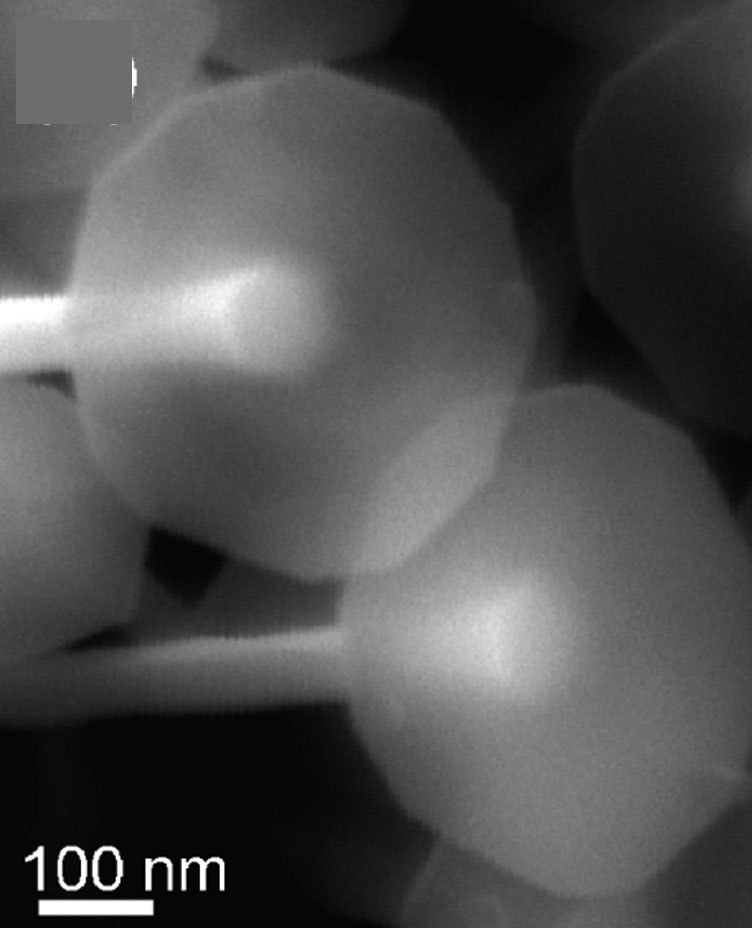
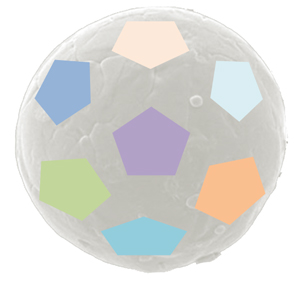
A titanium microsphere, used as the starting material to make hollow whisker balls

With Euro 2012 now well under away this month’s crystal clear couldn’t be more apt – a crystal soccer ball. The paper, from Issue 12 of CrystEngComm, reports the generation of highly crystalline hollow whisker balls.

Using the KCl flux cooling method, the team were able to grow highly crystalline K2Ti6O13 whiskers from the centres of titanium microspheres. The ultra-long whiskers grew on a TiO2 layer, leaving the centre of the sphere hollow and creating a bi-layer hollow whisker ball structure.

The team also used Ti powders as a starting material for the flux process and found this produced significantly different structures, for more details of the teams procedure and some remarkable images of their unique balls, download their article below for free.

Growth of ultralong potassium titanate whiskers by the KCl flux method with metallic titanium materials
Sayaka Suzuki, Katsuya Teshima, Mizuho Kiyohara, Hideya Kamikawa, Kunio Yubuta, Toetsu Shishido and Shuji Oishi
CrystEngComm, 2012,14, 4176-4180
DOI: 10.1039/C2CE00010E

Digg This
Reddit This
Stumble Now!
Share on Facebook
Bookmark this on Delicious
Share on LinkedIn
Bookmark this on Technorati
Post on Twitter
Google Buzz (aka. Google Reader)

May Crystal Clear: Micro-Flowers

Crystal engineering crystengcomm clear nano flower morphology superstructure

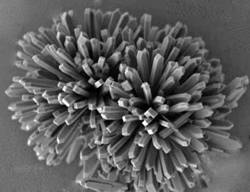
High-magnification FESEM image of 3D flower-like ZnO superstructure

This month’s crystal clear features some truly stunning hierarchical structures. 

These flower-like 3D formations have been made by Kezheng Chen et al. at the Lab of Functional and Biomedical Nanomaterials. The generation of these impressive superstructures is intriguing; the team were able to alter the reaction time to change the morphology of the produced crystals. 

The team propose that the crystalline ZnO aggregates, there is then orientated attachment of nanoclusters followed by heterogeneous nucleation and growth of secondary nanosheets. The result is striking. 

The average diameter of the superstructures is around 3µm, comprised of an intersecting network of nanosheets of the order of 15nm. The large porous surface of these zinc oxide flowers lend themselves to applications in catalysis, solar cells and sensors. 

This article was published in Issue 9 of CrystEngComm and can be downloaded for free. If you’re interested in crystal engineering you can also take a look at the previous winners of Crystal Clear

Facile synthesis of flower-like 3D ZnO superstructures via solution route
Yongjiang Sun, Li Wang, Xuegang Yu and Kezheng Chen 

Digg This
Reddit This
Stumble Now!
Share on Facebook
Bookmark this on Delicious
Share on LinkedIn
Bookmark this on Technorati
Post on Twitter
Google Buzz (aka. Google Reader)

April Crystal Clear: The Missing Crystal Fish

MOF Eu Eu-MOF fish & chips Crystal Clear CrystEngComm

Eu-MOF crystals which look suprisingly like chips or French fries

Fish and chips is a classic dish, however this month’s Crystal Clear is noticeably lacking in the crystal fish department. 

These chips (or French fries) are in fact crystals of a metal organic framework (MOF) constructed with Eu3+ and 1,3,5-Benzenetricarboxylic acid. The synthesis is performed in a mixture of water and DMF and the crystal size and shape can be manipulated by altering the ratio of the two liquids. 

The team from Qingdao and Changchun in China were looking at the influence additives and reaction conditions have on the MOF crystal morphology, these materials have interesting luminescence properties and potential application in colour displays and sensors. To read the full details of the teams discoveries take a look at Issue 8 of CrystEngComm, where you can also see how they were able to make ‘urchin-like balls’ as well as the pictured chips! l

ll

l

Solvothermal synthesis of luminescent Eu(BTC)(H2O)DMF hierarchical architectures
Biao Xu, Hailing Guo, Song Wang, Yuyang Li, Hongjie Zhang and Chenguang Liu

To keep up to date with the latest news sign up to our e-alerts, like us on facebook and follow us on twitter, and please do let us know if you know how to make crystal fish…

Digg This
Reddit This
Stumble Now!
Share on Facebook
Bookmark this on Delicious
Share on LinkedIn
Bookmark this on Technorati
Post on Twitter
Google Buzz (aka. Google Reader)