

As we enter the last quarter of 2025, we are excited to share our latest updates from Sensors & Diagnostics with the community.
Get future updates directly to your inbox with our email alerts. Sign up here.
Latest News

We’re pleased to share the recipients of our Outstanding Early Career Researcher Award 2024. This innovative research team from the Medical and Analytical Device Laboratory (MADLab) at the University of Southern California comprises Sina Khazaee Nejad, Haozheng Ma, Abdulrahman Al-Shami, Ali Soleimani, Mona A. Mohamed, Preston Dankwah, Hannah J. Lee, and team leader Maral Mousavi. Their article “Sustainable agriculture with LEAFS: a low-cost electrochemical analyzer of foliage stress” presents a portable and low-cost electrochemical sensor that detects salicylic acid – a key biomarker of plant stress. Find out more about the team and their article in our blog post.
Research Spotlight
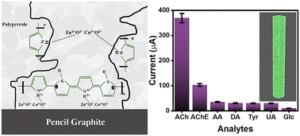
Afzal et al. have introduced a non-enzymatic electrochemical sensor for the biologically important molecule acetylcholine. Acetylcholine’s significance as a biomarker for neurodegenerative disease, cancer means sensitive and inexpensive quantification methods are highly valuable. Read their article, “Electrochemically patterned biomimetic polypyrrole integrating ZnO·CuO nanoleaves for picomolar acetylcholine detection in cancer and neurological disorders” for more.
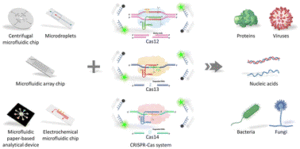
In “Microfluidic platforms for CRISPR-based biosensing advancing molecular diagnostics from benchtop to point-of-care”, Song, Gao et al. review how the integration of CRISPR-Cas tools for nucleic acid detection with microfluidics technology provides new opportunities sensing biomarkers in contexts ranging from clinical diagnosis to food safety to environmental monitoring. Read their article to learn more about the state of the art and challenges in this new sensing methodology.
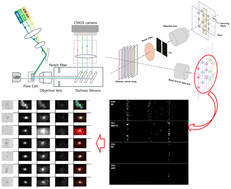
Can flow cytometry be simplified? In a new Communication, “Simple and fast detection of CD4 and CD8 cells: integration of image flow system and acoustophoresis”, Lee et al. use advances in high-throughput image analysis and acoustophoresis to analyse CD4 and CD7 cells in flow. Clinical validation suggests next steps for refining the technique, which the authors expect will allow performance comparable to conventional microscopy.
Sensors & Diagnostics in the Community
Assistant Editor Zareena Saleem represented Sensors & Diagnostics at Eurosensors 2025, and met with the community while enjoying the high-quality scientific program.
Sensors & Diagnostics was proud to sponsor a best poster prize at the 2025 Chemical Science Symposium – chemistry of imaging, biosensing and diagnostics, which took place at the Royal Society of Chemistry’s headquarters at Burlington House in London. Our congratulations to the winner, Sara Staudhammer (ETH Zürich)!
Editorial Board
We welcomed two new Associate Editors to the Sensors & Diagnostics Editorial Board this year, whose knowledge and research experience that will strengthen the journal’s commitment to advancing biosensing technologies and diagnostics.
Prof. Jiashu Sun is a professor at the National Centre for Nanoscience and Technology (NCNST) in China. Her research focuses on developing technologies for liquid biopsy, which can help detect cancer earlier and more accurately. Prof. Sun’s lab uses microfluidics and DNA materials to isolate cancer-related cells and molecules from blood samples, providing new insights into how we diagnose and monitor cancer.
With over 100 publications, Prof. Sun’s work is focused on turning laboratory breakthroughs into practical solutions that can have a real impact on patients.

Prof. Hongyan Sun is a professor at the City University of Hong Kong. She specializes in designing fluorescent probes that help detect molecules linked to various diseases. Her research has led to new ways of studying and understanding diseases, which is key to improving diagnostics and treatment options.
Her lab has developed tools that help researchers and clinicians better visualize disease markers, making it easier to track disease progression and treatment outcomes. Prof. Sun has published over 100 papers in high-impact journals, and her work is paving the way for more precise and reliable medical diagnostics.

We are excited to have these two outstanding researchers join our editorial board. With their combined expertise in biosensing and diagnostic technologies, Prof. Jiashu Sun and Prof. Hongyan Sun will help guide Sensors & Diagnostics as we continue to publish innovative research that addresses real-world health challenges.
The Sensors & Diagnostics Editorial Board met at the Royal Society of Chemistry headquarters in Burlington House, London in September for its annual meeting. This meeting allowed the journal to discuss its strategy for 2026, and review the journal’s progress and challenges over the past year.
Collections
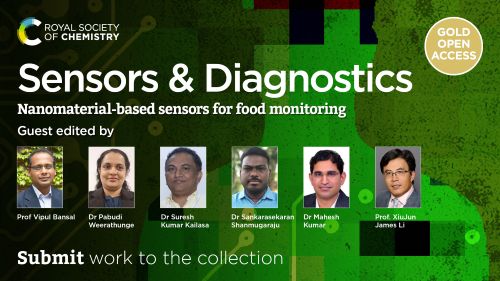
Our themed collection on Nanomaterial-based sensors for food monitoring is open for submissions until 31 January 2026. This collection will highlight state-of-the-art research on nanomaterials-based sensors for food monitoring applications, with an emphasis on nanomaterials-based colorimetric, fluorometric, electrochemical and other emerging analytical platforms for food analysis. The journal seeks submissions of high-quality research articles and reviews on the latest advances and insights on these topics of imminent interest. Find out more, including how to contribute your article at our call for papers.
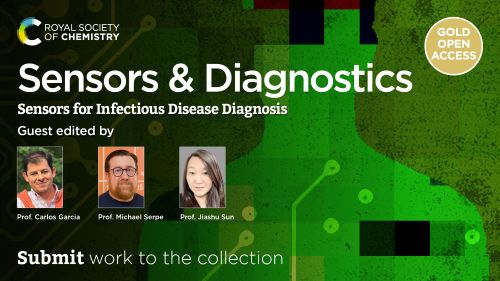
Our collection on Sensors for infectious disease diagnosis is also open for submissions. Led by our Associate Editors Carlos D. Garcia (Clemson University), Michael Serpe (University of Alberta) and Jiashu Sun (National Center for Nanoscience and Technology), this themed issue will compile contributions focusing on some of the most common health conditions, ranging from infectious diseases to cancer. While lab-based sensing and traditional analytical approaches are extensive and extremely useful, the submissions in this themed issue will highlight innovative technologies that can be used to detect analytes of interest using a myriad of transduction methods. Find out more at the call for papers, and contribute your work by 31 January 2026.
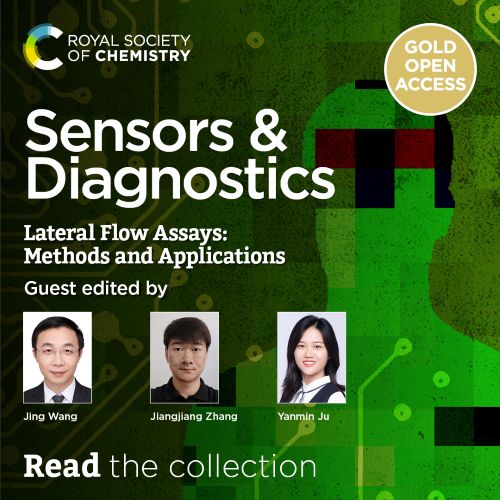
Our themed collection on Lateral Flow Assays is now available to read! This collection of articles, guest edited by Jing Wang (Zhejiang University of Technology), Jiangjiang Zhang (Beijing Institute of Technology) and Yanmin Ju (China Pharmaceutical University) showcases cutting-edge research in the design, development, and deployment of lateral flow technologies. The contributions span a wide range of topics, including novel nanomaterials, signal amplification strategies, point-of-care diagnostics, and real-world applications in healthcare, food safety, and environmental monitoring.
Taken together, this collection highlights the remarkable versatility and continuing evolution of lateral flow assays, with contributions from researchers across the globe. We hope that readers will be inspired by these representative studies to further explore the vast potential of lateral flow assays-from enhancing sensitivity and integrating digital readouts to broadening applications in medical diagnostics, environmental monitoring, and food safety.
Upcoming Events
Our Associate Editor Prof. Jiashu Sun will be speaking at the 5th Micro-Nano Technology and Medical Health Innovation Conference in Xiamen, China, taking place 5-7 December, 2025.
Executive Editor Anna Rulka will be representing Sensors & Diagnostics at this year’s Pacifichem symposium in Honolulu, Hawaii, on 15-20 December 2025. We look forward to meeting you there!
Stay Connected
Follow us on LinkedIn and Bluesky for new articles and the latest news from Sensors & Diagnostics and related journals at the Royal Society of Chemistry.