Archive for the ‘Blog’ Category

Celebration of 5 years of Environmental Science: Atmospheres Themed Collection

This year we are celebrating the 5th anniversary of Environmental Science: Atmospheres. To mark this occasion, we invited previous authors to contribute to an anniversary collection. The collection covers an exciting range of research in atmospheric science, from advances in analytical techniques for characterising atmospheric trace gases and aerosols to investigations of the impacts of human activities and wildfires on atmospheric composition and chemistry.

Please enjoy the articles in the collection below.

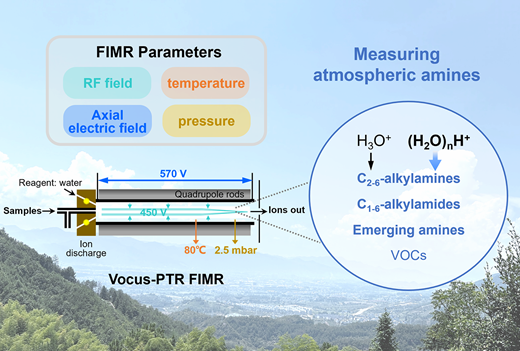
Optimizing Vocus proton-transfer-reaction mass spectrometry for detecting trace atmospheric amines

Yiqi Zhao, Zhaojin An,* Yuyang Li, Rujing Yin, Dandan Li, Dongbin Wang, Xuan Zheng, Jun Zheng, Hong He, Jincai Zhao, Douglas R. Worsnop and Jingkun Jiang*

Environ. Sci.: Atmos. (2026) 6 (6): 841–852

  Amines, as important alkaline gases in the atmosphere besides ammonia, profoundly influence air quality, climate and human health. This study optimized the Vocus-PTR to improve the detection efficiency of atmospheric trace amines.

Reduced U.S. methane emissions during the COVID-19 pandemic

Sergio Ibarra-Espinosa,* Lei Hu, Colin Harkins, Brian C. McDonald, Scot M. Miller, Youmi Oh, Lori Bruhwiler, Colm Sweeney and Arlyn Andrews

Environ. Sci.: Atmos. (2026) 6 (6): 831–840


The coronavirus disease 2019 (COVID-19) pandemic disrupted normal human activities worldwide, and mobility reductions resulted in reduced levels of air pollutants and greenhouse gases emissions.

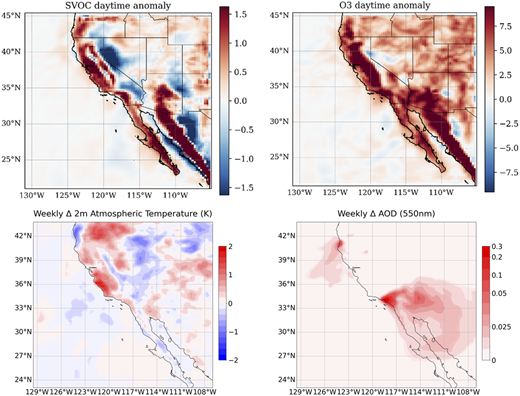
Seasonal controls on wildfire-driven urban atmospheric chemistry: evidence from the January 2025 Los Angeles wildfires

Eleni Dovrou,* Iulian-Alin Rosu and Apostolos Voulgarakis

Environ. Sci.: Atmos. (2026) xxx

Wildfire impacts on air quality are strongly linked to dominant chemical regimes and meteorological conditions, yet these dependencies remain poorly constrained for urban coastal regions.
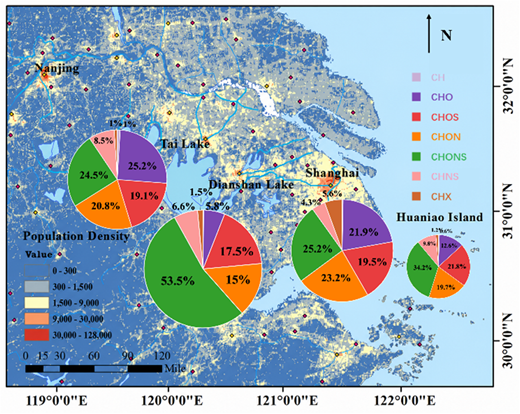
Molecular characteristics of organic aerosols across typical environments in the Yangtze River Delta, China: insights from Orbitrap-MS analysis

Luoqi Lv, Cong An, Gan Yang, Chuang Li, Ning Wang, Jiayi Zhou, Kaiqi Lai, Qiaodi Lu, Runlong Cai, Lin Wang and Lei Yao

Environ. Sci.: Atmos. (2026) xxx

Organic aerosol molecular formulas show distinct distributions across representative environmental conditions, with notable nitrogen- and sulfur-containing features in aquatic-associated environments of the Yangtze River Delta, China.

As part of this series, we interviewed authors about their motivation and research goals.

Dr Sergio Ibarra Espinosa (University of Maryland, and co-author of Reduced U.S. methane emissions during the COVID-19 pandemic) had this to say:
1. How has your research evolved from the first article you published with us, to your article investigating reduced U.S. methane emissions during the COVID-19 pandemic?
Back in 2022, my first paper in the journal focused on how aerosols interact with meteorology in São Paulo across wet and dry seasons. Ironically, I’m back to looking at aerosol-climate interactions today, but now at a planetary scale with solar geoengineering! The common thread through all of this has been emissions modeling. My work evolved from building bottom-up urban emission inventories to tackling continental-scale top-down atmospheric inversions at NOAA GML. Setting up those inverse modeling and Kalman filter frameworks meant spending thousands of hours with HYSPLIT and writing open-source software like rtorf to parallelize and process footprint runs across North America. That experience directly opened the doors to my current work at NOAA ARL and CISESS developing hysplit-strato. The COVID-19 methane study was the culmination of that shift using 35 aircraft and tower sites to verify what happens to continental greenhouse gas fluxes when human activity abruptly shifts.


2. What aspect of your work are you most excited about at the moment?

Going from local street-level problems to continental inversions, and now to global climate change and solar geoengineering. It’s pretty exciting to apply atmospheric modeling to questions that operate on a planetary scale, asking what happens when you intervene in the stratosphere and whether our global observing systems can even detect those signals.

3. In your opinion, what are the most important questions to be asked/answered in this field of research?
Even though most of my daily work lives in code, models, and inventories, I firmly believe the most critical foundation our field needs is more in-situ observations. Satellites and complex numerical models are only as reliable as the real-world measurements that constrain them, and we still have massive observational blind spots across the globe, especially in Latin America and Africa where most of the ITZC resides. Without sustained ground, tower, and vertical profile networks, we are modeling in the dark. Once we have those measurements, two major challenges need urgent answers: a) Locally & Regionally: How do we build comprehensive, bottom-up emission inventories that connect directly with observational networks? You simply cannot manage air quality or design effective public health policies without knowing who is emitting what, where, and when.*
b) Globally: How do we evaluate proposed climate interventions holistically rather than in a vacuum? For instance, Stratospheric Aerosol Injection (SAI) might inject anywhere from tens of Tg of SO2  per year to cool global temperatures, but that same intervention could delay stratospheric ozone recovery (increasing UV radiation and skin cancer risks), alter precipitation patterns, and ripple through local agricultural economies. We must ask what the true full-system cost of climate solutions will be, not just whether they move the global average temperature curve.

4. What do you find most challenging about your research?
Two things: data and culture.
a) On the technical side, getting reliable in-situ data is still a struggle. Despite modern APIs and automated pipelines, we still have huge observational blind spots in South America and Africa. Open science and open data must become a genuine global standard, not just a buzzword.
b) On the human side, the academic ego game and politics. Science moves faster when people drop the ‘diva’ personalities and stop spending their energy playing committee politics, lobbying, and chasing status. We should be focusing on solid science, accessible tools, and honest collaboration.

5. How do you feel about Environmental Science: Atmospheres as a place to publish?
It has been a really positive, smooth experience. It’s an accessible and rigorous home for interdisciplinary atmospheric science that brings together emissions, physical transport, and environmental impacts without unnecessary gatekeeping.

6. In which upcoming conferences or events may our readers meet you?
I’m honestly not the biggest fan of endless conference circuits, but I will be at the AMS Annual Meeting 2027 in Denver (presenting on stratospheric aerosol detectability). And since it’s Denver in January, I’ll definitely be taking a few days of vacation right after to go snowboarding in the Rockies.

7. How do you spend your spare time?
On Saturdays, you’ll often find me coding open-source packages and publishing science focused on Latin America. Outside of science, I love dancing, especially sensual bachata and salsa, heading to the mountains to snowboard, and firing up the grill for a good weekend BBQ with friends and family.

8. Which profession would you choose if you were not a scientist?
I would definitely be an entrepreneur running my own tech or software company. I love building things from scratch, solving practical problems, and putting functional tools directly into people’s hands.

9. Can you share one piece of career-related advice or wisdom with other atmospheric scientists?
Follow your instinct. Don’t just chase whatever topic happens to be fashionable, and don’t spend your career trying to please gatekeepers or play academic politics. Build tools you genuinely believe in, share your code openly, and trust your gut on the questions that actually matter to you.


Dr Eleni Dovrou (Assistant Professor at the University of Crete and co-author of Seasonal controls on wildfire-driven urban atmospheric chemistry: evidence from the January 2025 Los Angeles wildfires) had this to say:
1. In your opinion, what are the most important questions to be asked/answered in this field of research?

I believe that the most important question is: what are the exact chemical pathways that determine the evolve of a fire plume and subsequently which chemical mechanisms influence environmental changes and human health in a molecular level? If we understand these mechanisms, we will be better able to identify the key processes driving these impacts and develop more effective strategies for protection and prevention.

2. How do you feel about Environmental Science: Atmospheres as a place to publish?

Environmental Science: Atmospheres journal provides a great platform with a broad audience both within my field and across related fields. Thus, publishing in the journal offers strong visibility of our work while also helping connect new findings across disciplinaries. Although this was my first publication in the journal, I was satisfied and happy with the entire experience and the visibility the work has received.

3. Which profession would you choose if you were not a scientist?

If I were not a scientist, I would probably be a professional volleyball player or a medical doctor or a student guidance counsellor or a bookstore owner. These choices might initially seem unrelated, but each represent an import part of my life. Volleyball is a sport I have played at a high level for the past 22 years; my interest in medicine developed during and after my scientific studies; helping students find their own path is something I already do regularly and genuinely enjoy; and I enjoy reading books and spending time in bookstores searching for my next read and discussing with other costumers.

4. Can you share one piece of career-related advice or wisdom with other atmospheric scientists?

Take risks and try things that scare you the most. Remaining in your comfort zone will not help you grow. By choosing the path that feels intimidating, you may discover that you are far more capable than you thought, while opening yourself to new opportunities and experiences. And even if you fail, you will have learned something valuable and taken another step forward.

Thank you again for this invitation and opportunity!

Themed Collection dedicated to the 2025 International Conference on Nucleation and Atmospheric Aerosols

Research in nucleation and atmospheric aerosols continues to advance our understanding of the processes that govern atmospheric particle formation, growth and evolution. The field encompasses a broad range of approaches, from nucleation theory and experiments to tropospheric and stratospheric aerosols, cloud drop and ice nucleation and aerosol-climate interactions. This special collection, guest edited by Katrianne Lehtipalo, Zoran Ristovski, Neil Donahue and Paul Winkler, brings together research presented at the 22nd International Conference on Nucleation and Atmospheric Aerosols (ICNAA 2025), highlighting the diverse and cutting-edge work being carried out across the field.  

Please enjoy the articles in the collection below.

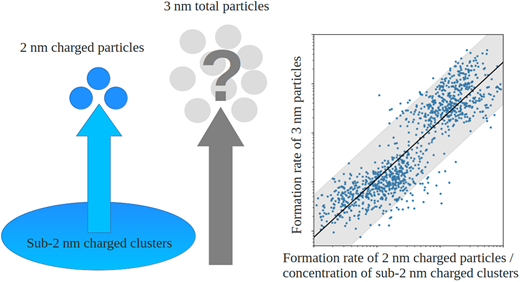
Estimation of atmospheric particle production based on measured ion concentrations

Santeri Tuovinen and Markku Kulmala et al.
Environ. Sci.: Atmos. (2026) 6 (8): 1178–1190, DOI: 10.1039/d6ea00045b

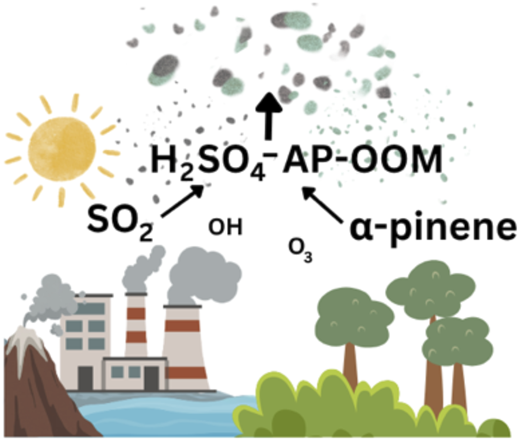
Nucleation of α-pinene oxidation products with sulfuric acid

Eva Sommer and Jasper Kirkby et al.
Environ. Sci.: Atmos.  (2026) 6 (8): 1131–1146, DOI: 10.1039/d6ea00046k

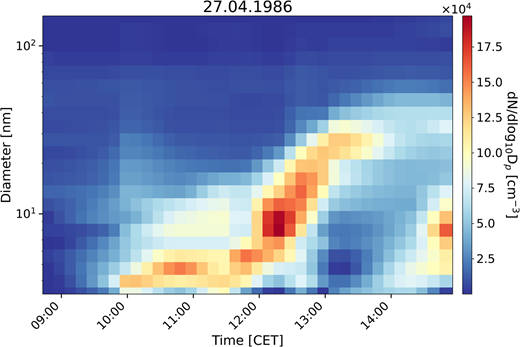
Reconstructed 40-year-old dataset of ultrafine particle concentrations in the urban background of Vienna, Austria compared to recent measurements – an investigation of long term air pollution evolution and dynamics

Aleksandra J. Morawiec and Paul M. Winkler et al.
Environ. Sci.: Atmos.  (2026) 6 (9): 1443–1452, DOI: 10.1039/d6ea00058d

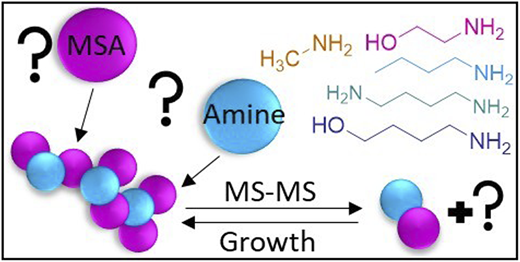
Chemically resolving the composition of methanesulfonic acid–amine nanoclusters

Colleen E. Miller, Ivo Neefjes, Yosef Knattrup, Paulus S. Bauer, Jonas Elm, Nanna Myllys*, Veronique Perraud*, James N. Smith*
Environ. Sci.: Atmos. (2026) 6 (9): 1386–1404, DOI: 10.1039/d6ea00060f

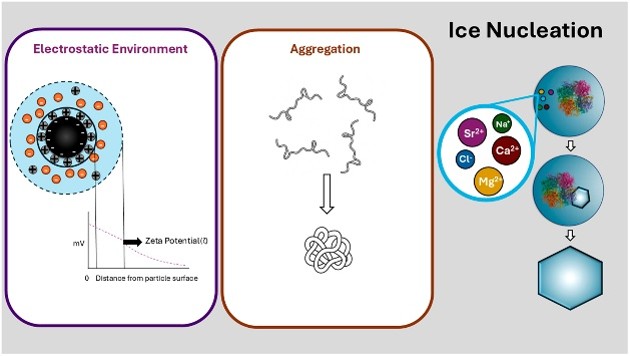
Promoting Ice Nucleation through Protein Aggregation and Electrostatic Environments

Roya Safa, Daniel C. O. Thornton, Sarah D. Brooks*.
Environ. Sci.: Atmos. (2026), Advance Article, DOI: 10.1039/d6ea00047a

New studies shed light on the role of methanesulfonic acid in marine cloud formation

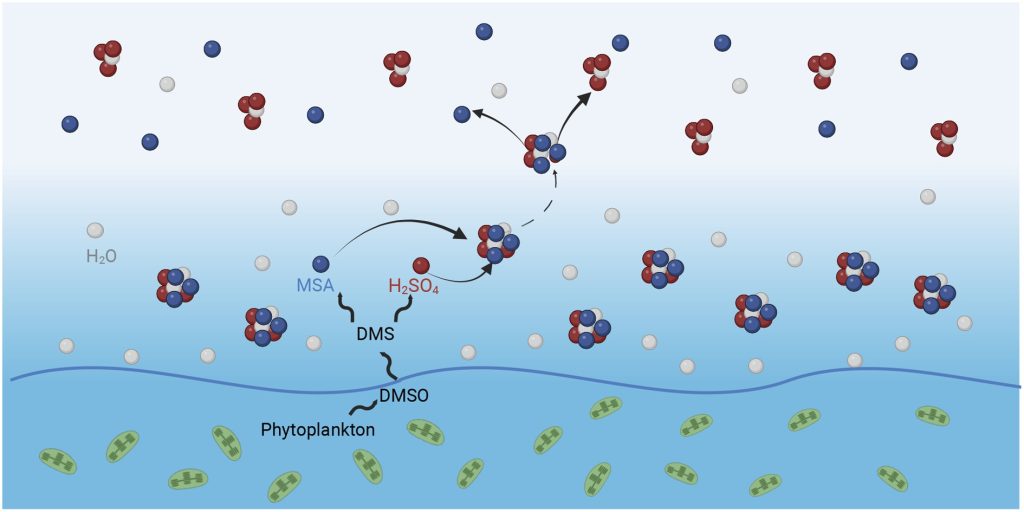
Schematic image depicting  ocean phytoplankton releasing dimethylsulfide, which oxidises into sulfuric acid and methanesulfonic acid (MSA). MSA then participates in cloud particle formation.

Methanesulfonic acid (MSA) contributes to atmospheric new particle formation and growth – Yu et al., Environ. Sci.: Atmos. 2026; https://doi.org/10.1039/d5ea00123d

Marine clouds are one of the most important regulators of global climate – however, they are also one of the biggest uncertainties in climate models. Two new studies recently published in Environmental Science: Atmospheres shed light on a previously overlooked driver of marine cloud formation: methanesulfonic acid. Two of the authors, Mr. Wenjuan Yu and Dr. Xu-Cheng He, from the University of Helsinki, have told us a bit more about the works: 

“Marine phytoplankton emit dimethylsulfide (DMS), a gas associated with the characteristic smell of the sea. When oxidised in the atmosphere, DMS produces sulfuric acid (SA) and methanesulfonic acid (MSA). Whereas SA is known to drive new particle formation and growth of the particles, the role of MSA has remained unclear until now. A recent study published in Nature [1] revealed that MSA is a previously overlooked driver of particle formation and growth in cold, pristine marine air. Our new study published in Environmental Science: Atmospheres [2] further identifies a key environmental control on this process: water. Experiments conducted under atmospherically relevant conditions in the CERN CLOUD chamber show that relative humidity strongly controls whether MSA contributes to particle growth. Between +10 °C and −10 °C, MSA contributes negligibly under very dry conditions but drives rapid additional growth when relative humidity exceeds approximately 50%. Even relatively small changes in humidity substantially alter particle growth rates.  

A complementary study also published in Environmental Science: Atmospheres  [3], by Hannah Klebach et al., investigates how MSA contributes to the initial formation of new particles in the presence of amines. CLOUD experiments at +5 °C an d −10 °C show that MSA can form new particles together with dimethylamine (DMA), although nucleation from MSA and DMA alone is relatively slow. However, when small amounts of SA are present, MSA strongly enhances particle formation, increasing nucleation rates by one to two orders of magnitude. Molecular measurements detect MSA, SA and DMA together in the initial clusters, demonstrating that MSA participates directly in the earliest stages of particle formation.  

Together, these findings strengthen the connection between marine biology, aerosol, atmospheric water and climate. By showing that MSA can contribute both to the formation of new particles under atmospherically relevant marine conditions and to their subsequent humidity-dependent growth, the two studies provide a more complete picture of how marine sulfur emissions can influence the atmospheric particle population. Newly formed particles must grow rapidly to survive and eventually become cloud condensation nuclei (CCN), the seeds on which cloud droplets form. As the climate warms, the atmosphere can hold more water vapour, potentially altering the conditions under which MSA contributes to particle formation and growth and, in turn, to the number of cloud seeds. An increase in the number of CCN might translate into brighter clouds, which therefore reflect more solar radiation back to space, thus exerting a cooling effect on the climate. However, current climate models do not fully capture MSA-related CCN formation processes correctly. These models may therefore underestimate natural CCN formation over polar oceans and in the cold free troposphere. Correctly representing both MSA-enhanced particle formation and the strong humidity dependence of MSA-driven growth is especially important as anthropogenic sulfur emissions decline and particles originating from natural marine emissions constitute a larger fraction of atmospheric aerosol. Therefore, these complementary findings provide the experimental basis needed to improve predictions of marine aerosol, cloud formation and their influence on the future climate.” 

[1] Baalbaki, J., Shen, J. et al. Role of methanesulfonic acid in atmospheric particle nucleation and growth. Nature (2026), DOI: 10.1038/s41586-026-10810-2.  

[2] Yu et al. Impact of humidity on aerosol growth from methanesulfonic acid. Environmental Science: Atmospheres (2026), DOI: 10.1039/d5ea00123d.  

[3] Klebach et al. Rapid new particle formation driven by methanesulfonic acid and amines. Environmental Science: Atmospheres (2026), DOI: 10.1039/d5ea00081e. 

Disaster Emissions and Effects on Air Quality Themed Collection

Image showing the Disaster Emissions themed collection Guest Editors asking for people to submit work📢 Now accepting submissions 📢

Guest edited by Rami Alfarra (Hamad bin Khalifa University), Sergey Nizkorodov (University of California, Irvine) and Albert Presto (Carnegie Mellon University), Environmental Science: Atmospheres is delighted to highlight our new collection exploring Disaster Emissions and Effects on Air Quality

Disaster Emissions and Effects on Air Quality is a broad collection that aims to publish work that highlights the impact that disasters can have on air quality, and by extension, on all Earth environmental systems. The collection will aim to include articles focussing on emission, transport, deposition, chemical transformation, and monitoring of contaminants that appeared in the atmosphere as a result of disastrous events.

A collection considering all aspects of Disaster Emissions in connection to the Earth atmosphere, including topics such as, but not limited to:

  • Natural phenomena such as unusually powerful wildfires, dust storms and volcanoes.
  • Industrial disasters such as chemical releases, urban fires, oil spills, nuclear accidents, etc.
  • Past, current, and possible future military conflicts.
  • Emissions, transport, deposition, chemical transformation, and monitoring of the disaster-related air contaminants.
  • Exposure, risk and health implications of atmospheric disaster emissions on biosphere, lithosphere, and hydrosphere.

This themed collection will include all manuscript types: original research papers, communications, perspectives and review articles. If authors are interested in submitting a review article, please send an outline proposal to the editors at esatmospheres-rsc@rsc.org for approval and official invitation.

Article publication online and in issues will occur without delay to ensure the timely dissemination of the work. The articles will then be assembled on the RSC Publishing platform and promoted as a web-based thematic collection, to permit readers to consult and download individual contributions from the entire series.

The submission deadline is 1st November 2025.

If you’re interested, we invite you to submit your research today, quoting ‘EADEAQ25’ when submitting your manuscript.

For more information on the scope of Environmental Science: Atmospheres and our author guidelines, please visit our website at https://rsc.li/esatmospheres or email us at esatmospheres-rsc@rsc.org.

Special themed collection dedicated to the 22nd International Conference on Nucleation and Atmospheric Aerosols (ICNAA)

The Editorial Office of Environmental Science: Atmospheres is excited to announce a special collection dedicated to the 22nd International Conference on Nucleation and Atmospheric Aerosols (ICNAA). This is the leading conference series in the wide field of nucleation and atmospheric aerosols.

We invite all researchers who will attend ICNAA 2025 to submit their papers for consideration in this special collection. It will encompass a broad range of topics, reflecting the diverse and cutting-edge research presented at the conference. The main topic areas of focus include:

Nucleation Theory & Experiment: Studies of homogeneous, heterogeneous and ion induced nucleation including single or multicomponent system cluster formation and properties, condensation, and evaporation, and experimental, theoretical and computational investigations as well as history of nucleation research.

Tropospheric & Stratospheric Aerosols: Fundamental processes associated with tropospheric and stratospheric aerosols, especially related to global warming, acid rain, air quality and multi-phase chemistry. Studies into aerosol concentrations and distributions, variability and long term trends. Focus on composition, hygroscopicity, thermodynamics, phase changes, physico-chemical and optical properties.

Cloud Drop and Ice Nucleation: Fundamental processes related to droplet and ice-crystal activation, growth, cloud condensation nuclei and ice nuclei origin, composition, spatial and temporal distributions and loadings, experimental and theoretical studies.

Aerosol-Climate Interactions: Direct and indirect effects of atmospheric aerosols on radiative forcing and climate, remote sensing and regional to global scale climate modelling of aerosol impacts and feedback systems.

This collection will be supported by our Guest Editors: Katrianne Lehtipalo, Zoran Ristovski, Neil Donahue and Paul Winkler. We look forward to your contributions to this themed collection, which will highlight the latest advancements and foster continued innovation in the field of atmospheric sciences. The submission deadline is December 31st 2025.

_ _ _ _ _ _ _ _ _ _ _ _ _ _ _ _ _ _ _ _ _ _ _ _ _ _ _ _ _ _ _ _ _ _ _ _ _ _ _ _ _ _ _ _ _ _ _ _ _ _ _ _ _ _ _ _ _ _ _ _ _ _

When you publish with Environmental Science: Atmospheres you can:

  • Put your trust in both our rigorous peer review process and fast times to publication – our average time to decision for peer-reviewed manuscripts is just 37 days.
  • Expect your work to be promoted through our journal social media (@envsci.rsc.org ‬and LinkedIn)
  • Be confident of a global audience for your work. This means that dissemination of this work will likely go beyond chemists and reach a broader audience.

Environmental Science: Atmospheres publishes high quality research in fundamental and applied atmospheric chemistry. The journal scope spans the entirety of Earth’s atmosphere, and studies addressing the interactions of indoor air pollutants with outdoor air, or considering human health effects, are encouraged. We offer authors the option to publish the peer review history alongside their article.

Article publication online and in issues will occur without delay to ensure the timely dissemination of the work. The articles will then be assembled on the RSC Publishing platform and promoted as a web-based thematic collection, to permit readers to consult and download individual contributions from the entire series.

If you’re interested, we invite you to submit your research today on our platform, quoting ‘EAICoNAA25’ in the ‘Comments to the Editor’ when submitting your manuscript. You can get in touch with the editorial office with any questions you may have about this collection.

New themed collection now online: Air Quality in Emerging Economic Regions

We are delighted to announce that the Environmental Science: Atmospheres themed collection on air quality in emerging economic regions is now online.

Understanding the sources and composition of air pollutants in emerging economic regions is essential for implementing effective pollution control measures and mitigating the adverse impacts on human health and the environment. Addressing air quality issues in these regions is important for sustainable development, as poor air quality can impede economic growth and hinder progress towards achieving global environmental goals. This collection highlights the impactful atmospheric science research occurring in these regions.

Our collection was guest edited by Francis Pope (The University of Birmingham), Vinayak Sinha (Indian Institute of Science Education and Research Mohali), Michael Gatari (University of Nairobi).

Read the full issue online.

It includes:

Statistical assessment of an atmospheric mercury passive sampler at a regional site in South Africa

Kerneels Jaars et al.

Environ. Sci.: Atmos., 2025, Advance Article, DOI: 10.1039/D4EA00071D


Air pollution (PM2.5) and its meteorology predictors in Kampala and Jinja cities, in Uganda

Gabriel Okello et al.

Environ. Sci.: Atmos., 2024,4, 1145-1156, DOI: 10.1039/D4EA00074A


Variability in air quality, ozone formation potential by VOCs, and associated air pollution attributable health risks for Delhi’s inhabitants

Mayank Pandey et al.

Environ. Sci.: Atmos., 2024,4, 897-910, DOI: 10.1039/D4EA00064A


Characterization of mercury in atmospheric particulate matter in the state of Rio de Janeiro, Brazil

Adriana Gioda et al.

Environ. Sci.: Atmos., 2024,4, 872-878, DOI: 10.1039/D4EA00044G

We hope that you enjoy reading this collection of articles. Please get in touch if you have any questions about this themed collection or want to contribute to the growing work on air quality in emerging economic regions.

New themed collection now online: Peroxy Radicals in the Atmosphere

We are delighted to announce that the Environmental Science: Atmospheres themed collection on peroxy radicals in the atmosphere is now online.

Understanding the chemistry and behaviour of peroxy radicals can help improve air quality models, leading to more accurate predictions of pollution levels and their impacts on human health and the environment. Additionally, peroxy radicals are key intermediates in atmospheric oxidation processes, influencing the atmospheric lifetime of greenhouse gases and contributing to climate change dynamics.

Our collection was guest edited by Carl Percival (California Institute of Technology), Barbara Nozière (KTH Royal Institute of Technology) and Lisa Whalley (University of Leeds).

Read the full issue online.

It includes:

Enhanced detection of aromatic oxidation products using NO3− chemical ionization mass spectrometry with limited nitric acid

Olga Garmash and Matti Rissanen et al.

Environ. Sci.: Atmos., 2024, 4, 1368-1381, DOI: 10.1039/D4EA00087K


Towards automated inclusion of autoxidation chemistry in models: from precursors to atmospheric implications

Lukas Pichelstorfer et al.

Environ. Sci.: Atmos., 2024,4, 879-896, DOI: 10.1039/D4EA00054D


Interactions of peroxy radicals from monoterpene and isoprene oxidation simulated in the radical volatility basis set

Neil M. Donahue et al.

Environ. Sci.: Atmos., 2024,4, 740-753, DOI: 10.1039/D4EA00056K


Lifetimes of pre-reactive complexes of peroxy radicals revisited: thermostat effects, temperature dependence and highly oxygenated molecules

Christopher David Daub et al.

Environ. Sci.: Atmos., 2024,4, 732-739, DOI: 10.1039/D4EA00037D


We hope that you enjoy reading this collection of articles. Please get in touch if you have any questions about this themed collection or want to contribute to the growing work on peroxy radical chemistry.

Special issue dedicated to the International Conference on Air Benefit and Cost and Attainment Assessment (ABaCAS) 2024

The Editorial Office of Environmental Science: Atmospheres is excited to announce a special issue dedicated to the International Conference on Air Benefit and Cost and Attainment Assessment (ABaCAS) 2024. This prestigious conference, held annually, serves as a global forum for scientists to exchange knowledge and strategies related to air pollution control and the pathway to carbon neutrality.

We invite all researchers who present their work at ABaCAS 2024 to submit their papers for consideration in this special issue. This special issue will encompass a broad range of topics, reflecting the diverse and cutting-edge research presented at the conference. The nine tentative areas of focus include:

  1. Emission inventory for atmospheric pollutants and greenhouse gases
  2. Advancing technologies applied in source emission measurements
  3. “Ground-air-space” monitoring for air pollutants and greenhouse gases
  4. Air quality modelling and cost-benefit analysis for air pollution control
  5. Roadmap to synergistic control of air pollutants and carbon
  6. Urban air pollution control
  7. Atmospheric environment and health
  8. Big data and artificial intelligence in the atmospheric environment
  9. Atmospheric haze chemistry

This collection will be supported by our Guest Editors: Dr Hongliang Zhang (Fudan University), Dr Song Guo (Peking University), Dr Biwu Chu (Chinese Academy of Sciences) and Dr Bo Zheng (Tsinghua University). We look forward to your contributions to this special issue, which will highlight the latest advancements and foster continued innovation in the field of atmospheric sciences. The submission deadline is November 30th 2025.

_ _ _ _ _ _ _ _ _ _ _ _ _ _ _ _ _ _ _ _ _ _ _ _ _ _ _ _ _ _ _ _ _ _ _ _ _ _ _ _ _ _ _ _ _ _ _ _ _ _ _ _ _ _ _ _ _ _ _ _ _ _ _ _ _ _ _

When you publish with Environmental Science: Atmospheres you can:

  • Put your trust in both our rigorous peer review process and fast times to publication – our average time to decision for peer-reviewed manuscripts is just 38 days.
  • Expect your work to be promoted through our journal social media (@EnvSciRSC and LinkedIn)
  • Be confident of a global audience for your work. This means that dissemination of this work will likely go beyond chemists and reach a broader audience.

Environmental Science: Atmospheres publishes high quality research in fundamental and applied atmospheric chemistry. The journal scope spans the entirety of Earth’s atmosphere, and studies addressing the interactions of indoor air pollutants with outdoor air, or considering human health effects, are encouraged. We offer authors the option to publish the peer review history alongside their article.

Article publication online and in issues will occur without delay to ensure the timely dissemination of the work. The articles will then be assembled on the RSC Publishing platform and promoted as a web-based thematic collection, to permit readers to consult and download individual contributions from the entire series.

If you’re interested, we invite you to submit your research today on our platform, quoting ‘EAABaCAS24’ in the ‘Comments to the Editor’ when submitting your manuscript. You can get in touch with the editorial office with any questions you may have about this collection.

Themed Collection Open Call: Solar Radiation Management

Submit your recent research on Solar Radiation Management to our new ES: Atmospheres collection! 

We invite you to contribute to our collection on Solar Radiation Management (SRM), also known as Solar Geoengineering. Understanding the mechanisms and potential impacts of SRM, as well as the broader field of solar geoengineering, can refine climate models, leading to more accurate projections of their efficacy and risks. SRM has the potential to reduce climate impacts globally, yet it also carries significant risks and uncertainties. For more information on the collection, which closes for submissions on 31 Jan 2025 , see our open call for papers.

When you publish with Environmental Science: Atmospheres you can:

  • Put your trust in both our rigorous peer review process and fast times to publication – our average time to decision for peer-reviewed manuscripts is just 38 days.
  • Expect your work to be promoted through our journal social media (@EnvSciRSC and LinkedIn)
  • Be confident of a global audience for your work. This means that dissemination of this work will likely go beyond chemists and reach a broader audience.

Environmental Science: Atmospheres publishes high quality research in fundamental and applied atmospheric chemistry. The journal scope spans the entirety of Earth’s atmosphere, and studies addressing the interactions of indoor air pollutants with outdoor air, or considering human health effects, are encouraged. We offer authors the option to publish the peer review history alongside their article.

Article publication online and in issues will occur without delay to ensure the timely dissemination of the work. The articles will then be assembled on the RSC Publishing platform and promoted as a web-based thematic collection, to permit readers to consult and download individual contributions from the entire series.

If you’re interested, we invite you to submit your research today, quoting ‘EASRM24’ in the ‘Comments to the Editor’ when submitting your manuscript. You can get in touch with the editorial office with any questions you may have about this collection.

Showcasing our Ab Initio Reaction Mechanisms themed collection

Environmental Science: Atmospheres is pleased to highlight the content that makes up our themed collection on ab initio reaction mechanisms. The full collection can be read here. In this blog, Associate Editor Stephen Klippenstein shares his thoughts on this topic and the articles published here:

The chemistry of the atmosphere is incredibly complex, with an enormous number of coupled reactions affecting key aspects of the atmosphere such as the concentration of aerosols. Various proposed responses to the global need for reducing our carbon emissions may dramatically alter emissions into the atmosphere. Quantitative models of the effect of such emissions are urgently needed. Such models rely on ever more detailed and accurate descriptions of a wide variety of elementary reactions. Ab initio studies of reaction mechanisms are a major contributor to the remarkable progress in our understanding of complex atmospheric reaction mechanisms.

This mini collection of articles provides three topical examples of the community efforts to advance our abilities to accurately model reaction mechanisms. The paper by Nguyen and Stanton on “Ab initio rate coefficients for the reaction of OH and H2O2 under troposphere and lower stratosphere conditions” demonstrates the utility of benchmark ab initio kinetics in mapping the rate constants for a simple but important reaction across wide ranges of temperature and pressure. There is an urgent to understand the global warming potentials of the molecules arising from the degradation of hydrofluoroolefins, which are a new class of refrigerants that are rapidly growing in importance. The paper by Watson and Beames on “Bimolecular sinks of Criegee intermediates derived from hydrofluoroolefins – a computational analysis” uses ab initio kinetics to map out a number of the key reaction rates and pathways for this new class of molecules. Highly oxygenated molecules, which are formed from the oxidation of various hydrocarbons, are important precursors to the formation of aerosols. The chemistry involved in the formation of such molecules is poorly understood. The reaction of two RO2 radicals provides one route to molecular growth that is expected to contributed to highly oxygenated molecule formation. The paper by Murphy et al. on “Accretion product formation in the self-reaction of ethene-derived hydroxy peroxy radicals” explores this chemistry in detail for a prototypical atmospheric hydrocarbon radical.

We hope you find these articles interesting. If you would like to contribute work on a similar topic, please feel free to send a proposal to esatmospheres-rsc@rsc.org, where a member of our editorial team will be happy to help.